
It is time to end the cruelty of cages and crates in UK farming
Originally published on the 12th of December 2025 on https://www.farmersguardian.com/blog/4523182/exclusive-adrian-ramsay-end-cruelty-cages-crates-uk-farming
The UK likes to believe it leads the world on animal welfare. We tell ourselves that we set high standards and that our farms reflect the compassion we hold so dear as a nation. Yet each year, millions of animals are trapped in conditions we would not allow our dogs or cats to endure. In far too many cases, hens are still confined to cages that offer less space than a sheet of A4 paper. Sows remain locked inside farrowing crates for weeks at a time, unable to turn around. Calves begin their lives alone in narrow pens that restrict natural movement. All of this continues despite mounting evidence, clear public concern, and workable alternatives.
Later this month, the Government is due to publish its Animal Welfare Strategy. It is a chance to meaningfully improve the lives of farmed animals. I led a group of 36 MPs and Lords from across the political spectrum, urging the Secretary of State for the Department for Environment, Food & Rural Affairs to use the animal welfare strategy to move towards a more humane treatment of farmed animals. This must start with a time-bound plan to phase out the use of confinement cages and crates in our farming system. However, regulation alone is not enough. The Government must offer financial and practical support to farmers so they can move to higher-welfare systems with confidence.
From talking with the NFU and farmers across my East Anglian constituency, it is clear that many support high welfare standards, and that they would welcome government support for improving welfare standards. They also often feel undercut by the megafarms – huge industrial units of hundreds of thousands of chickens or many thousands of pigs – which are becoming commonplace in East Anglia. Or they feel squeezed by the supermarkets driving down prices. Both these issues need simultaneous government action.
You might ask, Adrian, is this really a big issue? Well, there are almost eight million laying hens remaining in cages where they cannot even stretch their wings. About two hundred thousand pigs spend close to a quarter of their adult lives in farrowing crates. These animals live in conditions that deny their most basic instincts. Many countries in Europe have already recognised this and acted. They are moving away from cages for hens. Some, like Switzerland and Norway, have banned farrowing crates entirely. Research from Humane World for Animals shows that more than two-thirds of people in the UK oppose the use of farrowing crates, so there is growing public support to move towards a more humane system.
In our letter to the Secretary of State, we set out what must be done to bring the UK into line with international best practice. First, the Animal Welfare Strategy should set a timeline for the phase-out of farrowing crates, individual calf pens, and all cages used for birds. Second, the Government must back a funded transition package so that farmers can invest in new housing and management systems for their animals. Finally, stronger enforcement is essential. Too many existing laws go unmonitored and unenforced. New research from the Animal Law Foundation reveals that only 2.2% of UK farms were inspected in 2024, meaning 97.8% of farms received no official welfare visit at all. That means nearly all farms received no visit at all. This leaves both animals and law-abiding farmers at risk, while sending the wrong message to those, who do not follow the regulations. That means nearly all farms received no visit at all. This leaves both animals and law-abiding farmers at risk, while sending the wrong message to those who cut corners.
I was recently at an event where the problem was perfectly summed up. A country cannot claim leadership in animal protection while failing to check that its own laws are followed. When violations rarely lead to consequences, poor practice goes unchallenged. We would not tolerate it in any other regulatory area, nor should we accept it when animals are involved.
Alongside these measures, Greens would like to see trade rules reformed so that imports cannot be allowed where they fail to meet the same standards as are required in UK production. This is fundamental to supporting our farmers. We would also like to see action on supermarkets to stop the practice of driving down prices they pay to farmers to levels that stop farmers making a real living.
And of course, there are many other areas where I am advocating for farmers, such as the need for the Sustainable Farming Incentive to be reopened and put on a long-term footing that farmers can rely on – to help advance nature-friendly farming. Plus, I am pressing the Government to rethink its place on Agricultural Property Relief so that ordinary family farms are not impacted.
On my proposals for the Animal Welfare Strategy, many farmers already lead the way, and many more would join them if given the tools to do so. Higher welfare farming is part of a resilient food system because it supports healthier animals, reduces the risk of disease outbreaks and creates steadier supply chains that are less vulnerable to shocks. The Animal Welfare Strategy provides an opportunity to make improvements that reflect who we are as a country, while providing essential support to farmers for this transition. There’s strong public support for these changes and I hope the government delivers.
Call for the UK Government to impose sanctions on Israel following the International Court of Justice’s Landmark Advisory Opinion
-
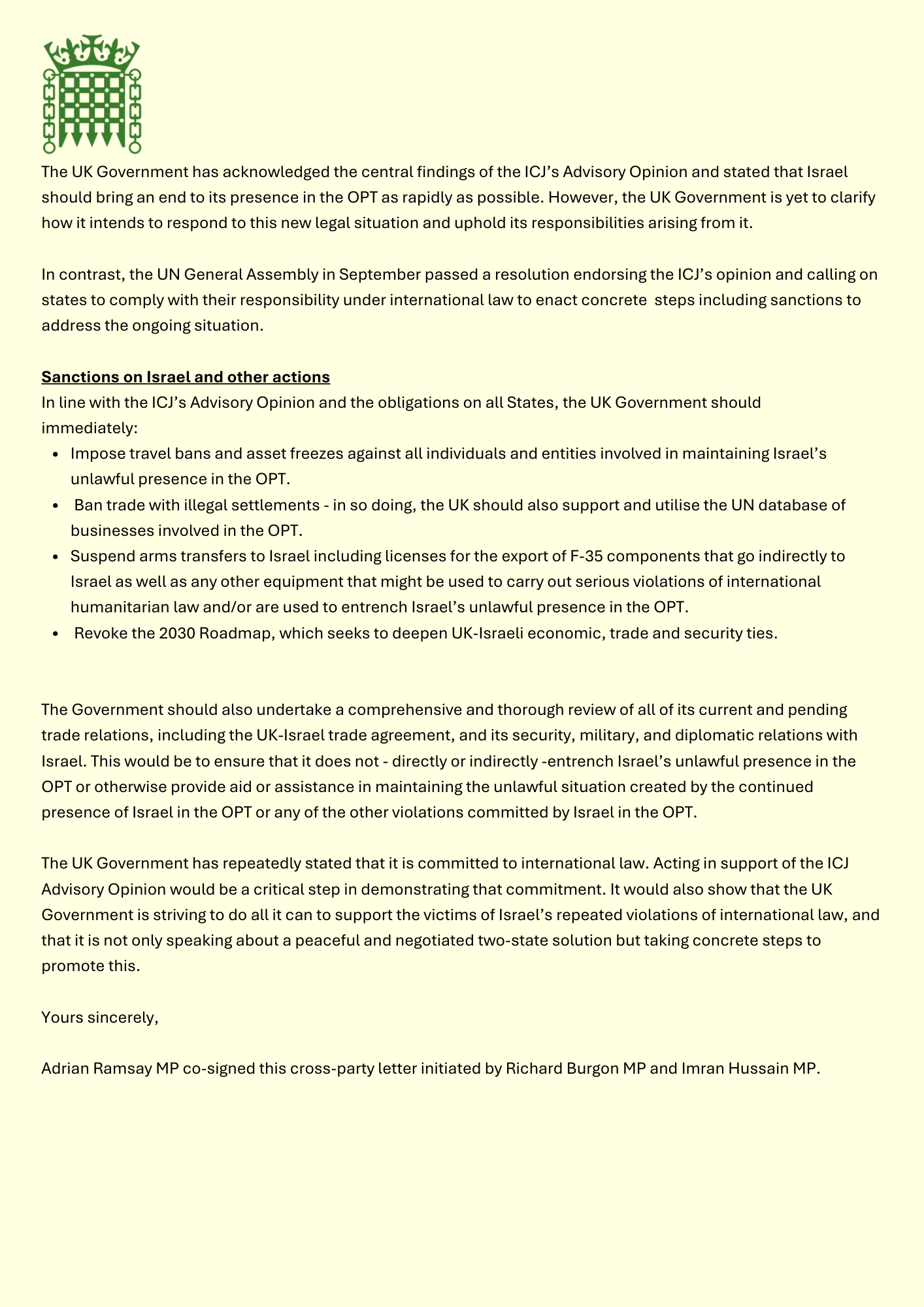
Dear Foreign Secretary,
Re: Call for the UK Government to impose sanctions on Israel following the International Court of Justice’s Landmark Advisory Opinion
We write to urge the UK government to impose sanctions and take other concrete steps to give effect to the landmark Opinion issued by the International Court of Justice (ICJ) on Israel’s continuing illegal presence in the Occupied Palestinian Territory (OPT).
Findings of the International Court of Justice
The ICJ, the world’s top court, found on 19 July 2024 that Israel’s continued presence in the Occupied Palestinian Territory, including East Jerusalem, is unlawful. It also found that Israel is under an obligation to bring to an end its unlawful presence in the OPT as rapidly as possible and to immediately cease all new settlement activities, amongst numerous other obligations.
The Court also found that all States, including the UK, have obligations to not recognise as legal the situation arising from the unlawful presence of Israel in the OPT and to not render any aid or assistance in maintaining this.
Further, amongst the numerous other obligations cited by the ICJ, all State Parties to the Fourth Geneva Convention have an obligation to ensure compliance by Israel with international humanitarian law as embodied in that Convention.
Obligations on the UK government
Flowing from these, the ICJ found that the UK and all states must take concrete actions including: taking steps to prevent trade or investment relations that assist in the maintenance of the illegal situation created by Israel in the OPT; abstaining from entering into economic or trade dealings with Israel concerning the OPT which may entrench its unlawful presence there; and abstaining from entering into any treaty relations with Israel in all cases in which it purports to act on behalf of the OPT.
It has now been four months since this landmark ICJ ruling. Since then the situation continues to worsen including with Israel’s intensified attacks on civilians and clear violations of international law occurring in Gaza.
The UK Government has acknowledged the central findings of the ICJ’s Advisory Opinion and stated that Israel should bring an end to its presence in the OPT as rapidly as possible. However, the UK Government is yet to clarify how it intends to respond to this new legal situation and uphold its responsibilities arising from it.
In contrast, the UN General Assembly in September passed a resolution endorsing the ICJ’s opinion and calling on states to comply with their responsibility under international law to enact concrete steps including sanctions to address the ongoing situation.
Sanctions on Israel and other actions
In line with the ICJ’s Advisory Opinion and the obligations on all States, the UK Government should immediately:
Impose travel bans and asset freezes against all individuals and entities involved in maintaining Israel’s unlawful presence in the OPT.
Ban trade with illegal settlements - in so doing, the UK should also support and utilise the UN database of businesses involved in the OPT.
Suspend arms transfers to Israel including licenses for the export of F-35 components that go indirectly to Israel as well as any other equipment that might be used to carry out serious violations of international humanitarian law and/or are used to entrench Israel’s unlawful presence in the OPT.
Revoke the 2030 Roadmap, which seeks to deepen UK-Israeli economic, trade and security ties.
The Government should also undertake a comprehensive and thorough review of all of its current and pending trade relations, including the UK-Israel trade agreement, and its security, military, and diplomatic relations with Israel. This would be to ensure that it does not - directly or indirectly - entrench Israel’s unlawful presence in the OPT or otherwise provide aid or assistance in maintaining the unlawful situation created by the continued presence of Israel in the OPT or any of the other violations committed by Israel in the OPT.
The UK Government has repeatedly stated that it is committed to international law. Acting in support of the ICJ Advisory Opinion would be a critical step in demonstrating that commitment. It would also show that the UK Government is striving to do all it can to support the victims of Israel’s repeated violations of international law, and that it is not only speaking about a peaceful and negotiated two-state solution but taking concrete steps to promote this.
Rachel Reeves’ Budget ignored this one reality about Britain
30th of October 2024
There was a lot of talk ahead of this Budget about it being the most significant financial statement for decades, a Budget that would set the course of our country for years to come.
After 14 years of underfunding which has left our public services in crisis, we needed a vision. What we got was a patchwork of promises, some of them positive but barely delivering on the long-term change that people voted for in July.
Indeed, after a rush of spending over the next year, the increase in funding slows to a crawl. A growth in real terms spending on public services of 1.5% a year after next year will barely touch the sides when you consider the need after 14 years during which public services have been brought to their knees.
This doesn’t feel like a plan for long-term transformation to build the economy of the future.
Don’t get me wrong: there was much to welcome. It was right that money is set aside to compensate the victims of the infected blood scandal and the Post Office horizon scandal. It was right too that the Chancellor changed the self-imposed fiscal rules to allow more borrowing to invest in our economy.
But this was a Budget which too often gave with one hand and took away with the other. While there is welcome and substantial investment in the NHS, mainly for diagnostic services, it comes in the wake of the withdrawal of winter fuel allowance for millions of pensioners which will leave them colder and sicker. The money in the Budget for social care will barely touch the sides – hardly an example of joined-up thinking.
The funding for schools is also welcome and a recognition of the dangerous state of many school buildings, which were constructed with dangerous concrete. I was also pleased to see the Chancellor recognise the huge un-met need of families with SEND children with a £1 billion increase in funding.
But let’s not forget that this Government also chose not to lift the two-child benefit cap which condemns 300,000 children to living in poverty.
The minimum wage is going up but raising employers’ national insurance and lowering the threshold at which they have to pay it places a huge burden on small and medium-sized businesses who form the backbone of our economy and provide more than 16 million jobs. The rise in bus fares will also make it more expensive for the worst-off to get to work.
Then there is the vital green transition to a thriving, sustainable economy. In the past seven Conservative budgets, the word “climate” was mentioned barely at all and then only in passing. Rachel Reeves continued that shameful tradition. The climate and nature crises have been virtually ignored – despite the huge impact they will have on our economy in the coming years.
Worse, the money to deal with some of the biggest impacts of climate breakdown – flooding – is to be reviewed and quite possibly cut, along with the budget for farming. As an MP for a rural constituency which is regularly affected by flooding, this is deeply worrying.
Rachel Reeves also showed political cowardice by following previous Conservative chancellors in freezing the fuel duty raise. This is not only costing the public purse £3 billion a year, it has also increased our carbon emissions by seven percent over the past 15 years.
The Chancellor is planning to spend a lot of money, particularly in the coming year, and our public services desperately need it.
But she has ignored the reality of where the wealth lies in Britain. The wealthiest 10 percent of the population own around half of all wealth, much of which is taxed at a much lower rate than the income of ordinary working people. The Chancellor seems to run scared of all the talk about millionaires and billionaires leaving the country, rather than looking to them to pay their fair share of tax so everyone can benefit from improved public services.
Yes, capital gains tax is going up but there is still a yawning gap between income from work and income from wealth. The rise in employers’ national insurance contributions means the money to fund the increase in public spending is coming from taxes on work, not wealth.
Rachel Reeves said there would be no return to austerity and “people must feel that”. Based on her plans, I’m not sure they will.