
-
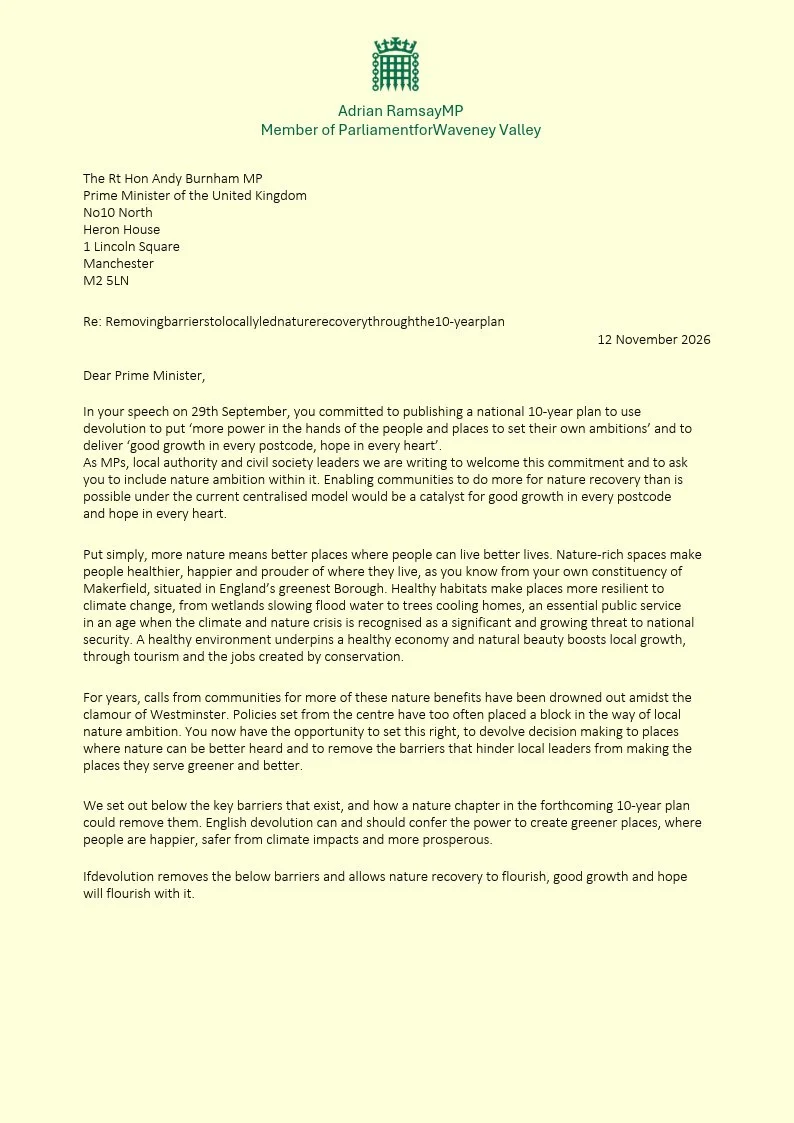
The Rt Hon Andy Burnham MP
Prime Minister of the United Kingdom
No10 North
Heron House
1 Lincoln Square
Manchester
M2 5LN
12th November 2026
Re: Removing barriers to locally led nature recovery through the 10-year plan
Dear Prime Minister,
In your speech on 29th September, you committed to publishing a national 10-year plan to use
devolution to put ‘more power in the hands of the people and places to set their own ambitions’ and to
deliver ‘good growth in every postcode, hope in every heart’.
As MPs, local authority and civil society leaders we are writing to welcome this commitment and to ask
you to include nature ambition within it. Enabling communities to do more for nature recovery than is
possible under the current centralised model would be a catalyst for good growth in every postcode
and hope in every heart.
Put simply, more nature means better places where people can live better lives. Nature-rich spaces make
people healthier, happier and prouder of where they live, as you know from your own constituency of
Makerfield, situated in England’s greenest Borough. Healthy habitats make places more resilient to
climate change, from wetlands slowing flood water to trees cooling homes, an essential public service
in an age when the climate and nature crisis is recognised as a significant and growing threat to national
security. A healthy environment underpins a healthy economy and natural beauty boosts local growth,
through tourism and the jobs created by conservation.
For years, calls from communities for more of these nature benefits have been drowned out amidst the
clamour of Westminster. Policies set from the centre have too often placed a block in the way of local
nature ambition. You now have the opportunity to set this right, to devolve decision making to places
where nature can be better heard and to remove the barriers that hinder local leaders from making the
places they serve greener and better.
We set out below the key barriers that exist, and how a nature chapter in the forthcoming 10-year plan
could remove them. English devolution can and should confer the power to create greener places, where
people are happier, safer from climate impacts and more prosperous.
If devolution removes the below barriers and allows nature recovery to flourish, good growth and hope
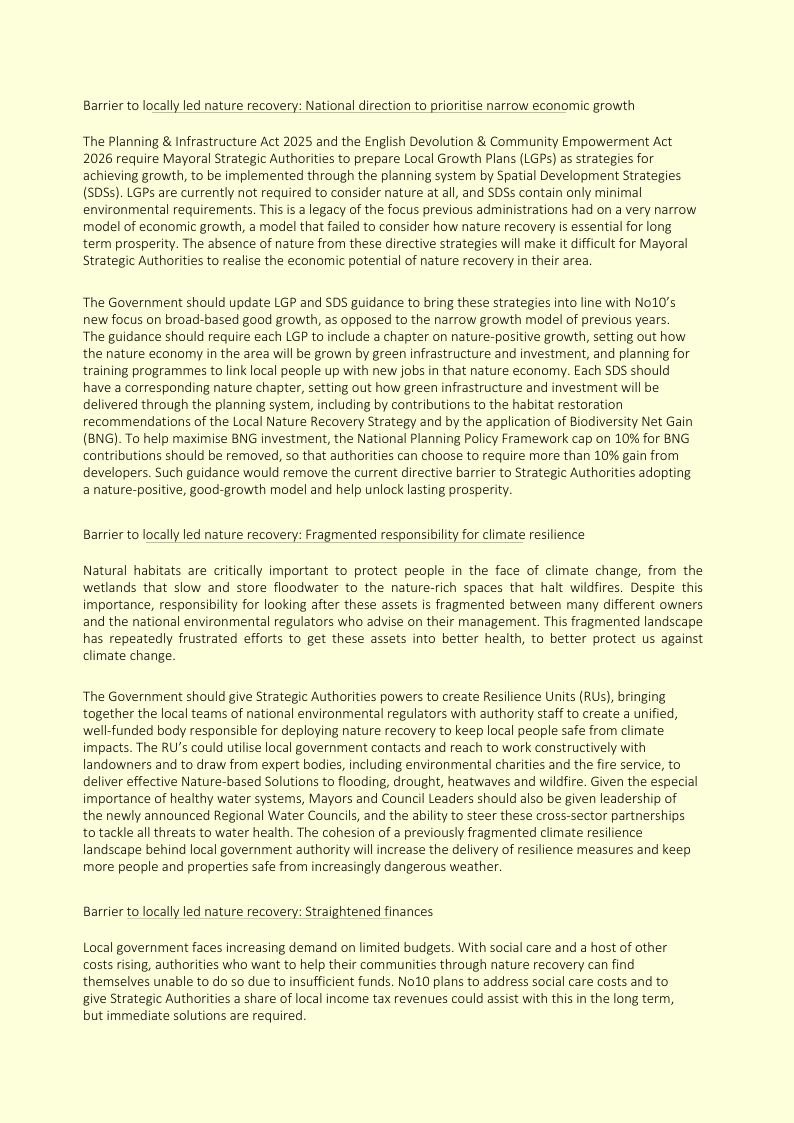
will flourish with it.Barrier to locally led nature recovery: National direction to prioritise narrow economic growth
The Planning & Infrastructure Act 2025 and the English Devolution & Community Empowerment Act
2026 require Mayoral Strategic Authorities to prepare Local Growth Plans (LGPs) as strategies for
achieving growth, to be implemented through the planning system by Spatial Development Strategies
(SDSs). LGPs are currently not required to consider nature at all, and SDSs contain only minimal
environmental requirements. This is a legacy of the focus previous administrations had on a very narrow
model of economic growth, a model that failed to consider how nature recovery is essential for long
term prosperity. The absence of nature from these directive strategies will make it difficult for Mayoral
Strategic Authorities to realise the economic potential of nature recovery in their area.
The Government should update LGP and SDS guidance to bring these strategies into line with No10’s
new focus on broad-based good growth, as opposed to the narrow growth model of previous years.
The guidance should require each LGP to include a chapter on nature-positive growth, setting out how
the nature economy in the area will be grown by green infrastructure and investment, and planning for
training programmes to link local people up with new jobs in that nature economy. Each SDS should
have a corresponding nature chapter, setting out how green infrastructure and investment will be
delivered through the planning system, including by contributions to the habitat restoration
recommendations of the Local Nature Recovery Strategy and by the application of Biodiversity Net Gain
(BNG). To help maximise BNG investment, the National Planning Policy Framework cap on 10% for BNG
contributions should be removed, so that authorities can choose to require more than 10% gain from
developers. Such guidance would remove the current directive barrier to Strategic Authorities adopting
a nature-positive, good-growth model and help unlock lasting prosperity.
Barrier to locally led nature recovery: Fragmented responsibility for climate resilience
Natural habitats are critically important to protect people in the face of climate change, from the
wetlands that slow and store floodwater to the nature-rich spaces that halt wildfires. Despite this
importance, responsibility for looking after these assets is fragmented between many different owners
and the national environmental regulators who advise on their management. This fragmented
landscape has repeatedly frustrated efforts to get these assets into better health, to better protect us
against climate change.
The Government should give Strategic Authorities powers to create Resilience Units (RUs), bringing
together the local teams of national environmental regulators with authority staff to create a unified,
well-funded body responsible for deploying nature recovery to keep local people safe from climate
impacts. The RU’s could utilise local government contacts and reach to work constructively with
landowners and to draw from expert bodies, including environmental charities and the fire service, to
deliver effective Nature-based Solutions to flooding, drought, heatwaves and wildfire. Given the especial
importance of healthy water systems, Mayors and Council Leaders should also be given leadership of
the newly announced Regional Water Councils, and the ability to steer these cross-sector partnerships
to tackle all threats to water health. The cohesion of a previously fragmented climate resilience
landscape behind local government authority will increase the delivery of resilience measures and keep
more people and properties safe from increasingly dangerous weather.Barrier to locally led nature recovery: Straightened finances
Local government faces increasing demand on limited budgets. With social care and a host of other
costs rising, authorities who want to help their communities through nature recovery can find
themselves unable to do so due to insufficient funds. No10 plans to address social care costs and to
give Strategic Authorities a share of local income tax revenues could assist with this in the long term,
but immediate solutions are required.
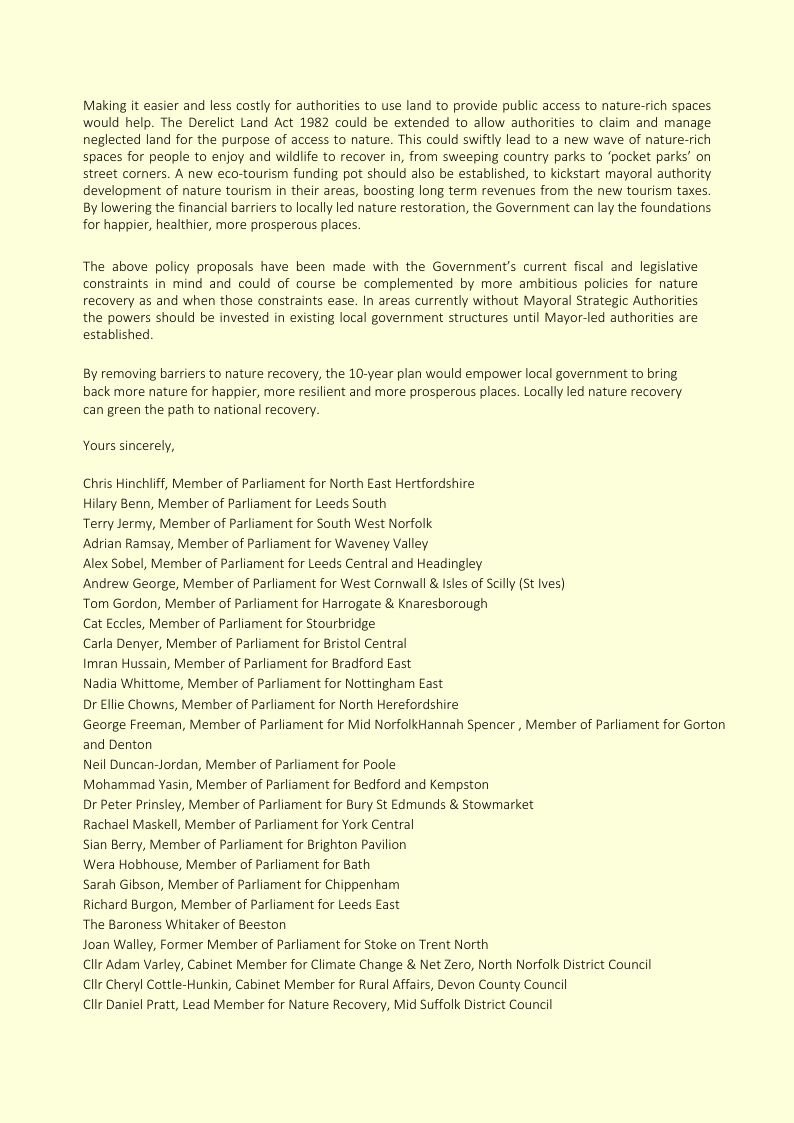
Making it easier and less costly for authorities to use land to provide public access to nature-rich spaces
would help. The Derelict Land Act 1982 could be extended to allow authorities to claim and manage
neglected land for the purpose of access to nature. This could swiftly lead to a new wave of nature-rich
spaces for people to enjoy and wildlife to recover in, from sweeping country parks to ‘pocket parks’ on
street corners. A new eco-tourism funding pot should also be established, to kickstart mayoral authority
development of nature tourism in their areas, boosting long term revenues from the new tourism taxes.
By lowering the financial barriers to locally led nature restoration, the Government can lay the
foundations for happier, healthier, more prosperous places.
The above policy proposals have been made with the Government’s current fiscal and legislative
constraints in mind and could of course be complemented by more ambitious policies for nature
recovery as and when those constraints ease. In areas currently without Mayoral Strategic Authorities
the powers should be invested in existing local government structures until Mayor-led authorities are
established.
By removing barriers to nature recovery, the 10-year plan would empower local government to bring
back more nature for happier, more resilient and more prosperous places. Locally led nature recovery
can green the path to national recovery.
Yours sincerely,
Chris Hinchliff, Member of Parliament for North East Hertfordshire
Hilary Benn, Member of Parliament for Leeds South
Terry Jermy, Member of Parliament for South West Norfolk
Adrian Ramsay, Member of Parliament for Waveney Valley
Alex Sobel, Member of Parliament for Leeds Central and Headingley
Andrew George, Member of Parliament for West Cornwall & Isles of Scilly (St Ives)
Tom Gordon, Member of Parliament for Harrogate & Knaresborough
Cat Eccles, Member of Parliament for Stourbridge
Carla Denyer, Member of Parliament for Bristol Central
Imran Hussain, Member of Parliament for Bradford East
Nadia Whittome, Member of Parliament for Nottingham East
Dr Ellie Chowns, Member of Parliament for North Herefordshire
George Freeman, Member of Parliament for Mid NorfolkHannah Spencer , Member of Parliament for Gorton and Denton
Neil Duncan-Jordan, Member of Parliament for Poole
Mohammad Yasin, Member of Parliament for Bedford and Kempston
Dr Peter Prinsley, Member of Parliament for Bury St Edmunds & Stowmarket
Rachael Maskell, Member of Parliament for York Central
Sian Berry, Member of Parliament for Brighton Pavilion
Wera Hobhouse, Member of Parliament for Bath
Sarah Gibson, Member of Parliament for Chippenham
Richard Burgon, Member of Parliament for Leeds East
The Baroness Whitaker of Beeston
Joan Walley, Former Member of Parliament for Stoke on Trent North
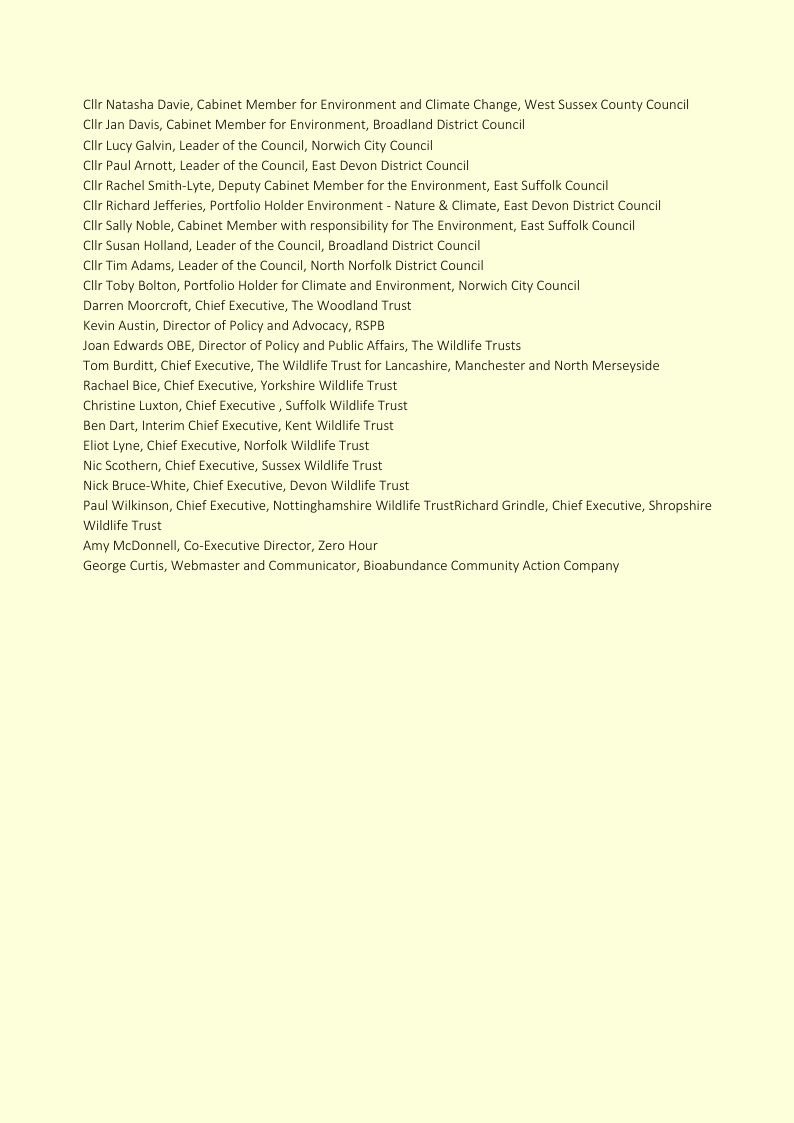
Cllr Adam Varley, Cabinet Member for Climate Change & Net Zero, North Norfolk District Council
Cllr Cheryl Cottle-Hunkin, Cabinet Member for Rural Affairs, Devon County Council
Cllr Daniel Pratt, Lead Member for Nature Recovery, Mid Suffolk District Council
Cllr Natasha Davie, Cabinet Member for Environment and Climate Change, West Sussex County Council
Cllr Jan Davis, Cabinet Member for Environment, Broadland District Council
Cllr Lucy Galvin, Leader of the Council, Norwich City Council
Cllr Paul Arnott, Leader of the Council, East Devon District Council
Cllr Rachel Smith-Lyte, Deputy Cabinet Member for the Environment, East Suffolk Council
Cllr Richard Jefferies, Portfolio Holder Environment - Nature & Climate, East Devon District Council
Cllr Sally Noble, Cabinet Member with responsibility for The Environment, East Suffolk Council
Cllr Susan Holland, Leader of the Council, Broadland District Council
Cllr Tim Adams, Leader of the Council, North Norfolk District Council
Cllr Toby Bolton, Portfolio Holder for Climate and Environment, Norwich City Council
Darren Moorcroft, Chief Executive, The Woodland Trust
Kevin Austin, Director of Policy and Advocacy, RSPB
Joan Edwards OBE, Director of Policy and Public Affairs, The Wildlife Trusts
Tom Burditt, Chief Executive, The Wildlife Trust for Lancashire, Manchester and North Merseyside
Rachael Bice, Chief Executive, Yorkshire Wildlife Trust
Christine Luxton, Chief Executive , Suffolk Wildlife Trust
Ben Dart, Interim Chief Executive, Kent Wildlife Trust
Eliot Lyne, Chief Executive, Norfolk Wildlife Trust
Nic Scothern, Chief Executive, Sussex Wildlife Trust
Nick Bruce-White, Chief Executive, Devon Wildlife Trust
Paul Wilkinson, Chief Executive, Nottinghamshire Wildlife TrustRichard Grindle, Chief Executive, Shropshire Wildlife Trust
Amy McDonnell, Co-Executive Director, Zero Hour
George Curtis, Webmaster and Communicator, Bioabundance Community Action Company
Removing barriers to locally led nature recovery through the 10-year plan

Previous
Previous
Concerns regarding the welfare of fast-growing chicken breeds
Next
Next