
RE: Windfall tax on those profiting from the war on Iran to tackle the cost of living crisis
-
Dear Prime Minister and Chancellor,
RE: Windfall tax on those profiting from the war on Iran to tackle the cost of living crisis
Across the UK, millions are barely staying afloat. Energy bills are bursting family budgets, childcare costs are washing away wages, businesses are struggling, and housing costs have skyrocketed. Many of the greatest problems people in the UK are facing right now will intensify as the impacts of the war on Iran continue to ripple through the economy.
The US-Israeli strikes on Iran as part of an illegal war, have caused chaos, killed civilians and have triggered the largest ever disruption to fuel supply, according to the International Energy Agency, sending crude oil costs surging over $100 per barrel in recent days. This has only worsened after the recent attacks on gasfields and LNG processing facilities in Iran and Qatar, which have caused gas prices to jump to four-year highs, with the impacts to be felt for many months and years to come.
Domestically, UK gas prices have more than doubled since late February. They are now at their highest since August 2022 and are likely to drive up energy bills unless action is taken to protect households and businesses when the next price cap is determined. Meanwhile, households are already grappling with the impacts of jumping fuel price increases, making simply getting by increasingly expensive. At the same time, experts are predicting major disruption to production and imports for agriculture inputs like fertilisers, risking further affordability issues for food and drink essentials in the months to come.
This crisis makes clear that the UK must end its reliance on fuels imported from overseas and invest in domestic renewable energy, to ensure British energy security is not left susceptible to global conflicts, disasters, or trade disputes. This will also help accelerate the UK’s transition toward a low-carbon economy, thereby reducing the likelihood of further economic shocks.
Sadly, there are some clear winners of the war on Iran. Oil and gas giants, big banks, agricultural input industries and defence companies will likely make record profits, at the expense of enormous human suffering. In recent crises, like those triggered by the Covid-19 pandemic and war in Ukraine, the wealthiest households and super-rich amassed even greater fortunes - to the tune of hundreds of billions of pounds, while millions were left struggling. Time after time, when wars break out, or major crises unfold, companies across different sectors, alongside super-rich individuals, make eye-watering sums of money. North Sea energy firms are set to make bumper profits. According to new data, for every month that energy prices remain at 18th March 2026 levels, profits could result in over £200m in tax revenue through the Energy Profits Levy. Banks reap profits due to the Bank of England’s misguided decision to raise interest rates in response to supply-side inflation. Higher rates are paid by borrowers - whose mortgage costs are already soaring off the back of the Iran crisis - and the Bank of England itself, which pays interest on the risk-free reserves banks hold with them. The latter cost is ultimately borne by the Treasury, currently to the tune of £20bn per year.
It is not right that extraordinary profits, generated off the backs of ordinary people during periods of crisis, are siphoned off into private hands and corporate bank accounts. All whilst households and businesses are in urgent need of substantial support to cope with the affordability crisis. The government’s own cost of living champion has called for measures to prevent profiteering. We urge you to make this crisis a turning point for the UK. Taking bold action to systemically reform our tax system and invest in our energy security will build resilience in our economy to
withstand future shocks and make life affordable for people and businesses in the UK.
We are writing to you today, as leading organisations from civil society, urging you to:
Ensure a permanent and strengthened energy profits mechanism which captures all excess profits made by oil and gas companies - including windfalls during crises - and close all loopholes which encourage further investment in harmful fossil fuels.
Introduce a levy on banks specifically targeting UK retail net income, profits they have made directly from the UK public.
Apply additional excess profits (windfall) taxes to companies in sectors profiteering from this crisis and the war in Iran, for example big agribusiness, the defence industry and associated AI and tech firms.
Invest revenue from excess profits into direct support to households and businesses to help weather the shock of the affordability crisis, alongside accelerating bringing online mass-scale low and zero carbon solutions to build a resilient energy system in the UK.
The billions in revenue from the additional proposed taxes on windfalls from this crisis must be reinvested into providing direct cost of living support and making our economy more resilient to withstand shocks in the future.
We can break free of the war-energy crisis doom loop, invest in renewables and low-carbon solutions, support people to deal with the cost of living crisis and put Britain on a path to better living standards for everyone in this country.
Yours sincerely,
Adrian Ramsay MP co-signed this letter along with Sian Berry MP, Carla Denyer MP, Hannah Spencer MP and Dr Ellie Chowns MP. Tax Justice UK, Faiza Shaheen, Executive Director
Greenpeace UK, Areeba Hamid, Co-Executive Director
Global Witness, Mike Davis, CEO
Women’s Budget Group, Dr Daniella Jenkins, Executive Director
National Education Union, Daniel Kebede, General Secretary38Degrees, Matthew McGregor, CEO
PCS Union, Fran Heathcote, General Secretary
Positive Money, Sara Hall, Co-Executive Director
End Fuel Poverty Coalition, Simon Francis, Coordinator
Global Justice Now, Nick Dearden, Executive Director
Autonomy Institute, Will Stronge, Chief Executive
Patriotic Millionaires UK, Rebecca Gowland, Executive Director
Green New Deal Rising
350.org, Anne Jellema, Executive Director
Zero Hour, Amy McDonnell and James Sutton, Co-Executive Directors
Care Full, Ruth Hannan & Hannah Webster, Co-Directors
Stamp Out Poverty, David Hillman, Director
War on Want, Liz McKean, Executive Director
Fairness Foundation, Will Snell, Chief Executive
Compass, Lena Swedlow, Deputy Director
Equality Trust, Priya Sahni-Nicholas and Jo Wittams; Co-Executive Directors
Taxpayers Against Poverty, Tom Burgess, CEO
Debt Justice, Heidi Chow, Executive Director
Fuel Poverty Action, Stuart Bretherton, Campaigns Lead
Mainstream
Women’s Environmental Network, Kate Metcalf, Co-Director
Voices Adfocad, Mike O'Brien, Founder
Tipping Point UK, Louise Hazan, Co-Director
Wellbeing Economy Alliance Scotland, Lisa Hough- Stewart, Interim Director
WEAll Global, Stewart Wallis, Executive Co Chair
Culture Unstained, Chris Garrard, Co-Director
Possible, Hirra Khan Adeogun & Juliet Michaelson, Co-directors
Cost of Living Action, Conor O'Shea, Campaign Coordinator Financial Transparency Coalition, Matti Kohonen, Executive Director
Conflict and Environment Observatory, Doug Weir, Director
JustMoney Movement, Sarah Edwards, Executive Director
Tipping Point North South, Deborah Burton. Co-founder
New Economics Foundation, Danny Sriskandarajah, Chief Executive
CLES (Centre for Local Economies), Dr Sarah Longlands
Oil Change International, Elizabeth Bast, Executive Director
Farming, Nature & Flood Control
5th of January 2025
There have been so many mis-steps by this Labour government in its first few months in office that it’s hard to know where to start. But the latest came in last month’s budget over its approach to farms.
The issue that’s grabbed most of the headlines is the change in inheritance tax rules which could impact family-owned farms which want to pass on the farm to the next generation. The Government needs to find a way to differentiate family farms from large estates bought to avoid tax and reconsider the £1 million threshold. Many family farms are worth much more than that, even though the farmer’s income is often very low.
What’s had less attention is the worrying freeze in the subsidy paid to farmers to encourage biodiversity on their land, amounting to a real-terms cut. This will make it much harder to achieve the switch to nature-friendly farming which is so vital to reverse the decline in wildlife, clean up our rivers and make farming more resilient to climate change.
The Government has its own legally binding targets on improving nature, a recognition of the fact that we are one of the most nature-depleted countries in the world. Yet when it comes to the crunch, the budget for achieving that is going down in real terms.
It is not only deeply short-sighted. It shows ministers just don’t understand the severity of the climate and nature crises. Both will have, and are already having, a major impact on the food we grow and our food security.
Let’s take the nature crisis first. Anyone who’s been walking or driving through the countryside over the years will have noticed the drastic decline in insect life. Insect numbers are down almost 60 percent in the past 20 years so we’re seeing fewer moths, flies, bees and butterflies. All of these are important pollinators for crops as well as our gardens.
Then there’s the state of our rivers. Only 14 percent of rivers in England are in good ecological health, none of them are in good overall health. This is partly down to water companies dumping sewage in the rivers. But, especially in areas like Waveney Valley, it is also a result of agricultural run-off from fertilisers or animal waste.
The chemicals from fertilisers and waste from slurry create algal blooms, disrupting ecosystems in the water and leading to “dead zones” for animals and plants, effectively killing the river.
The Government is reviewing the way water companies are regulated to try to curb their pollution of waterways and this is welcome and long overdue. But the review is largely ignoring waste from farms which accounts for 40 percent of water pollution, according to Defra. All the more reason for the Government to increase the funding available for nature-friendly farming to the levels the nature charities are saying is needed.
The health of our rivers is vital both to nature and our own health and wellbeing. It needs to be made a priority.
I had the chance to visit a couple of our local rivers recently, in the company of the Little Ouse Headwaters Project and the River Waveney Trust, both brilliant charities which are working to improve the health of the rivers and see how they can be better managed for the benefit of wildlife, people and the climate.
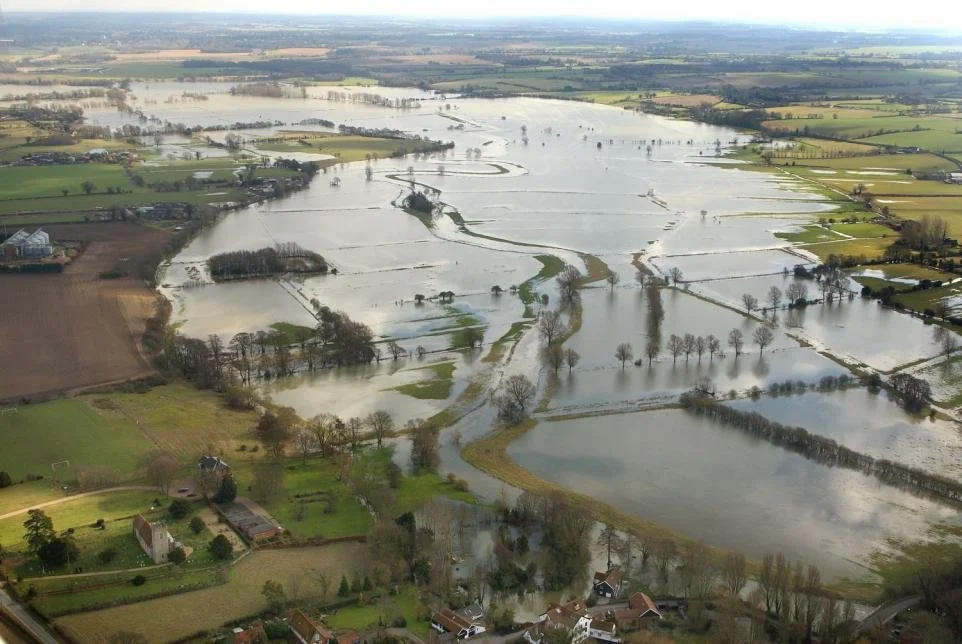
That brings us to the climate crisis. The last 18 months have been the wettest since records began in 1836 – a pattern which is likely to become the new normal with climate change. Although England has escaped the devastating floods which have hit Spain and other parts of Europe this autumn, many local communities have been affected by flooding in the last year and the frequency and severity is only likely to grow.
So flood management, especially in an area like East Anglia, has never been more important.
Gone are the days when engineers sought to channel rainfall as fast as possible into rivers. That just led to the rivers becoming overwhelmed and flooding areas further downstream.
The aim now is to hold back the water, using natural techniques like installing “leaky” dams to release water slowly, planting trees, digging ponds to store floodwater and protecting floodplains.
In Gissing, the River Waveney Trust and Norfolk Rivers Trust worked with the local community, landowners and the parish council to create a natural flood management scheme to make the land more flood resilient. They deployed low-cost solutions such as leaky dams, tree planting and using an adjacent meadow to temporarily store water so that heavy rainfall wouldn’t rush into the river and overwhelm it.
Eight named storms later, including Storm Babet in October last year, and no homes have been flooded in Gissing showing that natural flood management works.
The Little Ouse Headwaters Project is working to create a continuous corridor of wildlife habitat along the headwaters of the river, including restoring natural river features, all with flood management in mind.
Both are great projects but run on a shoestring, often with a large reliance on volunteers. Funding is always a challenge, making it difficult to scale up the work they’re doing which is vital if we’re to successfully manage flood risk and let nature recover.
I will continue to press the Government to invest properly in the nature-based solutions that are needed to support farming, restore biodiversity, capture carbon and manage floods.
Call it a reset, call it a “plan for change”, the Prime Minister’s administration was in desperate need of a relaunch
6th of December 2025
Call it a reset, call it a “plan for change”, the Prime Minister’s administration was in desperate need of a relaunch. Labour have had a shaky first few months, peppered with mis-steps from the ending of the winter fuel allowance to a budget which penalises small businesses and employers and won’t deliver improved living standards for people.
So now we have the Government’s new priorities from housing to NHS waiting lists to early years education. The ambition for Britain to be a clean energy superpower squeezes on to the list but, disappointingly, the ambition has been weakened to 95% clean power by 2030 – the same target set by the previous Conservative government.
What’s more disappointing is the silence on how we should be adapting to the impacts of climate breakdown which are affecting our communities now.
Even if we manage to limit global heating to 1.5C, and that looks more and more unlikely as emissions continue to grow and global efforts to decarbonise falter, significant changes to the climate and our weather systems are baked in. That means the UK faces more frequent severe flooding and more summer heatwaves.
We were all shocked this autumn by the images from Spain as the Valencia region was hit by devastating floods which destroyed homes, bridges, roads and cost hundreds of lives. The cost to the Spanish economy is huge. The Valencia region has asked for over 30 billion Euros in relief and the insurance costs are expected to run to several billion more.
Are we so confident that similar catastrophic flooding couldn’t happen here in the UK? The storms which hit parts of England and Wales this autumn were nothing like as severe as those in Spain yet they still led to hundreds of homes in the Midlands and South being flooded, exposing the total inadequacy of our flood defences. More than half the population say they’re not equipped to deal with flooding and the damage it would cause to their home.
The need to adapt to a different, more unstable climate shouldn’t come as a surprise to Government. Its own advisers, the Climate Change Committee, issued a review of the National Adaptation Programme earlier this year and it was scathing.
The UK is falling far short of what’s needed. The adaptation plans lack the pace and ambition to address the climate risks which are happening now. Fewer than half of the short-term actions needed to address the most urgent risks are in progress. There is no vision and the current approach isn’t working.
So while I welcome the Government’s ambition to make the UK a clean energy super-power to reduce our carbon emissions, ministers aren’t addressing the need to adapt and build up resilience now. And in some respects, we’re moving backwards.
Take the ambition for more house building. We urgently need more homes, especially more affordable homes and homes built for social rent. But building on floodplains not only condemns future owners to the misery of likely flooding, it also stops the land absorbing and holding back floodwater as nature intended.
Allowing floodplains to do their job isn’t the only nature-based solution that is being overlooked. We need to un-do the damage of previous generations and re-plant hedgerows and trees, rewind rivers and create ponds to hold back floodwaters. Nature is our ally in adapting to a changed climate: we shouldn’t ignore it.
Flooding is not the only risk to people’s livelihoods and the economy. So is extreme heat. We have already seen temperatures of above 40C in the UK which scientists say have happened only because of climate change. Our infrastructure needs to be resilient to these extreme temperatures so railways don’t buckle and people don’t bake in their homes. Retrofitting homes isn’t only about insulation to keep people warm in winter. It’s also about methods to keep them cool in summer. Over half of homes are at risk of over-heating which gives a sense of the scale of the challenge. On this, the Government has nothing to say.
Nor should we ignore the impact extreme temperatures have on our food security. The Climate Change Committee warned five years ago that more frequent weather extremes would damage crops and livestock, making food prices more volatile. Biodiversity loss could have an even greater impact, leaving crops more vulnerable to pests and pathogens.
So yes, Prime Minister, your Government needed a reset. But you’ve missed a critical mission – a national adaptation plan to safeguard our food security, better prepare the country for a future of more extreme weather and put nature at the heart of our response to climate change.