
Combating Illegal Seafood Imports
-
Adrian Ramsay MP co-signed this cross-party letter initiated by Kerry McCarthy MP & Sarah Champion MP.
Rt Hon Emma Reynolds MP
Secretary of State for Environment, Food and Rural Affairs
2 Marsham Street
London
SW1P 4DF
December 2025
Dear Secretary of State,
We are writing to express our alarm at the findings of the Coalition for Fisheries Transparency’s report, Criminal catches: how to stop the supply of illegal seafood to the UK, and urge the government to take urgent action in response to increase risk-based import controls and fully implement the Charter for Transparency.
The report reveals that seafood linked to illegal, unreported and unregulated (IUU) fishing and severe human rights abuses is entering the UK due to weak enforcement and under utilisation of our import controls. As a result, the public is at real risk of unwittingly purchasing seafood tainted by environmental harm and exploitation, while law-abiding British fishers are forced to compete to sell their produce on a domestic market flooded with cheap,
imported seafood that is at high risk of being illegally-caught.
IUU fishing has devastating impacts on marine ecosystems, it drives the collapse of fish populations, and often involves destructive fishing practices such as shark finning and the targeting of endangered species. It directly undermines global conservation efforts and the long-term sustainability of fish populations that support UK coastal livelihoods and provide a vital source of income and nutrition for billions of people in the Global South. Furthermore, investigations frequently show that where IUU fishing occurs, it is accompanied by human
trafficking, forced, bonded and slave labour.
As covered in The Times and revealed in Criminal catches, more than a quarter of UK seafood imports originate from countries that ranked among the world’s most notorious offenders for illegal fishing, including those that have been formally warned by the European Union (EU) for failing to address IUU fishing in their fleets. China and Russia are consistently among the worst-performing states globally, yet scrutiny of their imports remains far below
levels required to identify and screen out illegal catches. The UK receives around 1,000 catch certificates annually from China – covering roughly 58,000 tonnes of seafood – but only four consignments have been refused since 2012. No Russian catch certificates have been verified or refused since 2021.
Verification checks – a process through which authorities scrutinise catch documentation and request evidence from exporting flag-states to confirm legality – are a critical safeguard and using them frequently sends a clear message that a country wants to protect its market from illegal seafood. Despite this, since Brexit the UK has seen a three-fold decline in verifications – significantly fewer than best practice countries. Spain, for example, carries out more than 18 times as many verifications as the UK, despite historically importing only
around twice the number of catch certificates. Since Brexit, key monitoring and reporting of the UK’s IUU import controls has also ended, meaning we are now effectively blind to the full extent to which these controls are being implemented. Further, we are deeply concerned to learn from the report that Port Health Authorities currently receive no guidance identifying and prioritising high-risk seafood consignments for scrutiny. This lack of advice prevents a coordinated, risk-based approach and hinders the efficient use of their limited resources.
We welcome the government’s recent confirmation of its intention to update the information required in the UK catch certificate next year. It is imperative that these reforms match new data requirements from the EU – improvements that parliamentarians, industry and civil society have long supported. Falling behind the EU in this and other related areas risks the UK becoming Europe’s dumping ground for illegal and slave-caught seafood.
We should also match the EU’s introduction of a digitised catch certificate system, which would speed up processing times, allow for less administrative burden, and aid UK authorities in using a risk-based approach to identify and respond to IUU fishing links in imports. The use of a paper-based system in 2026 is deeply outdated and leaves us vulnerable to seafood fraud.
Crucially, we also urge the UK to require the provision of labour-specific risk information in catch certificates provided by seafood importers to the UK. Information such as the vessel’s time at sea, trans-shipment history, a vessel or captain’s history of prosecutions for labour offences, and whether crew have access to wifi serve as internationally recognised indicators of forced labour, trafficking and other serious abuses of crew. This information, which should already be held or easily accessible to importers, would enable UK authorities to assess the risk that seafood has been produced through both IUU fishing and associated labour abuses, which so often occur side-by-side. It would also encourage importers to conduct more robust supply chain due diligence, while creating a strong incentive to source from vessels and captains with clean records on labour abuses, rather than having to disclose links to unscrupulous operators.
We regard these changes to the UK’s catch documentation as important priorities. However, further strengthening is urgently required to ensure that the UK is not seen as an easy entry point for seafood linked to criminality, environmental destruction and human exploitation.
We therefore urge the government to adopt the full set of recommendations outlined in Criminal catches, including:
Turning the UK’s public support into a timebound commitment to fully implement the Global Charter for Fisheries Transparency.
Implementing a “carding” system based on yellow and red cards to incentivise positive reforms and ensure meaningful consequences for countries failing to act against IUU fishing. UK consumers were protected by such a system before Brexit.
Significantly increasing verification checks – with a clear focus on high-risk consignments – to prevent illegal imports and protect responsible industry.
Implement a risk-based approach to identify consignments for further scrutiny at the border.
Together, these measures would help protect our ocean, support ethical supply chains and level the playing field for responsible UK fishers and businesses that sell seafood on the UK market.
We would welcome a meeting with you or a member of your ministerial team to discuss these findings and how we can work together to support a strengthened UK response.
We look forward to your reply.
Adrian Ramsay MP co-signed this cross-party letter initiated by Kerry McCarthy MP & Sarah Champion MP.
RE: Palestine Solidarity Campaign Rally 18th January 2025
-
RE: Palestine Solidarity Campaign Rally 18th January 2025
Dear Home Secretary,
We write concerning the above, and specifically to raise concerns about the manner of the policing and
the apparent denial of civil liberties and freedom to protest.
We are all cautiously relieved that a ceasefire in the Gaza Strip has been announced and is currently
being implemented with hostages starting to return to their families and Palestinian detainees being
released.
The hope is that the staged ceasefire and release of hostages and prisoners continues as planned. But
the Palestine solidarity movement remains as pertinent as ever, with Palestinians still facing daily brutal
oppression under Israel’s decades long illegal occupation.
The situation for Palestinians in the Gaza Strip is desperate, and the lifting of sanctions against violent
settlers in the West Bank by Donald Trump has already fuelled further violence against Palestinians
living there. It is clear that the injustices experienced by Palestinians continues and remains an
important issue for many millions of UK citizens and for peoples across the world. The regular large
scale protests taking place across the country over the last 15 months have been an important
democratic expression of the strength of public feeling on this issue.
These protests have been very well organised, with 24 national demonstrations each with between
100,000 and a million people attending. They have been peaceful in nature and attended by a broad
range of people and groups – including a prominent Jewish block at every march. Ahead of every march,
the organisers have discussed fully with the Metropolitan Police to ensure their success.
We are deeply troubled, however, by the obstacles put in place by the Metropolitan Police ahead of the
18th January demonstration, as well as the policing on the day. We have spoken to the key figures in the
forefront of the events of the day, listened to their first-hand accounts and viewed the video footage,
and there are some significant issues of concern.
It is very clear from the published footage that the protest organisers announced their intention to send
a small delegation to walk towards the BBC, carrying flowers which they intended to lay there. They
announced that if the police were to stop them proceeding to the BBC, then they would lay the flowers
at the feet of the police instead.
Footage clearly shows the police inviting the delegation to ‘filter through’ from Whitehall into Trafalgar
Square, as opposed to it ‘breaching police lines’ as subsequently alleged. In this context, we fail to see
how the questioning of two Members of Parliament, the charging of Ben Jamal of Palestine Solidarity
Campaign and Chris Nineham of Stop the War Coalition with public order offences, and indeed the assault on Chris Nineham during his arrest, and the interviewing of others under caution, can be
thought justified or in any way appropriate.
There is a direct conflict in the respective positions of officers facilitating the progress of a delegation
to lay flowers, and the allegation by the police that their lines had been forcibly breached. Clearly being
invited to proceed is wholly inconsistent with the allegation of a forcible breach. We invite you to
contrast the web posts and social media posts by the Metropolitan Police and the footage shared by
the Palestine Solidarity Campaign.
We know that you will have received many direct representations no doubt detailing the chronology
and the discussions had before and throughout the rally as between the PSC and the Police and we will
not repeat those details here, but we were aghast to learn that Met Commissioner Mark Rowley said
publicly the day after the protest that ‘his force imposed unprecedented restrictions’ on a major
Palestine solidarity rally in London on 18th January that led to 77 arrests.
The changes to public order legislation by the last government, through both the Police, Crime,
Sentencing and Courts Act 2022 and through the Public Order Act 2023, were rightly resisted. Civil
society called it, ‘a staggering escalation of the Government’s clampdown on protest’. The Joint
Committee on Human Rights rightly condemned the creation of, ‘a hostile environment for peaceful
protestors.’ And an opposition frontbench reasoned amendment rightly declared this legislation would,
‘erode historic freedoms of peaceful protest’.
The High Court in May this year upheld legal challenges brought by Liberty against the almost “unlimited
powers of the Police” and it is regrettable that the Government is appealing that decision and is
seemingly supporting public order measures which we opposed when in Opposition.
The Government is rightly repealing anti-trade union legislation through the Employment Rights Bill. It
should repeal anti-protest legislation as well. The use of public order legislation passed by the last
Government, should be paused and subject to reconsideration by the Home Office rather than pursuing
use of its devices.
With regards to last weekend’s protest, we ask that you clarify whether there was any discussion
between the Commissioner and the Home Office, or any prior or subsequent engagement or
communication around such a significant change in policy.
If so, could you please advise as to the origins of such a significant change and whether such an
intention was approved in any way.
We believe the charges should be dropped against those unjustly arrested, or unjustly charged,
following the protest. And we ask that the Home Office commission an independent investigation into
the policing of the protest.
It was the former Government which fomented protest and used legislation to repress it, this
Government must demonstrate it is delivering change.
Yours,
1. Diane Abbott MP
2. Shockat Adam MP
3. Órfhlaith Begley MP
4. Apsana Begum MP
5. Baroness Natalie Bennett
6. Sian Berry MP
7. Baroness Christine Blower
8. Baroness Pauline Bryan
9. Richard Burgon MP
10. Ian Byrne MP
11. Ellie Chowns MP
12. Pat Cullen MP
13. Lord Bryn Davies
14. Carla Denyer MP
15. Neil Duncan-Jordan MP
16. John Finucane MP
17. Mary Kelly Foy MP
18. Chris Hazzard MP
19. Lord John Hendy
20. Dáire Hughes MP
21. Adnan Hussain MP
22. Imran Hussain MP
23. Kim Johnson MP
24. Baroness Jenny Jones
25. Ayoub Khan MP
26. Ben Lake MP
27. Ian Lavery MP
28. Chris Law MP
29. Graham Leadbitter MP
30. Brian Leishman MP
31. Clive Lewis MP
32. Andy McDonald MP
33. Cathal Mallaghan MP
34. Rachael Maskell MP
35. Paul Maskey MP
36. Abtisam Mohamed MP
37. Iqbal Mohammed MP
38. Grahame Morris MP
39. Brendan O’Hara MP
40. Simon Opher MP
41. Kate Osborne MP
42. Adrian Ramsay MP
43. Bell Ribeiro-Addy MP
44. Lord Prem Sikka
45. Cat Smith MP
46. Euan Stainbank MP
47. Zarah Sultana MP
48. Jon Trickett MP
49. Nadia Whittome MP
50. Steve Witherden MP
51. Lord Tony Woodley
Saving Beagles From Animal Testing
-
Adrian Ramsay MP co-signed this cross-party letter initiated by Save the Begales.
Shabana Mahmood MP
Secretary of State for the Home Department
2 Marsham Street
SW1P 4DF
London
Dear, Shabana Mahmood MP,
We write to you as an incredibly deeply concerned and caring group of public figures and animal lovers. We are calling for the immediate closure of the puppy breeding facility, MBR Acres, as part of an urgent transition away from all animal testing in the United Kingdom.
MBR Acres, as you may know, is a facility in Cambridgeshire with the sole purpose of breeding beagle puppies for the utterly unnecessary animal testing industry - an estimated 2,000 dogs every year. These dogs, often as young as 16 weeks, are regularly experimented upon, with little to no benefit for humans or scientific knowledge.
The United Kingdom is a nation of animal lovers; we are home to the world’s oldest animal charity, the RSPCA, and nearly 40% of our households count a dog as a family member. In the face of this, it is utterly shocking that we continue to subject defenceless puppies to unimaginable pain in the animal testing industry.
This betrayal is even more gut-wrenching because it’s beagles who are chosen - precisely because they are gentle, friendly, affectionate and trusting. These traits make them beloved members of the family. In the lab, they're the perfect victims who won't put up a fight.
The use of animals for testing has, largely, become obsolete. This is not new information. As long ago as 2004, the British Medical Journal raised serious concerns with its reliability, with a paper posing the question: “Where is the evidence that animal research benefits humans?” A 2015 Cambridge Quarterly of Healthcare Ethics paper concluded, “When considering the ethical justifiability of animal experiments, we should ask if it is ethically acceptable to deprive humans of resources, opportunity, hope, and even their lives by seeking answers in what may be the wrong place. In my view, it would be better to direct resources away from animal experimentation and into developing more accurate, human-based technologies.”
New technologies such as cell culture, organ-on-chip, and in silico testing promise more reliable results, in less time, without the massive suffering and deaths of animals. The future is clear; all that remains is for the right decision to be made to focus on funding and expanding alternatives to testing on animals, like the beagle puppies from MBR Acres. The future is clear; now is the time for the UK to lead the world into an animal-free testing paradigm, instead of clinging to unreliable techniques that are a stain on our nation’s values.
The majority of the public is firmly against the use of animal testing, and now is the time to step up and do the right thing. Shut down MBR Acres, rehome the dogs and let Britain lead the world into a future without animal testing.
Kind Regards,
Adrian Ramsay MP co-signed this cross-party letter initiated by Save the Begales.
Compensating women affected by the Government’s communication of State Pension age changes.
-
Adrian Ramsay MP co-signed this cross-party letter initiated by Steve Darling MP.
The Rt Hon. Pat McFadden MP
Secretary of State for Work and Pensions
January 2026
Dear Secretary of State,
Re: Compensating women affected by the Government’s communication of State Pension age changes.
We are writing following the out-of-court settlement reached between WASPI and the Government on 2 December 2025, and your commitment to undertake a full review of all the evidence relating to the Parliamentary and Health Service Ombudsman (PHSO)’s investigation within 12 weeks.
We welcome your acceptance that the Government’s initial decision not to compensate 1950s-born women was flawed, and the new opportunity which has arisen to reconsider the case for compensation and restore public confidence in the independent bodies that exist to hold the executive to account.
Women born in the 1950s have suffered a clear injustice, as detailed in the PHSO’s thorough and comprehensive report which took six years to produce. The investigation concluded those affected were denied the opportunity to make alternative arrangements for their retirement and still suffer the consequences today.
As you know, the PHSO found maladministration in the way the DWP failed to act on its own research which showed that significant numbers of 1950s-born women did not know about forthcoming increases to their State Pension age. The DWP has yet to explain why this occurred.
The Government was right to carefully reconsider its position on the Winter Fuel Payment, Personal Independence Payments, and most recently, inheritance tax relief on agricultural properties. We hope the coming weeks will allow you to reach the right decision for 1950s-born women.
We urge you to update the House on your plans to ensure that women born in the 1950s are finally treated fairly and properly compensated at your earliest convenience, or by 24th February 2026 at the latest.
We look forward to your response.
Adrian Ramsay MP co-signed this cross-party letter initiated by Steve Darling MP.
UK-Australia-Canada open letter calling to End Frozen Pensions
-
Adrian Ramsay MP co-signed this cross-party letter initiated by the End Frozen Pensions campaign.
Dear Prime Minister,
We recognise and cherish the deep and enduring relationship between Australia, Canada, and the United Kingdom, which has been built on shared history, values, and mutual respect.
As members of our respective Parliaments, we express our concern regarding the United Kingdom’s frozen pensions policy, which treats UK state pensioners residing in Australia and Canada differently from those residing in other overseas countries (such as the USA, Philippines, Israel and Türkiye). This policy unfairly denies annual pension uprating to pensioners now living in Australia and Canada, despite them having made contributions to the UK National Insurance system under the same rules as pensioners living elsewhere.
We urge the British Government to negotiate new reciprocal social security agreements with Australia and with Canada to end this longstanding inequity and ensure fair treatment for all UK pensioners.
We would be grateful for an urgent response.
Adrian Ramsay MP co-signed this cross-party letter initiated by the End Frozen Pensions campaign.
Settlement Rights Open Letter
-
The Rt Hon Shabana Mahmood MP
Secretary of State for the Home Department
2 Marsham Street
London SW1P 4DF
11th January 2026
Dear Home Secretary,
We the undersigned write to express our concern with the Government’s proposals to restrict settlement rights. They are unfair towards migrant workers who have put down roots, contributed to their communities and built lives here. This will undermine public services, social integration and the wider economy.
The British public believe in fair play: that if you work hard, follow the rules and contribute, that Government should tread lightly on your life. The proposal to double the qualifying period for Indefinite Leave to Remain to 10 years, rising to 15 years for those such as care workers, wrongly deemed “low-skilled”, alongside new conditionality is deeply unfair.
The proposals to change settlement rules would pull the rug from under migrant workers, including in social care who provide dignity and comfort to our loved ones, often in difficult conditions and for low pay. The Government must uphold its promises – we cannot simply change the rules halfway through an agreed process.
These proposals undermine the Government’s priorities for economic growth, reducing child poverty and strong public services. For instance, adult social care already faces around 110,000 vacancies, and as we await the Casey Review and the Fair Pay Agreement, these proposals risk pushing the sector closer to breaking point. While we support efforts to grow and train the domestic workforce, this is a separate task. Restricting the rights of the workers keeping the sector running will not grow the domestic workforce – it will only worsen care provision.
We make the following recommendations to the Home Office:
Halt the consultation process until a full Impact Assessment is published: The Government is making sweeping immigration reforms without transparency regarding its own forecasts on the economy, public services and communities with protected characteristics. It must restart the process with an Impact Assessment, together with a Child Rights Impact Assessment, with the starting point of treating people fairly as well as supporting the economy and public services.
Rule out retrospective application: The Government must immediately rule out applying new immigration rules to migrant families already in the UK. Thousands of families have planned their lives around current rules.
Upholding fairness, trust in Government and the dignity of work are core British values and essential to building
a country that works for everyone.
Neil Duncan-Jordan MP Andrea Egan Dr. Dora-Olivia Vicol,
Unison, General Secretary Work Rights Centre, CEO
Adrian Ramsay MP co-signed this cross-party letter initiated by Neil Duncan-Jordan MP.
Letter to the Home Secretary on Gaza Students Policy
-
INSERT HERE
The Rt Hon Shabana Mahmood MP
Home Secretary
6 January 2026
Adrian Ramsay MP co-signed this cross-party letter initiated by Abtisam Mohamed MP.
Dear Home Secretary,
We are writing to urgently to request a meeting regarding the Government’s evacuation policy
for scholarship students from Gaza, which ended on 31 December 2025.
From the initial application process through to the evacuation stage, students in Gaza have
faced delays, uncertainty, and confusion amid the daily horrors of life under bombardment and
siege. Despite this, dozens have successfully navigated the system and arrived here to start
their studies.
They were able to do so as new guidance confirmed the UK Government’s commitment to the
evacuation of scholarship students, as well as a further agreement for the evacuation of their
dependents. This was extremely welcome.
However, we understand that very few have been evacuated under the agreed policy for
dependents. In December, students were informed that despite previous assurances, no
dependents would be evacuated before the end of the scheme, and that students should take
the opportunity to leave Gaza without them. This included PhD student Mohammed Aldalou
bound for LSE, who has a severely autistic child and was expected to leave him behind in
Gaza.
PhD student Manar al Houbi campaigned for months to be able to take up her place at the
University of Glasgow. She was told repeatedly to either to leave Gaza without her spouse
and children, or to remain behind with her family in danger, abandoning her course.
Manar and her family were eventually evacuated at the end of last year, but this was not the
case for the rest who are still waiting. The wider scheme has now ended; and there is no
confirmed extension to the policy, which is causing extraordinary pressure and uncertainty for
the students. Time is critically short, and we believe that at the very least, an extension of this
scheme would bring both the compassion and the stability needed in these circumstances.
We would be grateful for an urgent response.
Adrian Ramsay MP co-signed this cross-party letter initiated by Abtisam Mohamed MP.
Requesting Meeting on Trophy Hunting BanInbox
-
Dear Secretary of State,
We are writing to request an urgent meeting.
We applaud many of the measures in the government’s new Animal Welfare Strategy. However, we were surprised and disappointed that banning imports of hunting trophies did not feature.
We are also concerned at suggestions that a ban may be highly selective. You previously stated that you sought to “ban the import of any goods that are related to trophy hunting.” (https://www.youtube.com/watch?v=uKsLggGf5rY)
Several reports have spelt out the shocking cruelty involved in trophy hunting. This is an issue about which voters feel very strongly. It is also an issue about which there is virtual consensus in Parliament.
We would therefore be grateful if you would agree to a meeting at the earliest available opportunity to clarify both the scope of the government’s proposed ban and the timeline for introducing legislation.
Yours sincerely,
,
Adrian Ramsay MP co-signed this cross-party letter initiated by the Campaign to Ban Trophy Hunting.
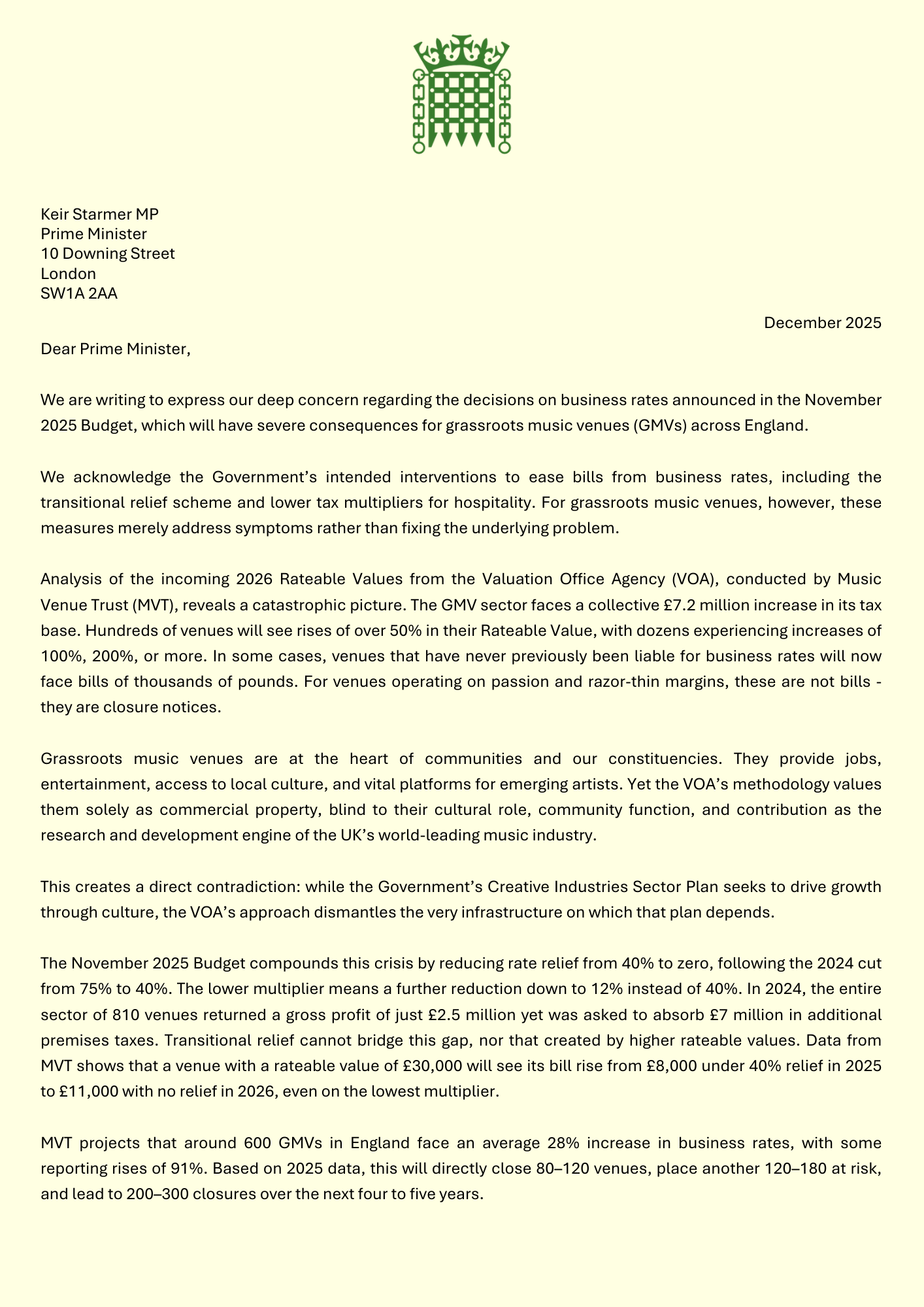
Letter to the Prime Minister urging a review of the business rates changes in the November 2025 budget.
-
Adrian Ramsay MP co-signed this cross-party letter initiated by the Music Venue Trust.
Keir Starmer MP
Prime Minister
10 Downing Street
London
SW1A 2AA
Xx December 2025
Dear Prime Minister,
We are writing to express our deep concern regarding the decisions on business rates announced in the November 2025 Budget, which will have severe consequences for grassroots music venues (GMVs) across England.
We acknowledge the Government’s intended interventions to ease bills from business rates, including the transitional relief scheme and lower tax multipliers for hospitality. For grassroots music venues, however, these measures merely address symptoms rather than fixing the underlying problem.
Analysis of the incoming 2026 Rateable Values from the Valuation Office Agency (VOA), conducted by Music Venue Trust (MVT), reveals a catastrophic picture. The GMV sector faces a collective £7.2 million increase in its tax base. Hundreds of venues will see rises of over 50% in their Rateable Value, with dozens experiencing increases of 100%, 200%, or more. In some cases, venues that have never previously been liable for business rates will now face bills of thousands of pounds. For venues operating on passion and razor-thin margins, these are not bills - they are closure notices.
Grassroots music venues are at the heart of communities and our constituencies. They provide jobs, entertainment, access to local culture, and vital platforms for emerging artists. Yet the VOA’s methodology values them solely as commercial property, blind to their cultural role, community function, and contribution as the research and development engine of the UK’s world-leading music industry.
This creates a direct contradiction: while the Government’s Creative Industries Sector Plan seeks to drive growth through culture, the VOA’s approach dismantles the very infrastructure on which that plan depends.
The November 2025 Budget compounds this crisis by reducing rate relief from 40% to zero, following the 2024 cut from 75% to 40%. The lower multiplier means a further reduction down to 12% instead of 40%. In 2024, the entire sector of 810 venues returned a gross profit of just £2.5 million yet was asked to absorb £7 million in additional premises taxes. Transitional relief cannot bridge this gap, nor that created by higher rateable values. Data from MVT shows that a venue with a rateable value of £30,000 will see its bill rise from £8,000 under 40% relief in 2025 to £11,000 with no relief in 2026, even on the lowest multiplier.
MVT projects that around 600 GMVs in England face an average 28% increase in business rates, with some reporting rises of 91%. Based on 2025 data, this will directly close 80–120 venues, place another 120–180 at risk, and lead to 200–300 closures over the next four to five years.
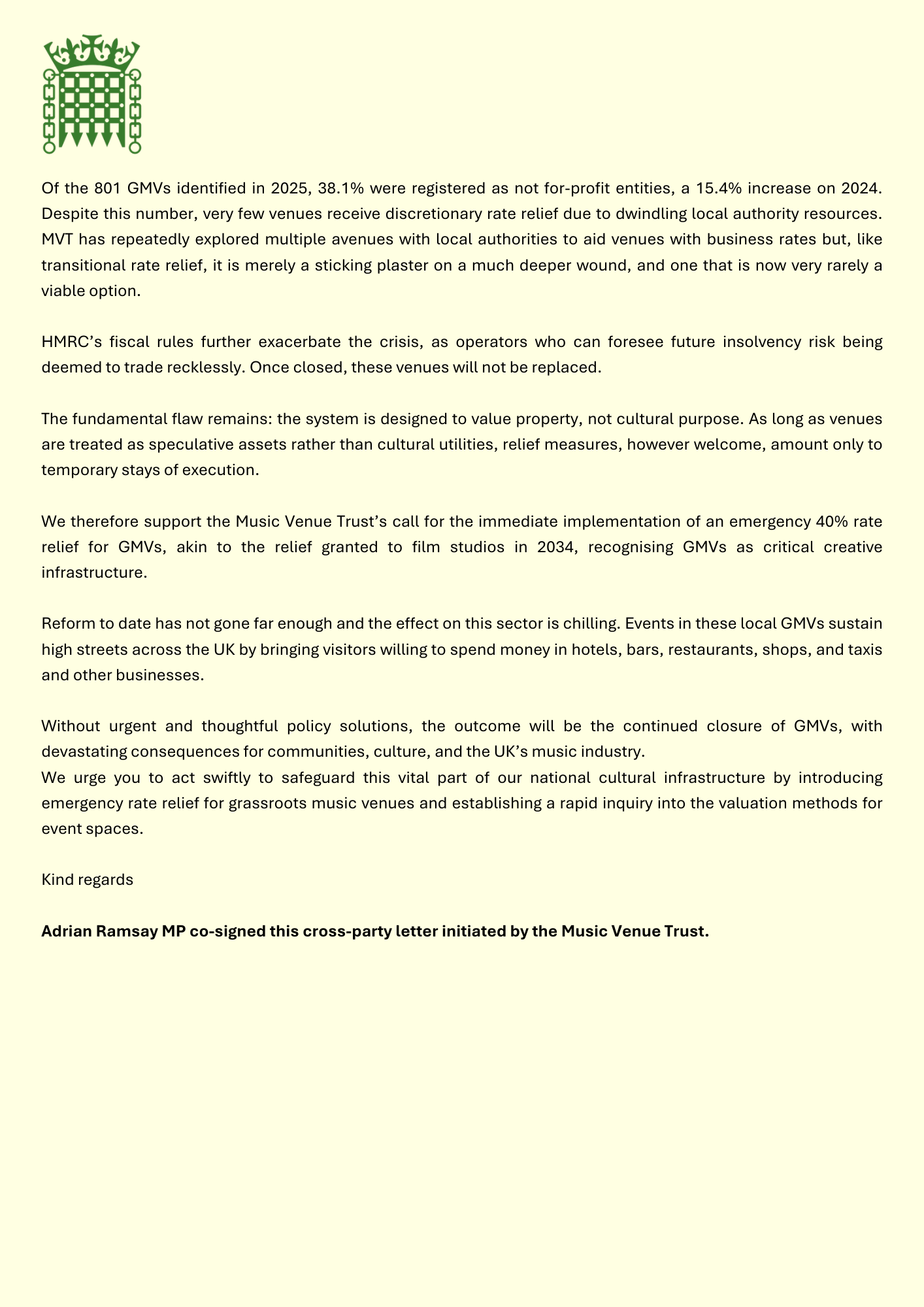
Of the 801 GMVs identified in 2025, 38.1% were registered as not for-profit entities, a 15.4% increase on 2024. Despite this number, very few venues receive discretionary rate relief due to dwindling local authority resources. MVT has repeatedly explored multiple avenues with local authorities to aid venues with business rates but, like transitional rate relief, it is merely a sticking plaster on a much deeper wound, and one that is now very rarely a viable option.
HMRC’s fiscal rules further exacerbate the crisis, as operators who can foresee future insolvency risk being deemed to trade recklessly. Once closed, these venues will not be replaced.
The fundamental flaw remains: the system is designed to value property, not cultural purpose. As long as venues are treated as speculative assets rather than cultural utilities, relief measures, however welcome, amount only to temporary stays of execution.
We therefore support the Music Venue Trust’s call for the immediate implementation of an emergency 40% rate relief for GMVs, akin to the relief granted to film studios in 2034, recognising GMVs as critical creative infrastructure.
Reform to date has not gone far enough and the effect on this sector is chilling. Events in these local GMVs sustain high streets across the UK by bringing visitors willing to spend money in hotels, bars, restaurants, shops, and taxis and other businesses.
Without urgent and thoughtful policy solutions, the outcome will be the continued closure of GMVs, with devastating consequences for communities, culture, and the UK’s music industry.
We urge you to act swiftly to safeguard this vital part of our national cultural infrastructure by introducing emergency rate relief for grassroots music venues and establishing a rapid inquiry into the valuation methods for event spaces.
Kind regards
Adrian Ramsay MP co-signed this cross-party letter initiated by the Music Venue Trust.
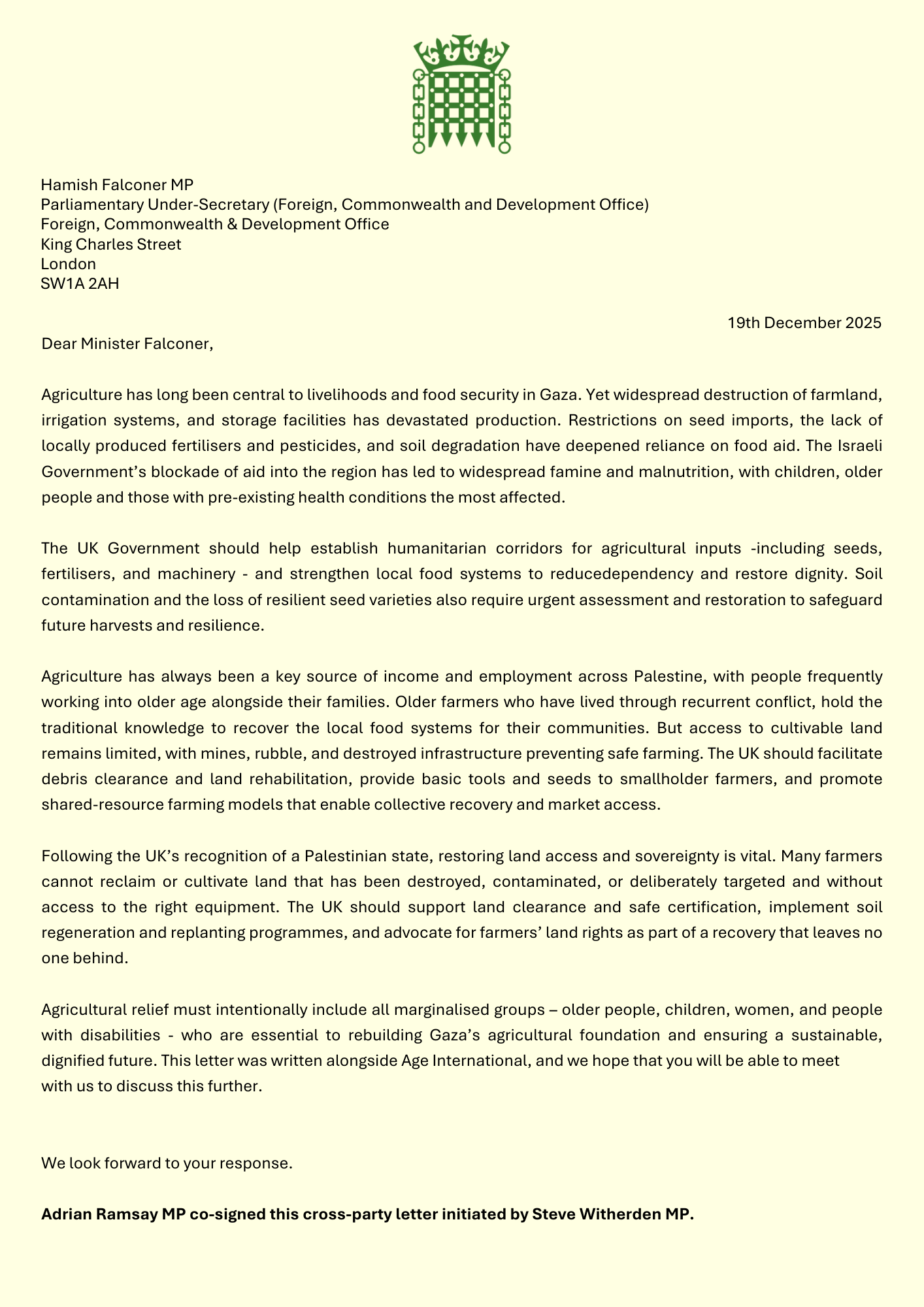
Letter on Agriculture in Palestine
-
Adrian Ramsay MP co-signed this cross-party letter initiated by Steve Witherden MP.
Hamish Falconer MP
Parliamentary Under-Secretary (Foreign, Commonwealth and Development Office)
Foreign, Commonwealth & Development Office
King Charles Street
London
SW1A 2AH
19th December 2025
Dear Minister Falconer,
Agriculture has long been central to livelihoods and food security in Gaza. Yet widespread
destruction of farmland, irrigation systems, and storage facilities has devastated production.
Restrictions on seed imports, the lack of locally produced fertilisers and pesticides, and soil
degradation have deepened reliance on food aid. The Israeli Government’s blockade of aid into
the region has led to widespread famine and malnutrition, with children, older people and those
with pre-existing health conditions the most affected.
The UK Government should help establish humanitarian corridors for agricultural inputs -
including seeds, fertilisers, and machinery - and strengthen local food systems to reduce
dependency and restore dignity. Soil contamination and the loss of resilient seed varieties also
require urgent assessment and restoration to safeguard future harvests and resilience.
Agriculture has always been a key source of income and employment across Palestine, with
people frequently working into older age alongside their families. Older farmers who have lived
through recurrent conflict, hold the traditional knowledge to recover the local food systems for
their communities. But access to cultivable land remains limited, with mines, rubble, and
destroyed infrastructure preventing safe farming. The UK should facilitate debris clearance and
land rehabilitation, provide basic tools and seeds to smallholder farmers, and promote shared-
resource farming models that enable collective recovery and market access.
Following the UK’s recognition of a Palestinian state, restoring land access and sovereignty is
vital. Many farmers cannot reclaim or cultivate land that has been destroyed, contaminated, or
deliberately targeted and without access to the right equipment. The UK should support land
clearance and safe certification, implement soil regeneration and replanting programmes, and
advocate for farmers’ land rights as part of a recovery that leaves no one behind.
Agricultural relief must intentionally include all marginalised groups – older people, children,
women, and people with disabilities - who are essential to rebuilding Gaza’s agricultural
foundation and ensuring a sustainable, dignified future.
This letter was written alongside Age International, and we hope that you will be able to meet
with us to discuss this further. We look forward to your response.
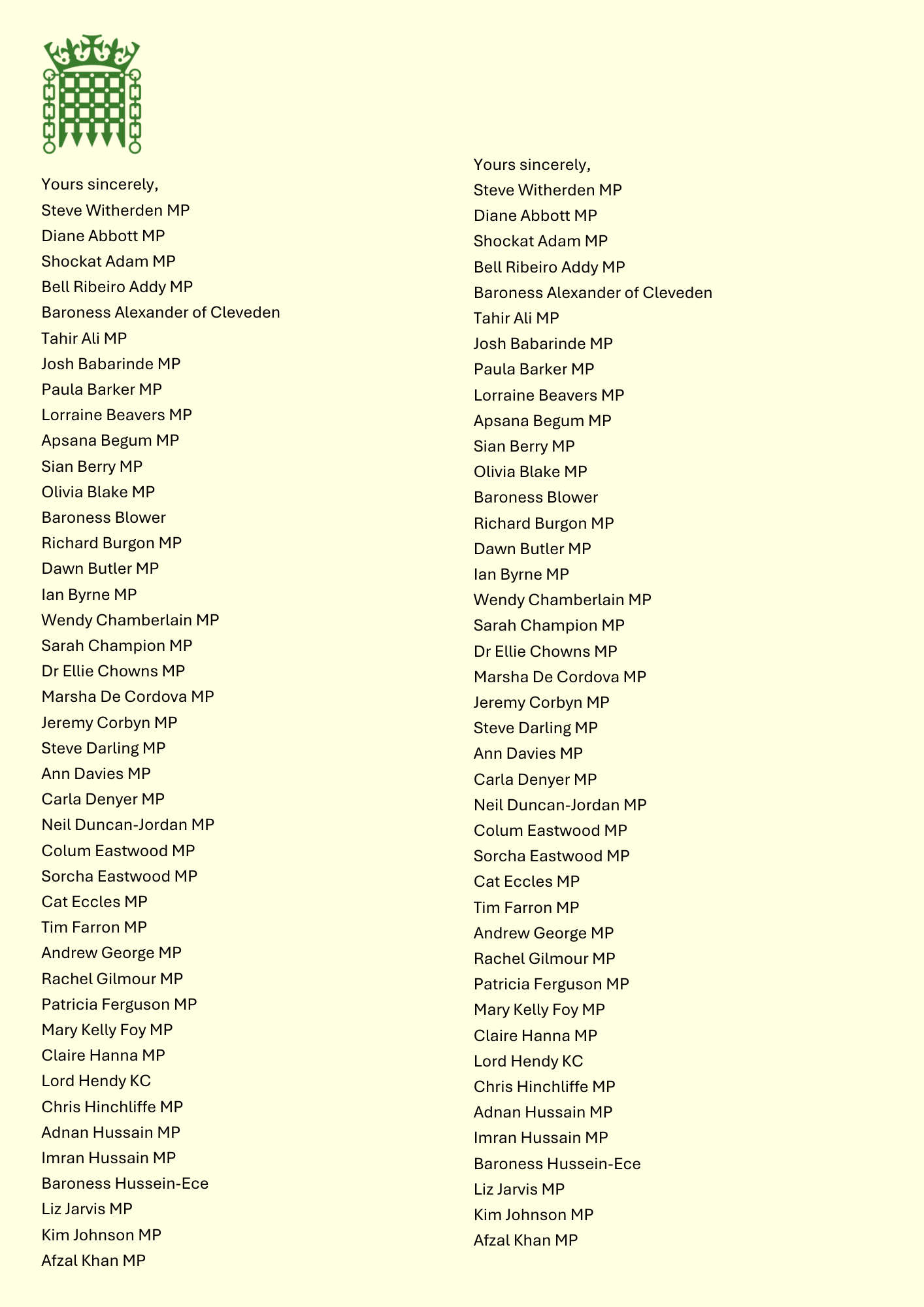
Yours sincerely,
Steve Witherden MP
Diane Abbott MP
Shockat Adam MP
Bell Ribeiro Addy MP
Baroness Alexander of Cleveden
Tahir Ali MP
Josh Babarinde MP
Paula Barker MP
Lorraine Beavers MP
Apsana Begum MP
Sian Berry MP
Olivia Blake MP
Baroness Blower
Richard Burgon MP
Dawn Butler MP
Ian Byrne MP
Wendy Chamberlain MP
Sarah Champion MP
Dr Ellie Chowns MP
Marsha De Cordova MP
Jeremy Corbyn MP
Steve Darling MP
Ann Davies MP
Carla Denyer MP
Neil Duncan-Jordan MP
Colum Eastwood MP
Sorcha Eastwood MP
Cat Eccles MP
Tim Farron MP
Andrew George MP
Rachel Gilmour MP
Patricia Ferguson MP
Mary Kelly Foy MP
Claire Hanna MP
Lord Hendy KC
Chris Hinchliffe MP
Adnan Hussain MP
Imran Hussain MP
Baroness Hussein-Ece
Liz Jarvis MP
Kim Johnson MP
Afzal Khan MP
Ayoub Khan MP
Ben Lake MP
Peter Lamb MP
Ian Lavery MP
Chris Law MP
Brian Leishman MP
Clive Lewis MP
Baroness Lister of Burtersett
Seamus Logan MP
Rebecca Long-Bailey MP
Rachael Maskell MP
Andy McDonald MP
John McDonnell MP
Llinos Medi MP
John Milne MP
Abtisam Mohamed MP
Iqbal Mohamed MP
Layla Moran MP
Grahame Morris MP
Lord Oates
Brendan O'Hara MP
Dr Simon Opher MP
Kate Osborne MP
Manuela Perteghella MP
Yasmin Qureshi MP
Adrian Ramsay MP
Martin Rhodes MP
Liz Saville Roberts MP
Roz Savage MP
Baroness Sheehan
Lord Singh of Wimbledon
Vikki Slade MP
Cat Smith MP
Jamie Stone MP
Lord Soames of Fletching
Alex Sobel MP
Jon Trickett MP
Valerie Vaz MP
Nadia Whittome MP
Lord Woodley
Mohammad Yasin MP
Hunger Strikers - request for urgent meeting with David Lammy MP
-
Dear Secretary of State,
We the undersigned MPs, are writing to implore you to meet with Imran Khan & Partners, the lawyers representing the 8 prisoners on hunger strike, immediately.
We note that Imran Khan & Partners wrote to you on the 9th December imploring you to meet with them "before our client’s health deteriorates beyond any possible recovery”. We draw your attention to the section of the letter which details the exceptionally urgent medical status of the prisoners, five of whom have already been hospitalised more than once. In particular the following extremely serious symptoms: pulse above 100 beats per minute, ketone levels above 4 (when they should be 0 in a non-diabetic person), weight loss of more than 10kg, deteriorating vision, shortness of breath, low blood pressure, hypoglycaemia, shallow breath, and signs of memory loss.
We are growing increasingly dismayed at the government’s lack of action to protect the health and well being of British citizens.
If you will not meet with the MPs who are representing the hunger strikers and their loved ones, then we plead with you to urgently meet with their solicitors and act to prevent a catastrophe.
Yours sincerely,
Adrian Ramsay MP co-signed this cross-party letter initiated by Rt Hon Jeremy Corbyn MP.
Proposed Restrictions on the Use of Terms Such as “Burger” and “Sausage” for Plant Based Foods
-
Adrian Ramsay MP co-signed this cross-party letter initiated by the Vegetarian Society.
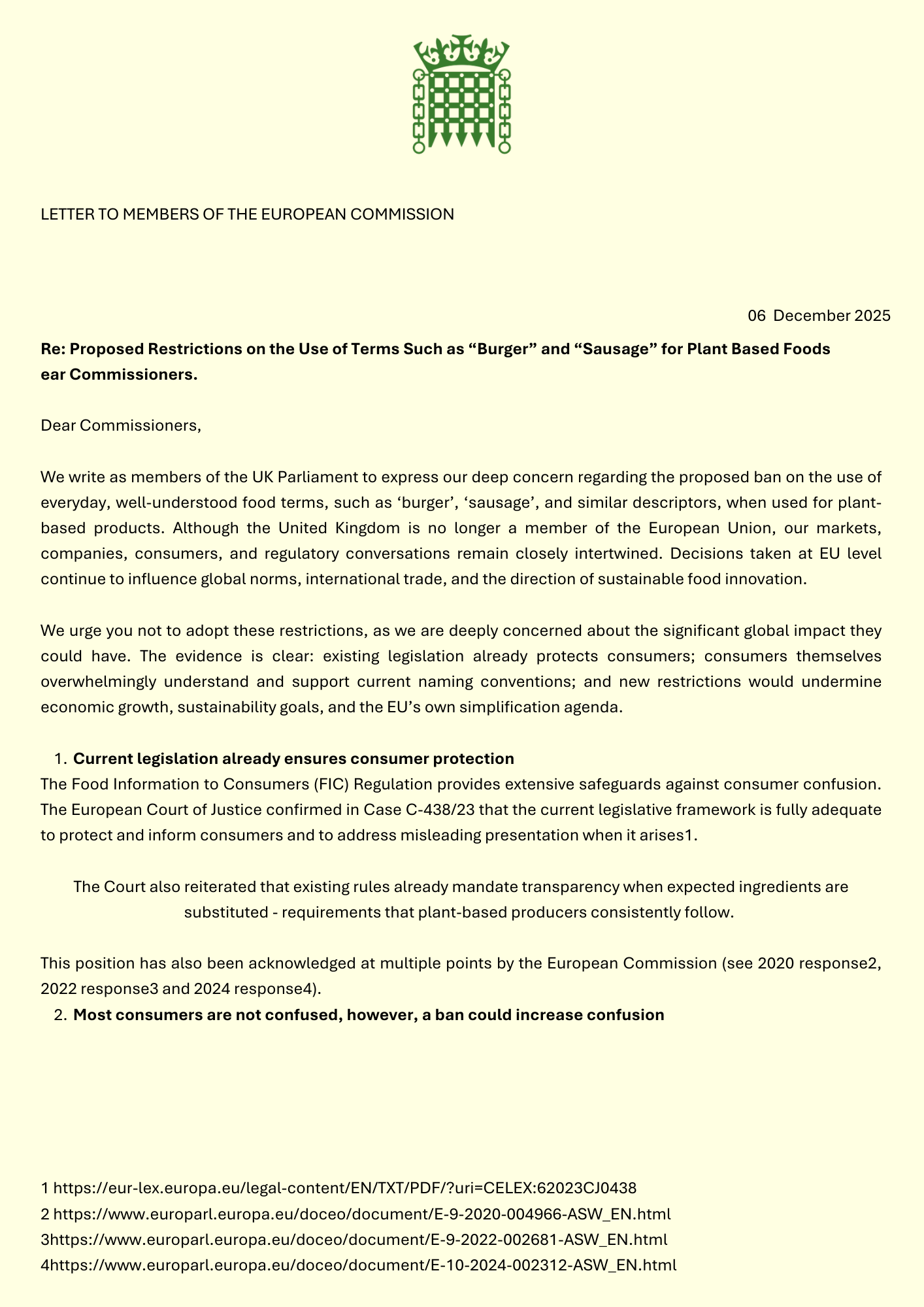
LETTER TO MEMBERS OF THE EUROPEAN COMMISSION
From Members of Parliament of the United Kingdom
Re: Proposed Restrictions on the Use of Terms Such as “Burger” and “Sausage” for Plant Based Foods
06/12/2025
Dear Commissioners,
We write as members of the UK Parliament to express our deep concern regarding the proposed ban on the use of everyday, well-understood food terms, such as ‘burger’, ‘sausage’, and similar descriptors, when used for plant-based products. Although the United Kingdom is no longer a member of the European Union, our markets, companies, consumers, and regulatory conversations remain closely intertwined. Decisions taken at EU level continue to influence global norms, international trade, and the direction of sustainable food innovation.
We urge you not to adopt these restrictions, as we are deeply concerned about the significant global impact they could have. The evidence is clear: existing legislation already protects consumers; consumers themselves overwhelmingly understand and support current naming conventions; and new restrictions would undermine economic growth, sustainability goals, and the EU’s own simplification agenda.
1. Current legislation already ensures consumer protection
The Food Information to Consumers (FIC) Regulation provides extensive safeguards against consumer confusion. The European Court of Justice confirmed in Case C-438/23 that the current legislative framework is fully adequate to protect and inform consumers and to address misleading presentation when it arises1.
The Court also reiterated that existing rules already mandate transparency when expected ingredients are substituted - requirements that plant-based producers consistently follow.
This position has also been acknowledged at multiple points by the European Commission (see 2020 response2, 2022 response3 and 2024 response4).
2. Most consumers are not confused, however, a ban could increase confusion
1 https://eur-lex.europa.eu/legal-content/EN/TXT/PDF/?uri=CELEX:62023CJ0438
2 https://www.europarl.europa.eu/doceo/document/E-9-2020-004966-ASW_EN.html 3 https://www.europarl.europa.eu/doceo/document/E-9-2022-002681-ASW_EN.html 4 https://www.europarl.europa.eu/doceo/document/E-10-2024-002312-ASW_EN.html
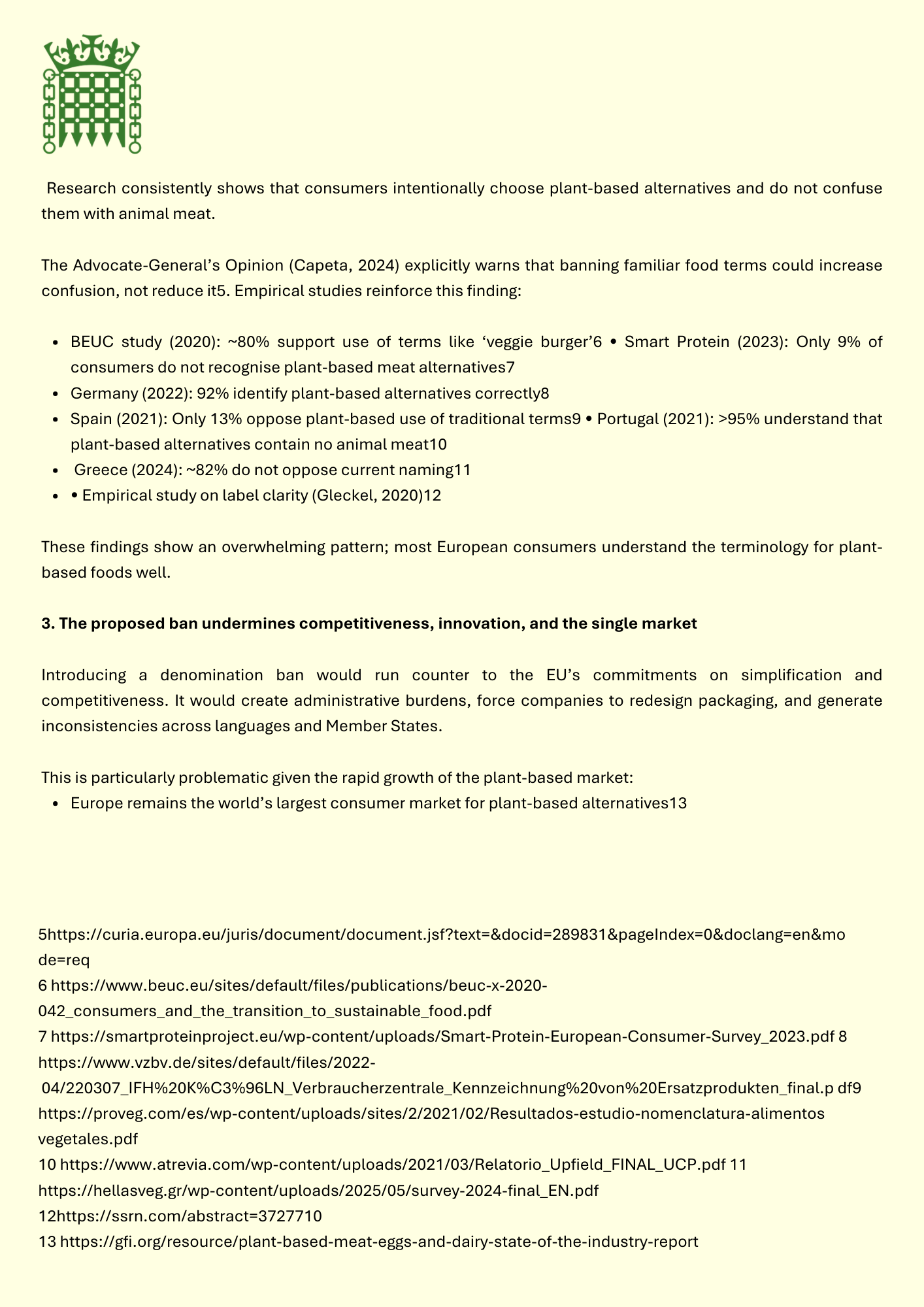
Research consistently shows that consumers intentionally choose plant-based alternatives and do not confuse them with animal meat.
The Advocate-General’s Opinion (Capeta, 2024) explicitly warns that banning familiar food terms could increase confusion, not reduce it5. Empirical studies reinforce this finding:
• BEUC study (2020): ~80% support use of terms like ‘veggie burger’6 • Smart Protein (2023): Only 9% of consumers do not recognise plant-based meat alternatives7
• Germany (2022): 92% identify plant-based alternatives correctly8
• Spain (2021): Only 13% oppose plant-based use of traditional terms9 • Portugal (2021): >95% understand that plant-based alternatives contain no animal meat10
• Greece (2024): ~82% do not oppose current naming11
• Empirical study on label clarity (Gleckel, 2020)12
These findings show an overwhelming pattern; most European consumers understand the terminology for plant-based foods well.
3. The proposed ban undermines competitiveness, innovation, and the single market
Introducing a denomination ban would run counter to the EU’s commitments on simplification and competitiveness. It would create administrative burdens, force companies to redesign packaging, and generate inconsistencies across languages and Member States.
This is particularly problematic given the rapid growth of the plant-based market: • Europe remains the world’s largest consumer market for plant-based alternatives13
5
https://curia.europa.eu/juris/document/document.jsf?text=&docid=289831&pageIndex=0&doclang=en&mo de=req
6 https://www.beuc.eu/sites/default/files/publications/beuc-x-2020-
042_consumers_and_the_transition_to_sustainable_food.pdf
7 https://smartproteinproject.eu/wp-content/uploads/Smart-Protein-European-Consumer-Survey_2023.pdf 8 https://www.vzbv.de/sites/default/files/2022-
04/220307_IFH%20K%C3%96LN_Verbraucherzentrale_Kennzeichnung%20von%20Ersatzprodukten_final.p df9 https://proveg.com/es/wp-content/uploads/sites/2/2021/02/Resultados-estudio-nomenclatura-alimentos vegetales.pdf
10 https://www.atrevia.com/wp-content/uploads/2021/03/Relatorio_Upfield_FINAL_UCP.pdf 11 https://hellasveg.gr/wp-content/uploads/2025/05/survey-2024-final_EN.pdf
12https://ssrn.com/abstract=3727710
13 https://gfi.org/resource/plant-based-meat-eggs-and-dairy-state-of-the-industry-report
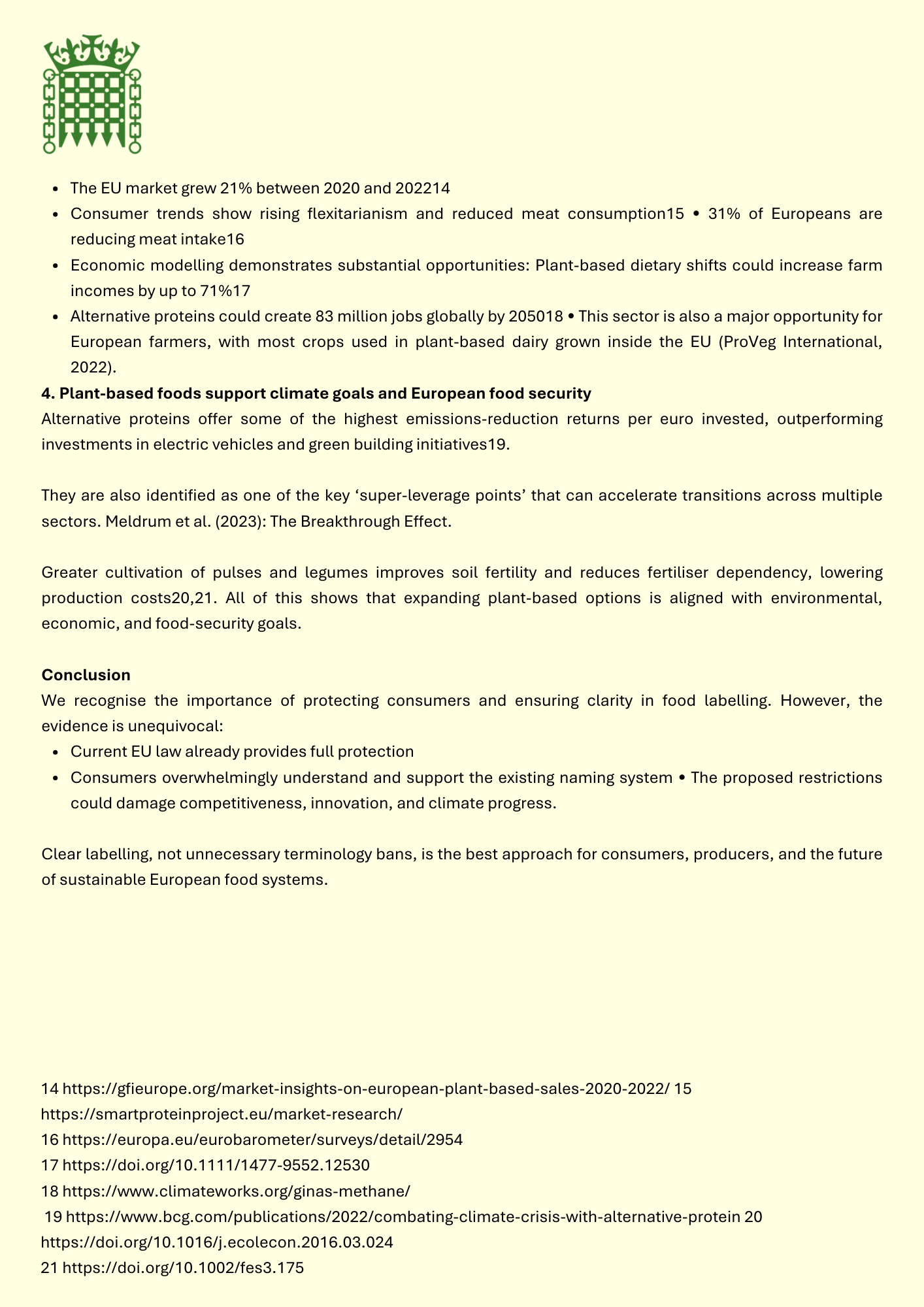
• The EU market grew 21% between 2020 and 202214
• Consumer trends show rising flexitarianism and reduced meat consumption15 • 31% of Europeans are reducing meat intake16
• Economic modelling demonstrates substantial opportunities: Plant-based dietary shifts could increase farm incomes by up to 71%17
• Alternative proteins could create 83 million jobs globally by 205018 • This sector is also a major opportunity for European farmers, with most crops used in plant-based dairy grown inside the EU (ProVeg International, 2022).
4. Plant-based foods support climate goals and European food security
Alternative proteins offer some of the highest emissions-reduction returns per euro invested, outperforming investments in electric vehicles and green building initiatives19.
They are also identified as one of the key ‘super-leverage points’ that can accelerate transitions across multiple sectors. Meldrum et al. (2023): The Breakthrough Effect.
Greater cultivation of pulses and legumes improves soil fertility and reduces fertiliser dependency, lowering production costs20,21. All of this shows that expanding plant-based options is aligned with environmental, economic, and food-security goals.
Conclusion
We recognise the importance of protecting consumers and ensuring clarity in food labelling. However, the evidence is unequivocal:
• Current EU law already provides full protection
• Consumers overwhelmingly understand and support the existing naming system • The proposed restrictions could damage competitiveness, innovation, and climate progress.
Clear labelling, not unnecessary terminology bans, is the best approach for consumers, producers, and the future of sustainable European food systems.
14 https://gfieurope.org/market-insights-on-european-plant-based-sales-2020-2022/ 15 https://smartproteinproject.eu/market-research/
16 https://europa.eu/eurobarometer/surveys/detail/2954
17 https://doi.org/10.1111/1477-9552.12530
18 https://www.climateworks.org/ginas-methane/
19 https://www.bcg.com/publications/2022/combating-climate-crisis-with-alternative-protein 20 https://doi.org/10.1016/j.ecolecon.2016.03.024
21 https://doi.org/10.1002/fes3.175
We therefore urge the Commission to reject these restrictions and maintain the current, proportionate, effective regulatory framework, which we firmly believe sets the global standard for best practice.
Yours sincerely,
Members of Parliament of the United Kingdom
Siân Berry MP
Irene Campbell MP
Jeremy Corbyn MP
Carla Denyer MP
Kerry McCarthy MP
Navendu Mishra MP
Adrian Ramsay MP
Alex Sobel MP
Also supported by:
The McCartney Family
Giving staff time to travel sustainably is smart business - letter for the Financial Times
-
Adrian Ramsay MP co-signed this cross-party letter initiated by We Are Possible.Giving staff time to travel sustainably is smart business
Many employees would choose low-carbon travel for their holidays if they did not have to forfeit precious time off work. Sustainable Travel Leave, pioneered by the charity Possible, offers a simple fix: grant a small amount of extra paid leave when staff choose trains, coaches or ferries instead of flying.
The principle is straightforward. A London–Berlin rail journey cuts emissions by roughly 92% but takes seven hours longer than flying. Under the Sustainable Travel Leave policy, employers cover that additional time with a modest leave allowance.
Possible has already supported almost 200 employers to adopt the policy, and it is now spreading internationally as standard practice. Employees can make lower-carbon choices; employers face minimal disruption.
Six years’ worth of data shows that the extra amount of leave taken averages just three minutes per employee per month. Yet participating organisations report measurable gains: 74% say it increases staff motivation and wellbeing, 67% say it has aided recruitment efforts, and 81% say it helps embed sustainability across their operations.
We are calling on the Cabinet Office to offer Sustainable Travel Leave within the Civil Service. It is an ultra low-cost way to align workplace practice with the Government’s net-zero strategy while improving the public-sector employee offer. It also signals credible leadership at a time when voters expect consistency between climate ambition and day-to-day decisions. Crucially, it requires no new regulation, no subsidy and no complex administration.
The UK has repeatedly shown that people embrace climate-positive measures when they are practical and fair. Allowing employees modest time to travel responsibly is exactly that: commercially sensible, reputationally valuable and operationally light. It should become a standard part of the modern employment offer, in Whitehall and beyond.
Cross-party Parliamentarians urge Government to end cruelty of cages and crates in UK farming ahead of forthcoming Animal Welfare Strategy.
-
Adrian Ramsay MP initiated this cross-party letter with Irene Campbell MP.
3rd December 2025
The Rt Hon Emma Reynolds
Secretary of State for Environment, Food and Rural Affairs.
Dear Secretary of State,
We are writing as cross-party Parliamentarians to request that the forthcoming Animal Welfare Strategy includes a time-bound phase-out of all confinement cages and crates in farming, alongside a properly funded package of support for farmers to transition away from this practice.
Every year, millions of farmed animals in the UK endure severe and prolonged suffering confined to crates and cages. Around 8 million laying hens are kept in cages no larger than an A4 sheet of paper, unable to forage, feel sunlight, or fully stretch their wings. In addition, around 200,000 mother pigs spend nearly a quarter of their adult lives in farrowing crates, unable to turn around for weeks at a time and forced to nurse their piglets through metal bars.
The UK claims to have some of the highest farmed animal welfare standards. But despite progress in moving towards cage-free systems, millions of animals are still suffering daily, leaving us behind a number of European countries. Cagesfor hens are either banned or being phased-out in Austria, Germany, Czech Republic, France, Slovenia and Slovakia. Farrowing crates for sows are banned in Sweden, Switzerland and Norway.
In the UK there is clear and growing public, professional and industry-level support for ending this cruel and unnecessary practice. Research from Humane World for Animals shows that over two-thirds of the public oppose the use of farrowing crates. The British Veterinary Association reports that 75% of vets are concerned about the welfare impacts of these crates. And many farmers are ready and willing to transition away from this practice, given appropriate support to do so.
This Government was elected on a mandate to deliver the most ambitious animal welfare improvements in a generation. To deliver on this promise, we call on you to ensure the forthcoming Animal Welfare Strategy includes:
A time-bound phase-out of farrowing crates for sows, individual calf pens, and all cages used for birds, including hens, partridges, pheasants and quail.
A comprehensive, funded package of support to help farmers transition to higher-welfare systems.
Adequate resourcing for enforcement bodies and enhanced enforcement powers.
Measures to ensure Parliament can properly track and scrutinise progress on the phase-out, and the Strategy more broadly.
We should be grateful for your response to this letter.
Yours sincerely,
Adrian Ramsay MP
Irene Campbell MP
Fleur Anderson MP
Baroness Bennett of Manor Castle
Siân Berry MP
Bob Blackman MP
Olivia Blake MP
Richard Burgon MP
Ellie Chowns MP
Jeremy Corbyn MP
Carla Denyer MP
Dame Caroline Dinenage MP
Neil Duncan-Jordan MP
Sorcha Eastwood MP
Sarah Edwards MP
Andrew George MP
Lord Goldsmith of Richmond Park
Andrew Gwynne MP
Wera Hobhouse MP
Terry Jermy MP
Baroness Jones of Moulsecoomb
Clive Lewis MP
Kerry McCarthy MP
John McDonnell MP
Helen Maguire MP
Rachael Maskell MP
Manuela Perteghella MP
Peter Prinsley MP
Baroness Redfern
Bell Ribeiro-Addy MP
Jenny Riddell-Carpenter MP
Andrew Rosindell MP
Vikki Slade MP
Alex Sobel MP
Ian Sollom MP
Steve Witherden MP
A Letter on the Urgent Need for Targeted Prostate Cancer Screening
-
Adrian Ramsay MP co-signed this cross-party letter initiated by Prostate Cancer Research
Dear Secretary of State,
We write united by a belief that no man should die because of his postcode, ethnicity, or GP access.
Prostate cancer is now the most common cancer in UK men, with over 63,000 diagnoses and 12,000 deaths annually.i Today, the UK National Screening Committee (UK NSC) meets to decide on prostate cancer screening. This is a defining moment for men’s health. The Government must be ready to act so that those at highest risk – men aged 45–69 who are Black, have a family history of prostate, breast or ovarian cancer, or carry BRCA1/BRCA2 variants, all of whom face at least twice the average risk of developing prostate cancer – are no longer left behind.ii
1) A growing inequity
The latest National Prostate Cancer Audit (2025) shows inequalities are deepening. Men in deprived areas are more likely to present with advanced disease and more likely to die.iii Our current opportunistic PSA testing system is unstructured, inefficient and unfair – a postcode lottery where some men succeed because they know to ask or can pay privately, while others are turned away despite repeated requests.
Yet the data hide what cannot be modelled: eroded trust among communities who feel abandoned. Black men, already at higher risk, often believe the system fails them. Families bear devastating emotional and financial burdens from late-stage disease – costs absent from formal modelling but among the most compelling reasons to act.
2) The evidence is now clear
The evidence shows screening saves lives. The 23-year follow-up of the European Randomised Study of Screening for Prostate Cancer demonstrated a 13% mortality reduction – comparable to breast and bowel screening, with the numbers needed to screen and treat to prevent a death in line with those for existing programmes.v
Modern diagnostic pathways have transformed safety. Prostate Cancer UK’s 2024 analysis found harms reduced by 79% thanks to MRI and improved biopsy techniques.vi The Göteborg-2 trial confirmed pre-biopsy MRI halves overdiagnosis.vii
Today, the pathway is entirely different to when the UK NSC last evaluated screening: men have an MRI before any biopsy is considered; biopsies are carried out using safer transperineal methods; and low-grade cancers are far less likely to be detected – and, when they are, they are managed with active surveillance rather than treatment. Harms that once justified inaction have largely been engineered out.
These advances mean we now have the tools to deliver screening safely and effectively, yet the system is frozen waiting for next-generation trial data. Comments in The Times (3 October) suggest results from the upcoming TRANSFORM trial may take over a decade.viii Waiting would entrench inequality and allow preventable deaths. Evidence is strong enough to act now.Perfection must not be the enemy of progress.
3) Practical, affordable and efficient
Targeted screening is practical and affordable. Prostate Cancer Research’s 2025 report, Prostate Cancer Screening: The Impact on the NHS, with modelling by Carnall Farrar, shows additional annual costs would be around £25m – just 0.01% of the NHS budget – with modest workforce uplift and costs per screen comparable to existing programmes.ix Recent data also show a simplified MRI, taking 10 minutes, is as effective as current scans, opening the path to increased capacity within existing resources.x
The socio-economic benefits are substantial. Deloitte UK modelling found a five-year targeted programme would deliver a net benefit of £54m through earlier diagnosis, reduced treatment costs, and quality-of-life gains.xi Late-stage treatment averages £127,000 per patient vs. £13,000 for early-stage.xii Every delay costs lives and money.
Public support is overwhelmingly behind action: a nationally representative Healthwatch England poll of 3,575 men found 79% would attend screening if invited.xiii Tens of thousands have called on Parliament to act. We have a duty to listen, and to act.
4) Learning from the world
The UK can lead but risks falling behind. Sweden’s Organised Prostate Testing (OPT) programme shows that structured, equitable testing is achievable even without a formal programme, laying the groundwork for a future national rollout.xiv Across Europe, the EU is implementing its prostate cancer screening recommendation, and Australia is preparing to endorse risk-adapted testing for high-risk men.xv xvi
Introducing targeted screening would be a legacy-defining advance for men’s health, aligned with the ambitions of the Men’s Health Strategy and the National Cancer Plan.
Yours sincerely,
Adrian Ramsay MP co-signed this cross-party letter initiated by Prostate Cancer Research.
i prostatecanceruk.org/for-health-professionals/data-and-evidence
ii James ND, Tannock I, N'Dow J et al. The Lancet Commission on prostate cancer: planning for the surge in cases. Lancet.
2024 Apr 27;403(10437):1683-1722. doi: 10.1016/S0140-6736(24)00651-2. Epub 2024 Apr 4. Erratum in: Lancet. 2024 Apr
27;403(10437):1634. doi: 10.1016/S0140-6736(24)00748-7
iii National Prostate Cancer Audit (NPCA) State of the Nation Report 2025. London: National Cancer Audit Collaborating
Centre, Royal College of Surgeons of England, 2025. natcan.org.uk/reports/npca-state-of-the-nation-report-2025/
iv Roobol MJ, de Vos II, Månsson M, et al. European Study of Prostate Cancer Screening - 23-Year Follow-up. N Engl J Med.
2025 Oct 30;393(17):1669-1680. doi: 10.1056/NEJMoa2503223
v Vickers A. Early Detection of Prostate Cancer - Time to Fish or Cut Bait. N Engl J Med. 2025 Oct 30;393(17):1742-1743. doi:
10.1056/NEJMe2509793
vi Norori N, Burns-Cox L, Blaney N et al. Using real world data to bridge the evidence gap left by prostate cancer screening
trials, ESMO Real World Data and Digital Oncology, Volume 6, 2024, 100073, ISSN 2949-8201, doi:
10.1016/j.esmorw.2024.100073
vii Hugosson J, Månsson M, Wallström J et al. Prostate Cancer Screening with PSA and MRI Followed by Targeted Biopsy Only.
N Engl J Med. 2022 Dec 8;387(23):2126-2137. doi: 10.1056/NEJMoa2209454
ix Prostate Cancer Research. Prostate Cancer Screening: Impact on the NHS; 2025
x Ng ABCD, Asif A, Agarwal R et al. Biparametric vs Multiparametric MRI for Prostate Cancer Diagnosis: The PRIME Diagnostic
Clinical Trial. JAMA. 2025 Oct 7;334(13):1170-1179. doi: 10.1001/jama.2025.13722
xi Prostate Cancer Research. Socio-Economic Impact of Prostate Cancer Screening; 2024
xii Prostate Cancer Research, ibid
xiii healthwatch.co.uk/blog/2025-10-08/men-would-come-forward-prostate-cancer-screening
xiv Bratt O, Godtman RA, Jiborn T et al. Population-based Organised Prostate Cancer Testing: Results from the First Invitation
of 50-year-old Men. Eur Urol. 2024 Mar;85(3):207-214. doi: 10.1016/j.eururo.2023.11.013
xv EU Council Recommendation 2022/2381 and Beating Cancer Plan updates (2024). consilium.europa.eu/en/press/press-
releases/2022/12/09/council-updates-its-recommendation-to-screen-for-cancer/
xvi Prostate Cancer Foundation of Australia, Public Consultation: Draft 2025 Clinical Guidelines for the Early Detection of
Prostate Cancer. pcfa.org.au/public-consultation/
Letter to Chancellor on Tax-Free Childcare Cap
-
Adrian Ramsay MP co-signed this cross-party letter initiated by Claire Hanna MP.
Rt Hon Rachel Reeves MP
Chancellor of the Exchequer
HM Treasury
1 Horse Guards Road
Westminster
London
SW1A 2HQ
25 November 2025
Dear Chancellor,
We are writing to you as Members of Parliament and stakeholders from across England, Northern Ireland,
Scotland and Wales, alongside Pregnant Then Screwed, the leading charity working to end the motherhood
penalty, to request urgent action to support families who are struggling with the rising cost of childcare.
As per previous correspondence earlier this year, we are calling for the cap on Tax-Free Childcare, fixed at
£2,000 per child per year since the scheme was introduced in 2017, to be uprated in line with inflation.
Since 2017, prices have risen by approximately 34%, yet the cap has never been adjusted. As a result, the
real value of the support available to families has been significantly eroded.
During this period, childcare costs across the UK have increased sharply, placing growing pressure on
households already struggling to make ends meet. Updating the Tax-Free Childcare cap to reflect inflation
would be a simple, fair and effective way to ease the financial burden on families.
It is also important to note that many other benefits and forms of support, including tax credits and
pensions are uprated each year. We therefore believe it is both reasonable and consistent that the same
principle should be applied to the Tax-Free Childcare cap.
The forthcoming Budget provides an opportunity to address this. Increasing the cap would offer vital
support to parents and would strengthen the economy by enabling more parents to enter, remain in or
return to the workforce.
We look forward to your response.
Introduction of a Medal for British Soldiers Injured in Combat
-
Adrian Ramsay MP co-signed this cross-party letter initiated by Davin Baines MP.
Re: Introduction of a Medal for British Soldiers Injured in Combat
Dear Minister,
I am writing to urge the Government to support the campaign of my constituent Corporal Andy Reid MBE to establish an official medal to recognise British service personnel who have been wounded or injured while serving on active duty.
In October 2009, Corporal Andy Reid MBE stepped on a Taliban improvised explosive device while on patrol in Helmand Province, Afghanistan. Injured so badly that it was thought he would not survive, he defied the odds to the extent that, within a month, he was able to meet up with members of his patrol again. Since then, as a triple amputee, he has gone on to carry out many arduous challenges to raise money for charity and give back to the associations that helped him and his family through difficult times.
Through his Standing Tall Foundation, Andy continues to provide invaluable support to injured service personnel and their families, demonstrating remarkable dedication to those who have served and also to the wider community.
Currently, UK service personnel who are wounded in active service receive no formal medal or honour to reflect the profound physical and mental sacrifices they have made in defence of our country. While the Elizabeth Cross appropriately recognises the families of those who have made the ultimate sacrifice, there is no equivalent recognition for those who bear the wounds of their service. This stands in stark contrast to our international allies: the United States awards the Purple Heart, and India presents the Wound Medal or Parakram Padak to those injured in conflict.
Andy understands intimately the sacrifices made by our armed forces and is leading the charge for this vital recognition. As Andy eloquently states: "For many injured soldiers that bit of recognition in the form of a medal for
the mental and physical sacrifices they have made would give them that real boost they might need – a thank you from the nation that might just pull them out of that dark place and move forward with their lives towards a better future."
This medal would provide something instantly recognisable to the general population – a visible acknowledgement that this individual has paid a sacrifice for their safety and the safety of the nation.
My colleagues and I look forward to your response and to working with you on this important matter.
Adrian Ramsay MP co-signed this cross-party letter initiated by Davin Baines MP.
Use the Autumn Budget to lower electricity prices
-
Adrian Ramsay MP co-signed this cross-party letter initiated by the MCS Foundation.
Dear Chancellor,
Subject: Use the Autumn Budget to lower electricity prices
The cost of living crisis is still hitting millions of households across Britain. Prices remain high, and the latest rise in the Energy Price Cap will only make things worse. The public wants to see action to reduce energy bills, which now ranks as the most worrying household expense amongst the population.
Britain has some of the highest electricity costs in Europe. A significant factor in keeping prices high is the social and environmental levies placed directly on households’ electricity bills. These levies make up 18% of a typical household’s electricity bill and disproportionately affect the most vulnerable. Households reliant on direct electric heating, such as electric radiators and fan heaters, are more likely to be in fuel poverty – yet they pay a far higher proportion of their income funding social and environmental levies.
Research from The MCS Foundation shows that moving these levies off electricity prices could save households, including those on direct electric heating and those with heat pumps, up to £300 on their bills.
Reducing the cost of electricity has the dual benefit of tackling fuel poverty while providing a significant financial incentive for households to electrify - a necessity for tackling climate change and meeting our net-zero obligations.
Social and environmental levies were introduced to raise revenue to support those in fuel poverty and boost renewable energy. While these areas are still in critical need of funding, retaining levies on electricity is now running directly counter to these initial aims, by disincentivising the switch away from fossil fuel heating.
While we appreciate that there are political and economic challenges that must be overcome, we believe now is the time for bold action. We urge you to use the Autumn Budget to reduce bills and incentivise electrification. There’s no time to waste.
Yours sincerely,
Adrian Ramsay MP co-signed this cross-party letter initiated by the MCS Foundation.
Letter to the Prime Minister Ahead of COP30
-
Adrian Ramsay MP co-signed this letter along with Sian Berry MP, Carla Denyer MP and Dr Ellie Chowns MP.
Rt Hon Sir Keir Starmer MP
Prime Minister
10 Downing Street
London
SW1A 2AA
31 October 2025
Dear Prime Minister,
We are writing ahead of COP30 to urge that you use the UK’s influence to ensure an ambitious outcome consistent with avoiding the most catastrophic climate impacts. This year’s COP summit is taking place at a pivotal moment in history - just past the mid-point in what’s a critical decade for climate and nature action.
The state of nature, biodiversity and ecosystems are deteriorating more rapidly than ever, and global temperatures continue to climb at a terrifyingly dangerous rate. The combined effect is devastating for the life support systems on which we all depend, and therefore also for our security, for our economic, social and political stability, and for everything from our food supplies to our health and wellbeing.
The UN Secretary General has called the fossil fuel companies the godfathers of climate chaos and the IPCC warn that emissions from fossil fuels are the dominant cause of global warming. Yet COP30 is taking place against a backdrop of continued financial support from governments for the fossil fuel industry – including an estimated £17.5 billion every year here in the UK.
At the same time, the poorest peoples of the world, with the least historic responsibility for climate emissions, continue to bear the brunt of climate breakdown. It is vital that the decisions made at COP30 do not further perpetuate climate injustice.
And with this year marking the start of a new round of Nationally Determined Contributions, COP30 is critical to closing the 1.5°C delivery gap and other gaps – as the UN Secretary General said in his remarks of 27th October 2025:
We need Nationally Determined Contributions that cut emissions much more deeply and accelerate the transition from fossil fuels to renewables. At COP30 in Brazil, we must go further and faster to close the ambition gap. We need more ambition in adaptation, mitigation and climate financial justice.
We warmly welcome your attendance at COP30 and hope your leadership will include advocating for:
A Climate Damages Tax – a “polluters pay” tax on the extraction of fossil fuels in the world’s richest advanced economies.
The Fossil Fuel Non-Proliferation Treaty – a framework to manage the global transition to safe, renewable & affordable energy for all.
Climate Justice – a climate finance package made up primarily of public funded grants funds, accompanied by debt cancellation measures, and that enables countries in the Global South to reduce their emissions, adapt to the impacts of climate change and meet the costs associated with loss and damage.
A global Just Transition - negotiators must stop blocking progress towards a Belém Action Mechanism (BAM).
An action plan to end forest destruction by 2030 - voluntary initiatives have failed to halt and reverse deforestation or to stop forest degradation, and substantive, structural change is needed to ensure existing forest commitments are met in an efficient, just and equitable way.
The UK’s global leadership should also be matched with ambitious domestic action as evidence of leading by example.
So we also call on you to back national measures that are aligned with the priorities of a successful COP30, and signal to the rest of the world that the UK is prepared to do its fair share in closing the gap between what the climate science demands and current emissions projections. Specifically, we urge you to:
End handouts to fossil fuel companies - use the forthcoming Budget to stop tax reliefs, investment allowances and subsidies, and to close loopholes in the ban on UK overseas finance supporting fossil fuels.
Play fair on climate finance – this must not come at the expense of overseas development aid, must be new government money, must not increase debt burdens, and must reflect the UK’s historic responsibilities.
Back the Energy Jobs Bill - to invest in British jobs and a just transition for workers in the oil and gas sector.
Deliver climate justice at home – with policies that ensure the poorest in our communities do not bear the financial brunt of climate action.
Keep your promise on no new oil and gas – by rejecting Rosebank, Jackdaw, other new extraction proposals and all new use of tie-backs – and go even further by refusing development consent for oil and gas projects that have already been licensed.
Step up on climate adaptation – with a national climate resilience plan and a sixth Government mission on adaptation that reflects the CCC’s advice of 15th October 2025.
Whilst we recognise that the UK and the world are making significant strides towards a carbon free economy, this is still accompanied by plans to produce more than double the quantity of fossil fuels in 2030 than would be consistent with holding global temperature rises to 1.5C above preindustrial levels.
This collective failure is driving climate breakdown.
COP 30 is an opportunity to change course – to choose transformative action that tackles injustice and inequality alongside greenhouse gas emissions.
We trust you will recognise this decisive moment by ramping up your ambition still further, in order to help secure a liveable future for all.
Yours sincerely,
Adrian Ramsay MP co-signed this letter along with Sian Berry MP, Carla Denyer MP and Dr Ellie Chowns MP.
Gentoo penguins at Sea Life London
-
Adrian Ramsay MP co-signed this cross-party letter initiated by David Taylor MP.
Dear Secretary of State,
Re: Urgent review of the welfare of Gentoo penguins at SEA LIFE London Aquarium
We, the undersigned Members of Parliament, are writing to express our deep concern regarding the welfare of fifteen Gentoo penguins currently kept at the SEA LIFE London Aquarium, a short walk from Parliament. In light of the growing public concern, we respectfully request that DEFRA conduct an independent review into whether the current conditions meet the highest standards of animal welfare and, if necessary, intervene to secure a more appropriate environment for these animals.
Recent reports have highlighted that the penguins are housed in a windowless basement enclosure, with no access to natural light or fresh air, and that the pool depth is around six to seven feet, which is far shallower than the environments Gentoo penguins experience in the wild. Concerns have been raised by respected conservationists, including Chris Packham and Megan McCubbin, who argue that such an environment cannot adequately support the species’ natural behaviours.
As Members of Parliament from across the political spectrum, we share a collective commitment to animal welfare. All political parties in this great nation value the protection of animals as a reflection of our shared compassion and sense of moral duty. The United Kingdom has a proud record in this area, from the Hunting Act 2004, which banned the hunting of wild mammals with dogs, to the ongoing work to strengthen welfare protections for both domestic and wild animals. The 2024 General Election manifesto commitments to phase out animal testing, ban the use of snares, end the import of hunting trophies, and strengthen protections for wildlife reflect the continued importance placed on these issues across Parliament.
In that spirit, we respectfully ask that DEFRA:
Commission an independent welfare assessment of the Gentoo penguin enclosure at SEA LIFE London, involving external veterinary and zoological specialists. Evaluate the facility’s compliance with both the Standards of Modern Zoo Practice and the Animal Welfare Act 2006, as well the likelihood of compliance with the revised zoo Standards entering into force in May 2027, with particular focus on light, air quality, pool depth, and enrichment.
Consider whether the penguins should be relocated to a more suitable facility better aligned with their behavioural, ecological and physiological needs. Publish the findings of this review to ensure transparency and maintain public confidence in welfare standards.
We wish to make clear that this is not an adversarial request but a constructive one, recognising the Government’s strong record on animal welfare and DEFRA’s expertise in safeguarding species under human care. This is an opportunity to demonstrate that the United Kingdom continues to lead the world in setting and upholding exemplary welfare standards.
We would be grateful for your response outlining the Department’s intended course of action and the anticipated timeframe for review.
Kind Regards,
Adrian Ramsay MP co-signed this cross-party letter initiated by David Taylor MP.