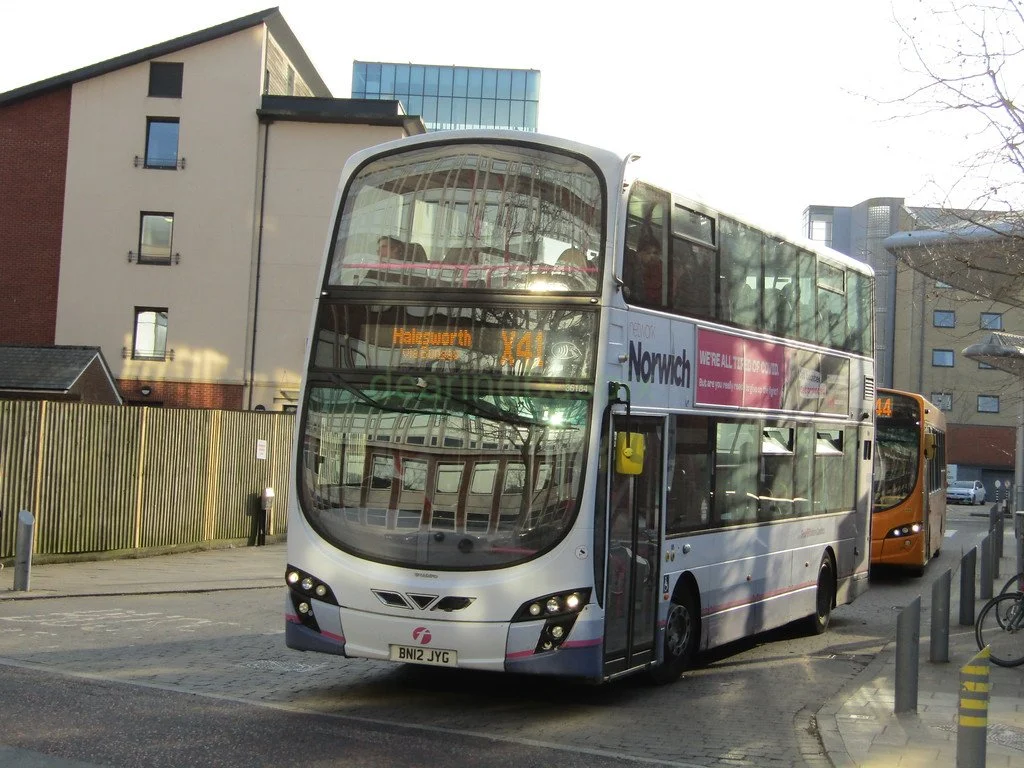
Adrian Ramsay MP demands Reform restore funding for rural buses as X41 service is cut back
Adrian Ramsay, Green Party MP for Waveney Valley, is calling on Reform to provide the funding needed to keep rural bus services running, after it was annouced that the X41 will have a reduced service between Halesworth, Bungay and Norwich.
The X41 now runs only once an hour, and journeys are taking longer. Adrian and Peter Ianno, the Green County Councillor for Bungay, say the change is having a huge impact on people in Bungay, Halesworth and the surrounding area, with residents contacting both of them in large numbers to complain.
Adrian has requested a meeting with the Reform cabinet member to discuss the X41's timetable and funding.
Adrian Ramsay MP said:
"Rural buses are a lifeline. They get people to work, to appointments and to see family, and for many they are the only way to do it. Reform are refusing to provide the funding needed to keep the X41 going, and people in Bungay, Halesworth and the surrounding area are paying the price.
"Cutting rural buses cuts people off from jobs, healthcare and each other. I will keep pressing Reform to provide the funding our crucial local bus services need, and I will keep standing up for residents until this service is protected."
ENDS

Adrian Ramsay MP to hold village tour across Waveney Valley with 13 public meetings, 13 drop-ins, 5 evening meetings and coffee mornings.
Adrian Ramsay MP for Waveney Valley will be holding a village tour across the constituency between September and October, visiting over 30 locations across market towns and villages.
Adrian Ramsay MP said:
"Over the next few weeks, I'll be visiting village halls and pubs across market towns and villages to talk to you about the issues most important to you."
"When I was elected, I promised to be Waveney Valley's voice in Westminster, not Westminster's voice in Waveney Valley. Throughout the year I am out and about in all corners of my big rural constituency, but recess gives me a chance to meet more people, talk about my work representing you in Parliament, and listen to your views. A core part of that is being as accessible as possible to the people I represent."
ENDS
The village tour includes visits to:
Public meetings: Bressingham, Palgrave, Wetheringsett, Bacton, Fressingfield, Hoxne, Worlingworth, Wenhaston, Haughley, Stradbroke, Ditchingham, Earsham, Gislingham
Drop-ins: Tibenham, Brockdish, Pulham St Mary, Stoke Ash, Stowmarket, Mendham, Woodbridge, Westhall, Ringsfield, Ilketshall St Andrew, Kirby Row, Rickinghall, Walsham le Willows
Evening public meetings: Stowupland, Halesworth, Bungay, Eye, Diss
Coffee mornings: Bunwell
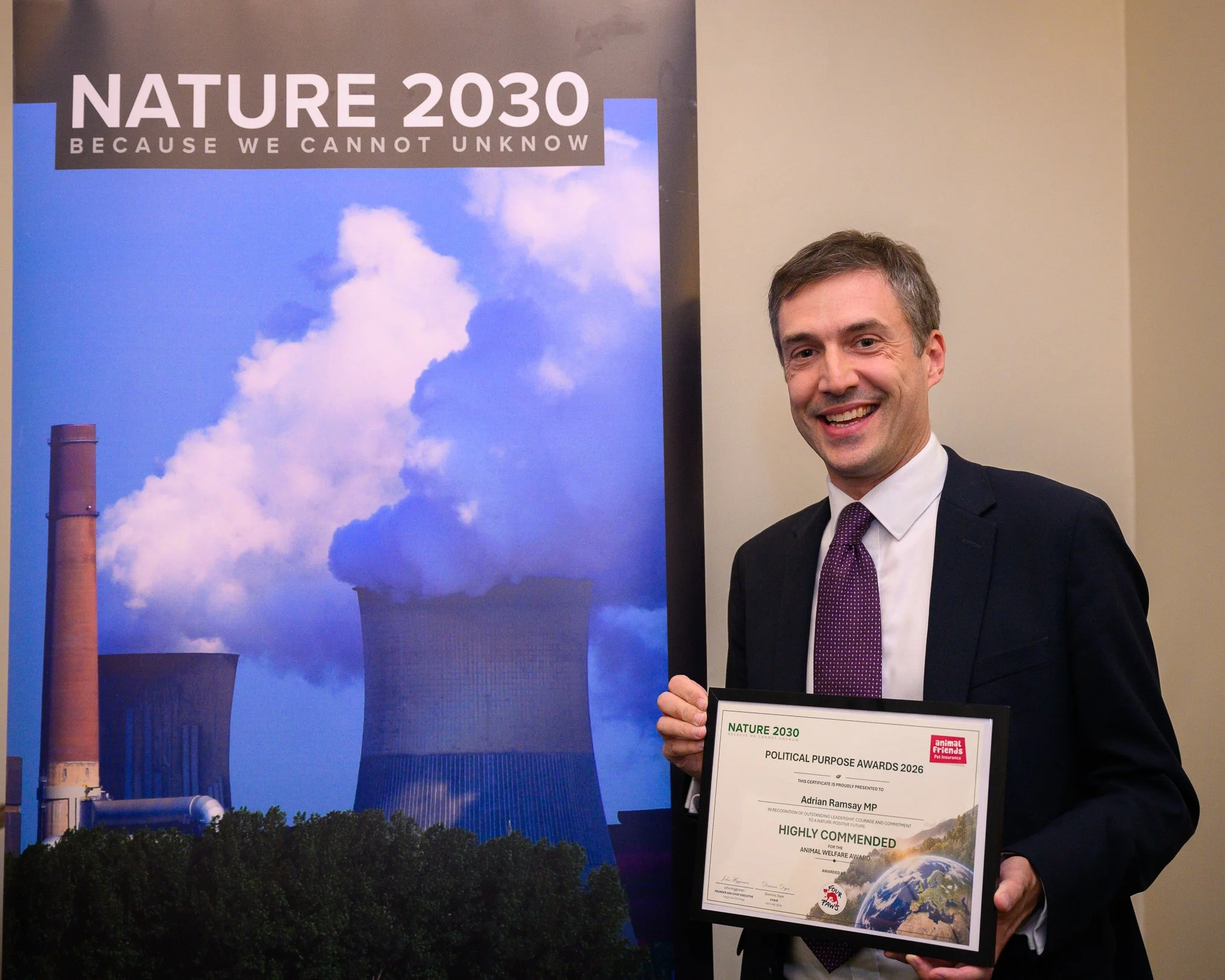
Adrian Ramsay MP highly commended for animal welfare work at Nature 2030 Political Purpose Awards
Adrian Ramsay MP for Waveney Valley has been highly commended for his work on animal welfare at the Nature 2030 Political Purpose Awards.
Adrian Ramsay MP said:
“I’m honoured to be highly commended for my work on animal protection at the Nature 2030 Political Purpose Awards. I enjoy working closely with animal charities and cross-party MPs to champion real improvements for animals - issues which many constituents write to me about all the time. How we treat animals is a test of our compassion and values as a country.
"The Government made many welcome pledges in the Animal Welfare Strategy release last year. It must now deliver on these promises for farmed animals, wildlife and pets alike. We need to end the cage age, stop the exploitation of animals for blood sports and stop the import of trophies from hunting. The Government should also go further with a clear pathway for ending experiments on animals and stopping greyhound racing.
“A huge thank you to all the brilliant campaigners who are keeping these issues in the spotlight. I look forward to working further with them to see meaningful change in this next year."
ENDS
Notes to editors:
The Nature 2030 Political Purpose Awards recognise Parliamentarians for their work on nature and animal welfare issues.
Photos can be found here:
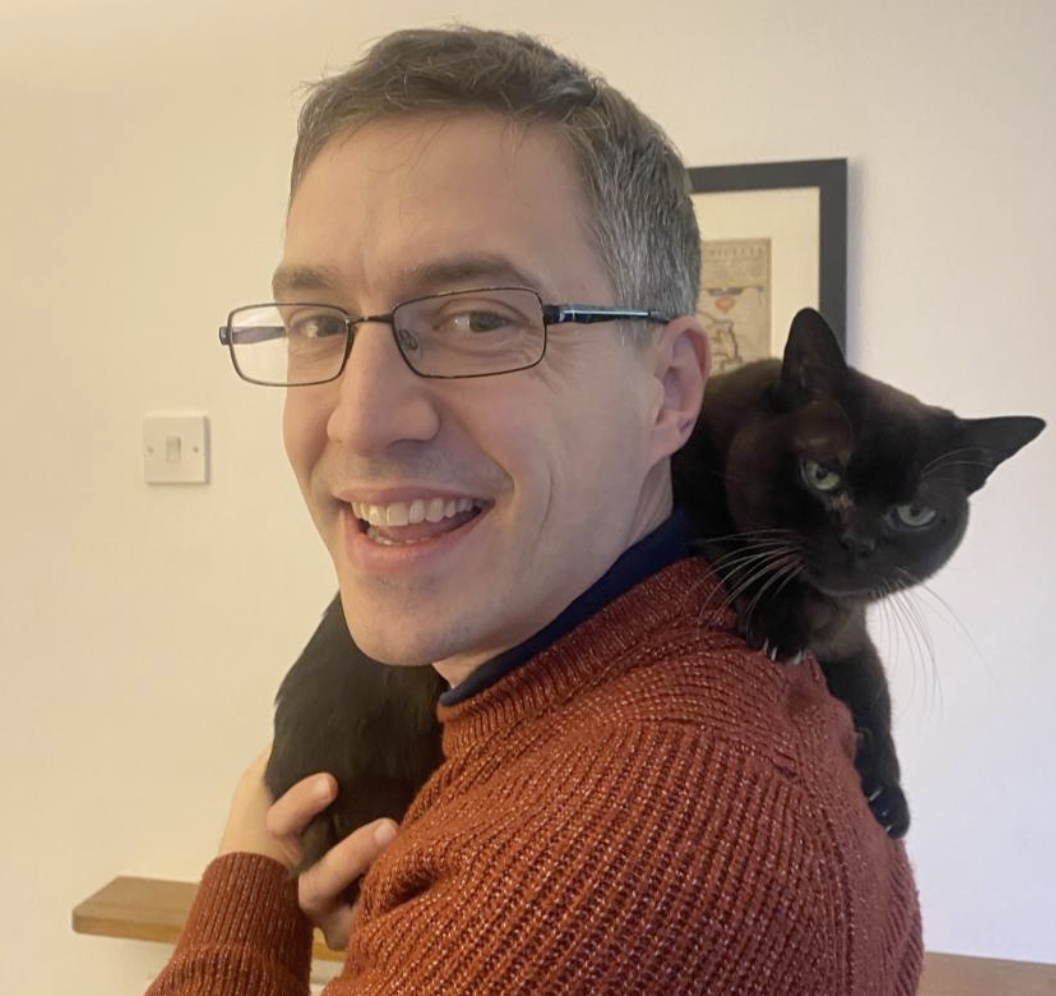
Adrian Ramsay MP's cat Bella crowned Purr Minister of 2026
Adrian Ramsay MP for Waveney Valley is delighted that his beloved cat Bella has won the public vote for Purr Minister of the Year.
Welcoming the victory and reinforcing his work on animal protection, Adrian said:
“I'm delighted that the real boss of our house, Bella, has been crowned Purr Minister of the United Kingdom. I'm very proud of her! Battersea does vital work on behalf of cats nationwide, helping to highlight the welfare challenges cats face and the action needed to keep them safe and healthy.”
Adrian continued by saying, “We are a nation of animal lovers, and I am proud to play a leading role in championing animal issues in Parliament. Animal protection isn’t a side issue. It is fundamental to the kind of country we want to be, and the public rightly expects us to act.”
“That is why it is vital that this Government fully implements the commitments in the Animal Welfare Strategy published last December. Ministers must set clear timescales to phase out confined systems in factory farms like crates and cages, properly support farmers through the transition, and ensure imports meet the same standards we expect of our own farmers. Warm words in a strategy document mean nothing without delivery, and animals deserve action not more delay.”
ENDS
Notes to editors:
Through Purr Minister, Battersea aims to encourage policymakers and the public alike to consider the welfare challenges facing cats today and the actions needed to help keep them safe and healthy.
For those inspired by Bella's success, Battersea encourages prospective owners to consider adopting a rescue cat and helping more animals find the loving homes they deserve. For more information about Purr Minister 2026, and to read Bella's winning 'Manifursto', visit: https://www.battersea.org.uk/about-us/news/purr-minister
Adrian has a long-standing record on animal welfare. In December 2025, he coordinated a cross-party letter, signed by over 35 Parliamentarians, urging the Government to ensure the forthcoming Animal Welfare Strategy included a time-bound phase-out of all confinement cages and crates in UK farming, alongside a fully-funded package to support farmers through the transition. At the time, Adrian said: "We often say the UK leads the world on animal welfare, yet millions of animals remain confined in awful conditions that many other European countries have already moved away from. As a nation that prides itself on caring for animals, it is unacceptable that these cruel practices continue."
When the Government's Animal Welfare Strategy was published, Adrian welcomed it but warned it "must have real teeth to deliver meaningful improvements for animals," calling for clear timescales to phase out crates and cages, proper support for farmers through the transition, and no imports that fail to meet UK standards. He also welcomed action on snares, hunting and puppy farming, while calling for the strategy to go further, including by ending greyhound racing, as the Welsh Government is doing.
Picture of Adrian & Bella can be found it at this link https://drive.google.com/file/d/1wyrPZdxsWLfMM39hVRMUsV7yRK3WN-f8/view?usp=sharing.
Press release from Battersea in case you did not receive it.
Battersea is delighted to announce that Bella, the beloved cat of Waveney Valley MP Adrian Ramsay, has been elected Purr Minister 2026.
After weeks of campaigning and public voting, 14-year-old Bella secured 36 per cent of the public vote, triumphing over three fellow feline candidates to become Westminster's top cat for 2026.
Bella won over voters with the promise of sweeping reforms - such as a ban on visible bowl bottoms and the introduction of a tuna-based economy - positioning herself as the candidate determined to tackle the issues that matter most to cats. Her vision of a future built on sunlight, full bowls, warm
keyboards and obedient humans clearly struck a chord with the electorate, landing her the title of Purr Minister 2026.
Battersea's much-loved Purr Minister competition continues to celebrate the unique role cats play in our lives while raising awareness of important cat welfare issues. Since launching in 2014, the contest has seen parliamentary cats from across Westminster compete for the prestigious title.
Adrian Ramsay, Waveney Walley MP and proud owner of Bella said: “Bella is greatly looking forward to devoting all of her 1.5 waking hours per day - when she isn’t eating, hunting spiders or grooming – to serving the cats of the United Kingdom and advancing the battle for full feline dominance and
sovereignty.”
Bella's victory comes as Battersea continues to campaign on behalf of cats nationwide. While microchipping became compulsory for pet cats in England in 2024, Battersea's latest research found that more than one in five cats still do not have a microchip, highlighting the ongoing need to raise awareness among owners. Through Purr Minister, Battersea aims to encourage policymakers and the public alike to consider the welfare challenges facing cats today and the actions needed to help keep them safe and healthy.
For those inspired by Bella's success, Battersea encourages prospective owners to consider adopting a rescue cat and helping more animals find the loving homes they deserve.
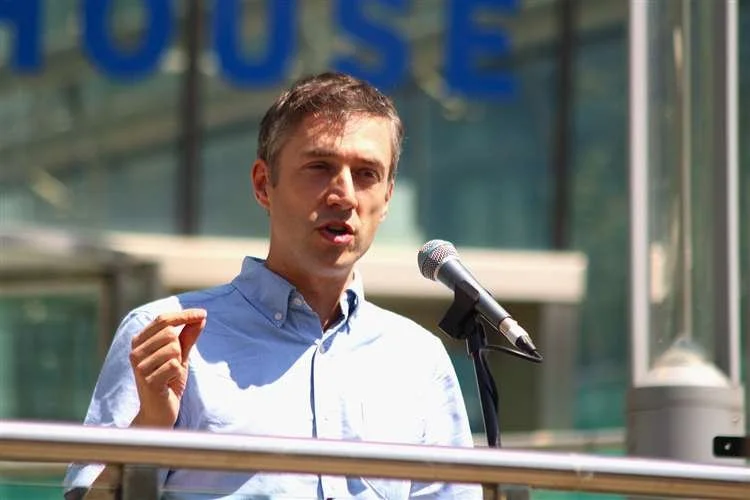
Packed Parliamentary debate on National Security Assessment on biodiversity loss and ecosystem collapse
Packed Parliamentary debate on National Security Assessment on biodiversity loss and ecosystem collapse
he Joint Intelligence Committee's (JIC) National Security Assessment on biodiversity loss and ecosystem collapse, a report which the Government reportedly refused to release in full, was the subject of a packed Parliamentary debate this afternoon.
The report presents a world where cascading risks from nature loss and ecosystem collapse lead to crop failures, water scarcity, floods and novel diseases, meaning millions of people could face food shortages, inflation, public health risks, supply-chain disruption, loss of livelihoods, mass displacement and conflict.
Adrian Ramsay, MP for Waveney Valley, who secured the debate, said in his speech that "Today, we debate a crucial National Security Assessment report that warns of the rapid depletion of global biodiversity, the collapse of critical ecosystems, and the dismantling of major global food systems.” He continued “Historians will write about our decisions. Future generations will judge us for it. They will recount how we knowingly gambled with global stability, the health of the natural world, and the safety of human life, and call it a Growth Agenda."
Roz Savage, MP for South Cotswolds said "The Government’s own intelligence assessment is that ecosystem collapse is a security threat. We are not governing it as a security threat, nor funding it as a security threat, nor communicating it as a security threat. Nature has a monopoly on our capacity to thrive. I have rowed three oceans to say this. I brought a Bill to this House to say this. The Government's own report now says it. I spoke in this debate because we need the Government to listen, and we need them - urgently - to respond."
Kerry McCarthy, MP for Bristol East said “Whether it’s heatwaves and wildfires in Europe or the destruction caused by glacier collapse in Nepal and Tibet, the message is clear. The consequences of climate change and environmental degradation are real, not some distant future threat. And they present immediate economic and security risks too, that we ignore at our peril.”
Ed Jarvis from the Climate Majority Project said “The government has shown itself today to not be taking the threat of global ecosystem collapse to the UK’s National Security anywhere near as seriously as it should - even based on reports by its >own< security services and DEFRA. What we need is clear; immediate publication of both the National Security reports, a televised national ‘covid style’ emergency briefing, a wartime mobilisation of the country around a funded national Strategic Adaptation plan, a Secretary of State for Resilience and Adaptation at Cabinet level, as well as an independent commissioner for Resilience and Adaptation to make sure the Secretary of State and Adaptation Plan is actually delivered. Only then will the government demonstrate that it is treating the climate and nature emergency like the wartime emergency it is.”
Dr Amy McDonnell, Co-Director at Zero Hour, the climate and nature campaign said in response to today's debate
“At the start of the year, our top security officials raised the alarms about the serious threat that global nature breakdown poses to people's lives here in Britain. Today MPs finally had the chace to debate their warnings.
“But after an unbearable summer that saw crops fail, hospitals break down, and fires tear through the country, the government should have gone further and used today’s debate to outline how these issues will be front-and-centre of the 10-year plan for Britain they are currently drafting.”
ENDS
Notes to the editor.
You can watch the full debate here: https://parliamentlive.tv/event/index/d01b4723-b547-472e-a5ca-71809e83bf11
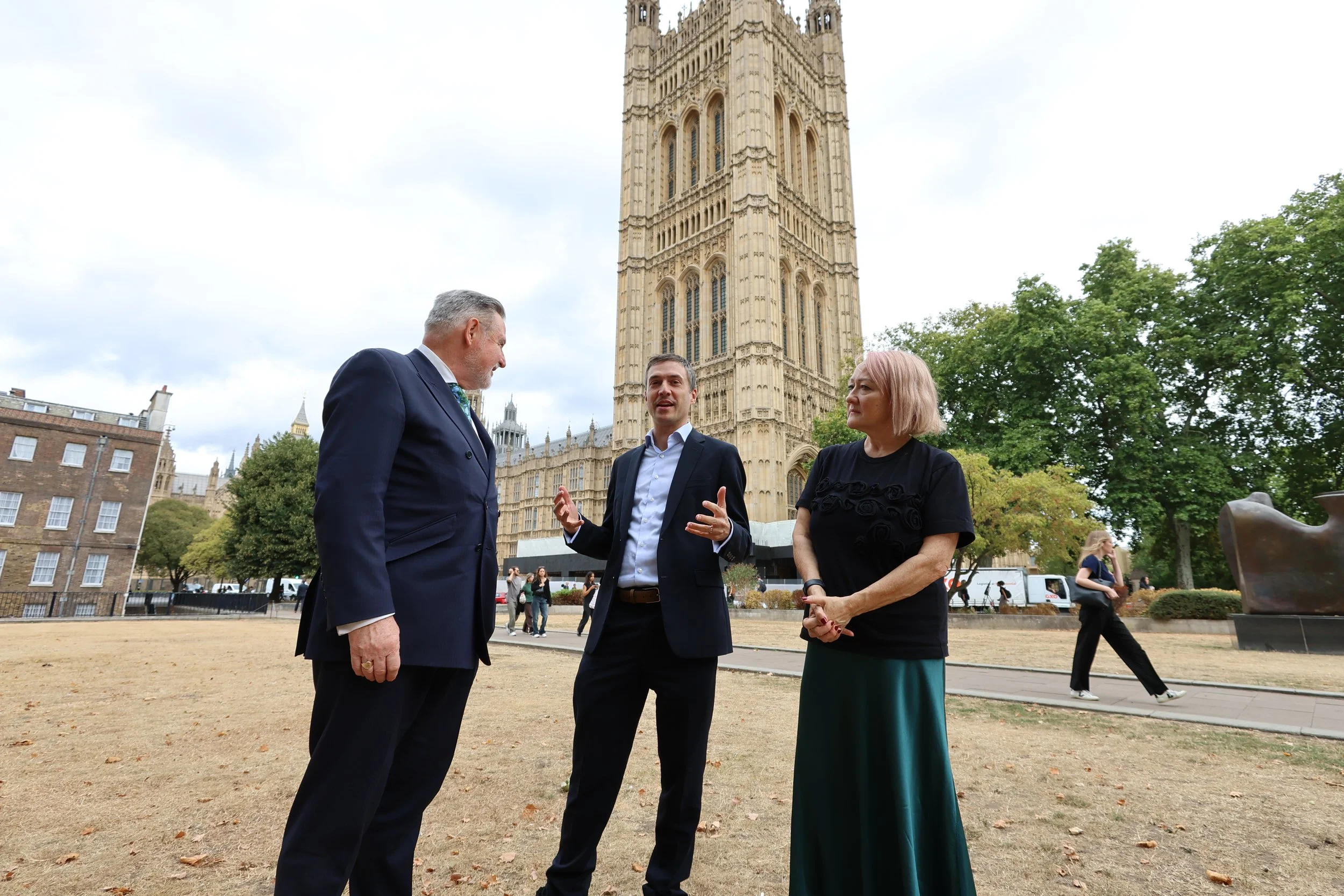
“Future generations will recount how we knowingly gambled the health of the natural world, and the safety of human life, and call it a growth agenda”
PRESS RELEASE
“Future generations will recount how we knowingly gambled the health of the natural world, and the safety of human life, and call it a growth agenda” — Adrian Ramsay MP will say in a speech urging the Government to release the National Security Assessment in full.
Adrian Ramsay, MP for Waveney Valley and environment spokesperson for the Green MPs, will lead a debate in Parliament on the Joint Intelligence Committee's (JIC) National Security Assessment on biodiversity loss and ecosystem collapse, a report which the Government reportedly refused to release in full. The report presents a world where cascading risks from nature loss and ecosystem collapse lead to crop failures, water scarcity, floods and novel diseases, meaning millions of people could face food shortages, inflation, public health risks, supply-chain disruption, loss of livelihoods, mass displacement and conflict.
In the speech, Adrian is expected to say, “If this is not one of the gravest and prevailing national security risks of our time, I do not know what is.” Adrian will argue that “Nature is a foundational element of national security.”
Arguing that climate breakdown is destabilising all our natural systems, Adrian will challenge the fact that governments have repeatedly failed to make the decisions that are needed to protect our citizens. Adrian said that “Historians will write about our decisions. Future generations will judge us for it. They will recount how we knowingly gambled with global stability, the health of the natural world, and the safety of human life, and call it a growth agenda. Environmental protections are under attack from policy which pitches nature against the economy. There will be major damage to the economy with such dangerous levels of systemic ecological risk.”
Adrian will argue it is imperative that this Parliament finally tackles climate breakdown head-on, arguing that: “We cannot neglect to address this for another generation. The assessment makes clear that there is still a chance for major interventions to slow the trend and protect communities and restore national security if we act now, in this Parliament.”
ENDS
Notes to editors:
There will be a photocall with campaigners and some MPs speaking in the debate at College Green at 12:45. Please get in touch with Ben, Adrian's media officer, to arrange it via WhatsApp on +44 7939 335565 or [email protected].
Adrian Ramsay is leading a Backbench Business Committee debate on Thursday 3rd September in Westminster Hall, which is expected to start at 3:10pm.
The Joint Intelligence Committee's National Security Assessment, published in January 2026, stated that biodiversity loss and ecosystem collapse pose a threat to national security. This report was only published after a Freedom of Information request by Green Alliance - and it was only published in redacted form. Since January, Adrian Ramsay MP has repeatedly called for a debate in Parliament on its findings and for the full report to be published.
Adrian has also proposed a dedicated Climate Adaptation Unit, based in Number 10, to coordinate the Government's response to the growing risks posed by climate breakdown. A key responsibility of the unit would be ensuring councils, local authorities and public bodies work together effectively on local resilience planning, including flood prevention, heat adaptation, emergency response and protecting vulnerable communities. The proposal follows the Climate Change Committee's recommendation for a more structured national approach to managing the interdependencies between critical systems and services.

Bungay illustrates "biggest problem" with rural banking access, says Adrian Ramsay MP
Speaking in a parliamentary debate on access to face-to-face banking, Adrian Ramsay MP for Waveney Valley highlighted the market town of Bungay as an example of the collapse of banking services in rural communities.
“Bungay once had branches of HSBC, Barclays, NatWest and Lloyds. All four have now closed.
Mr Ramsay told the Commons that Link, the body responsible for assessing community access to cash, had says that Bungay does not qualify for a banking hub because cash facilities remain available in the town. He said: "Access to cash is not the same as access to banking and the personalised support that staffed branches or banking hubs provide."
He also challenged Link's reasoning that a hub would not be granted for Bungay because one already exists in nearby Harleston, saying: "In rural communities, getting from one market town to another is not always easy."
Mr Ramsay pressed the Minister to review the criteria used to assess eligibility for banking hubs, asking: "Will she look at whether communities such as Bungay can qualify for banking hubs where there's a clear demand for face-to-face services, even if cash withdrawals are accessible?"
ENDS
Link to the intervention
https://parliamentlive.tv/Download/Index/b72c2f12-ac6f-4e8d-924e-6bcc0ebb6fa0
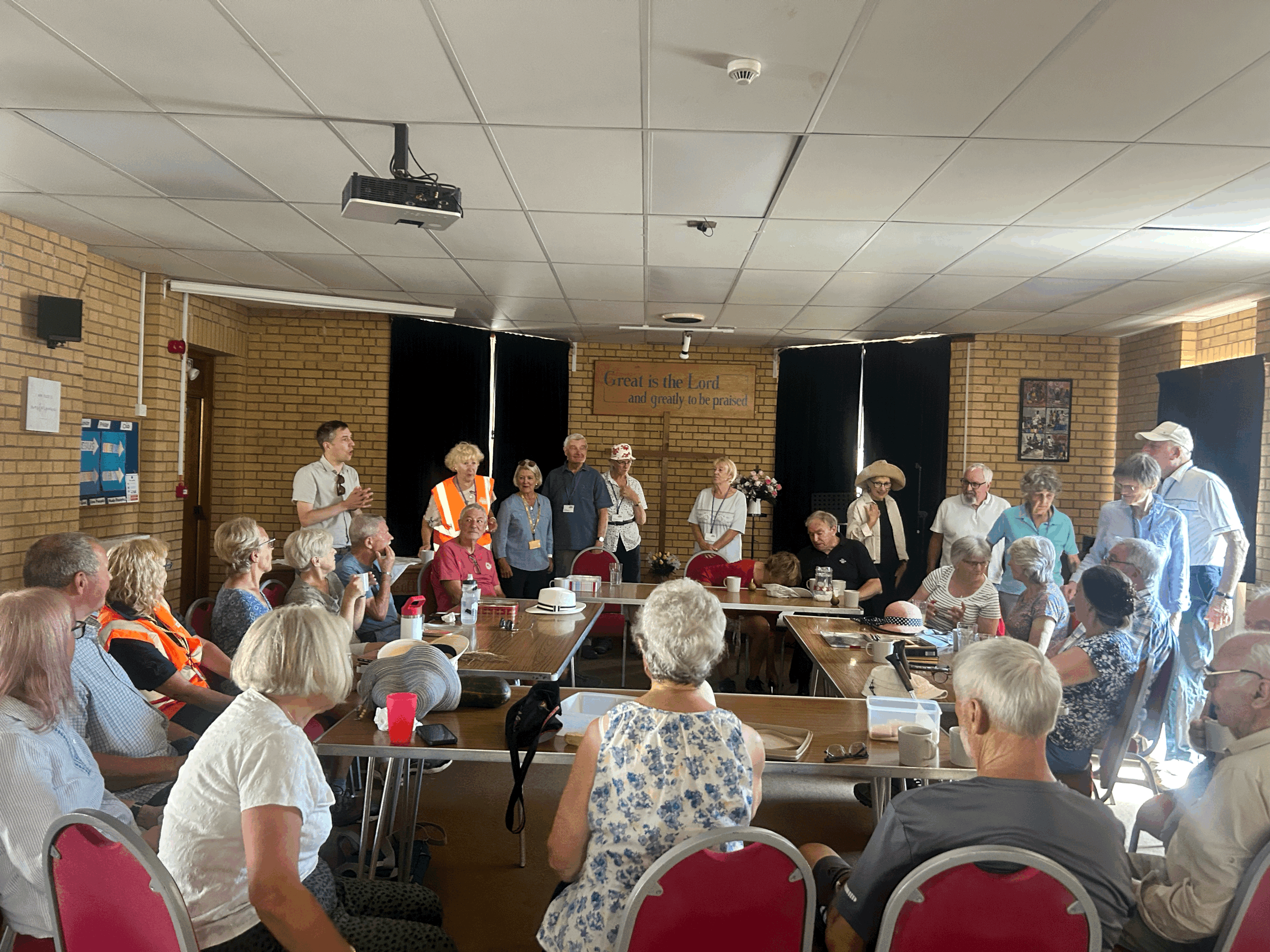
Adrian Ramsay MP joins Botesdale & Rickinghall Ramblers for social walk at Redgrave Park
Adrian Ramsay MP joins Botesdale & Rickinghall Ramblers for social walk at Redgrave Park
Adrian Ramsay MP, Green Party MP for Waveney Valley, said:
"It was a pleasure to join the Ramblers group in Botesdale & Rickinghall for their weekly walk, taking in the beautiful surroundings of Redgrave Park on a gorgeous day. It was great to spend time with local residents and hear more about what the group means to them.
"What makes this group so special is that it's part of a social prescribing model, local medical centres identify people who could benefit from a bit more company and connection and refer them to join the Ramblers. It's a brilliant example of a simple, community-led idea making a real difference to people's health and wellbeing.
"I want to thank everyone who came along today, and everyone involved in keeping this group going every week. Groups like this are a lifeline for many people, and exactly the kind of community support we should be championing."
ENDS
Notes to editors:
The Botesdale & Rickinghall Ramblers meet every Tuesday morning for a social walk around the village and surrounding area.
The group operates as part of a social prescribing model, with local medical centres referring residents who may benefit from increased social contact and community connection.
Student Loans Letter to Chancellor


-
The Rt Hon John Healey MP
Chancellor of the Exchequer
HM Treasury
The Correspondence & Enquiry unit
1 Horse Guards Road
London
SW1A 2HQ
Letter coordinated by Rethink Repayment
Thursday 6th August 2026
Dear Chancellor,
We write to you as a cross-party group of 121 MPs and peers to highlight a growing concern
across the country: the compounding financial pressure on recent graduates and early-career
professionals due to the current structure of student loan repayments.
While higher education remains a vital pathway for personal advancement and national
economic growth, successive governments' adjustments to repayment thresholds - together
with high interest and marginal tax rates - are placing an unsustainable burden on the next
generation of workers.
Across the country, we are hearing from young teachers, nurses, engineers, and entrepreneurs
who are facing historically high effective marginal tax rates. For many middle-income
graduates, the combination of income tax, National Insurance, and student loan repayments
means they see less than half of any hard-earned pay rise. At a time when the cost of living
remains a primary concern, this significantly diminishes disposable income, delays milestones
such as first-time homeownership and family formation, and disincentivises career
progression.
We are united in the belief that the current repayment framework requires urgent review, as
indicated by the Treasury Select Committee’s recent inquiry recommendations, to ensure it is
fair, sustainable, and supportive of aspiration.
We welcome the opportunity to meet with you alongside campaigners to discuss how we can
better support graduates while maintaining a responsible fiscal approach. We would be
grateful if you could reach out to Rethink Repayment on [email protected] to
organise a meeting.
Yours,
Co-sponsors:
Sadik Al-Hassan MP, Labour
Jas Athwal MP, Labour
Rt Hon Laura Trott MP, Conservatives
David Reed MP, Conservatives
Munira Wilson MP, Liberal Democrats
Oliver Gardner, Rethink Repayment
National Union of StudentsAnd the undersigned:
Abtisam Mohamed MP (Co-chair of APPG for Students)
Alex Sobel MP (Co-chair of APPG for Students)
Tahir Ali MP
The Lord Alton of Liverpool
The Baroness Altmann CBE
Gareth Bacon MP
The Baroness Bakewell of Hardington Mandeville
The Lord Balfe
Apsana Begum MP
Saqib Bhatti MP
Bob Blackman CBE MP
The Baroness Blackstone
Sarah Bool MP
The Lord Bourne of Aberystwyth
The Baroness Bowles of Berkhamsted
Rt Hon Dame Karen Bradley MP
Aphra Brandreth MP
The Rt Hon the Baroness Butler-Sloss GBE
The Baroness Cash
The Lord Cashman CBE
David Chadwick MP
Danny Chambers MP
Bambos Charalambous MP
Dr Ellie Chowns MP
Lewis Cocking MP
Victoria Collins MP
Daisy Cooper MP
John Cooper MP
Rt Hon Sir Geoffrey Cox KC MP
Stella Creasy MP
Adam Dance MP
The Baroness Deech DBE
Carla Denyer MP
Charlie Dewhirst MP
Dame Caroline Dinenage MP
Neil Duncan-Jordan MP
Sorcha Eastwood MP
Cat Eccles MP
Will Forster MP
Zoe Franklin MP
George Freeman MP
Louie French MP
The Baroness Garden of Frognal
Dr Allison Gardner MP
Mark Garnier OBE MP
Rt Hon John Glen MP
Tom Gordon MP
The Rt Hon the Lord Hain
The Baroness Hamwee
Wera Hobhouse MP
Paul Holmes MP
The Rt Hon the Lord Howell of Guilford
Dr Neil Hudson MP
Liz Jarvis MP
Dr Caroline Johnson MP
Kim Johnson MPLincoln Jopp MC MP
Alicia Kearns MP
Afzal Khan CBE MP
The Baroness Brown of Cambridge DBE (Julia King)
Ben Lake MP
Katie Lam MP
Alan Mak MP
Rt Hon Kit Malthouse MP
The Baroness Manzoor CBE
Dr Brian Mathew MP
Jerome Mayhew MP
Rt Hon John McDonnell MP
Rt Hon Andrew Mitchell MP
Iqbal Mohamed MP
Gagan Mohindra MP
Robbie Moore MP
Joy Morrissey MP
Rt Hon Sir David Mundell MP
Rt Hon Dr Andrew Murrison MP
Neil O'Brien OBE MP
Dr Simon Opher MP
Kate Osamor MP
Rebecca Paul MP
Toby Perkins MP
Lee Pitcher MP
Yasmin Qureshi MP
Shivani Raja MP
Adrian Ramsay MP
Jack Rankin MP
Bell Ribeiro-Addy MP
Joe Robertson MP
Anna Sabine MP
Jim Shannon MP
Dr Neil Shastri-Hurst MP
Sir Alec Shelbrooke MP
David Simmonds CBE MP
Vikki Slade MP
The Baroness Smith of Llanfaes (Carmen Smith)
Cat Smith MP
Rt Hon Sir Julian Smith MP
Andrew Snowden MP
Ian Sollom MP
Hannah Spencer MP
Patrick Spencer MP
Greg Stafford MP
Blake Stephenson MP
Rt Hon Graham Stuart MP
Rt Hon Sir Desmond Swayne MP
Bradley Thomas MP
The Earl of Clancarty (Nicolas Trench)
Rt Hon Tom Tugendhat MP
The Baroness Uddin
Martin Vickers MP
The Baroness Warwick of Undercliffe
The Baroness Watkins of Tavistock
Rt Hon Sir John Whittingdale MP
James Wild MP
Max Wilkinson MPRt Hon Sir Gavin Williamson MP
Rt Hon Sammy Wilson MP
Mohammad Yasin MP
Claire Young MP
Total signatories: 121
Powered by TCPDF (www.tcpdf.org)
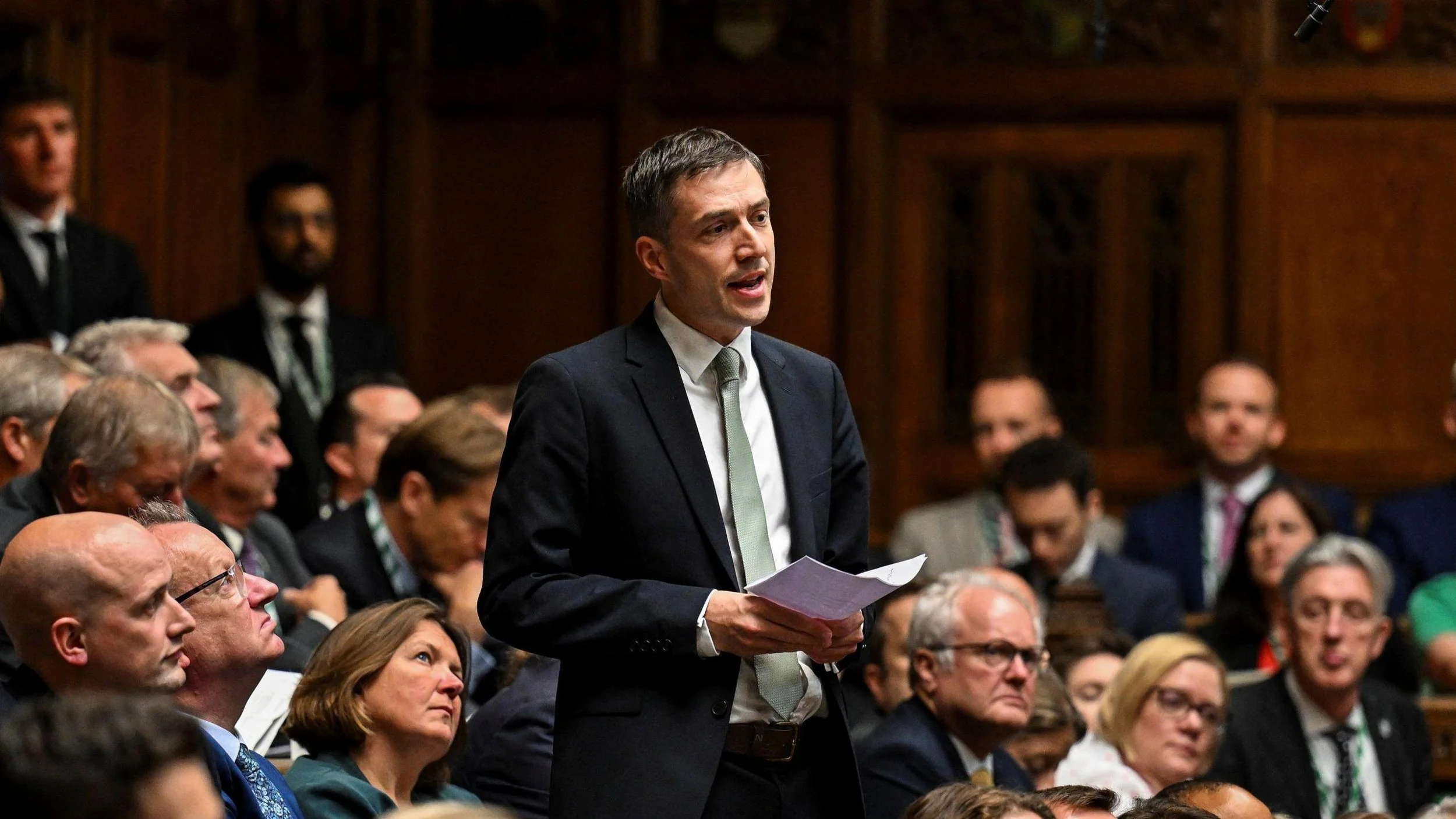
"We are in a new climate reality" — Adrian Ramsay MP calls for Minister for Climate Adaptation as Britain faces fourth, most dangerous heatwave of the year
"We are in a new climate reality" — Adrian Ramsay MP calls for Minister for Climate Adaptation as Britain faces fourth, most dangerous heatwave of the year
Britain is bracing for its fourth and most dangerous heatwave of the year, with temperatures set to surpass 30°C today, as Green Party MP Adrian Ramsay calls on the Prime Minister to create a dedicated Minister for Climate Adaptation.
"We are in a new climate reality," said Adrian Ramsay MP. "While the Prime Minister gets ready for his decade of renewal, he must face the fact that Britain must get used to extreme weather, from heatwaves and wildfires to flooding and storms. This is a major threat to our country and we need the Government to step up."
With land parched and a record early harvest after weeks of sustained heat, Ramsay warned that the growing wildfire risk now amounts to a national security threat, one the Government is failing to treat with the urgency it demands.
Adrian Ramsay Green Party MP for Waveney Valley said:
"With temperatures set to surpass 30°C today after a sustained period of heat this summer, our land is now a tinderbox," Ramsay said. “We're already seeing wildfires visible from space in Spain and devastating fires in France, and Britain is not immune, we've seen homes evacuated and communities put at risk by fires here too. This is what our new normal looks like, and our neighbours are living it right now. This is a national security threat, and the Prime Minister needs to treat it as one."
"With Europe the fastest-warming continent on Earth, Ramsay argued that "the crisis our neighbours are facing today is a warning of what's coming for us tomorrow," urging the Prime Minister to use this moment to put significant mitigation measures in place before it's too late including a Heat Resilience Strategy."
"This would include prioritising cooling, including air conditioning where needed, in settings where people are vulnerable, such as hospitals, schools, prisons and care homes, ensuring emergency services are properly equipped to respond to extreme heat, setting up cool spaces for the public, and introducing measures to ensure people can stay safe in the workplace. This would include."
ENDS
Notes to editors:
Adrian has called on the Government to deliver a national Heat Resilience Strategy urgently, led from the Cabinet Office with clear ministerial accountability, ensuring that decisions on housing, infrastructure, health, energy and land use are all designed for the climate we now face.
Adrian has also proposed a dedicated Climate Adaptation Unit, based in Number 10, to coordinate the Government's response to the growing risks posed by climate breakdown. A key responsibility of the unit would be ensuring councils, local authorities and public bodies work together effectively on local resilience planning, including flood prevention, heat adaptation, emergency response and protecting vulnerable communities. The proposal follows the Climate Change Committee's recommendation for a more structured national approach to managing the interdependencies between critical systems and services.
The Green Party is reiterating its call for an urgent package of heatproofing measures, including a street-by-street programme to insulate every home that needs it, keeping homes warm in winter and cool in summer, alongside blinds and shutters where needed to keep heat out.
Other measures include prioritising cooling, including air conditioning where needed, in settings where people are vulnerable, such as hospitals, schools, prisons and care homes, and introducing a maximum temperature limit for workplaces and classrooms.
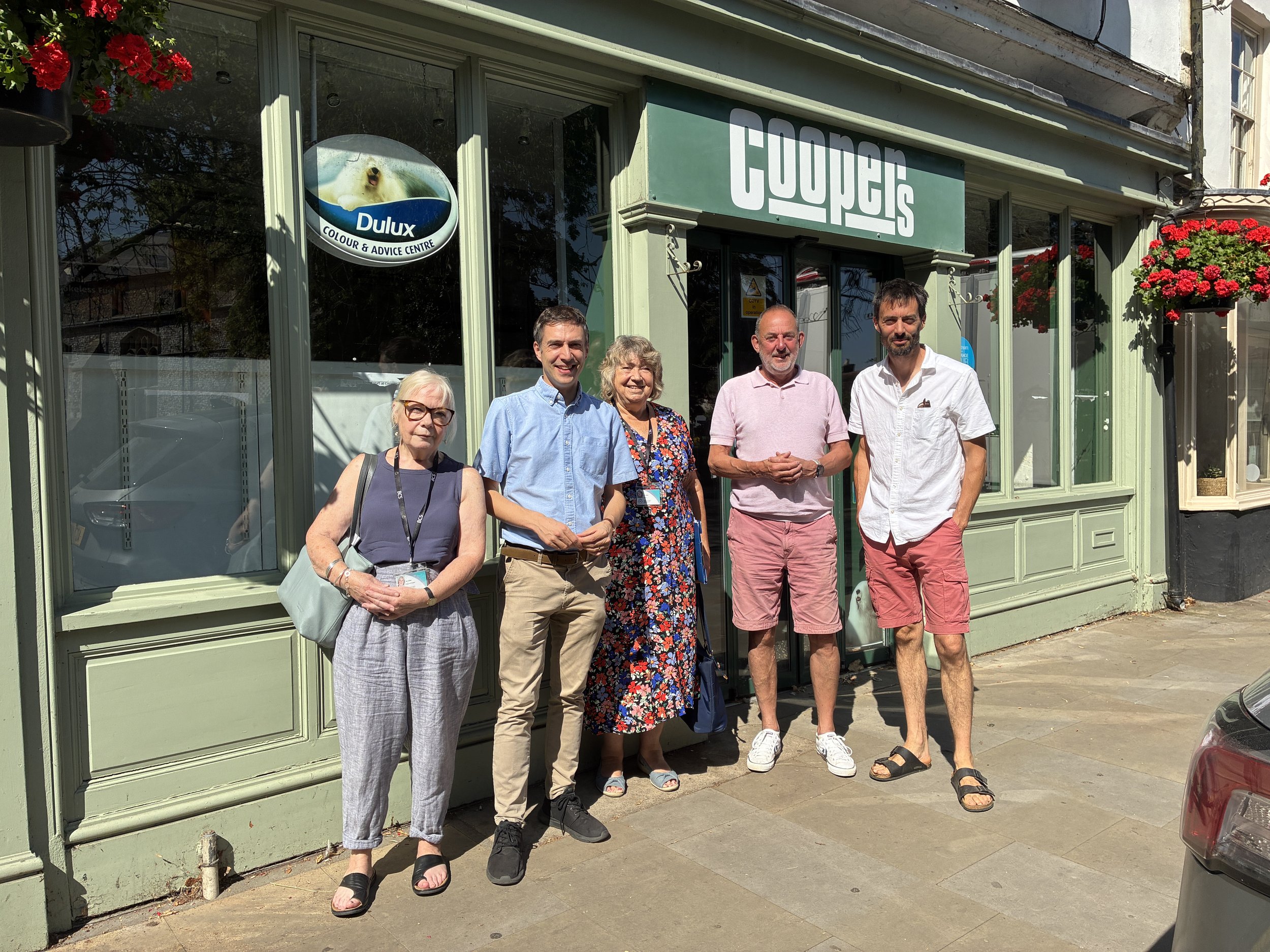
Adrian Ramsay MP encourages local business people to apply to be a trustee of Bungay Community Support
Adrian Ramsay MP encourages local business people to apply to be a trustee of Bungay Community Support
Bungay Community Support (BCS) is appealing for a new trustee with business or property expertise to join its board on a voluntary basis, as the charity works to secure a landmark building in the town centre for community use.
BCS has identified a former retail building in the heart of Bungay, as a potential long-term home for its work supporting the local community.
The charity's plan is to secure funding from a local benefactor, or benefactors, to purchase the building outright, with BCS then renting the space from them to run its services. To help make this happen, BCS is now looking to strengthen its board with a trustee who can bring business, financial or property expertise to guide the charity through the purchase and beyond.
Trustees give their time voluntarily and play a vital role in shaping the charity's strategy and ensuring it is run responsibly and sustainably.
Adrian Ramsay, Green Party MP for Waveney Valley, said:
"Bungay Community Support does incredible work for people across our town, and securing a permanent home in the heart of Bungay would make a real difference to what they can offer local people for years to come. This is a brilliant opportunity for someone with business or property expertise to put those skills to use for their community. I'd encourage anyone who cares about Bungay's future to seriously consider putting themselves forward."
Susan Collins BEM the Chair of Trustees for BCS
“Since our beginnings in 2020, the kindness and dedication of local people have shaped everything we do. Their spirit has carried us forward and strengthened our belief in what a united community can achieve.
Today, Bungay Community Support is an ever-increasing lifeline for residents across Bungay and the surrounding villages — and this moment feels full of possibility.
We are seeking people who share our determination to build a brighter future. Whether you can offer your expertise and time, or contribute financially, we invite you to join us and help transform that shared vision into lasting change.”
ENDS
Notes to editors:
Bungay Community Support (BCS) is a registered charity (CIO), Registered Charity No: 1200141, providing practical support to local residents affected by age, ill-health, disability, or social or economic hardship.
BCS began in March 2020 as Bungay Emergency Community Support (BECS), set up by Bungay Town Council, local residents and a local charity to deliver food and prescriptions to vulnerable residents during the first lockdown. It became an independent charity in August 2022.
The charity now runs a range of services from Number 28, Bungay's community hub in the town centre, including a befriending service for housebound residents, shopping and prescription collection, winter Warm Rooms, and a Food Hall offering discounted staple and fresh food on a community pantry model.
For more information, visit bungaycommunitysupport.org.uk
Image available here https://drive.google.com/drive/folders/1DV54px7g0iAxbSHcTAAuXWuReImEqGFs?usp=sharing
"Deeply irresponsible": MP condemns Suffolk County Council's climate U-turn as firefighters battle wildfires.
"Deeply irresponsible": MP condemns Suffolk County Council's climate U-turn as firefighters battle wildfires.
Adrian Ramsay, Green MP for Waveney Valley, has warned that Suffolk County Council's move to rescind its Climate and Nature Emergency Declaration comes at exactly the wrong moment, as firefighters battle a surge in wildfires and extreme heat incidents across the country.
Speaking outside Endeavour House in Ipswich, where the County Council is this afternoon debating a motion from the new Reform-led administration to rescind the declaration first made in 2019, Adrian was joined by Richard from the Suffolk Fire Brigades Union, who set out the reality frontline crews are facing.
Richard said the Fire Brigades Union was currently responding to 14 wildfires declared nationwide, with a rising number of field and open fires across Suffolk. Crews are tackling these fires in full protective kit. He said flooding incidents were also increasing year on year, and that fire services are under-resourced and underfunded to meet the scale of the challenge, calling for an uplift in funding to properly protect the public.
Mr Ramsay had earlier written to Council Leader Cllr Hadwen, warning that undeclaring a climate emergency would not remove the threats of flooding or extreme heat that Suffolk residents face and would not save the council money. His letter noted that public sector organisations have worked together to deliver the Suffolk Climate Emergency Plan since 2021, with co-benefits including warmer, more affordable homes, improved air quality and health, and job creation. He warned that rescinding the declaration sends the wrong message when cross-party cooperation on these issues is needed more than ever.
Commenting today, Adrian Ramsay MP said:
"Suffolk County Council's Climate and Nature Emergency Declaration in 2019 was crucial in helping establish the UK's commitments on climate and nature. We should be stepping up that action now, not rolling it back, and we're seeing exactly why with the extreme heat we're experiencing.
"I've heard directly from firefighters on the front line of this crisis, dealing with wildfires and flooding that are becoming more frequent, without the resources they need to keep up. Whether it's our fire services, our food security, our water security, our transport, schools or hospitals, we are all feeling the impact of extreme heat right now, and it will only get worse if this is left unchecked.
"It's deeply irresponsible of Reform-led councils, like the one here in Suffolk, to be taking backward steps when we should be taking forward ones. I'm calling on the Government to urgently step up action on preparedness for extreme heat, on nature security, and on cutting emissions, and I'm calling on this council to reverse course."
ENDS
Notes to editors
In his letter to Cllr Hadwen, Leader of Suffolk County Council, Adrian Ramsay made the following points:
Undeclaring a Climate Emergency does not remove the threats of flooding or extreme heat that residents will still face, and will not, on its own, save the council money.
The council must use its powers to safeguard residents affected by extreme heat and other increasingly common extreme weather.
Understanding that this is an emergency affecting food production and economic markets, as well as the environment, is crucial to making decisions that help Suffolk residents live well in the years ahead.
Public sector organisations have worked together to deliver the Suffolk Climate Emergency Plan since 2021, with co-benefits including warmer, more affordable homes, improved air quality and health, and job creation.
Declaring a Climate Emergency is a call to focus on activity that benefits residents now and in future as the climate changes. Projects that don't improve safety and prosperity for Suffolk residents would not be compatible with the declaration in the first place, so rescinding it will not deliver savings or efficiencies.
Rescinding the declaration sends the wrong message when cross-party cooperation on these issues is vital and has, rightly, existed until now.
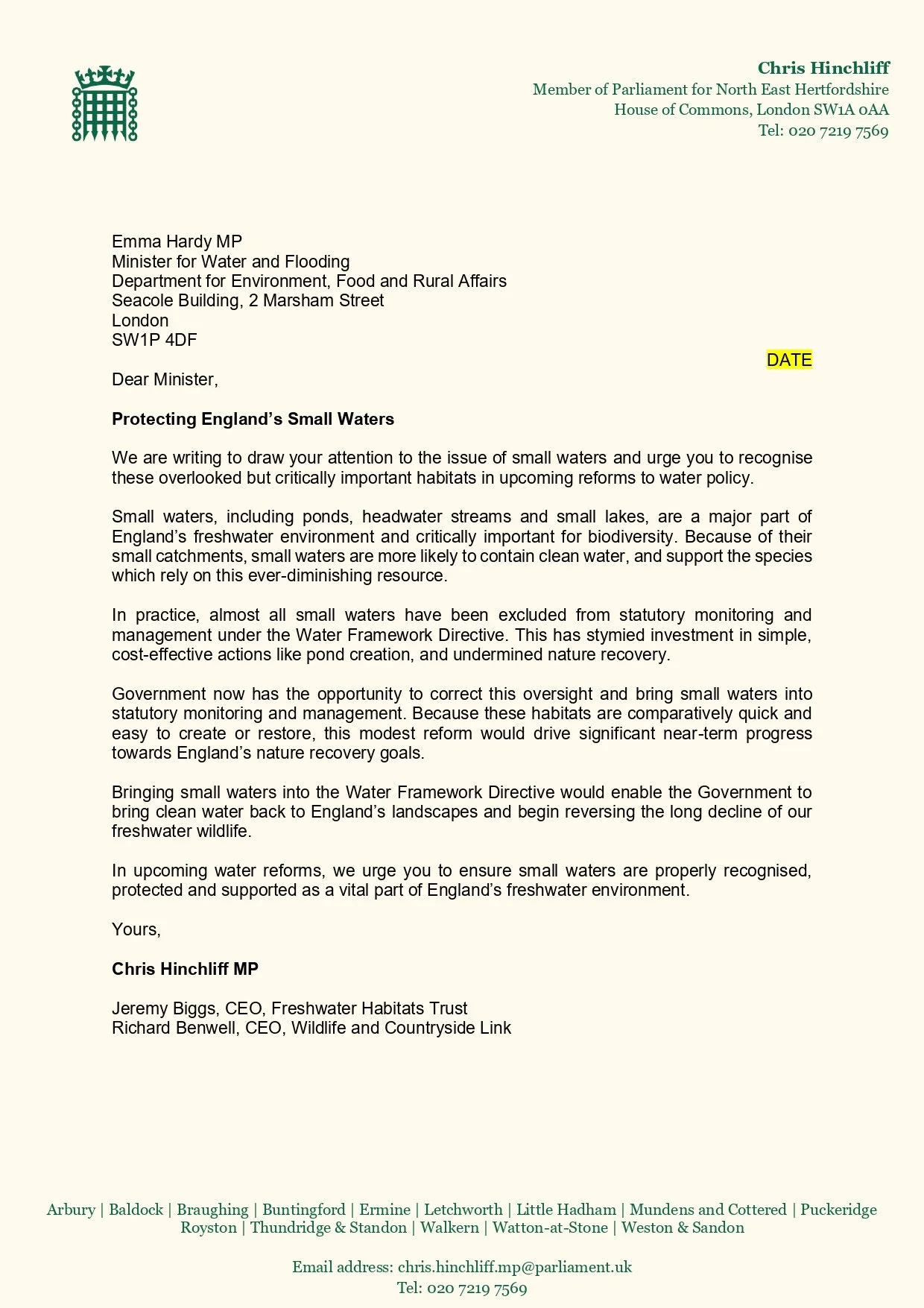
Protecting England’s Small Waters
-
Emma Hardy MP
Minister for Water and Flooding
Department for Environment, Food and Rural Affairs
Seacole Building, 2 Marsham Street
London
SW1P 4DF
Dear Minister,
Protecting England’s Small Waters
We are writing to draw your attention to the issue of small waters and urge you to recognise
these overlooked but critically important habitats in upcoming reforms to water policy.
Small waters, including ponds, headwater streams and small lakes, are a major part of
England’s freshwater environment and critically important for biodiversity. Because of their
small catchments, small waters are more likely to contain clean water, and support the species
which rely on this ever-diminishing resource.
In practice, almost all small waters have been excluded from statutory monitoring and
management under the Water Framework Directive. This has stymied investment in simple,
cost-effective actions like pond creation, and undermined nature recovery.
Government now has the opportunity to correct this oversight and bring small waters into
statutory monitoring and management. Because these habitats are comparatively quick and
easy to create or restore, this modest reform would drive significant near-term progress
towards England’s nature recovery goals.
Bringing small waters into the Water Framework Directive would enable the Government to
bring clean water back to England’s landscapes and begin reversing the long decline of our
freshwater wildlife.
In upcoming water reforms, we urge you to ensure small waters are properly recognised,
protected and supported as a vital part of England’s freshwater environment.
Yours,
Chris Hinchliff MP
Jeremy Biggs, CEO, Freshwater Habitats Trust
Richard Benwell, CEO, Wildlife and Countryside Link
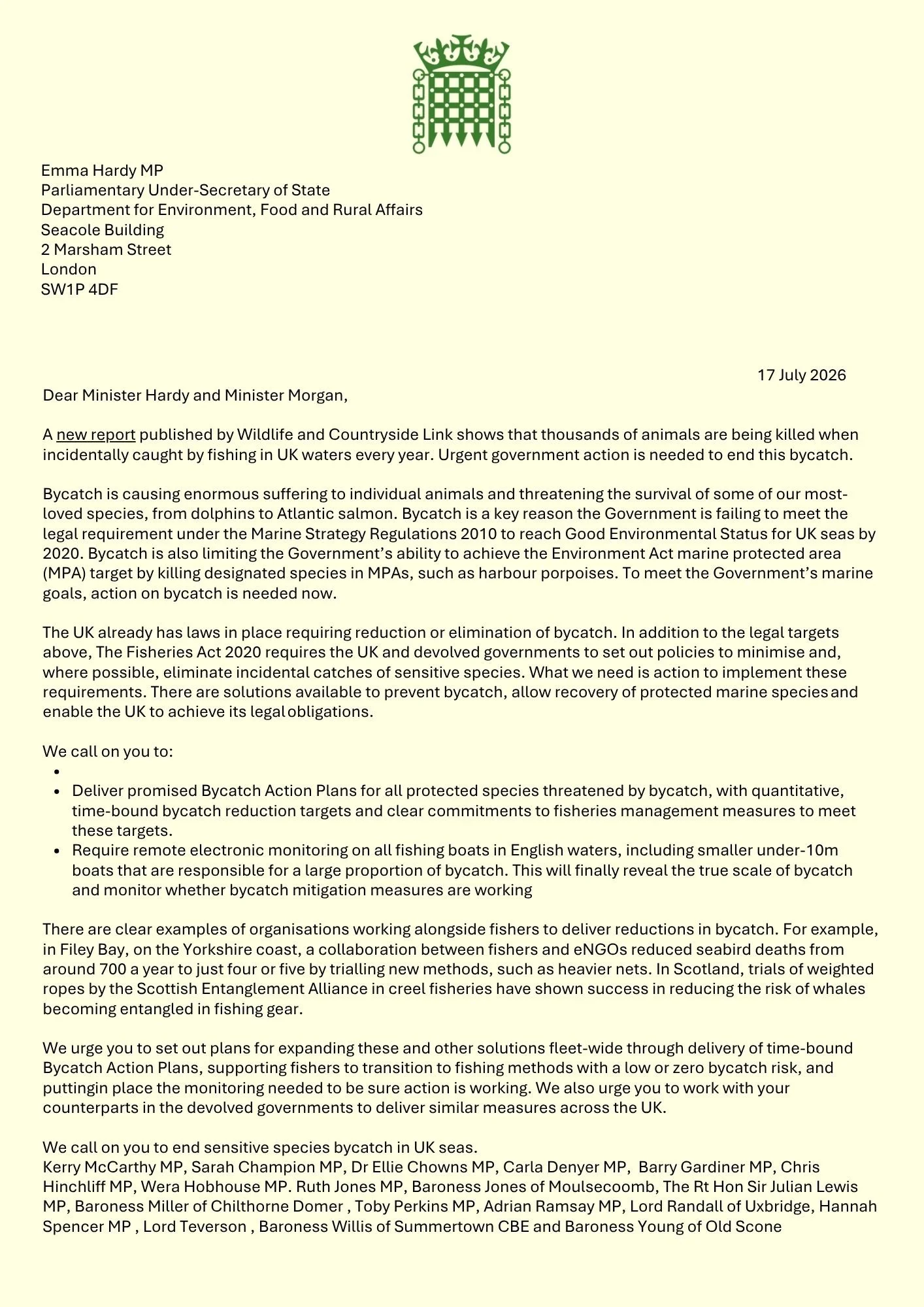
Letter to Ministers Hardy & Morgan on bycatch
-
Emma Hardy MP
Parliamentary Under-Secretary of State
Department for Environment, Food and Rural Affairs
Seacole Building
2 Marsham Street
London
SW1P 4DF
Stephen Morgan MP
Minister of State
Department for Environment, Food and Rural Affairs
Seacole Building
2 Marsham Street
London
SW1P 4DF
Date
Dear Minister Hardy and Minister Morgan,
A new report published by Wildlife and Countryside Link shows that thousands of animals are being killed when incidentally caught by fishing in UK waters every year. Urgent government action is needed to end this bycatch.
Bycatch is causing enormous suffering to individual animals and threatening the survival of some of our most-loved species, from dolphins to Atlantic salmon. Bycatch is a key reason the Government is failing to meet the legal requirement under the Marine Strategy Regulations 2010 to reach Good Environmental Status for UK seas by 2020. Bycatch is also limiting the Government’s ability to achieve the Environment Act marine protected area (MPA) target by killing designated species in MPAs, such as harbour porpoises. To meet the Government’s marine goals, action on bycatch is needed now.
The UK already has laws in place requiring reduction or elimination of bycatch. In addition to the legal targets above, The Fisheries Act 2020 requires the UK and devolved governments to set out policies to minimise and, where possible, eliminate incidental catches of sensitive species. What we need is action to implement these requirements. There are solutions available to prevent bycatch, allow recovery of protected marine species and enable the UK to achieve its legal obligations.
We call on you to:
Deliver promised Bycatch Action Plans for all protected species threatened by bycatch, with quantitative, time-bound bycatch reduction targets and clear commitments to fisheries management measures to meet these targets.
Require remote electronic monitoring on all fishing boats in English waters, including smaller under-10m boats that are responsible for a large proportion of bycatch. This will finally reveal the true scale of bycatch and monitor whether bycatch mitigation measures are working.
There are clear examples of organisations working alongside fishers to deliver reductions in bycatch. For example, in Filey Bay, on the Yorkshire coast, a collaboration between fishers and eNGOs reduced seabird deaths from around 700 a year to just four or five by trialling new methods, such as heavier nets. In Scotland, trials of weighted ropes by the Scottish Entanglement Alliance in creel fisheries have shown success in reducing the risk of whales becoming entangled in fishing gear.
We urge you to set out plans for expanding these and other solutions fleet-wide through delivery of time-bound Bycatch Action Plans, supporting fishers to transition to fishing methods with a low or zero bycatch risk, and puttingin place the monitoring needed to be sure action is working. We also urge you to work with your counterparts in the devolved governments to deliver similar measures across the UK.
We call on you to end sensitive species bycatch in UK seas.
Yours sincerely,
Kerry McCarthy MP
Sarah Champion MP
Dr Ellie Chowns MP
Carla Denyer MP
Barry Gardiner MP
Chris Hinchliff MP
Wera Hobhouse MP
Ruth Jones MP
Baroness Jones of Moulsecoomb
The Rt Hon Sir Julian Lewis MP
Baroness Miller of Chilthorne Domer
Toby Perkins MP
Adrian Ramsay MP
Lord Randall of Uxbridge
Hannah Spencer MP
Lord Teverson
Baroness Willis of Summertown CBE
Baroness Young of Old Scone
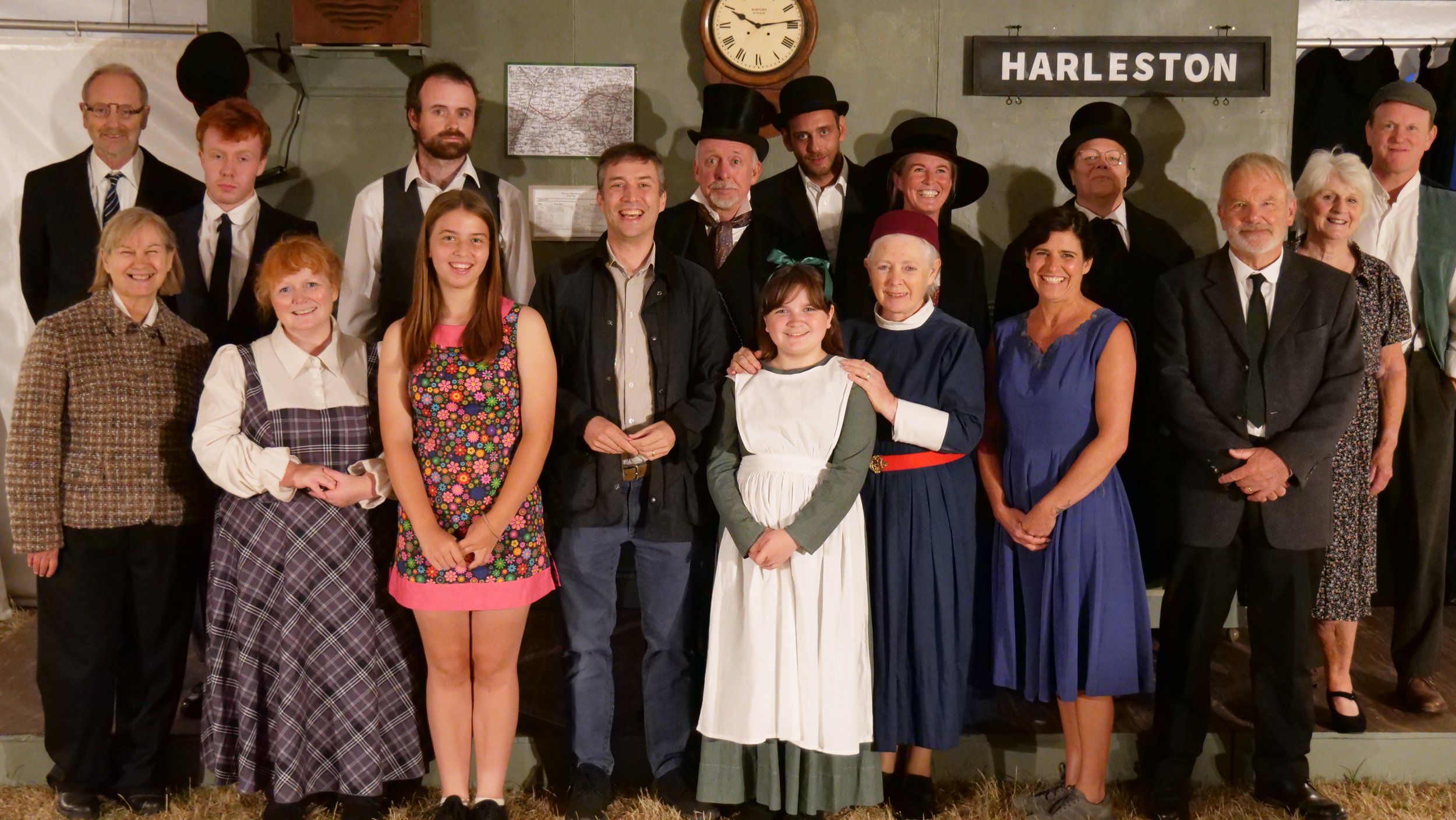
Final weekend to catch "All Aboard for the Waveney Valley Line!" at Harleston Players
Harleston Players' community production "All Aboard for the Waveney Valley Line!" reaches its final weekend on Thursday, 17th and Friday, 18th July.
The play follows a typical "railway" family as they work their way along the Waveney Valley Line, from Tivetshall to Beccles, charting its story from its opening in the 1850s to its closure a century later. The script draws on extensive research, contemporary newspaper reports and interviews with local people who remember the line when trains were still running.
The production brings together a cast of local amateurs spanning an age range of nearly seventy years, whose day jobs include teachers, nurses, social workers and sports instructors, to tell the story of an important part of the region's heritage.
Adrian Ramsay, MP for Waveney Valley, attended a recent performance and praised the production:
"I really enjoyed watching 'All Aboard for the Waveney Valley Line'. Congratulations to Harleston Players on a fantastic play, beautifully delivered. Eileen Ryan's extensive research of our local history enabled them to tell the story of the Waveney Valley line from its hopeful inception to its sad closure a century later. It was such a big part of the fabric of our wonderful area, and we can see the history around us today.
"The closure of so many railway lines in the 1950s and 60s was one of the most short-sighted political decisions ever. These lines today would be popular, financially viable, and have clean trains taking people around our communities.
"The play is funny, entertaining and educational, and I would recommend others to watch."
ENDS
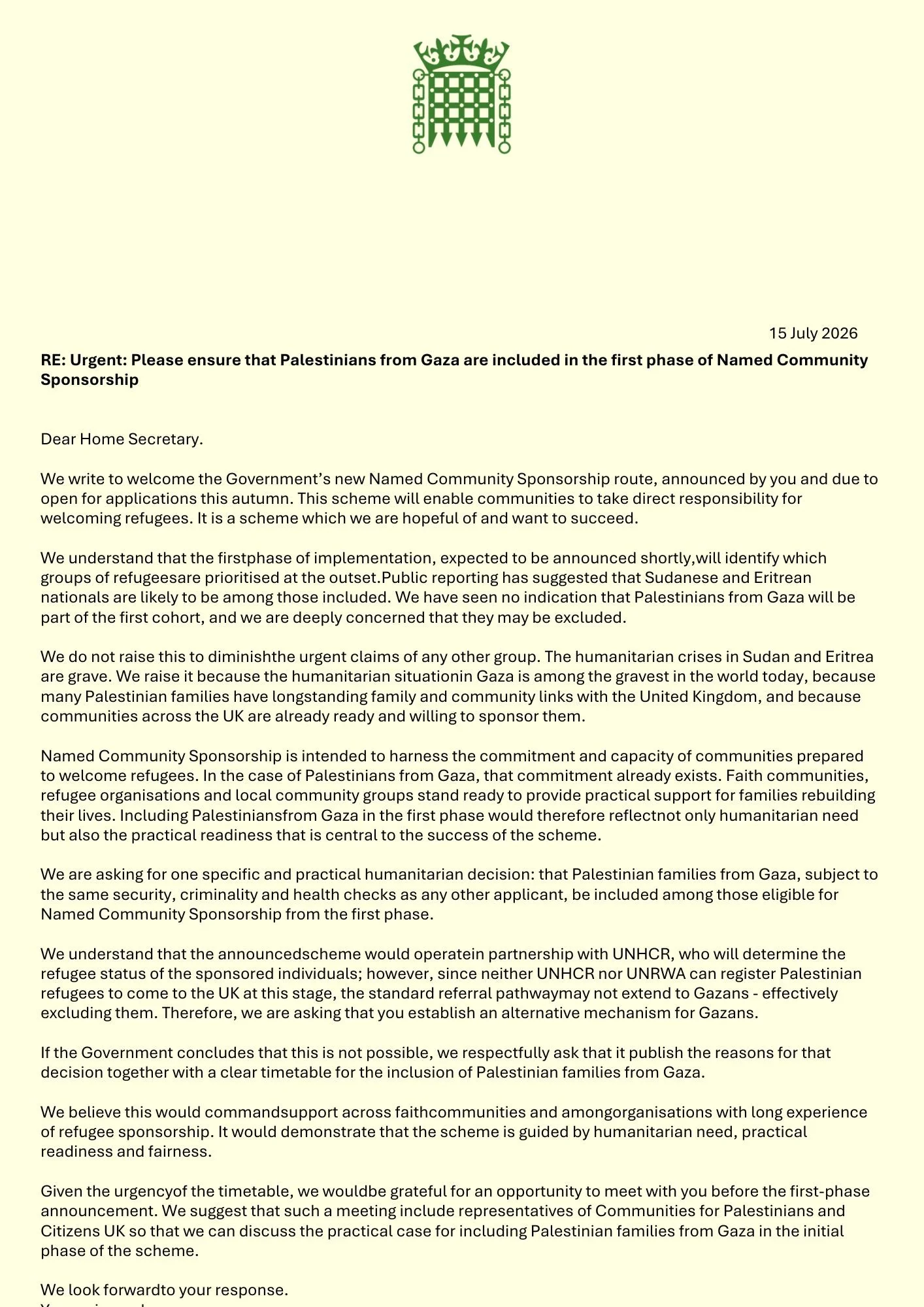
Letter on Palestinian Refugees
-
Urgent: Please ensure that Palestinians from Gaza are included in the first phase of Named Community Sponsorship
Dear Home Secretary.
We write to welcome the Government’s new Named Community Sponsorship route, announced by you and due to openfor applications this autumn. This scheme will enable communities to take direct responsibility for welcoming refugees. It is a scheme which we are hopeful of and want to succeed.
We understand that the first phase of implementation, expected to be announced shortly, will identify which groups ofrefugees are prioritised at the outset. Public reporting has suggested that Sudanese and Eritrean nationals are likely to be among those included. We have seen no indication that Palestinians from Gaza will be part of the first cohort, and we are deeply concerned that they may be excluded.
We do not raise this to diminish the urgent claims of any other group. The humanitarian crises in Sudan and Eritrea aregrave. We raise it because the humanitarian situation in Gaza is among the gravest in the world today, because many Palestinian families have longstanding family and community links with the United Kingdom, and because communities across the UK are already ready and willing to sponsor them.
Named Community Sponsorship is intended to harness the commitment and capacity of communities prepared to welcome refugees. In the case of Palestinians from Gaza, that commitment already exists. Faith communities, refugee organisations and local community groups stand ready to provide practical support for families rebuilding their lives. Including Palestinians from Gaza in the first phase would therefore reflect not only humanitarian need but also the practical readiness that is central to the success of the scheme.
We are asking for one specific and practical humanitarian decision: that Palestinian families from Gaza, subject to the same security, criminality and health checks as any other applicant, be included among those eligible for Named Community Sponsorship from the first phase.
We understand that the announced scheme would operate in partnership with UNHCR, who will determine the refugee status of the sponsored individuals; however, since neither UNHCR nor UNRWA can register Palestinian refugees to come to the UK at this stage, the standard referral pathway may not extend to Gazans - effectively excluding them. Therefore, we are asking that you establish an alternative mechanism for Gazans.
If the Government concludes that this is not possible, we respectfully ask that it publish the reasons for that decision together with a clear timetable for the inclusion of Palestinian families from Gaza.
We believe this would command support across faith communities and among organisations with long experience of refugee sponsorship. It would demonstrate that the scheme is guided by humanitarian need, practical readiness and fairness.
Given the urgency of the timetable, we would be grateful for an opportunity to meet with you before the first-phase announcement. We suggest that such a meeting include representatives of Communities for Palestinians and Citizens UK so that we can discuss the practical case for including Palestinian families from Gaza in the initial phase of the scheme.
We look forward to your response.
Yours sincerely,
Adrian Ramsay MP
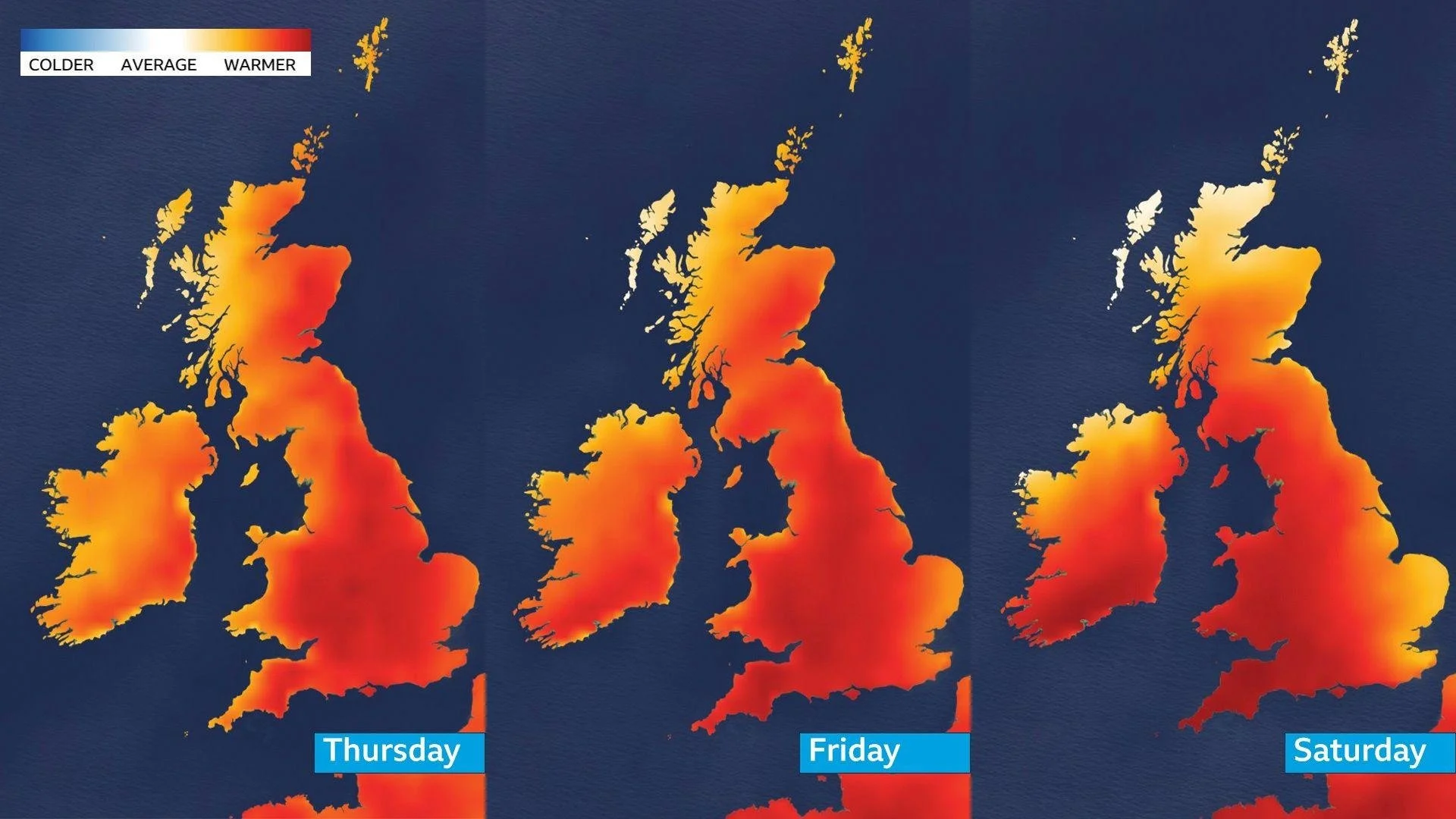
"Britain has entered a new climate reality" — Adrian Ramsay MP demands Government action after leading Westminster Hall debate on extreme heat
Adrian Ramsay MP, Green Party MP for Waveney Valley, today led a Westminster Hall debate on the UK's preparedness for extreme heat, warning MPs that "Britain has entered a new climate reality" and demanding the Government urgently deliver a national Heat Resilience Strategy, led from the Cabinet Office with clear ministerial accountability, ensuring that decisions on housing, infrastructure, health, energy and land use are all designed for the climate we now face. Heat-health warnings, public information and targeted support for vulnerable people should become routine before heatwaves strike.
In the debate, Adrian said recent heatwaves had exposed dangerous gaps in the country's readiness for a hotter climate, citing hospitals declaring critical incidents, record ambulance demand, school closures and major wildfires.
Among the most alarming failures raised in the debate was the breakdown of MRI scanners at the Norfolk and Norwich hospital, which serves part of Adrian’s Waveney Valley constituency, after their cooling systems failed during the June heatwave. Ramsay said this showed the NHS estate was "not designed to operate safely during prolonged periods of temperatures approaching 40°C."
Adrian pointed to analysis showing around 2,700 heat-related deaths occurred during the May and June heatwaves in England and Wales alone, and warned the June 2026 heatwave is estimated to have cost the UK economy at least £2.36 billion in lost productivity, a figure that could rise to £25 billion a year by 2030 without action.
Adrian Ramsay MP said:
"Britain has entered a new climate reality, and our public services are not ready for it. These were not isolated weather events, they were a real-world test of our preparedness for a hotter climate, exposing vulnerabilities across our health service, critical infrastructure, emergency response and natural environment.
"Hospitals have declared critical incidents and postponed operations. The London Ambulance Service recorded its busiest week on record. At the Norfolk and Norwich hospital in my constituency, MRI scanners stopped working when their cooling systems failed.
“The impacts of extreme heat don't fall evenly. It's the elderly, pregnant women and those with chronic illnesses who feel this most, and it's not just a public health issue, it threatens the resilience of the whole health and care system.
"This isn't just about hotter summers either. It's about whether our prisons, care homes, schools, transport and food supply can withstand the climate we're already living in. Water security is one of Britain's greatest long-term resilience challenges, fundamental to public health, food production, economic resilience and national security. Climate change is no longer just affecting where our food is grown, it is affecting what families can afford.
"The Government's own experts have told them what's needed, an £11 billion a year investment in resilience, led properly from the Cabinet Office. Instead, we get delay after delay.
"Adaptation is not a cost, it's an investment. Every year the Government fails to act, the bill for recovery gets bigger and the human cost gets higher. Britain needs a Heat Resilience Strategy now, not after the next heatwave kills more people."
ENDS
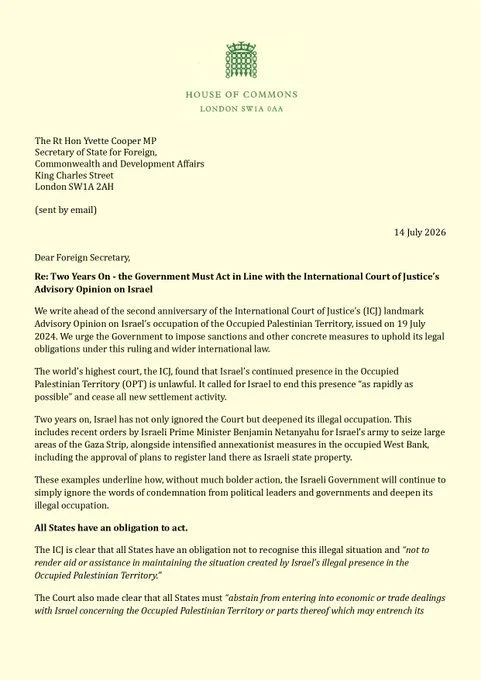
Letter on the International Court of Justice’s landmark Advisory Opinion on Israel’s occupation
-
The Rt Hon Yvette Cooper MP
Secretary of State for Foreign,
Commonwealth and Development Affairs
King Charles Street
London SW1A 2AH
(sent by email)
14 July 2026
Dear Foreign Secretary,
Re: Two Years On - the Government Must Act in Line with the International Court of Justice’s
Advisory Opinion on Israel
We write ahead of the second anniversary of the International Court of Justice’s (ICJ) landmark
Advisory Opinion on Israel’s occupation of the Occupied Palestinian Territory, issued on 19 July
2024. We urge the Government to impose sanctions and other concrete measures to uphold its legal
obligations under this ruling and wider international law.
The world’s highest court, the ICJ, found that Israel’s continued presence in the Occupied
Palestinian Territory (OPT) is unlawful. It called for Israel to end this presence “as rapidly as
possible” and cease all new settlement activity.
Two years on, Israel has not only ignored the Court but deepened its illegal occupation. This
includes recent orders by Israeli Prime Minister Benjamin Netanyahu for Israel’s army to seize large
areas of the Gaza Strip, alongside intensified annexationist measures in the occupied West Bank,
including the approval of plans to register land there as Israeli state property.
These examples underline how, without much bolder action, the Israeli Government will continue to
simply ignore the words of condemnation from political leaders and governments and deepen its
illegal occupation.
All States have an obligation to act.
The ICJ is clear that all States have an obligation not to recognise this illegal situation and “not to
render aid or assistance in maintaining the situation created by Israel’s illegal presence in the
Occupied Palestinian Territory.
”
The Court also made clear that all States must “abstain from entering into economic or trade dealings
with Israel concerning the Occupied Palestinian Territory or parts thereof which may entrench itsunlawful presence in the territory” and “take steps to prevent trade or investment relations that assist
in the maintenance of the illegal situation created by Israel in the OPT .
”
Additionally, the ICJ reiterated the obligations of all State Parties to the Fourth Geneva Convention to
ensure Israel’s compliance with international humanitarian law.
The Government’s Responsibilities
The ICJ’s Opinion identifies clear legal responsibilities on the Government.
Yet, despite acknowledging the Court’s findings, two years on, the Government has still not formally
responded or taken the steps required to meet its legal and moral obligations. Further delay is
simply indefensible.
The Government knows what needs to be done. It has rightly imposed widespread sanctions on
Russia for its illegal war on Ukraine. Yet there has been no such comprehensive response to Israel’s
actions in Gaza and the rest of the Occupied Palestinian Territory.
We are clear that international law cannot be applied selectively. The Government must apply the
same principles to Israel’s unlawful occupation as it does elsewhere.
In line with the ICJ’s Advisory Opinion and to uphold its legal obligations, we urge the Government
to act without delay by:
• Banning all trade in goods and services with illegal Israeli settlements and taking action
against companies profiting from or sustaining the illegal occupation.
• Imposing targeted sanctions, including travel bans and asset freezes, on all individuals and
entities complicit in maintaining Israel’s unlawful presence in the OPT , including political
leaders responsible for illegal settlement expansion and annexationist policies.
• Suspending the UK-Israel trade agreement until Israel complies with international law.
• Ending all arms transfers to Israel, including F-35 components and other equipment that may
be used in violations of international humanitarian law.
If the Government wants to show that its stated commitment to international law and human rights
is more than words, then it must act decisively and without further delay.
Yours sincerely,
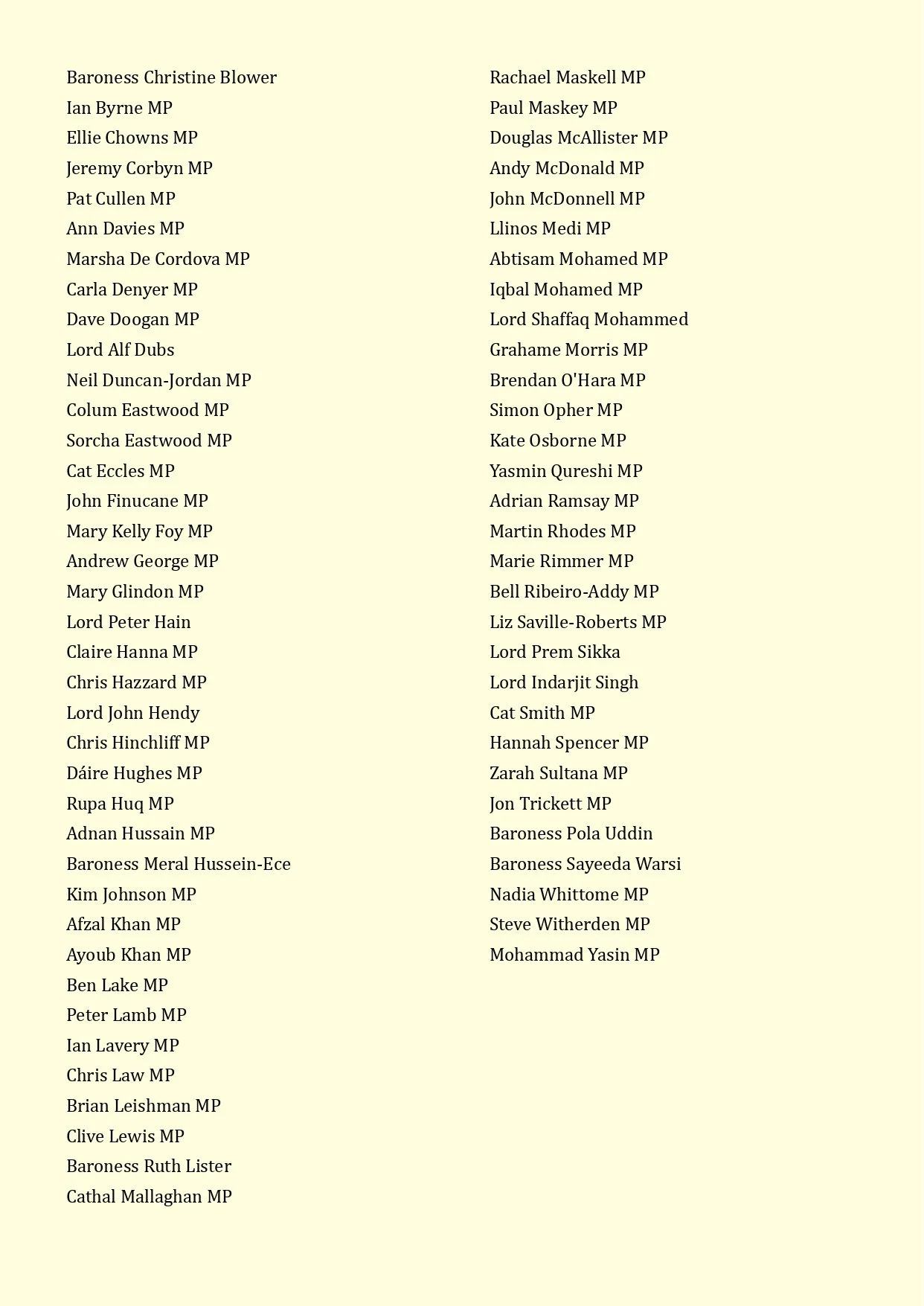
Richard Burgon MP and Imran Hussain MP
Diane Abbott MP
Shockat Adam MP
Lord John Alderdice
Tahir Ali MP
Paula Barker MP
Lorraine Beavers MP
Órfhlaith Begley MP
Apsana Begum MP
Siân Berry MP
Lara Bird MP
Lee Barron MP
Olivia Blake MPBaroness Christine Blower
Ian Byrne MP
Ellie Chowns MP
Jeremy Corbyn MP
Pat Cullen MP
Ann Davies MP
Marsha De Cordova MP
Carla Denyer MP
Dave Doogan MP
Lord Alf Dubs
Neil Duncan-Jordan MP
Colum Eastwood MP
Sorcha Eastwood MP
Cat Eccles MP
John Finucane MP
Mary Kelly Foy MP
Andrew George MP
Mary Glindon MP
Lord Peter Hain
Claire Hanna MP
Chris Hazzard MP
Lord John Hendy
Chris Hinchliff MP
Dáire Hughes MP
Rupa Huq MP
Adnan Hussain MP
Baroness Meral Hussein-Ece
Kim Johnson MP
Afzal Khan MP
Ayoub Khan MP
Ben Lake MP
Peter Lamb MP
Ian Lavery MP
Chris Law MP
Brian Leishman MP
Clive Lewis MP
Baroness Ruth Lister
Cathal Mallaghan MP
Rachael Maskell MP
Paul Maskey MP
Douglas McAllister MP
Andy McDonald MP
John McDonnell MP
Llinos Medi MP
Abtisam Mohamed MP
Iqbal Mohamed MP
Lord Shaffaq Mohammed
Grahame Morris MP
Brendan O'Hara MP
Simon Opher MP
Kate Osborne MP
Yasmin Qureshi MP
Adrian Ramsay MP
Martin Rhodes MP
Marie Rimmer MP
Bell Ribeiro-Addy MP
Liz Saville-Roberts MP
Lord Prem Sikka
Lord Indarjit Singh
Cat Smith MP
Hannah Spencer MP
Zarah Sultana MP
Jon Trickett MP
Baroness Pola Uddin
Baroness Sayeeda Warsi
Nadia Whittome MP
Steve Witherden MP
Mohammad Yasin MP
Cross-party Rosebank letter to the Prime Minister
-
Dear Prime Minister,
We are writing as a cross-party group of Members of Parliament and Members of the Scottish
Parliament to voice our collective opposition to the Rosebank oil field.
The decision your Government now faces is about more than just a single oil development –
a defining test of your commitment to the UK’s economic resilience and climate security.
Opposition to Rosebank spans across parliamentary benches and the nations of the UK.
Approving this development would be fundamentally incompatible with our legally binding
climate obligations and, crucially, with the secure future that energy workers and communities
deserve.
it is
While the oil and gas sector has previously served an important role in the UK’s economy,
claims that Rosebank would guarantee UK energy security or protect jobs do not hold up to
scrutiny. Most of what would be produced by Rosebank would be sold on international markets,
while profits continue to flow overseas rather than revitalising the industrial communities
currently struggling in the North East of Scotland, the North of England and beyond. The oil and
gas industry has scaled back on domestic renewable investment alongside repeated rounds of
redundancies, leading to increasingly insecure employment for the workforce.
Approving Rosebank would markedly diminish the UK’s standing on the world stage. At a time
when global climate action requires bold leadership, approving one of the largest undeveloped
oil fields in the UK would undermine our international credibility and weaken our ability to lead
on the world stage.
Instead, we urge you to use this pivotal moment to signal a decisive shift towards the green
industrial revolution. This is not a political choice between jobs and climate. This is a choice
between prolonging our dependence on volatile, declining markets, or instead investing directly
in British clean energy manufacturing capabilities that will provide employment for years to
come. Our focus must be on creating secure, well-paid jobs that place oil and gas workers at
the very heart of a genuinely fair energy transition.
The decision on Rosebank will be one of the defining choices of your premiership. We urge you
to reject this development, cement the UK’s climate leadership, and work with us to build a
fairer, cleaner, and more prosperous future for all of the communities we represent.
Yours sincerely,