
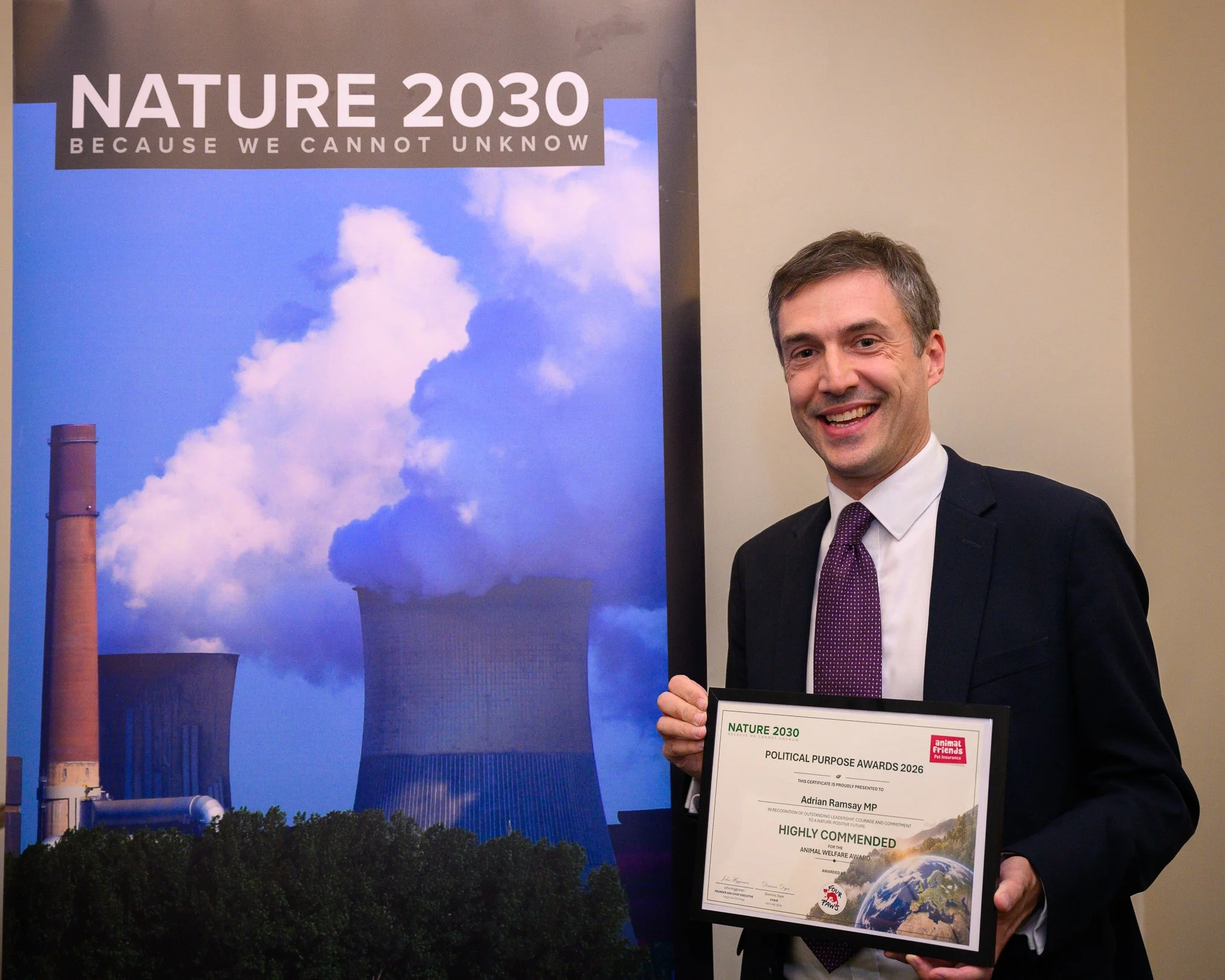
Adrian Ramsay MP highly commended for animal welfare work at Nature 2030 Political Purpose Awards
Adrian Ramsay MP for Waveney Valley has been highly commended for his work on animal welfare at the Nature 2030 Political Purpose Awards.
Adrian Ramsay MP said:
“I’m honoured to be highly commended for my work on animal protection at the Nature 2030 Political Purpose Awards. I enjoy working closely with animal charities and cross-party MPs to champion real improvements for animals - issues which many constituents write to me about all the time. How we treat animals is a test of our compassion and values as a country.
"The Government made many welcome pledges in the Animal Welfare Strategy release last year. It must now deliver on these promises for farmed animals, wildlife and pets alike. We need to end the cage age, stop the exploitation of animals for blood sports and stop the import of trophies from hunting. The Government should also go further with a clear pathway for ending experiments on animals and stopping greyhound racing.
“A huge thank you to all the brilliant campaigners who are keeping these issues in the spotlight. I look forward to working further with them to see meaningful change in this next year."
ENDS
Notes to editors:
The Nature 2030 Political Purpose Awards recognise Parliamentarians for their work on nature and animal welfare issues.
Photos can be found here:
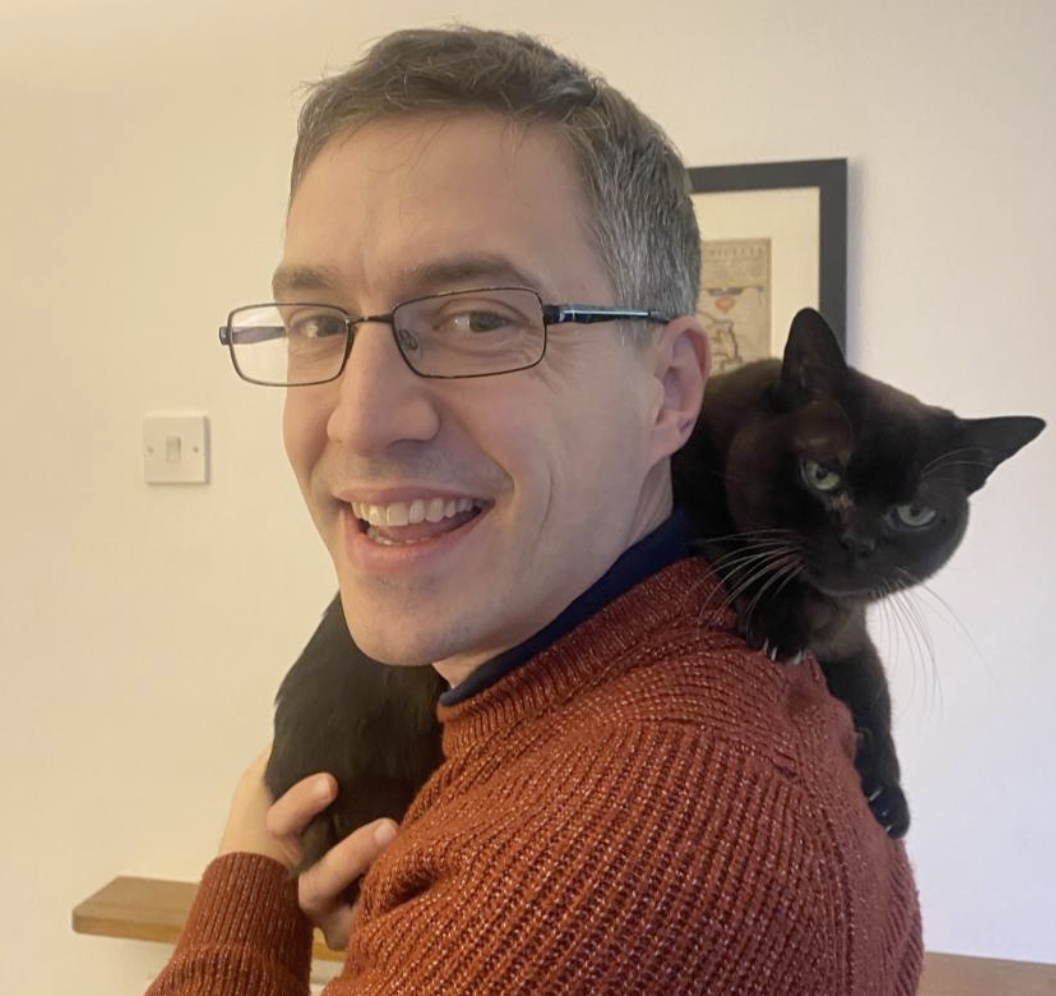
Adrian Ramsay MP's cat Bella crowned Purr Minister of 2026
Adrian Ramsay MP for Waveney Valley is delighted that his beloved cat Bella has won the public vote for Purr Minister of the Year.
Welcoming the victory and reinforcing his work on animal protection, Adrian said:
“I'm delighted that the real boss of our house, Bella, has been crowned Purr Minister of the United Kingdom. I'm very proud of her! Battersea does vital work on behalf of cats nationwide, helping to highlight the welfare challenges cats face and the action needed to keep them safe and healthy.”
Adrian continued by saying, “We are a nation of animal lovers, and I am proud to play a leading role in championing animal issues in Parliament. Animal protection isn’t a side issue. It is fundamental to the kind of country we want to be, and the public rightly expects us to act.”
“That is why it is vital that this Government fully implements the commitments in the Animal Welfare Strategy published last December. Ministers must set clear timescales to phase out confined systems in factory farms like crates and cages, properly support farmers through the transition, and ensure imports meet the same standards we expect of our own farmers. Warm words in a strategy document mean nothing without delivery, and animals deserve action not more delay.”
ENDS
Notes to editors:
Through Purr Minister, Battersea aims to encourage policymakers and the public alike to consider the welfare challenges facing cats today and the actions needed to help keep them safe and healthy.
For those inspired by Bella's success, Battersea encourages prospective owners to consider adopting a rescue cat and helping more animals find the loving homes they deserve. For more information about Purr Minister 2026, and to read Bella's winning 'Manifursto', visit: https://www.battersea.org.uk/about-us/news/purr-minister
Adrian has a long-standing record on animal welfare. In December 2025, he coordinated a cross-party letter, signed by over 35 Parliamentarians, urging the Government to ensure the forthcoming Animal Welfare Strategy included a time-bound phase-out of all confinement cages and crates in UK farming, alongside a fully-funded package to support farmers through the transition. At the time, Adrian said: "We often say the UK leads the world on animal welfare, yet millions of animals remain confined in awful conditions that many other European countries have already moved away from. As a nation that prides itself on caring for animals, it is unacceptable that these cruel practices continue."
When the Government's Animal Welfare Strategy was published, Adrian welcomed it but warned it "must have real teeth to deliver meaningful improvements for animals," calling for clear timescales to phase out crates and cages, proper support for farmers through the transition, and no imports that fail to meet UK standards. He also welcomed action on snares, hunting and puppy farming, while calling for the strategy to go further, including by ending greyhound racing, as the Welsh Government is doing.
Picture of Adrian & Bella can be found it at this link https://drive.google.com/file/d/1wyrPZdxsWLfMM39hVRMUsV7yRK3WN-f8/view?usp=sharing.
Press release from Battersea in case you did not receive it.
Battersea is delighted to announce that Bella, the beloved cat of Waveney Valley MP Adrian Ramsay, has been elected Purr Minister 2026.
After weeks of campaigning and public voting, 14-year-old Bella secured 36 per cent of the public vote, triumphing over three fellow feline candidates to become Westminster's top cat for 2026.
Bella won over voters with the promise of sweeping reforms - such as a ban on visible bowl bottoms and the introduction of a tuna-based economy - positioning herself as the candidate determined to tackle the issues that matter most to cats. Her vision of a future built on sunlight, full bowls, warm
keyboards and obedient humans clearly struck a chord with the electorate, landing her the title of Purr Minister 2026.
Battersea's much-loved Purr Minister competition continues to celebrate the unique role cats play in our lives while raising awareness of important cat welfare issues. Since launching in 2014, the contest has seen parliamentary cats from across Westminster compete for the prestigious title.
Adrian Ramsay, Waveney Walley MP and proud owner of Bella said: “Bella is greatly looking forward to devoting all of her 1.5 waking hours per day - when she isn’t eating, hunting spiders or grooming – to serving the cats of the United Kingdom and advancing the battle for full feline dominance and
sovereignty.”
Bella's victory comes as Battersea continues to campaign on behalf of cats nationwide. While microchipping became compulsory for pet cats in England in 2024, Battersea's latest research found that more than one in five cats still do not have a microchip, highlighting the ongoing need to raise awareness among owners. Through Purr Minister, Battersea aims to encourage policymakers and the public alike to consider the welfare challenges facing cats today and the actions needed to help keep them safe and healthy.
For those inspired by Bella's success, Battersea encourages prospective owners to consider adopting a rescue cat and helping more animals find the loving homes they deserve.
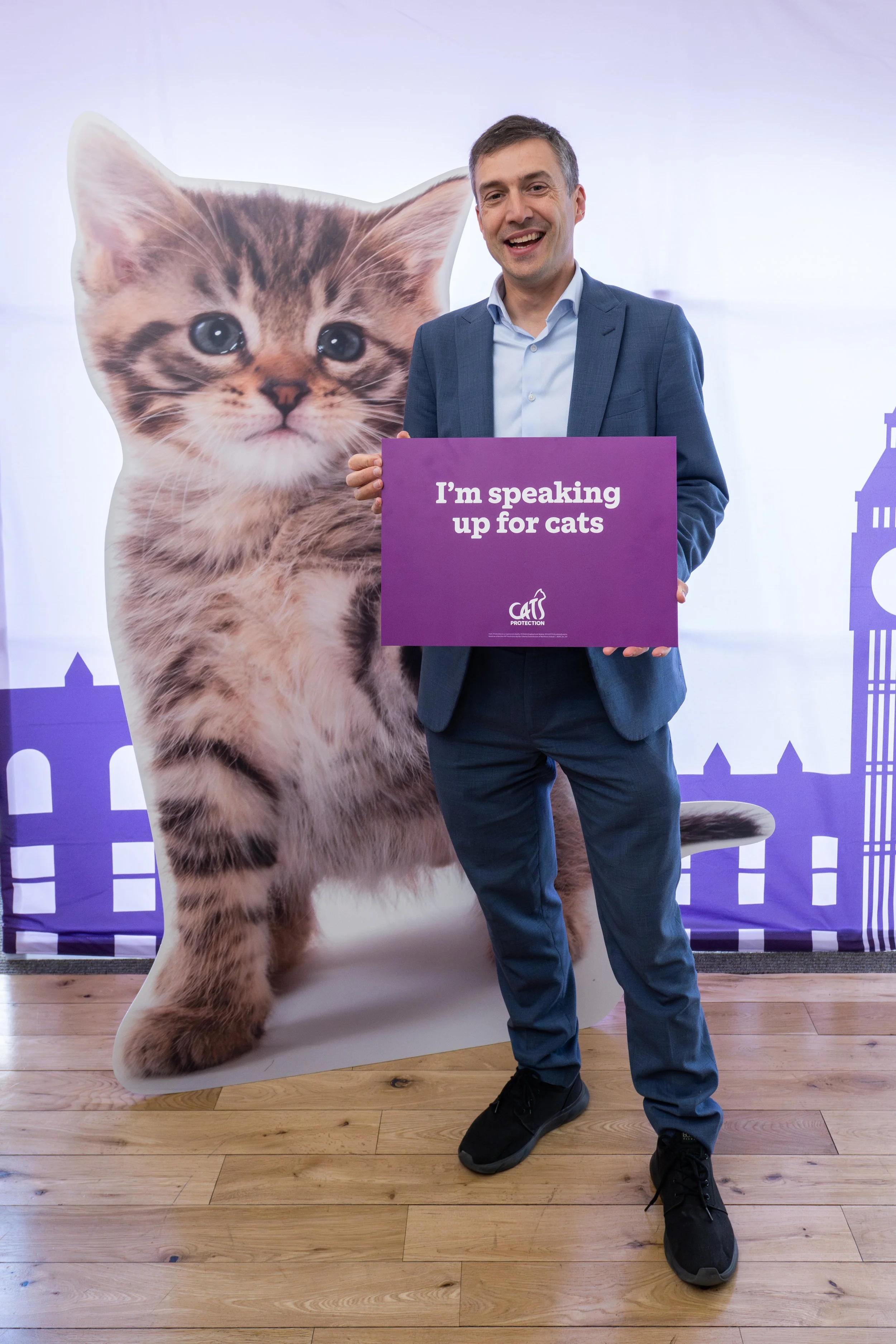
Adrian Ramsay joins Cats Protection in Parliament to discuss cat welfare
Adrian Ramsay joins Cats Protection in Parliament to discuss cat welfare
Adrian Ramsay MP for Waveney Valley joined fellow MPs and members of the House of Lords this week at a Cats Protection reception to discuss the UK’s most pressing cat welfare issues.
The UK’s leading cat charity hosted the parliamentary reception to raise awareness of many of the issues affecting the UK’s 10.4 million pet cats and the people who care for them.
A key issue raised at the event was exploitative cat breeding practices. According to Cats Protection, 36% of owned cats in the UK are pedigrees, which is up from 23% just five years ago1, and this includes an increasing number of “designer cats” with extreme characteristics like folded ears, flat faces or hairless bodies which will cause them chronic health problems and an extremely poor quality of life.
The charity is calling for a ban on the breeding of these cats with extreme characteristics, as well as a crackdown on sick and suffering cats being sold online and recently delivered a petition with over 60,000 signatures to 10 Downing Street calling for cat breeding regulations.
Other topics raised at the reception included a Cats Protection call to ban electric shock collars and to restrict fireworks to minimize stress to cats while Adrian Ramsay also spoke to the charity’s volunteers and staff about their essential cat rehoming, neutering and education work.
Adrian Ramsay said: “It was a privilege to meet Cats Protection’s volunteers and staff and hear about their vital work rehoming, neutering and caring for cats across the country. Sharing my home with our rescue cat, Bella, I know first-hand the joy that cats bring to families.
The Cats Protection reception was invaluable in shining a light on serious welfare issues still facing cats, from the rise of ‘designer cats’ bred with extreme characteristics that cause lifelong suffering, to the stress caused by fireworks and the cruelty of electric shock collars. I support Cats Protection’s calls for much tighter regulation of cat breeding and ending kitten smuggling, and I’ll continue to back their work to improve the lives of cats up and down the country.”
Madison Rogers, Associate Director of Advocacy, Campaigns and External Affairs said:
“We were delighted to bring MP and Peers together at our parliamentary reception to shine a light on some of the most pressing issues affecting cats today.
“From the urgent need for effective cat breeding regulations to prevent exploitation and suffering, to calls for a ban on electronic shock collars and stronger restrictions on fireworks, it’s clear that more must be done to protect cat welfare.
“Cats Protection is proud to make a difference nationally and in local constituencies through the dedication of our employees and volunteers. We look forward to working closely with parliamentarians to ensure cats and the people who care for them receive the protection and support they deserve.”
Cats Protection is the UK’s leading cat welfare charity and helps 191,000 cats through a national network of 182 volunteer-run teams and 31 centres.
Ends
Notes to Editors:
Picture of Adrian at the Cats Protection reception & with his Cat bella are avalible for use at this link https://drive.google.com/drive/folders/1fM9VDfgxD748HqyxQrMP8ovC7PhBYkw_?usp=sharing
Cats Protection is Charity No. 203644 (England and Wales) and SC037711 (Scotland). A company limited by guarantee registered in England and Wales (06772997). Registered office National Cat Centre, Chelwood Gate, Haywards Heath, Sussex, RH17 7TT.
Founded as the Cats Protection League in 1927, the charity adopted the name Cats Protection in 1998. We ask that you use the name Cats Protection when referring to the charity in all published material.
More information about the work of Cats Protection can be found at www.cats.org.uk
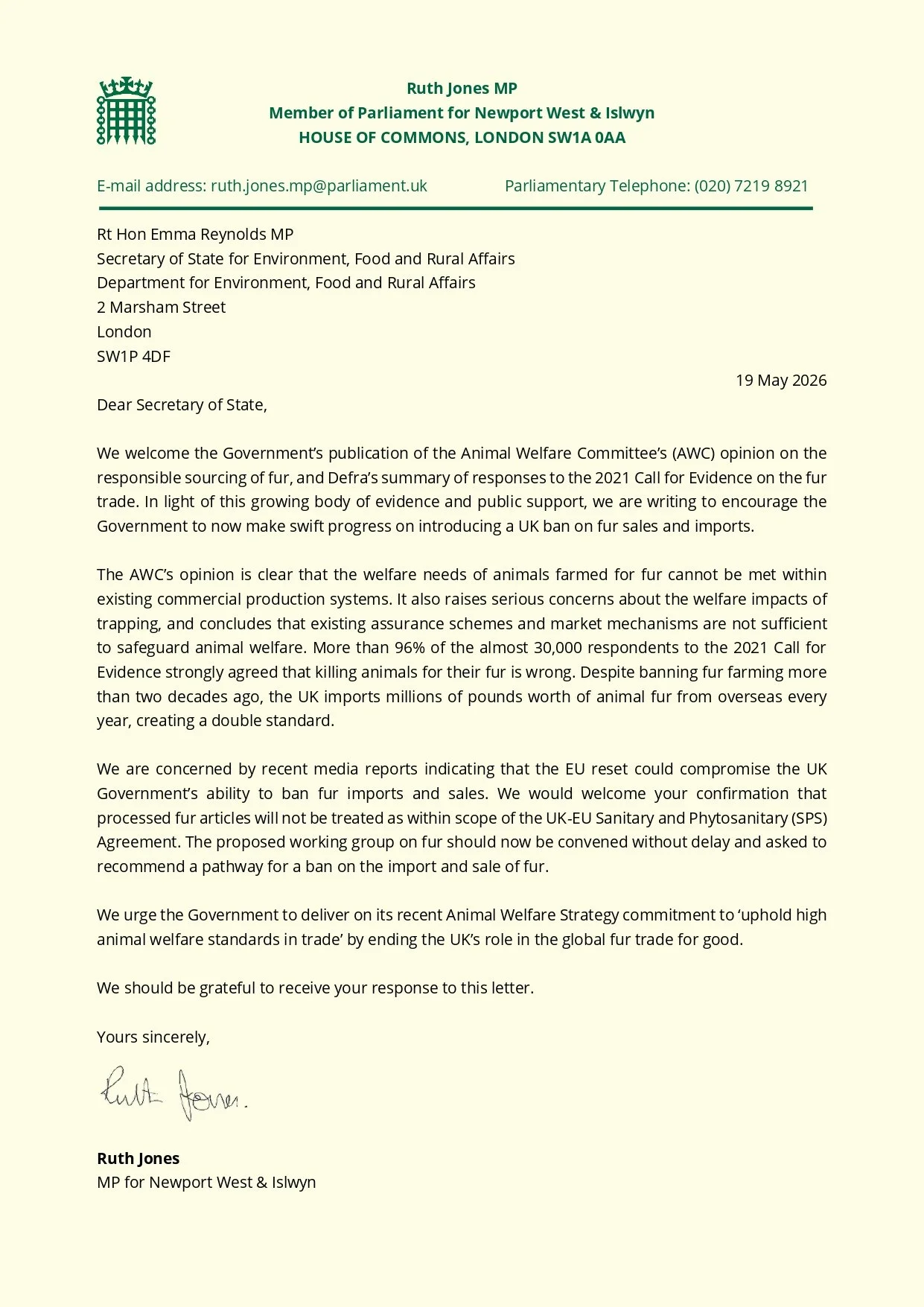
Cross-Party Letter on Fur Sale and Imports May 2026

-
Rt Hon Emma Reynolds MP
Secretary of State for Environment, Food and Rural Affairs
Department for Environment, Food and Rural Affairs
2 Marsham Street
London
SW1P 4DF
19 May 2026
Dear Secretary of State,
We welcome the Government’s publication of the Animal Welfare Committee’s (AWC) opinion on the
responsible sourcing of fur, and Defra’s summary of responses to the 2021 Call for Evidence on the fur
trade. In light of this growing body of evidence and public support, we are writing to encourage the
Government to now make swift progress on introducing a UK ban on fur sales and imports.
The AWC’s opinion is clear that the welfare needs of animals farmed for fur cannot be met within
existing commercial production systems. It also raises serious concerns about the welfare impacts of
trapping, and concludes that existing assurance schemes and market mechanisms are not sufficient
to safeguard animal welfare. More than 96% of the almost 30,000 respondents to the 2021 Call for
Evidence strongly agreed that killing animals for their fur is wrong. Despite banning fur farming more
than two decades ago, the UK imports millions of pounds worth of animal fur from overseas every
year, creating a double standard.
We are concerned by recent media reports indicating that the EU reset could compromise the UK
Government’s ability to ban fur imports and sales. We would welcome your confirmation that
processed fur articles will not be treated as within scope of the UK-EU Sanitary and Phytosanitary (SPS)
Agreement. The proposed working group on fur should now be convened without delay and asked to
recommend a pathway for a ban on the import and sale of fur.
We urge the Government to deliver on its recent Animal Welfare Strategy commitment to ‘uphold high
animal welfare standards in trade’ by ending the UK’s role in the global fur trade for good.
We should be grateful to receive your response to this letter.
Yours sincerely,
Ruth Jones
MP for Newport West & Islwyn
Paula Barker MP
Baroness Bakewell of Hardington Mandeville
Lorraine Beavers MP
Baroness Bennett of Manor Castle
Siân Berry MP
Bob Blackman CBE MP
Richard Burgon MP
Irene Campbell MP
Danny Chambers MP
Sarah Champion MP
Dr Ellie Chowns MP
Daisy Cooper MP
Alex Davies-Jones MP
Neil Duncan-Jordan MP
Sarah Dyke MP
Cat Eccles MP
Alex Easton MP
Patricia Ferguson MP
Baroness Fookes DBE
Mary Kelly Foy MP
Baroness Gale
Lord Gascoigne
Lord Goldsmith of Richmond Park
Wera Hobhouse MP
Baroness Helic
Baroness Hussein-Ece OBE
Alison Hume MP
Liz Jarvis MP
Terry Jermy MP
Baroness Jones of Moulsecoomb
Kim Johnson MP
Clive Lewis MP
Seamus Logan MP
Douglas McAllister MP
Kerry McCarthy MP
Rachael Maskell MP
Abtisam Mohamed MP
Iqbal Mohamed MP
Navendu Mishra MP
Josh Newbury MP
Adrian Ramsay MP
Baroness Redfern
Bell Ribeiro-Addy MP
Vikki Slade MP
Hannah Spencer MP
Lord Watts
Jo White MP
Nadia Whittome MP
Steve Witherden MP
Baroness Young of Old Scone
Supported by:
Claire Bass, Senior Director Campaigns and Public Affairs, Humane World for Animals UK
Sonul Badiani-Hamment, Country Director, FOUR PAWS UK
David Bowles, Head of Campaigns & Public Affairs, RSPCA
Elisa Allen, Vice President of Programmes and Operations, People for the Ethical Treatment of
Animals UK
Iain Green, Director, Animal Aid
Lorraine Platt, Co-founder, CAWF
Mark Glover, Campaigns Director, Respect for Animals
Richard Bissett, Executive Committee, Labour Animal Welfare Society
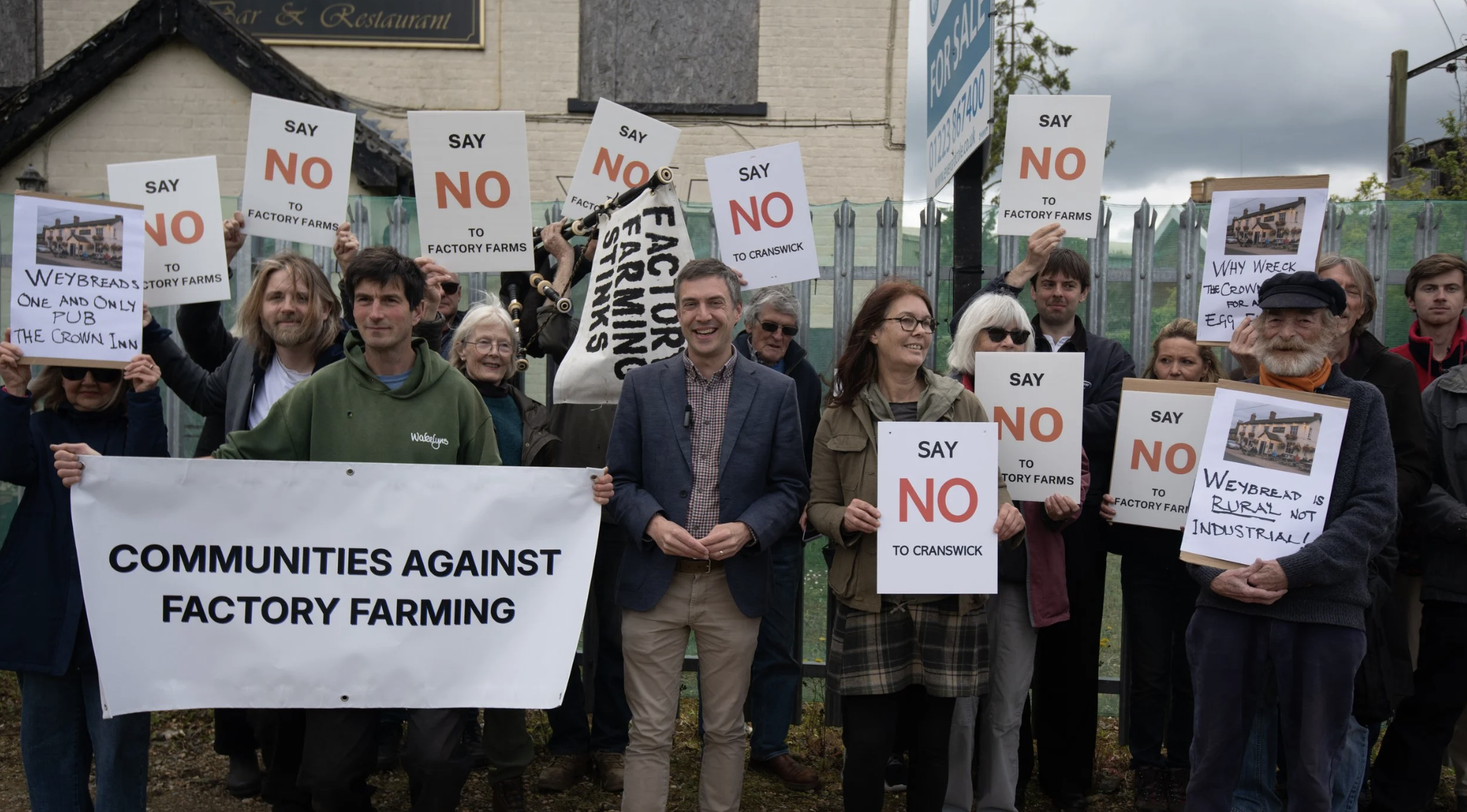
Green MP and Newly Elected Councilor join residents in Weybread to protest the Cranswick expansion.
Adrian Ramsay MP for Waveney Valley & Cllr Sally Mittuch joined residents in Weybread in a peaceful protest today against plans for a large-scale chicken incubation unit in the village.
The protest will see residents and campaigners gather outside the former Crown Inn to voice concerns over agricultural giant Cranswick’s controversial planning application for a broiler chicken incubation facility.
Campaign group Communities Against Factory Farming (CAFF), which has been supporting residents opposing the application, will attend alongside members of the Weybread Community Group.
Campaigners are urging Mid Suffolk District Council’s planning committee to “Stop the Incubator” and “Save Our Pub”.
Under the plans, The Crown Inn, which has been owned by Cranswick and closed for several years, would be demolished to make way for the factory development. Residents have raised concerns about the long-term loss of an important community asset, alongside worries over increased HGV traffic, industrial activity, pollution and the wider impact on village life.
Adrian Ramsay MP said
“The impact of large-scale factory farm developments on rural communities, like the one proposed in Weybread, is becoming increasingly concerning. These enormous industrial operations are being placed in tiny villages that are just not suitable.
Residents are rightly worried about the impact of three shift working patterns, with significant numbers of HGV movements travelling through small village roads throughout the day and night.
At a time when many rural communities desperately need genuinely affordable housing and investment in local services, people are asking why yet more large-scale industrial facilities are being prioritised over developments that would actually strengthen village life and support local people.
In addition, residents in Weybread are rightly concerned about the pollution impacts of this development and the huge implications of an increasingly industrialised food system for animal welfare."
Cllr Sally Mittuch, newly elected Green Councillor for Hoxne & Eye, said.
“Our community in Weybread has already seen huge changes over the past decade, and many residents feel we are gradually losing the very character of the village we love. People move to places like Weybread because of the countryside, the peace and the strong sense of community, but increasingly those qualities are being eroded by large-scale industrial developments that are completely out of keeping with a small rural village.
Residents still feel the loss of the village pub. Rural pubs are not just businesses; they are community spaces that bring people together and help sustain village life. We are deeply worried about the growing levels of industrial traffic, noise and disturbance associated with these kinds of developments, alongside the wider environmental impacts on the River Waveney and the surrounding countryside.”
ENDS
Prevalence of Criminal Activity Across the Greyhound Racing Industry
-
The Rt Hon Emma Reynolds MP
Secretary of State
Department for Environment, Food and Rural Affairs
Nobel House
17 Smith Square
London
SW1P 3JR
16 March 2026
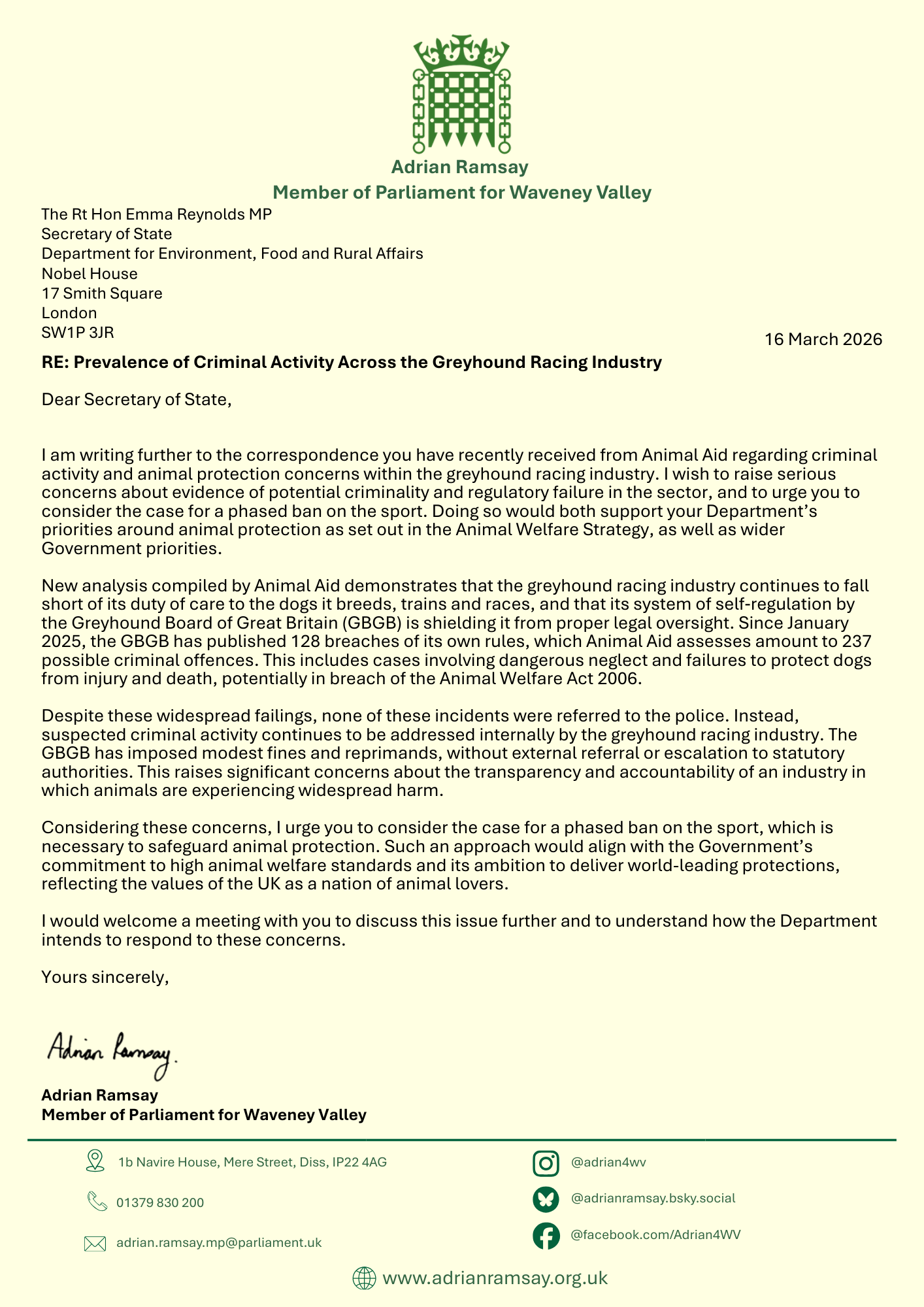
RE: Prevalence of Criminal Activity Across the Greyhound Racing Industry
Dear Secretary of State,
I am writing further to the correspondence you have recently received from Animal Aid regarding criminal activity and animal protection concerns within the greyhound racing industry. I wish to raise serious concerns about evidence of potential criminality and regulatory failure in the sector, and to urge you to consider the case for a phased ban on the sport. Doing so would both support your Department’s priorities around animal protection as set out in the Animal Welfare Strategy, as well as wider Government priorities.
New analysis compiled by Animal Aid demonstrates that the greyhound racing industry continues to fall short of its duty of care to the dogs it breeds, trains and races, and that its system of self‑regulation by the Greyhound Board of Great Britain (GBGB) is shielding it from proper legal oversight. Since January 2025, the GBGB has published 128 breaches of its own rules, which Animal Aid assesses amount to 237 possible criminal offences. This includes cases involving dangerous neglect and failures to protect dogs from injury and death, potentially in breach of the Animal Welfare Act 2006.
Despite these widespread failings, none of these incidents were referred to the police. Instead, suspected criminal activity continues to be addressed internally by the greyhound racing industry. The GBGB has imposed modest fines and reprimands, without external referral or escalation to statutory authorities. This raises significant concerns about the transparency and accountability of an industry in which animals are experiencing widespread harm.
Considering these concerns, I urge you to consider the case for a phased ban on the sport, which is necessary to safeguard animal protection. Such an approach would align with the Government’s commitment to high animal welfare standards and its ambition to deliver world-leading protections, reflecting the values of the UK as a nation of animal lovers.
I would welcome a meeting with you to discuss this issue further and to understand how the Department intends to respond to these concerns.
Yours sincerely,
Adrian Ramsay
Member of Parliament for Waveney Valley
Combating Illegal Seafood Imports
-
Adrian Ramsay MP co-signed this cross-party letter initiated by Kerry McCarthy MP & Sarah Champion MP.
Rt Hon Emma Reynolds MP
Secretary of State for Environment, Food and Rural Affairs
2 Marsham Street
London
SW1P 4DF
December 2025
Dear Secretary of State,
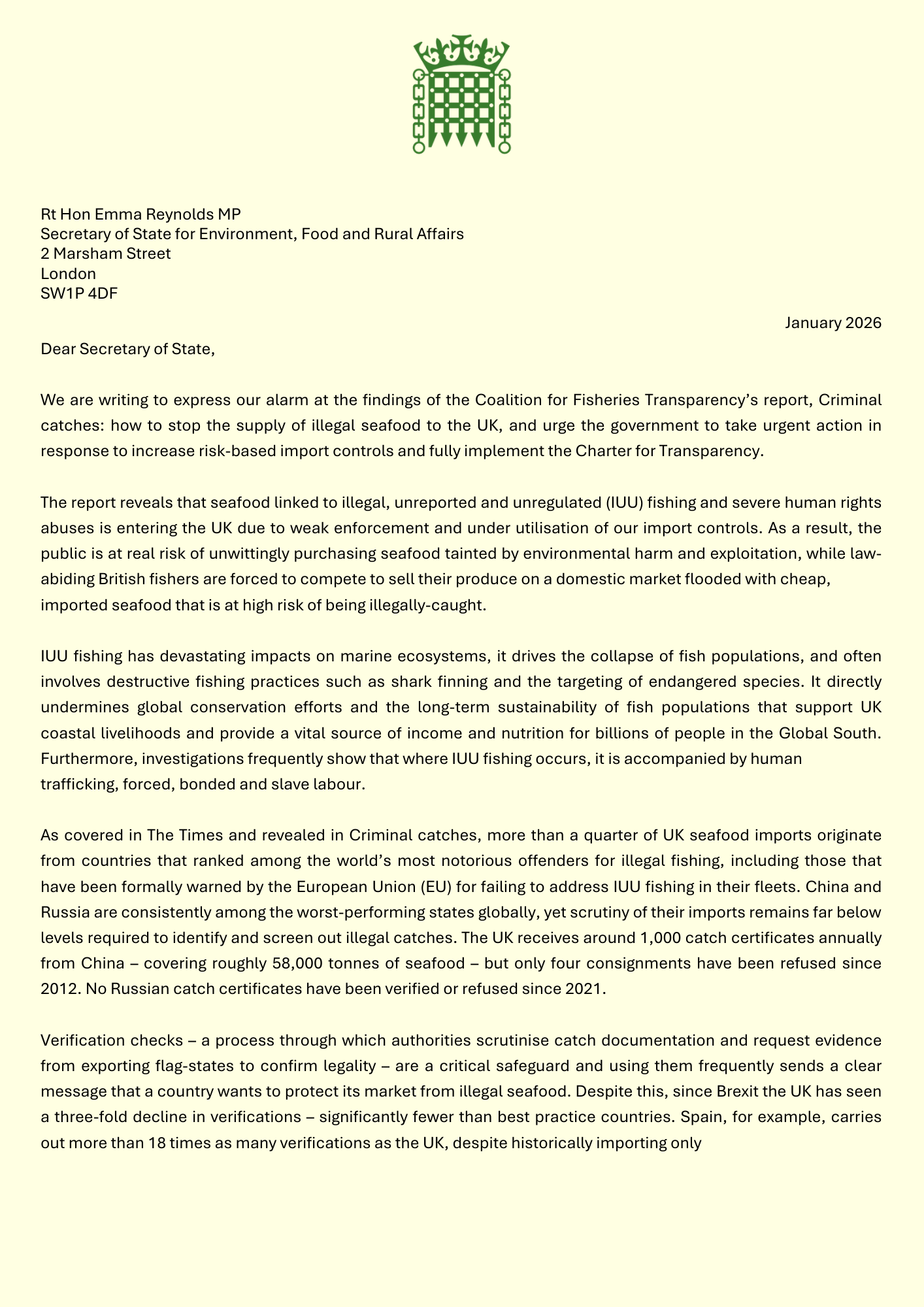
We are writing to express our alarm at the findings of the Coalition for Fisheries Transparency’s report, Criminal catches: how to stop the supply of illegal seafood to the UK, and urge the government to take urgent action in response to increase risk-based import controls and fully implement the Charter for Transparency.
The report reveals that seafood linked to illegal, unreported and unregulated (IUU) fishing and severe human rights abuses is entering the UK due to weak enforcement and under utilisation of our import controls. As a result, the public is at real risk of unwittingly purchasing seafood tainted by environmental harm and exploitation, while law-abiding British fishers are forced to compete to sell their produce on a domestic market flooded with cheap,
imported seafood that is at high risk of being illegally-caught.
IUU fishing has devastating impacts on marine ecosystems, it drives the collapse of fish populations, and often involves destructive fishing practices such as shark finning and the targeting of endangered species. It directly undermines global conservation efforts and the long-term sustainability of fish populations that support UK coastal livelihoods and provide a vital source of income and nutrition for billions of people in the Global South. Furthermore, investigations frequently show that where IUU fishing occurs, it is accompanied by human
trafficking, forced, bonded and slave labour.
As covered in The Times and revealed in Criminal catches, more than a quarter of UK seafood imports originate from countries that ranked among the world’s most notorious offenders for illegal fishing, including those that have been formally warned by the European Union (EU) for failing to address IUU fishing in their fleets. China and Russia are consistently among the worst-performing states globally, yet scrutiny of their imports remains far below
levels required to identify and screen out illegal catches. The UK receives around 1,000 catch certificates annually from China – covering roughly 58,000 tonnes of seafood – but only four consignments have been refused since 2012. No Russian catch certificates have been verified or refused since 2021.
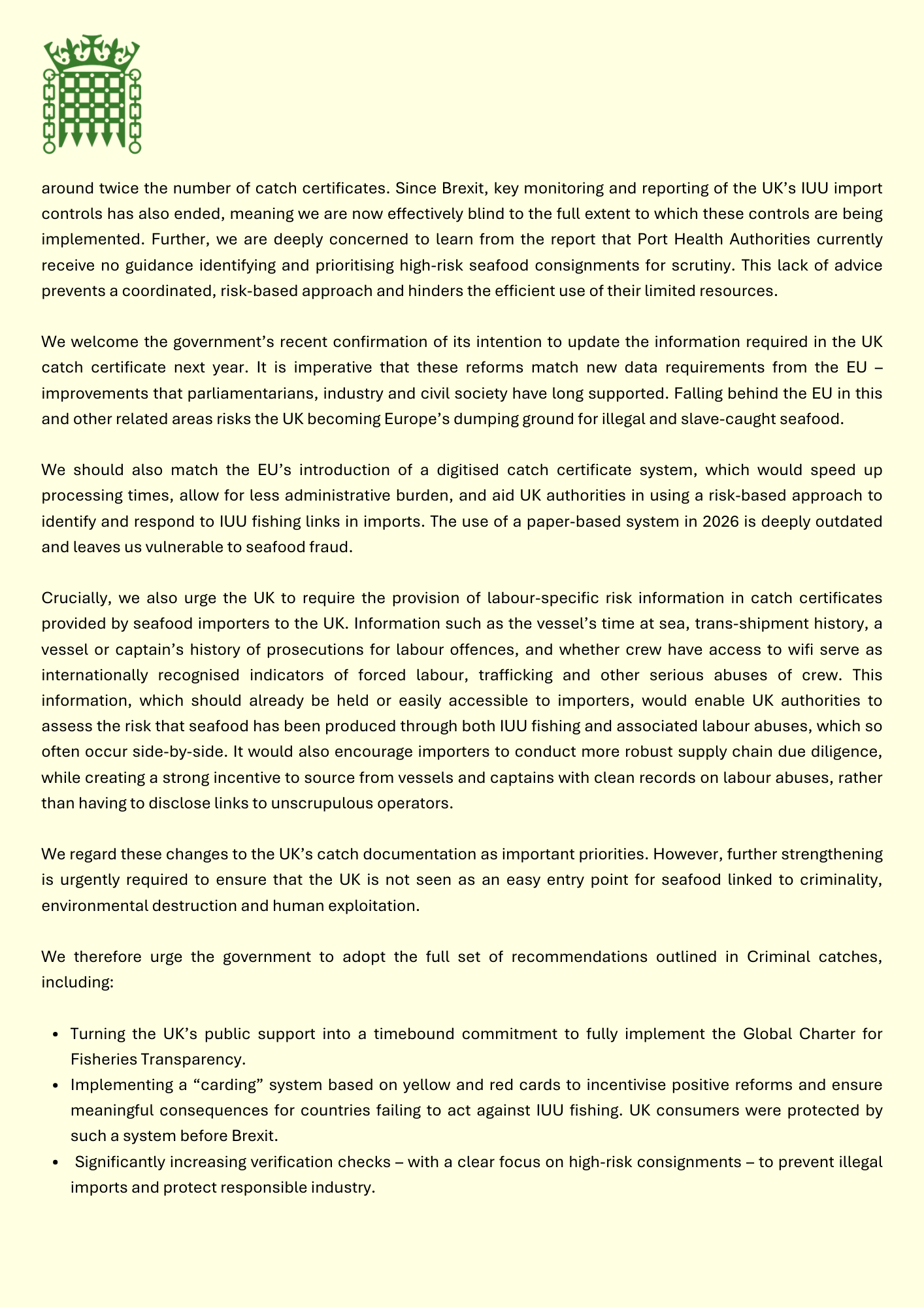
Verification checks – a process through which authorities scrutinise catch documentation and request evidence from exporting flag-states to confirm legality – are a critical safeguard and using them frequently sends a clear message that a country wants to protect its market from illegal seafood. Despite this, since Brexit the UK has seen a three-fold decline in verifications – significantly fewer than best practice countries. Spain, for example, carries out more than 18 times as many verifications as the UK, despite historically importing only
around twice the number of catch certificates. Since Brexit, key monitoring and reporting of the UK’s IUU import controls has also ended, meaning we are now effectively blind to the full extent to which these controls are being implemented. Further, we are deeply concerned to learn from the report that Port Health Authorities currently receive no guidance identifying and prioritising high-risk seafood consignments for scrutiny. This lack of advice prevents a coordinated, risk-based approach and hinders the efficient use of their limited resources.
We welcome the government’s recent confirmation of its intention to update the information required in the UK catch certificate next year. It is imperative that these reforms match new data requirements from the EU – improvements that parliamentarians, industry and civil society have long supported. Falling behind the EU in this and other related areas risks the UK becoming Europe’s dumping ground for illegal and slave-caught seafood.
We should also match the EU’s introduction of a digitised catch certificate system, which would speed up processing times, allow for less administrative burden, and aid UK authorities in using a risk-based approach to identify and respond to IUU fishing links in imports. The use of a paper-based system in 2026 is deeply outdated and leaves us vulnerable to seafood fraud.
Crucially, we also urge the UK to require the provision of labour-specific risk information in catch certificates provided by seafood importers to the UK. Information such as the vessel’s time at sea, trans-shipment history, a vessel or captain’s history of prosecutions for labour offences, and whether crew have access to wifi serve as internationally recognised indicators of forced labour, trafficking and other serious abuses of crew. This information, which should already be held or easily accessible to importers, would enable UK authorities to assess the risk that seafood has been produced through both IUU fishing and associated labour abuses, which so often occur side-by-side. It would also encourage importers to conduct more robust supply chain due diligence, while creating a strong incentive to source from vessels and captains with clean records on labour abuses, rather than having to disclose links to unscrupulous operators.
We regard these changes to the UK’s catch documentation as important priorities. However, further strengthening is urgently required to ensure that the UK is not seen as an easy entry point for seafood linked to criminality, environmental destruction and human exploitation.
We therefore urge the government to adopt the full set of recommendations outlined in Criminal catches, including:
Turning the UK’s public support into a timebound commitment to fully implement the Global Charter for Fisheries Transparency.
Implementing a “carding” system based on yellow and red cards to incentivise positive reforms and ensure meaningful consequences for countries failing to act against IUU fishing. UK consumers were protected by such a system before Brexit.
Significantly increasing verification checks – with a clear focus on high-risk consignments – to prevent illegal imports and protect responsible industry.
Implement a risk-based approach to identify consignments for further scrutiny at the border.
Together, these measures would help protect our ocean, support ethical supply chains and level the playing field for responsible UK fishers and businesses that sell seafood on the UK market.
We would welcome a meeting with you or a member of your ministerial team to discuss these findings and how we can work together to support a strengthened UK response.
We look forward to your reply.
Adrian Ramsay MP co-signed this cross-party letter initiated by Kerry McCarthy MP & Sarah Champion MP.
Saving Beagles From Animal Testing
-
Adrian Ramsay MP co-signed this cross-party letter initiated by Save the Begales.
Shabana Mahmood MP
Secretary of State for the Home Department
2 Marsham Street
SW1P 4DF
London
Dear, Shabana Mahmood MP,
We write to you as an incredibly deeply concerned and caring group of public figures and animal lovers. We are calling for the immediate closure of the puppy breeding facility, MBR Acres, as part of an urgent transition away from all animal testing in the United Kingdom.
MBR Acres, as you may know, is a facility in Cambridgeshire with the sole purpose of breeding beagle puppies for the utterly unnecessary animal testing industry - an estimated 2,000 dogs every year. These dogs, often as young as 16 weeks, are regularly experimented upon, with little to no benefit for humans or scientific knowledge.
The United Kingdom is a nation of animal lovers; we are home to the world’s oldest animal charity, the RSPCA, and nearly 40% of our households count a dog as a family member. In the face of this, it is utterly shocking that we continue to subject defenceless puppies to unimaginable pain in the animal testing industry.
This betrayal is even more gut-wrenching because it’s beagles who are chosen - precisely because they are gentle, friendly, affectionate and trusting. These traits make them beloved members of the family. In the lab, they're the perfect victims who won't put up a fight.
The use of animals for testing has, largely, become obsolete. This is not new information. As long ago as 2004, the British Medical Journal raised serious concerns with its reliability, with a paper posing the question: “Where is the evidence that animal research benefits humans?” A 2015 Cambridge Quarterly of Healthcare Ethics paper concluded, “When considering the ethical justifiability of animal experiments, we should ask if it is ethically acceptable to deprive humans of resources, opportunity, hope, and even their lives by seeking answers in what may be the wrong place. In my view, it would be better to direct resources away from animal experimentation and into developing more accurate, human-based technologies.”
New technologies such as cell culture, organ-on-chip, and in silico testing promise more reliable results, in less time, without the massive suffering and deaths of animals. The future is clear; all that remains is for the right decision to be made to focus on funding and expanding alternatives to testing on animals, like the beagle puppies from MBR Acres. The future is clear; now is the time for the UK to lead the world into an animal-free testing paradigm, instead of clinging to unreliable techniques that are a stain on our nation’s values.
The majority of the public is firmly against the use of animal testing, and now is the time to step up and do the right thing. Shut down MBR Acres, rehome the dogs and let Britain lead the world into a future without animal testing.
Kind Regards,
Adrian Ramsay MP co-signed this cross-party letter initiated by Save the Begales.
Green MP calls out Government over low-welfare imports
23rd January 2026
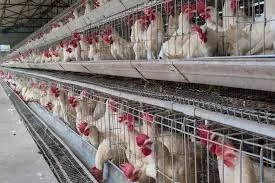
Adrian Ramsay says Government is 'importing cruelty' and not allowing British farmers a 'level playing field'
Adrian Ramsay MP, Waveney Valley, has criticised the Government for an incoherent system that undermines British farmers and animal welfare.
Speaking in Parliament, Adrian highlighted the contradiction that the UK rightfully bans many cruel farming practices, yet imports produced in the same way remain legal.
Contributing to the debate, Adrian said:
"What is illegal to produce here because it is too cruel remains legal to import and sell. It undermines public confidence and leaves higher-welfare British farmers facing unfair competition," he said.
UK farmers operate some of the highest animal welfare standards in the world, yet imports of pork, poultry, lamb, and eggs from countries with lower standards have soared. Trade deals risk widening the gap, while public support for banning low-welfare imports is overwhelming.
"According to the RSPCA and Compassion in World Farming, 95 per cent of countries with UK market access have lower animal welfare standards than the UK. HMRC data shows non-EU imports of eggs have more than tripled since 2020, poultry imports have risen by 60%, and pork imports by over 80%. In trade discussions with the United States, Ministers have focused on food safety and sanitary standards, but this narrow focus risks leaving a huge loophole for imports produced in ways that would be illegal here, widening the welfare gap instead of closing it," Adrian added.
Adrian called on the Government to ensure all animal products sold in the UK, domestic or imported, meet British welfare standards and carry clear welfare labelling, closing the loophole once and for all.
Adrian also continues to press for further improvements in UK welfare standards such as ending the use of farrowing crates and cages - with real support for farmers for this transition.
ENDS
Requesting Meeting on Trophy Hunting BanInbox
-
Dear Secretary of State,
We are writing to request an urgent meeting.
We applaud many of the measures in the government’s new Animal Welfare Strategy. However, we were surprised and disappointed that banning imports of hunting trophies did not feature.
We are also concerned at suggestions that a ban may be highly selective. You previously stated that you sought to “ban the import of any goods that are related to trophy hunting.” (https://www.youtube.com/watch?v=uKsLggGf5rY)
Several reports have spelt out the shocking cruelty involved in trophy hunting. This is an issue about which voters feel very strongly. It is also an issue about which there is virtual consensus in Parliament.
We would therefore be grateful if you would agree to a meeting at the earliest available opportunity to clarify both the scope of the government’s proposed ban and the timeline for introducing legislation.
Yours sincerely,
,
Adrian Ramsay MP co-signed this cross-party letter initiated by the Campaign to Ban Trophy Hunting.
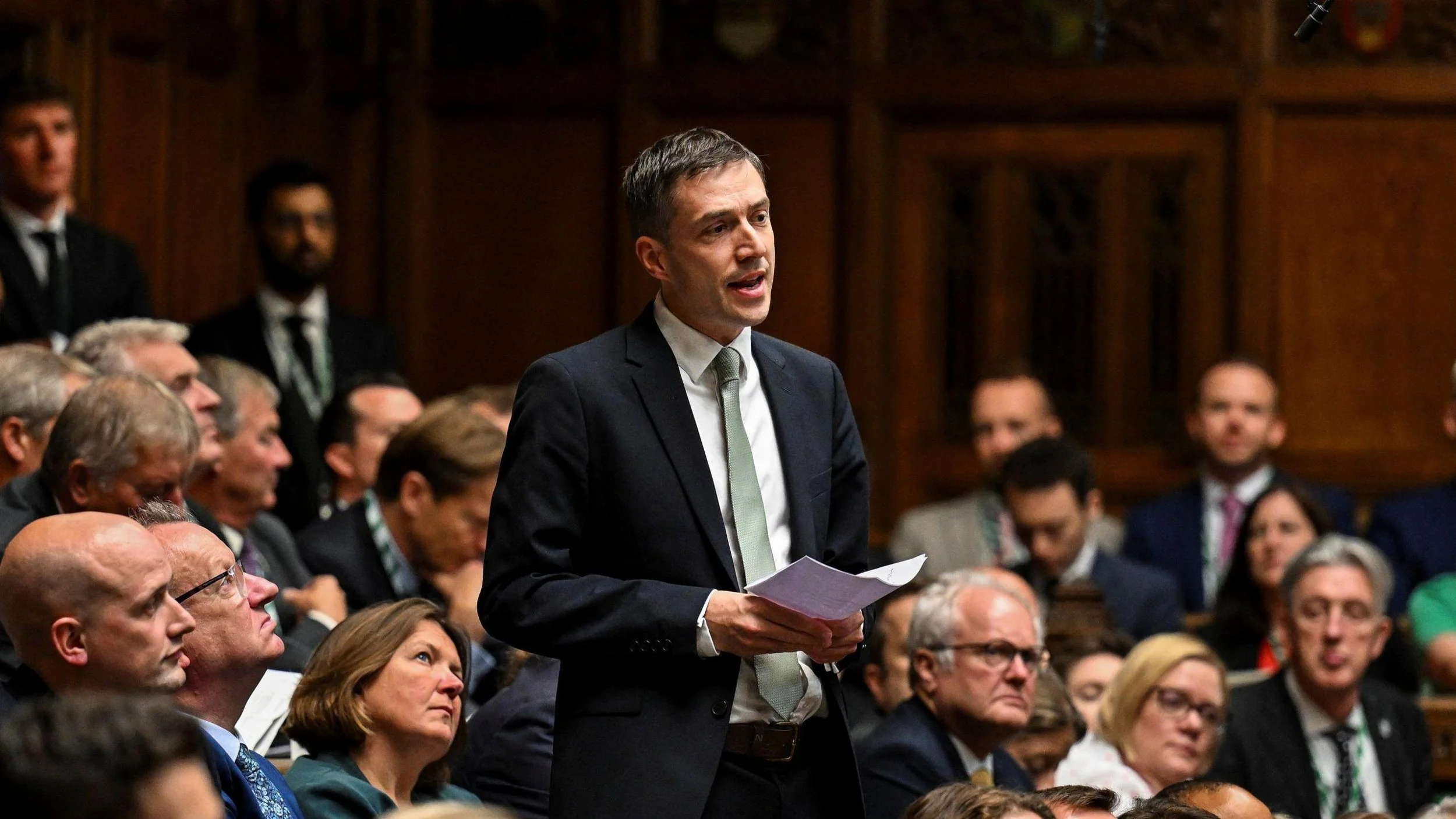
Adrian Ramsay, has welcomed the Government’s Animal Welfare Strategy, published today, but warned that it must have real teeth to deliver meaningful improvements for animals.
22nd of December 2025
Green MP for Waveney Valley, Adrian Ramsay, has welcomed the Government’s Animal Welfare Strategy, published today, but warned that it must have real teeth to deliver meaningful improvements for animals.
Adrian Ramsay said:
“There is much to welcome in the Animal Welfare Strategy, but it must have real teeth to deliver for animals. Ministers must set clear timescales to phase out crates and cages, properly support farmers through the transition and not allow imports that don’t meet UK standards.
“I welcome the action on snares, hunting and puppy farming. Puppy legislation must end breeding for extreme, unhealthy traits in dogs. The strategy could go further for animals, particularly by ending greyhound racing, as the Welsh Government is doing.
“Ending the use of farrowing crates and cages – as we called for in the cross-party letter I organised – is particularly crucial for tackling cruelty, and the strategy must set out how and when this will happen.”
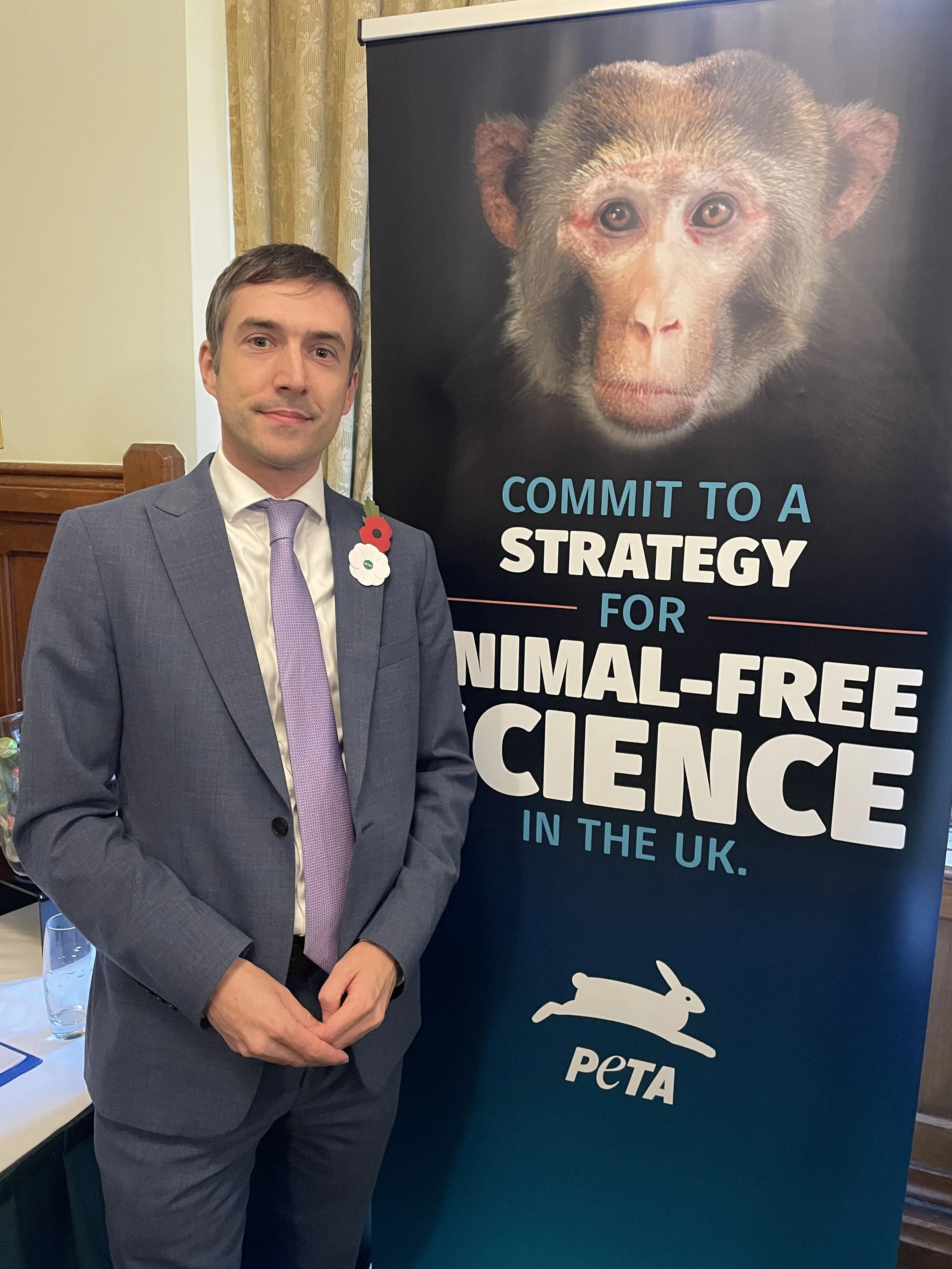
It is time to end the cruelty of cages and crates in UK farming
Originally published on the 12th of December 2025 on https://www.farmersguardian.com/blog/4523182/exclusive-adrian-ramsay-end-cruelty-cages-crates-uk-farming
The UK likes to believe it leads the world on animal welfare. We tell ourselves that we set high standards and that our farms reflect the compassion we hold so dear as a nation. Yet each year, millions of animals are trapped in conditions we would not allow our dogs or cats to endure. In far too many cases, hens are still confined to cages that offer less space than a sheet of A4 paper. Sows remain locked inside farrowing crates for weeks at a time, unable to turn around. Calves begin their lives alone in narrow pens that restrict natural movement. All of this continues despite mounting evidence, clear public concern, and workable alternatives.
Later this month, the Government is due to publish its Animal Welfare Strategy. It is a chance to meaningfully improve the lives of farmed animals. I led a group of 36 MPs and Lords from across the political spectrum, urging the Secretary of State for the Department for Environment, Food & Rural Affairs to use the animal welfare strategy to move towards a more humane treatment of farmed animals. This must start with a time-bound plan to phase out the use of confinement cages and crates in our farming system. However, regulation alone is not enough. The Government must offer financial and practical support to farmers so they can move to higher-welfare systems with confidence.
From talking with the NFU and farmers across my East Anglian constituency, it is clear that many support high welfare standards, and that they would welcome government support for improving welfare standards. They also often feel undercut by the megafarms – huge industrial units of hundreds of thousands of chickens or many thousands of pigs – which are becoming commonplace in East Anglia. Or they feel squeezed by the supermarkets driving down prices. Both these issues need simultaneous government action.
You might ask, Adrian, is this really a big issue? Well, there are almost eight million laying hens remaining in cages where they cannot even stretch their wings. About two hundred thousand pigs spend close to a quarter of their adult lives in farrowing crates. These animals live in conditions that deny their most basic instincts. Many countries in Europe have already recognised this and acted. They are moving away from cages for hens. Some, like Switzerland and Norway, have banned farrowing crates entirely. Research from Humane World for Animals shows that more than two-thirds of people in the UK oppose the use of farrowing crates, so there is growing public support to move towards a more humane system.
In our letter to the Secretary of State, we set out what must be done to bring the UK into line with international best practice. First, the Animal Welfare Strategy should set a timeline for the phase-out of farrowing crates, individual calf pens, and all cages used for birds. Second, the Government must back a funded transition package so that farmers can invest in new housing and management systems for their animals. Finally, stronger enforcement is essential. Too many existing laws go unmonitored and unenforced. New research from the Animal Law Foundation reveals that only 2.2% of UK farms were inspected in 2024, meaning 97.8% of farms received no official welfare visit at all. That means nearly all farms received no visit at all. This leaves both animals and law-abiding farmers at risk, while sending the wrong message to those, who do not follow the regulations. That means nearly all farms received no visit at all. This leaves both animals and law-abiding farmers at risk, while sending the wrong message to those who cut corners.
I was recently at an event where the problem was perfectly summed up. A country cannot claim leadership in animal protection while failing to check that its own laws are followed. When violations rarely lead to consequences, poor practice goes unchallenged. We would not tolerate it in any other regulatory area, nor should we accept it when animals are involved.
Alongside these measures, Greens would like to see trade rules reformed so that imports cannot be allowed where they fail to meet the same standards as are required in UK production. This is fundamental to supporting our farmers. We would also like to see action on supermarkets to stop the practice of driving down prices they pay to farmers to levels that stop farmers making a real living.
And of course, there are many other areas where I am advocating for farmers, such as the need for the Sustainable Farming Incentive to be reopened and put on a long-term footing that farmers can rely on – to help advance nature-friendly farming. Plus, I am pressing the Government to rethink its place on Agricultural Property Relief so that ordinary family farms are not impacted.
On my proposals for the Animal Welfare Strategy, many farmers already lead the way, and many more would join them if given the tools to do so. Higher welfare farming is part of a resilient food system because it supports healthier animals, reduces the risk of disease outbreaks and creates steadier supply chains that are less vulnerable to shocks. The Animal Welfare Strategy provides an opportunity to make improvements that reflect who we are as a country, while providing essential support to farmers for this transition. There’s strong public support for these changes and I hope the government delivers.
Proposed Restrictions on the Use of Terms Such as “Burger” and “Sausage” for Plant Based Foods
-
Adrian Ramsay MP co-signed this cross-party letter initiated by the Vegetarian Society.
LETTER TO MEMBERS OF THE EUROPEAN COMMISSION
From Members of Parliament of the United Kingdom
Re: Proposed Restrictions on the Use of Terms Such as “Burger” and “Sausage” for Plant Based Foods
06/12/2025
Dear Commissioners,
We write as members of the UK Parliament to express our deep concern regarding the proposed ban on the use of everyday, well-understood food terms, such as ‘burger’, ‘sausage’, and similar descriptors, when used for plant-based products. Although the United Kingdom is no longer a member of the European Union, our markets, companies, consumers, and regulatory conversations remain closely intertwined. Decisions taken at EU level continue to influence global norms, international trade, and the direction of sustainable food innovation.
We urge you not to adopt these restrictions, as we are deeply concerned about the significant global impact they could have. The evidence is clear: existing legislation already protects consumers; consumers themselves overwhelmingly understand and support current naming conventions; and new restrictions would undermine economic growth, sustainability goals, and the EU’s own simplification agenda.
1. Current legislation already ensures consumer protection
The Food Information to Consumers (FIC) Regulation provides extensive safeguards against consumer confusion. The European Court of Justice confirmed in Case C-438/23 that the current legislative framework is fully adequate to protect and inform consumers and to address misleading presentation when it arises1.
The Court also reiterated that existing rules already mandate transparency when expected ingredients are substituted - requirements that plant-based producers consistently follow.
This position has also been acknowledged at multiple points by the European Commission (see 2020 response2, 2022 response3 and 2024 response4).
2. Most consumers are not confused, however, a ban could increase confusion
1 https://eur-lex.europa.eu/legal-content/EN/TXT/PDF/?uri=CELEX:62023CJ0438
2 https://www.europarl.europa.eu/doceo/document/E-9-2020-004966-ASW_EN.html 3 https://www.europarl.europa.eu/doceo/document/E-9-2022-002681-ASW_EN.html 4 https://www.europarl.europa.eu/doceo/document/E-10-2024-002312-ASW_EN.html
Research consistently shows that consumers intentionally choose plant-based alternatives and do not confuse them with animal meat.
The Advocate-General’s Opinion (Capeta, 2024) explicitly warns that banning familiar food terms could increase confusion, not reduce it5. Empirical studies reinforce this finding:
• BEUC study (2020): ~80% support use of terms like ‘veggie burger’6 • Smart Protein (2023): Only 9% of consumers do not recognise plant-based meat alternatives7
• Germany (2022): 92% identify plant-based alternatives correctly8
• Spain (2021): Only 13% oppose plant-based use of traditional terms9 • Portugal (2021): >95% understand that plant-based alternatives contain no animal meat10
• Greece (2024): ~82% do not oppose current naming11
• Empirical study on label clarity (Gleckel, 2020)12
These findings show an overwhelming pattern; most European consumers understand the terminology for plant-based foods well.
3. The proposed ban undermines competitiveness, innovation, and the single market
Introducing a denomination ban would run counter to the EU’s commitments on simplification and competitiveness. It would create administrative burdens, force companies to redesign packaging, and generate inconsistencies across languages and Member States.
This is particularly problematic given the rapid growth of the plant-based market: • Europe remains the world’s largest consumer market for plant-based alternatives13
5
https://curia.europa.eu/juris/document/document.jsf?text=&docid=289831&pageIndex=0&doclang=en&mo de=req
6 https://www.beuc.eu/sites/default/files/publications/beuc-x-2020-
042_consumers_and_the_transition_to_sustainable_food.pdf
7 https://smartproteinproject.eu/wp-content/uploads/Smart-Protein-European-Consumer-Survey_2023.pdf 8 https://www.vzbv.de/sites/default/files/2022-
04/220307_IFH%20K%C3%96LN_Verbraucherzentrale_Kennzeichnung%20von%20Ersatzprodukten_final.p df9 https://proveg.com/es/wp-content/uploads/sites/2/2021/02/Resultados-estudio-nomenclatura-alimentos vegetales.pdf
10 https://www.atrevia.com/wp-content/uploads/2021/03/Relatorio_Upfield_FINAL_UCP.pdf 11 https://hellasveg.gr/wp-content/uploads/2025/05/survey-2024-final_EN.pdf
12https://ssrn.com/abstract=3727710
13 https://gfi.org/resource/plant-based-meat-eggs-and-dairy-state-of-the-industry-report
• The EU market grew 21% between 2020 and 202214
• Consumer trends show rising flexitarianism and reduced meat consumption15 • 31% of Europeans are reducing meat intake16
• Economic modelling demonstrates substantial opportunities: Plant-based dietary shifts could increase farm incomes by up to 71%17
• Alternative proteins could create 83 million jobs globally by 205018 • This sector is also a major opportunity for European farmers, with most crops used in plant-based dairy grown inside the EU (ProVeg International, 2022).
4. Plant-based foods support climate goals and European food security
Alternative proteins offer some of the highest emissions-reduction returns per euro invested, outperforming investments in electric vehicles and green building initiatives19.
They are also identified as one of the key ‘super-leverage points’ that can accelerate transitions across multiple sectors. Meldrum et al. (2023): The Breakthrough Effect.
Greater cultivation of pulses and legumes improves soil fertility and reduces fertiliser dependency, lowering production costs20,21. All of this shows that expanding plant-based options is aligned with environmental, economic, and food-security goals.
Conclusion
We recognise the importance of protecting consumers and ensuring clarity in food labelling. However, the evidence is unequivocal:
• Current EU law already provides full protection
• Consumers overwhelmingly understand and support the existing naming system • The proposed restrictions could damage competitiveness, innovation, and climate progress.
Clear labelling, not unnecessary terminology bans, is the best approach for consumers, producers, and the future of sustainable European food systems.
14 https://gfieurope.org/market-insights-on-european-plant-based-sales-2020-2022/ 15 https://smartproteinproject.eu/market-research/
16 https://europa.eu/eurobarometer/surveys/detail/2954
17 https://doi.org/10.1111/1477-9552.12530
18 https://www.climateworks.org/ginas-methane/
19 https://www.bcg.com/publications/2022/combating-climate-crisis-with-alternative-protein 20 https://doi.org/10.1016/j.ecolecon.2016.03.024
21 https://doi.org/10.1002/fes3.175
We therefore urge the Commission to reject these restrictions and maintain the current, proportionate, effective regulatory framework, which we firmly believe sets the global standard for best practice.
Yours sincerely,
Members of Parliament of the United Kingdom
Siân Berry MP
Irene Campbell MP
Jeremy Corbyn MP
Carla Denyer MP
Kerry McCarthy MP
Navendu Mishra MP
Adrian Ramsay MP
Alex Sobel MP
Also supported by:
The McCartney Family
Cross-party Parliamentarians urge Government to end cruelty of cages and crates in UK farming ahead of forthcoming Animal Welfare Strategy.
-
Adrian Ramsay MP initiated this cross-party letter with Irene Campbell MP.
3rd December 2025
The Rt Hon Emma Reynolds
Secretary of State for Environment, Food and Rural Affairs.
Dear Secretary of State,
We are writing as cross-party Parliamentarians to request that the forthcoming Animal Welfare Strategy includes a time-bound phase-out of all confinement cages and crates in farming, alongside a properly funded package of support for farmers to transition away from this practice.
Every year, millions of farmed animals in the UK endure severe and prolonged suffering confined to crates and cages. Around 8 million laying hens are kept in cages no larger than an A4 sheet of paper, unable to forage, feel sunlight, or fully stretch their wings. In addition, around 200,000 mother pigs spend nearly a quarter of their adult lives in farrowing crates, unable to turn around for weeks at a time and forced to nurse their piglets through metal bars.
The UK claims to have some of the highest farmed animal welfare standards. But despite progress in moving towards cage-free systems, millions of animals are still suffering daily, leaving us behind a number of European countries. Cagesfor hens are either banned or being phased-out in Austria, Germany, Czech Republic, France, Slovenia and Slovakia. Farrowing crates for sows are banned in Sweden, Switzerland and Norway.
In the UK there is clear and growing public, professional and industry-level support for ending this cruel and unnecessary practice. Research from Humane World for Animals shows that over two-thirds of the public oppose the use of farrowing crates. The British Veterinary Association reports that 75% of vets are concerned about the welfare impacts of these crates. And many farmers are ready and willing to transition away from this practice, given appropriate support to do so.
This Government was elected on a mandate to deliver the most ambitious animal welfare improvements in a generation. To deliver on this promise, we call on you to ensure the forthcoming Animal Welfare Strategy includes:
A time-bound phase-out of farrowing crates for sows, individual calf pens, and all cages used for birds, including hens, partridges, pheasants and quail.
A comprehensive, funded package of support to help farmers transition to higher-welfare systems.
Adequate resourcing for enforcement bodies and enhanced enforcement powers.
Measures to ensure Parliament can properly track and scrutinise progress on the phase-out, and the Strategy more broadly.
We should be grateful for your response to this letter.
Yours sincerely,
Adrian Ramsay MP
Irene Campbell MP
Fleur Anderson MP
Baroness Bennett of Manor Castle
Siân Berry MP
Bob Blackman MP
Olivia Blake MP
Richard Burgon MP
Ellie Chowns MP
Jeremy Corbyn MP
Carla Denyer MP
Dame Caroline Dinenage MP
Neil Duncan-Jordan MP
Sorcha Eastwood MP
Sarah Edwards MP
Andrew George MP
Lord Goldsmith of Richmond Park
Andrew Gwynne MP
Wera Hobhouse MP
Terry Jermy MP
Baroness Jones of Moulsecoomb
Clive Lewis MP
Kerry McCarthy MP
John McDonnell MP
Helen Maguire MP
Rachael Maskell MP
Manuela Perteghella MP
Peter Prinsley MP
Baroness Redfern
Bell Ribeiro-Addy MP
Jenny Riddell-Carpenter MP
Andrew Rosindell MP
Vikki Slade MP
Alex Sobel MP
Ian Sollom MP
Steve Witherden MP
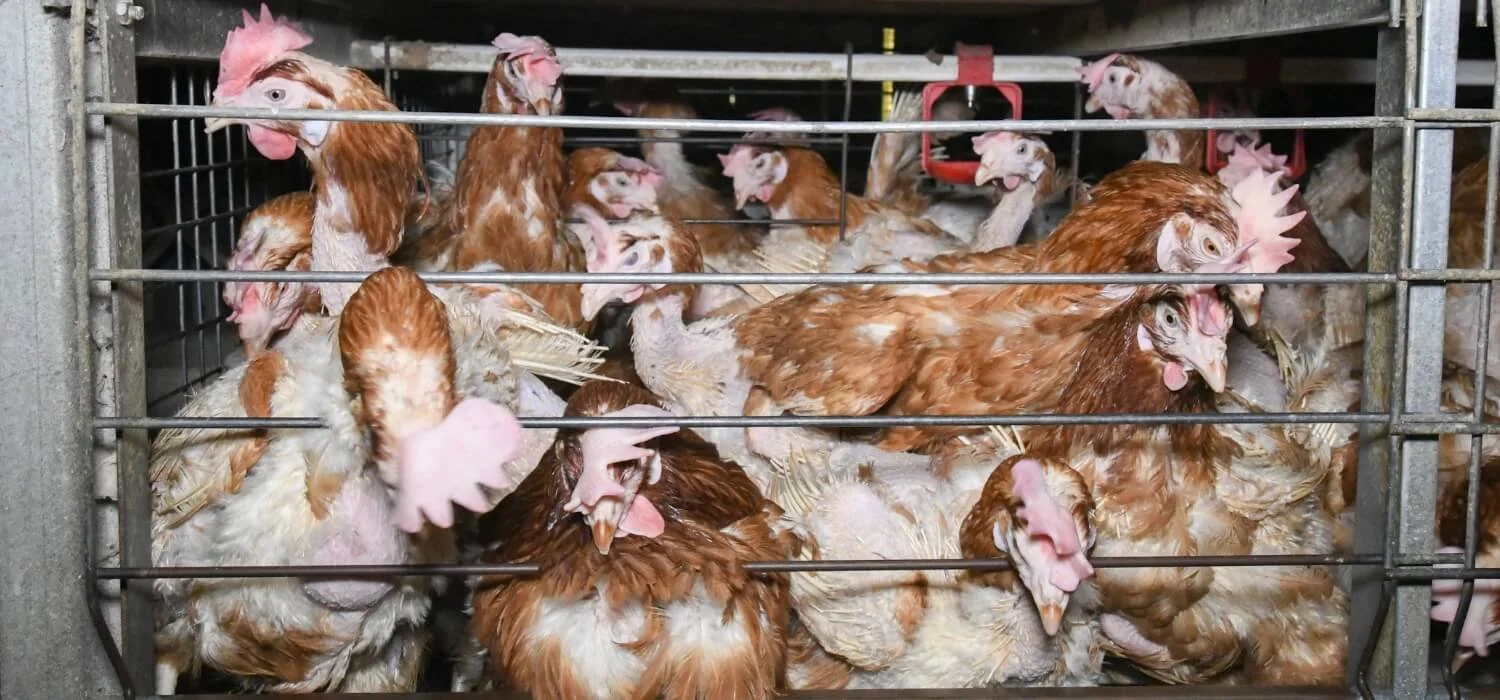
Cross-party Parliamentarians urge Government to end cruelty of cages and crates in UK farming ahead of forthcoming Animal Welfare Strategy.
3rd of December 2025
A cross-party group of over 35 Parliamentarians coordinated by Green MP Adrian Ramsay, have today written to the Secretary of State for Environment, Food and Rural Affairs urging her to ensure that the Animal Welfare Strategy - expected later this month - includes a time-bound phase-out of all confinement cages and crates in UK farming, alongside a fully-funded package to support farmers through the transition.
The letter urges the Government to commit to a phase-out of farrowing crates for sows, individual calf pens, and all cages used for birds. It also calls for adequate financial support to help farmers transition to higher-welfare systems.
Every year, millions of farmed animals in the UK endure severe and prolonged needless suffering inside cages and crates that restrict natural movement and behaviour. Sows in crates cannot turn around, while hens in cages can't even fully stretch their wings.
Speaking after submitting the letter Adrian Ramsay, the Green MP for Waveney Valley, said:
“We often say the UK leads the world on animal welfare, yet millions of animals remain confined in awful conditions that many other European countries have already moved away from. As a nation that prides itself on caring for animals, it is unacceptable that these cruel practices continue. The Animal Welfare Strategy is the moment to put this right and set a clear timetable for moving away from crates and cages.”
The MPs warn that failing to act would mean a wasted opportunity to deliver the ambitious and essential animal welfare improvements that voters were promised.
The letter also calls for stronger resources and powers for enforcement bodies, to ensure already existing laws surrounding animal protection are properly enforced.
This comes as new data reveals that only 2.2% of UK farms were inspected in 2024, meaning 97.8% of farms received no official welfare visit at all. The report, published by the Animal Law Foundation today, highlights the current state of monitoring and enforcement in UK farms.
Edie Bowles, Executive Director, The Animal Law Foundation said:
"The UK government cannot claim to be a world leader in animal protection while failing to enforce the laws that already exist.
"This is our third report, and it is also our third year of disappointment. Year after year, the evidence tells the same story: the system is simply not working. When only a tiny fraction of violations ever lead to consequences, the message to industry is clear: breaking the law carries no real risk."
ENDS
Full letter & signatories:
3rd December 2025
The Rt Hon Emma Reynolds
Secretary of State for Environment, Food and Rural Affairs.
Dear Secretary of State,
We are writing as cross-party Parliamentarians to request that the forthcoming Animal Welfare Strategy includes a time-bound phase-out of all confinement cages and crates in farming, alongside a properly funded package of support for farmers to transition away from this practice.
Every year, millions of farmed animals in the UK endure severe and prolonged suffering confined to crates and cages. Around 8 million laying hens are kept in cages no larger than an A4 sheet of paper, unable to forage, feel sunlight, or fully stretch their wings. In addition, around 200,000 mother pigs spend nearly a quarter of their adult lives in farrowing crates, unable to turn around for weeks at a time and forced to nurse their piglets through metal bars.
The UK claims to have some of the highest farmed animal welfare standards. But despite progress in moving towards cage-free systems, millions of animals are still suffering daily, leaving us behind a number of European countries.Cages for hens are either banned or being phased-out in Austria, Germany, Czech Republic, France, Slovenia and Slovakia. Farrowing crates for sows are banned in Sweden, Switzerland and Norway.
In the UK there is clear and growing public, professional and industry-level support for ending this cruel and unnecessary practice. Research from Humane World for Animals shows that over two-thirds of the public oppose the use of farrowing crates. The British Veterinary Association reports that 75% of vets are concerned about the welfare impacts of these crates. And many farmers are ready and willing to transition away from this practice, given appropriate support to do so.
This Government was elected on a mandate to deliver the most ambitious animal welfare improvements in a generation. To deliver on this promise, we call on you to ensure the forthcoming Animal Welfare Strategy includes:
A time-bound phase-out of farrowing crates for sows, individual calf pens, and all cages used for birds, including hens, partridges, pheasants and quail.
A comprehensive, funded package of support to help farmers transition to higher-welfare systems.
Adequate resourcing for enforcement bodies and enhanced enforcement powers.
Measures to ensure Parliament can properly track and scrutinise progress on the phase-out, and the Strategy more broadly.
We should be grateful for your response to this letter.
Yours sincerely,
Adrian Ramsay MP
Irene Campbell MP
Fleur Anderson MP
Baroness Bennett of Manor Castle
Siân Berry MP
Bob Blackman MP
Olivia Blake MP
Richard Burgon MP
Ellie Chowns MP
Jeremy Corbyn MP
Carla Denyer MP
Dame Caroline Dinenage MP
Neil Duncan-Jordan MP
Sorcha Eastwood MP
Sarah Edwards MP
Andrew George MP
Lord Goldsmith of Richmond Park
Andrew Gwynne MP
Wera Hobhouse MP
Terry Jermy MP
Baroness Jones of Moulsecoomb
Clive Lewis MP
Kerry McCarthy MP
John McDonnell MP
Helen Maguire MP
Rachael Maskell MP
Manuela Perteghella MP
Peter Prinsley MP
Baroness Redfern
Bell Ribeiro-Addy MP
Jenny Riddell-Carpenter MP
Andrew Rosindell MP
Vikki Slade MP
Alex Sobel MP
Ian Sollom MP
Steve Witherden MP
Gentoo penguins at Sea Life London
-
Adrian Ramsay MP co-signed this cross-party letter initiated by David Taylor MP.
Dear Secretary of State,
Re: Urgent review of the welfare of Gentoo penguins at SEA LIFE London Aquarium
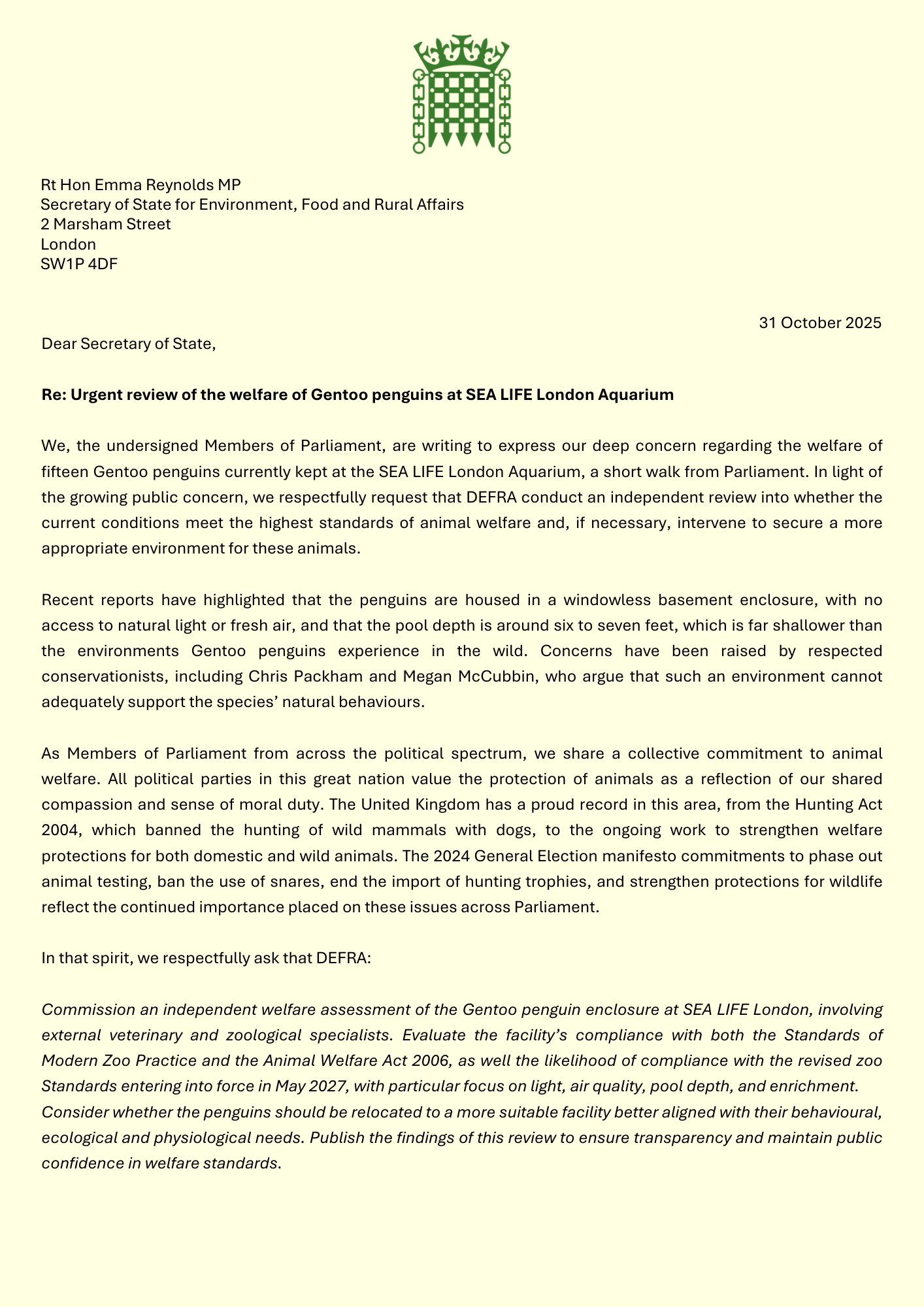
We, the undersigned Members of Parliament, are writing to express our deep concern regarding the welfare of fifteen Gentoo penguins currently kept at the SEA LIFE London Aquarium, a short walk from Parliament. In light of the growing public concern, we respectfully request that DEFRA conduct an independent review into whether the current conditions meet the highest standards of animal welfare and, if necessary, intervene to secure a more appropriate environment for these animals.
Recent reports have highlighted that the penguins are housed in a windowless basement enclosure, with no access to natural light or fresh air, and that the pool depth is around six to seven feet, which is far shallower than the environments Gentoo penguins experience in the wild. Concerns have been raised by respected conservationists, including Chris Packham and Megan McCubbin, who argue that such an environment cannot adequately support the species’ natural behaviours.
As Members of Parliament from across the political spectrum, we share a collective commitment to animal welfare. All political parties in this great nation value the protection of animals as a reflection of our shared compassion and sense of moral duty. The United Kingdom has a proud record in this area, from the Hunting Act 2004, which banned the hunting of wild mammals with dogs, to the ongoing work to strengthen welfare protections for both domestic and wild animals. The 2024 General Election manifesto commitments to phase out animal testing, ban the use of snares, end the import of hunting trophies, and strengthen protections for wildlife reflect the continued importance placed on these issues across Parliament.
In that spirit, we respectfully ask that DEFRA:
Commission an independent welfare assessment of the Gentoo penguin enclosure at SEA LIFE London, involving external veterinary and zoological specialists. Evaluate the facility’s compliance with both the Standards of Modern Zoo Practice and the Animal Welfare Act 2006, as well the likelihood of compliance with the revised zoo Standards entering into force in May 2027, with particular focus on light, air quality, pool depth, and enrichment.
Consider whether the penguins should be relocated to a more suitable facility better aligned with their behavioural, ecological and physiological needs. Publish the findings of this review to ensure transparency and maintain public confidence in welfare standards.
We wish to make clear that this is not an adversarial request but a constructive one, recognising the Government’s strong record on animal welfare and DEFRA’s expertise in safeguarding species under human care. This is an opportunity to demonstrate that the United Kingdom continues to lead the world in setting and upholding exemplary welfare standards.
We would be grateful for your response outlining the Department’s intended course of action and the anticipated timeframe for review.
Kind Regards,
Adrian Ramsay MP co-signed this cross-party letter initiated by David Taylor MP.
Cross-party letter on phasing out animal experiments
-
Lord Vallance
Minister of State for Science, Innovation & Technology
Department for Science, Innovation & Technology
100 Parliament Street
London SW1A 2BQ
Dear Lord Vallance, Lord Hanson and Baroness Hayman,
We are writing to you as the Ministers responsible for producing the Government’s forthcoming strategy to support the development, validation and uptake of non-animal methods.
We support the Government’s commitment to phasing out animal experiments. As well as improving animal welfare, focusing on modern, human-specific methods will accelerate medical breakthroughs and unlock the economic opportunities presented by this growing global market. The non-animal alternatives testing market is expected to grow at a Compound Annual Growth Rate of 12% to reach $4.08 billion in 2029.
Around the world, policymakers are taking bold steps to support the transition to human-specific science. This includes the US FDA’s Roadmap that seeks to make animal testing ‘the exception rather than the norm’ over the next 3-5 years in preclinical safety testing, while the European Union has committed to a roadmap to phase out chemical testing on animals. If we are to keep pace, and position Britain as a global leader in human-specific life sciences, the forthcoming alternatives strategy must be bold and transformative.
As well as measures to increase funding and practical support to enable scientists to transition to non-animal methods, it should commit to:
Introduce Herbie’s Law to provide a clear timeline for the phase-out. Recommended by Animal Free Research UK, Herbie’s Law would set a goal of phasing out animal experiments in medical research over the next decade, working closely with the scientific community to support them with the transition.
As a first step, stop issuing licences for experiments using dogs and cats, as well as non-human primates. It is crucial that these are replaced with non-animal methods, not other species of animal, which would fail to address the scientific and ethical problems.
Institute a thorough overhaul of the licensing of animal experiments to ensure that basic legal requirements to use non-animal methods wherever possible are being properly enforced.
Including these measures will ensure that the strategy has real impact in driving the phase-out of animal experiments. As a nation of animal lovers, we must harness our long-established scientific excellence to lead the transition to future-focused, human- specific medical research, which will transform the lives of people around the world.
Yours sincerely,
Irene Campbell MP (Labour)
Chair of the All-Party Parliamentary Group on Phasing Out Animal Experiments in Medical
Research
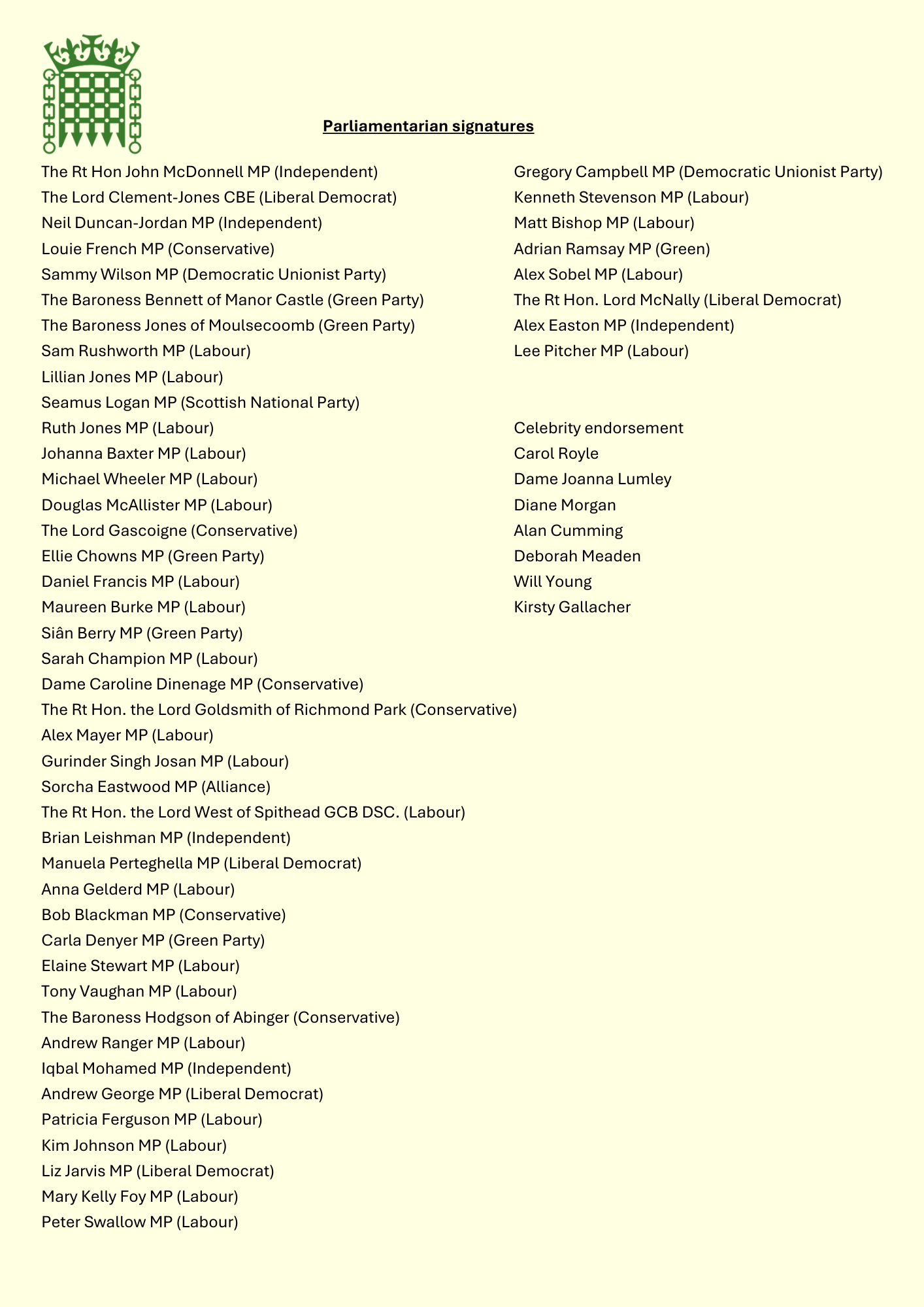
Parliamentarian signatures
The Rt Hon John McDonnell MP (Independent)
The Lord Clement-Jones CBE (Liberal Democrat)
Neil Duncan-Jordan MP (Independent)
Louie French MP (Conservative)
Sammy Wilson MP (Democratic Unionist Party)
The Baroness Bennett of Manor Castle (Green Party)
The Baroness Jones of Moulsecoomb (Green Party)
Sam Rushworth MP (Labour)
Lillian Jones MP (Labour)
Seamus Logan MP (Scottish National Party)
Ruth Jones MP (Labour)
Johanna Baxter MP (Labour)
Michael Wheeler MP (Labour)
Douglas McAllister MP (Labour)
The Lord Gascoigne (Conservative)
Ellie Chowns MP (Green Party)
Daniel Francis MP (Labour)
Maureen Burke MP (Labour)
Siân Berry MP (Green Party)
Sarah Champion MP (Labour)Dame Caroline Dinenage MP (Conservative)
The Rt Hon. the Lord Goldsmith of Richmond Park (Conservative)
Alex Mayer MP (Labour)
Gurinder Singh Josan MP (Labour)
Sorcha Eastwood MP (Alliance)
The Rt Hon. the Lord West of Spithead GCB DSC. (Labour)
Brian Leishman MP (Independent)
Manuela Perteghella MP (Liberal Democrat)
Anna Gelderd MP (Labour)
Bob Blackman MP (Conservative)
Carla Denyer MP (Green Party)
Elaine Stewart MP (Labour)
Tony Vaughan MP (Labour)
The Baroness Hodgson of Abinger (Conservative)
Andrew Ranger MP (Labour)
Iqbal Mohamed MP (Independent)
Andrew George MP (Liberal Democrat)
Patricia Ferguson MP (Labour)
Kim Johnson MP (Labour)
Liz Jarvis MP (Liberal Democrat)
Mary Kelly Foy MP (Labour)
Peter Swallow MP (Labour)
Gregory Campbell MP (Democratic Unionist Party)
Kenneth Stevenson MP (Labour)
Matt Bishop MP (Labour)
Adrian Ramsay MP (Green)
Alex Sobel MP (Labour)
The Rt Hon. Lord McNally (Liberal Democrat)Alex Easton MP (Independent)
Lee Pitcher MP (Labour)
The Baroness Cass OBE FRCP FRCPCH (Crossbench)
The Lord Weir of Ballyholme (Democratic Unionist Party)
Christine Jardine MP (Liberal Democrat)
The Earl of Courtown (Conservative)
Tan Dhesi MP (Labour)
Terry Jermy MP (Labour)
Celebrit y endorsement
Carol Royle
Dame Joanna Lumley
Diane Morgan
Alan Cumming
Deborah Meaden
Will Young
Kirsty Gallacher
Open letter to DEFRA Minister on issue of male chick cullingInbox
-
Adrian Ramsay MP co-signed this cross-party letter initiated by The Vegetarian Society.
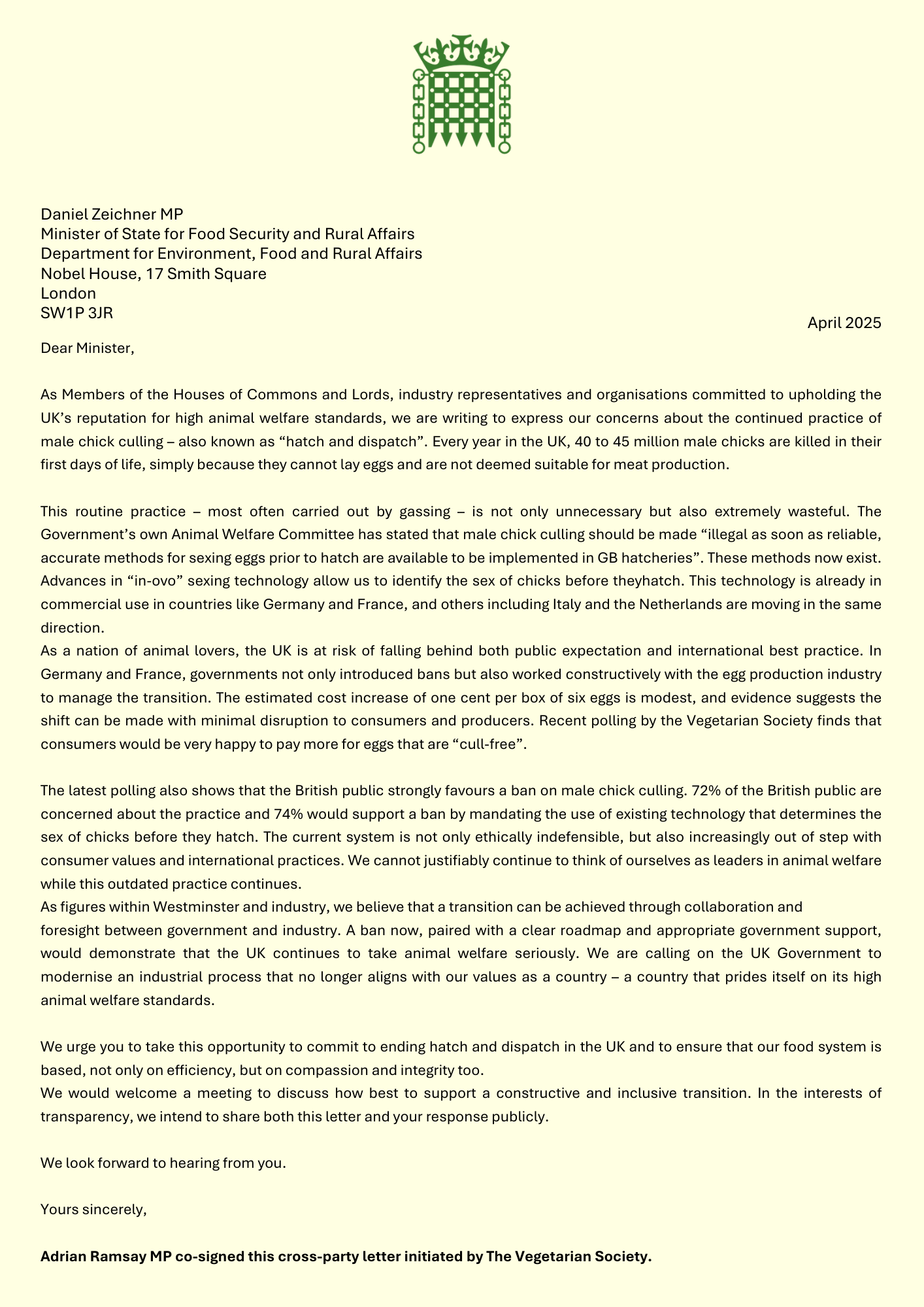
Dear Minister,
As Members of the Houses of Commons and Lords, industry representatives and organisations committed to upholding the UK’s reputation for high animal welfare standards, we are writing to express our concerns about the continued practice of male chick culling – also known as “hatch and dispatch”. Every year in the UK, 40 to 45 million male chicks are killed in their first days of life, simply because they cannot lay eggs and are not deemed suitable for meat production.
This routine practice – most often carried out by gassing – is not only unnecessary but also extremely wasteful. The Government’s own Animal Welfare Committee has stated that male chick culling should be made “illegal as soon as reliable, accurate methods for sexing eggs prior to hatch are available to be implemented in GB hatcheries”. These methods now exist. Advances in “in-ovo” sexing technology allow us to identify the sex of chicks before theyhatch. This technology is already in commercial use in countries like Germany and France, and others including Italy and the Netherlands are moving in the same direction.
As a nation of animal lovers, the UK is at risk of falling behind both public expectation and international best practice. In Germany and France, governments not only introduced bans but also worked constructively with the egg production industry to manage the transition. The estimated cost increase of one cent per box of six eggs is modest, and evidence suggests the shift can be made with minimal disruption to consumers and producers. Recent polling by the Vegetarian Society finds that consumers would be very happy to pay more for eggs that are “cull-free”.
The latest polling also shows that the British public strongly favours a ban on male chick culling. 72% of the British public are concerned about the practice and 74% would support a ban by mandating the use of existing technology that determines the sex of chicks before they hatch. The current system is not only ethically indefensible, but also increasingly out of step with consumer values and international practices. We cannot justifiably continue to think of ourselves as leaders in animal welfare while this outdated practice continues.
As figures within Westminster and industry, we believe that a transition can be achieved through collaboration and
foresight between government and industry. A ban now, paired with a clear roadmap and appropriate government support, would demonstrate that the UK continues to take animal welfare seriously. We are calling on the UK Government to modernise an industrial process that no longer aligns with our values as a country – a country that prides itself on its high animal welfare standards.
We urge you to take this opportunity to commit to ending hatch and dispatch in the UK and to ensure that our food system is based, not only on efficiency, but on compassion and integrity too.
We would welcome a meeting to discuss how best to support a constructive and inclusive transition. In the interests of transparency, we intend to share both this letter and your response publicly.
We look forward to hearing from you.
Yours sincerely,
Adrian Ramsay MP co-signed this cross-party letter initiated by The Vegetarian Society.
Farming & inheritance tax
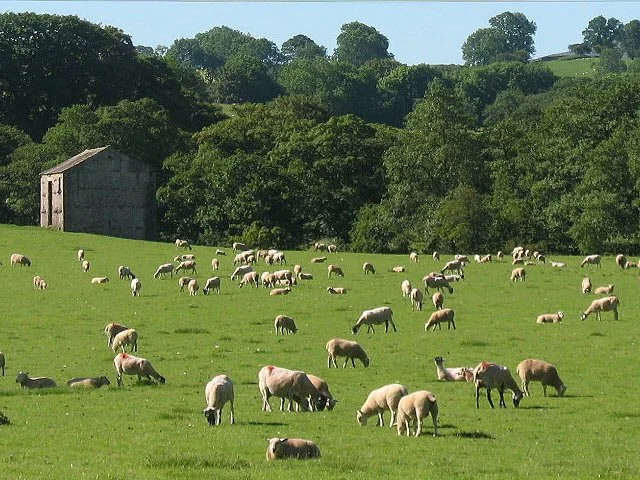
If the Government was hoping that the deep concern over its plans for inheritance tax on farmland would go away in the New Year, it was reminded last week that farmers remain as incensed as ever about the changes. About 100 tractors blockaded Oxford city centre when the Environment Secretary was giving a speech at the Oxford Farming Conference.
3rd of February 2025
If the Government was hoping that the deep concern over its plans for inheritance tax on farmland would go away in the New Year, it was reminded last week that farmers remain as incensed as ever about the changes. About 100 tractors blockaded Oxford city centre when the Environment Secretary was giving a speech at the Oxford Farming Conference.
He was honest enough to admit that the changes were “very unwelcome” (that’s quite the under-statement) and not something that the Government had wanted or intended to do.
I’ve spent some of the past few weeks talking to farmers in my constituency who are very worried about the changes. But what they’ve also told me is that the current tax situation isn’t working for them either. In fact, in many ways, it’s harming ordinary working farmers.
I heard about a 350-acre farm in Suffolk which was bought recently by a merchant banker from London who didn’t even visit the property so clearly had no intention of farming it. In fact, he bought it before it even went on the market, to add to his existing property portfolio and minimise his inheritance tax liabilities.
If this was an unusual or exceptional case, that would be bad enough. But it isn’t. According to one nationwide land agency, non-farmers bought more than half of the farms and estates sold on the open market in England in 2023. The amount of land bought by ordinary farmers was the lowest on record. That is an astonishing state of affairs.
What makes it worse is that the interest of very wealthy outside investors is driving up land prices, which are now at a record high. As one farmer told me, when an ordinary working farmer hopes to expand, the last thing he or she wants is high land prices. Yet that is exactly what they’ve got.
So while farmers have genuine fears that their children will not be able to inherit the family farm and continuing producing food, what’s become clear is that they are already being squeezed out of buying more land. If they can’t expand, they can’t increase food production, affecting our food security. It also makes it harder for them to set aside land for environmental benefits.
The current tax situation is not sustainable. It’s not helping ordinary farmers and it’s depriving the Government of tax revenue which is needed to fund our crumbling public services such as schools, health care and public transport. I want to see it changed so that the very wealthy pay their fair share of taxes, while genuine farmers can carry on doing what they do best – growing and producing food for us all.
But the Government’s plans won’t achieve either of these aims. The reduced inheritance tax rate being proposed will still entice wealthy investors who want to limit their inheritance tax liabilities, while farmers will face huge tax bills when they try to pass on a family farm to the next generation. Many will end up having to sell land to meet the tax liability with an impact on our food security.
This policy has been badly drawn up and thrown together without taking into full consideration what’s been happening in the farming sector, in particular the steep rise in land prices which makes the average-sized family farm worth on paper several million pounds, even though the farmer may be earning barely more than the minimum wage.
There is a clear solution to this. Close the tax loophole to deter investors and, hopefully, bring down land prices but protect genuine farmers by raising the threshold much higher than the proposed £1 million. That’s what the farmers and local National Farmers Union reps I’ve spoken to want to see.
Farming is an absolutely critical industry – vital for our food security, the protection of wildlife and our response to climate change. But if we want to protect it, there must be a fair deal for farmers to include: ensuring the funding pots for environmental land management schemes are adequate and easy to access; tackling the power of the supermarkets and stopping them squeezing the prices that farmers receive; and addressing the existing tax loophole.
The Conservatives and others who want to keep the status quo aren’t acting in the interests of genuine farmers – they are protecting the interests of very wealthy investors. I want to see those with the broadest shoulders like these wealthy investors pay their fair share of tax. I also want to family farms to thrive.
The Chancellor should close this tax loophole while raising the inheritance tax threshold to protect ordinary farms. After a very difficult 2024, it would at least bring some relief to farmers for the year ahead.
Adrian Ramsay MP
Farming and IHT
20th of December 2024
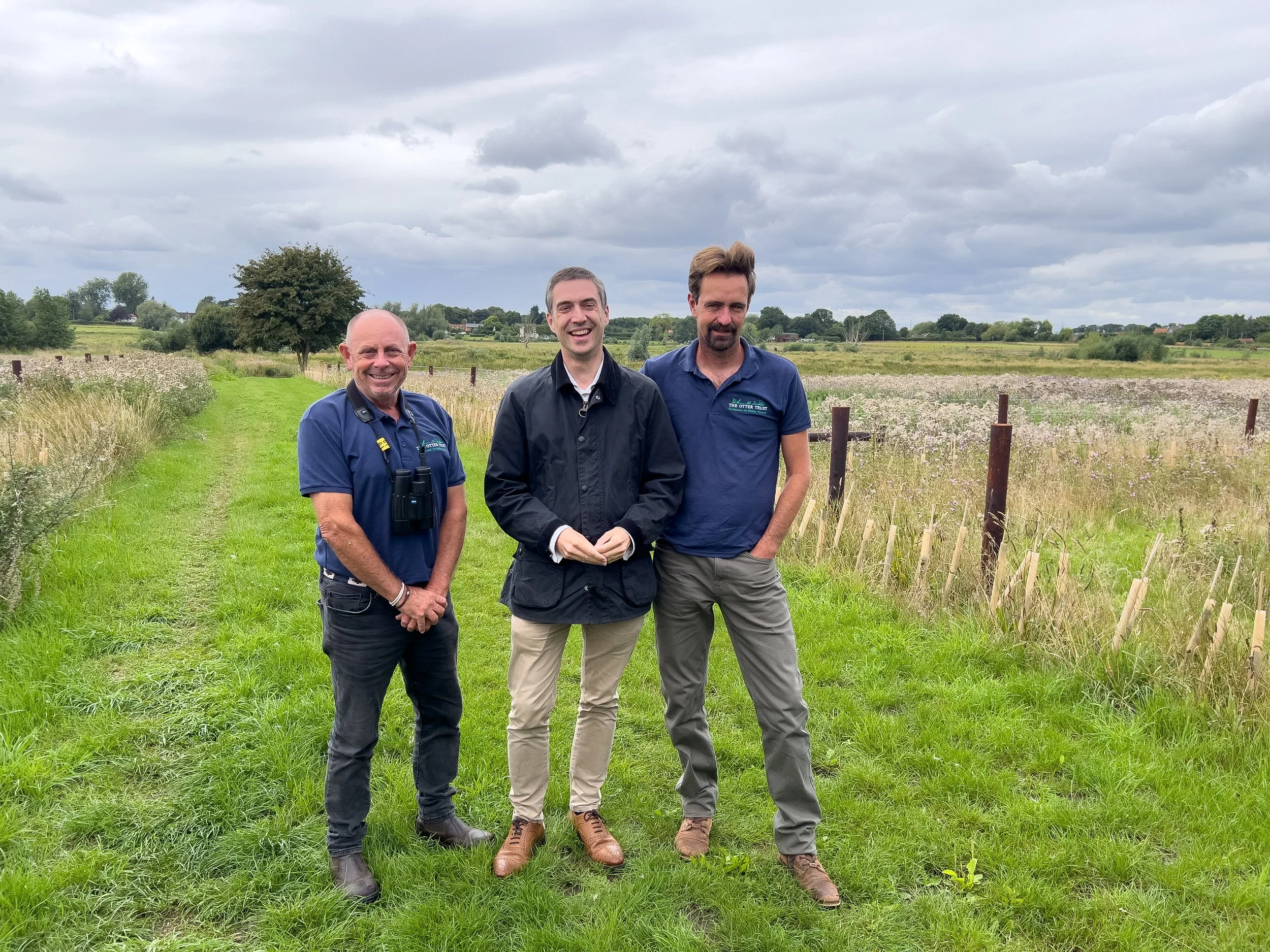
In the last few weeks I’ve had many conversations with farmers in my constituency about the very difficult year they had last year and their concerns for the future.
As many of us will remember, 2024 was extraordinarily wet, even though East Anglia thankfully escaped the worst of it. Nationwide, 2024 was the second worst harvest on record. On top of that, farmers have faced rising costs which, combined with the injustice of supermarkets squeezing margins evermore, makes it very difficult to make a living.
Then came the October Budget and the proposal to close a tax loophole which exempted farmland and businesses from inheritance tax. The Chancellor is proposing a threshold of £1 million on business and agricultural assets - anything more than that would be subject to inheritance tax of 20 percent. Cue mass protests by farmers at Westminster and a growing tide of concern and anger in farming communities.
This issue has been quickly politicised with opposition parties lining up to attack the Government. There’s no surprise there. Looking for a weakness in the Government’s position is what opposition parties do. It’s part of how our democracy works. But it’s not enough for opposition parties to simply defend the current situation and offer no alternative – as the Conservatives are doing.
Because what’s become clear to me in my conversations with local farmers is that, while the Government’s proposed changes are deeply flawed, the status quo is not working either. More and more farmland is being bought by wealthy investors to avoid inheritance tax, driving up prices and denying ordinary farmers the chance to expand their farms. And these investors often have no interest in farming.
I spoke to one farmer who told me about a 350-acre farm in Suffolk which had been bought by a wealthy London banker who didn’t even visit the property. In fact, he bought it before it even went on the market. In another case, a farmer who was hoping to expand his farm and had set aside the money to buy some neighbouring land saw that land sold for 60 percent above the asking price – again bought by someone taking advantage of tax rules. It’s no wonder that land prices are rising by an average of 14 percent every year.
One nationwide land agency found that non-farmers bought more than half of the farms and estates sold on the open market in England in 2023. The amount of land bought by ordinary farmers was the lowest on record.
This is not good for farmers or for our food security. It’s clear to me that this tax loophole has to be addressed in order to save family farms and the livelihoods of ordinary working farmers.
But the way the Government has framed this policy is going to end up protecting the investors while harming the farmers. The reduced inheritance tax rate will still entice wealthy investors who want to minimise their inheritance tax liabilities, even if they can’t avoid them altogether. But farmers will face huge tax bills when they try to pass on a family farm to the next generation.
The rise in land values isn’t only pricing out many ordinary farmers. It is also driving up the paper value of their farms, pushing many of them way above the £1 million threshold proposed by the Chancellor. An average-sized farm of 300 acres could easily be worth £3 million and that’s just for the land. Then there are the buildings, the farm equipment and the livestock on the farm.
Yet many farmers are earning barely more than the minimum wage, despite working very long hours.
There is a clear solution to this. Close the tax loophole to deter investors and, hopefully, bring down land prices but protect genuine farmers by raising the threshold much higher than the proposed £1 million. That’s what the farmers and local National Farmers Union reps I’ve spoken to want to see.
Farming is an absolutely critical industry – vital for our food security, the protection of wildlife and our response to climate change. But if we want to protect it, there must be a fair deal for farmers to include: ensuring the funding pots for environmental land management schemes are adequate and easy to access; tackling the power of the supermarkets and stopping them squeezing the prices that farmers receive; and addressing the existing tax loophole. This loophole is clearly creating major problems for ordinary working farmers and costing the Treasury millions in lost tax revenue. That money is urgently needed for public services like the NHS, education and public transport – and nature friendly farming schemes.
The Conservatives and others who want to preserve the status quo aren’t acting in the interests of genuine farmers – they are protecting the interests of very wealthy investors. I want to see a huge investment in our public services, funded by taxing those with the broadest shoulders like these wealthy investors. I also want to family farms to thrive.
The Chancellor can do both by closing this tax loophole and raising the inheritance tax threshold to protect ordinary farms. It would be positive way to start the new year.
I wish you all a hopeful and peaceful 2025.