
Packed Parliamentary debate on National Security Assessment on biodiversity loss and ecosystem collapse
Packed Parliamentary debate on National Security Assessment on biodiversity loss and ecosystem collapse
he Joint Intelligence Committee's (JIC) National Security Assessment on biodiversity loss and ecosystem collapse, a report which the Government reportedly refused to release in full, was the subject of a packed Parliamentary debate this afternoon.
The report presents a world where cascading risks from nature loss and ecosystem collapse lead to crop failures, water scarcity, floods and novel diseases, meaning millions of people could face food shortages, inflation, public health risks, supply-chain disruption, loss of livelihoods, mass displacement and conflict.
Adrian Ramsay, MP for Waveney Valley, who secured the debate, said in his speech that "Today, we debate a crucial National Security Assessment report that warns of the rapid depletion of global biodiversity, the collapse of critical ecosystems, and the dismantling of major global food systems.” He continued “Historians will write about our decisions. Future generations will judge us for it. They will recount how we knowingly gambled with global stability, the health of the natural world, and the safety of human life, and call it a Growth Agenda."
Roz Savage, MP for South Cotswolds said "The Government’s own intelligence assessment is that ecosystem collapse is a security threat. We are not governing it as a security threat, nor funding it as a security threat, nor communicating it as a security threat. Nature has a monopoly on our capacity to thrive. I have rowed three oceans to say this. I brought a Bill to this House to say this. The Government's own report now says it. I spoke in this debate because we need the Government to listen, and we need them - urgently - to respond."
Kerry McCarthy, MP for Bristol East said “Whether it’s heatwaves and wildfires in Europe or the destruction caused by glacier collapse in Nepal and Tibet, the message is clear. The consequences of climate change and environmental degradation are real, not some distant future threat. And they present immediate economic and security risks too, that we ignore at our peril.”
Ed Jarvis from the Climate Majority Project said “The government has shown itself today to not be taking the threat of global ecosystem collapse to the UK’s National Security anywhere near as seriously as it should - even based on reports by its >own< security services and DEFRA. What we need is clear; immediate publication of both the National Security reports, a televised national ‘covid style’ emergency briefing, a wartime mobilisation of the country around a funded national Strategic Adaptation plan, a Secretary of State for Resilience and Adaptation at Cabinet level, as well as an independent commissioner for Resilience and Adaptation to make sure the Secretary of State and Adaptation Plan is actually delivered. Only then will the government demonstrate that it is treating the climate and nature emergency like the wartime emergency it is.”
Dr Amy McDonnell, Co-Director at Zero Hour, the climate and nature campaign said in response to today's debate
“At the start of the year, our top security officials raised the alarms about the serious threat that global nature breakdown poses to people's lives here in Britain. Today MPs finally had the chace to debate their warnings.
“But after an unbearable summer that saw crops fail, hospitals break down, and fires tear through the country, the government should have gone further and used today’s debate to outline how these issues will be front-and-centre of the 10-year plan for Britain they are currently drafting.”
ENDS
Notes to the editor.
You can watch the full debate here: https://parliamentlive.tv/event/index/d01b4723-b547-472e-a5ca-71809e83bf11
“Future generations will recount how we knowingly gambled the health of the natural world, and the safety of human life, and call it a growth agenda”
PRESS RELEASE
“Future generations will recount how we knowingly gambled the health of the natural world, and the safety of human life, and call it a growth agenda” — Adrian Ramsay MP will say in a speech urging the Government to release the National Security Assessment in full.
Adrian Ramsay, MP for Waveney Valley and environment spokesperson for the Green MPs, will lead a debate in Parliament on the Joint Intelligence Committee's (JIC) National Security Assessment on biodiversity loss and ecosystem collapse, a report which the Government reportedly refused to release in full. The report presents a world where cascading risks from nature loss and ecosystem collapse lead to crop failures, water scarcity, floods and novel diseases, meaning millions of people could face food shortages, inflation, public health risks, supply-chain disruption, loss of livelihoods, mass displacement and conflict.
In the speech, Adrian is expected to say, “If this is not one of the gravest and prevailing national security risks of our time, I do not know what is.” Adrian will argue that “Nature is a foundational element of national security.”
Arguing that climate breakdown is destabilising all our natural systems, Adrian will challenge the fact that governments have repeatedly failed to make the decisions that are needed to protect our citizens. Adrian said that “Historians will write about our decisions. Future generations will judge us for it. They will recount how we knowingly gambled with global stability, the health of the natural world, and the safety of human life, and call it a growth agenda. Environmental protections are under attack from policy which pitches nature against the economy. There will be major damage to the economy with such dangerous levels of systemic ecological risk.”
Adrian will argue it is imperative that this Parliament finally tackles climate breakdown head-on, arguing that: “We cannot neglect to address this for another generation. The assessment makes clear that there is still a chance for major interventions to slow the trend and protect communities and restore national security if we act now, in this Parliament.”
ENDS
Notes to editors:
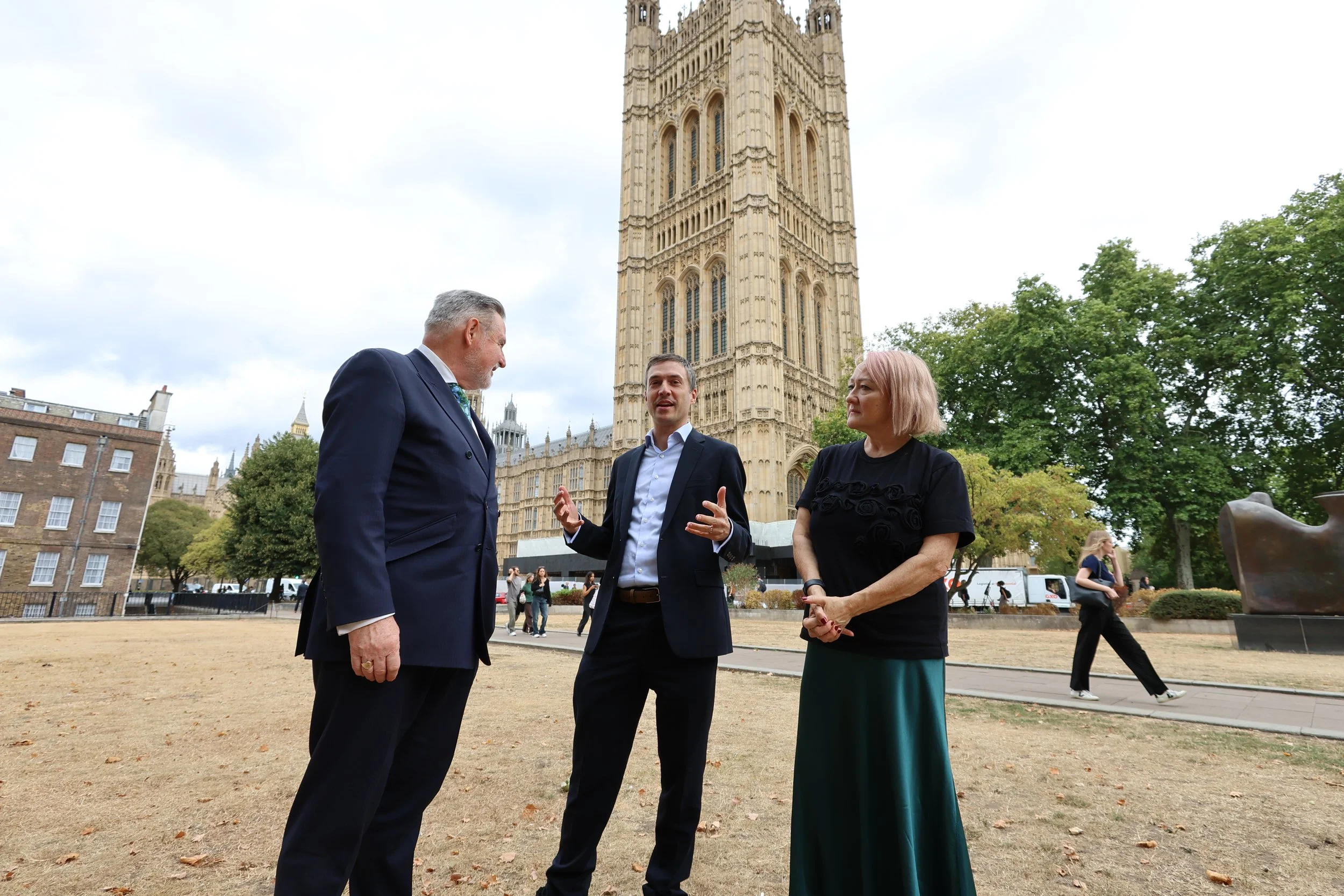
There will be a photocall with campaigners and some MPs speaking in the debate at College Green at 12:45. Please get in touch with Ben, Adrian's media officer, to arrange it via WhatsApp on +44 7939 335565 or [email protected].
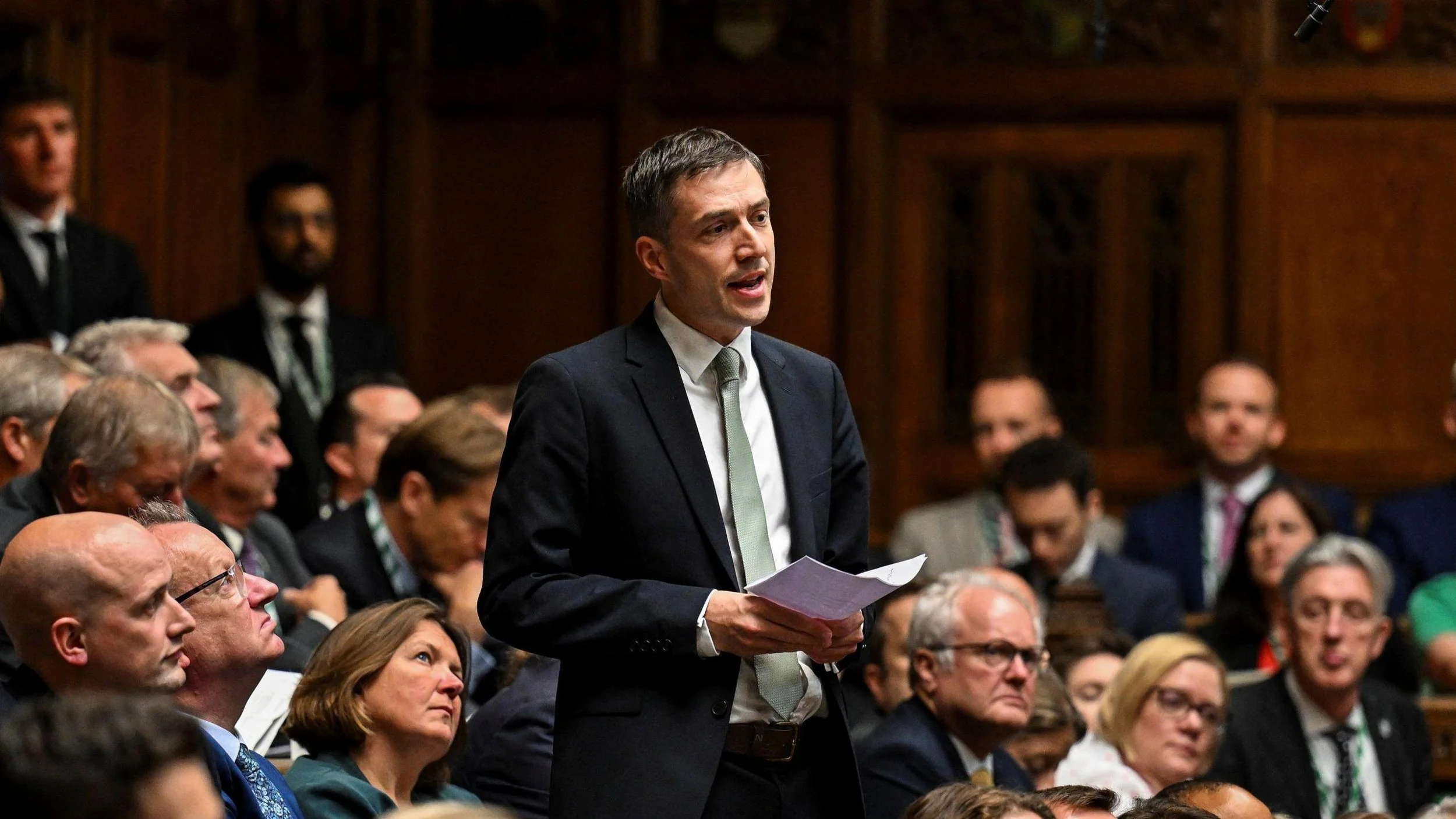
Adrian Ramsay is leading a Backbench Business Committee debate on Thursday 3rd September in Westminster Hall, which is expected to start at 3:10pm.
The Joint Intelligence Committee's National Security Assessment, published in January 2026, stated that biodiversity loss and ecosystem collapse pose a threat to national security. This report was only published after a Freedom of Information request by Green Alliance - and it was only published in redacted form. Since January, Adrian Ramsay MP has repeatedly called for a debate in Parliament on its findings and for the full report to be published.
Adrian has also proposed a dedicated Climate Adaptation Unit, based in Number 10, to coordinate the Government's response to the growing risks posed by climate breakdown. A key responsibility of the unit would be ensuring councils, local authorities and public bodies work together effectively on local resilience planning, including flood prevention, heat adaptation, emergency response and protecting vulnerable communities. The proposal follows the Climate Change Committee's recommendation for a more structured national approach to managing the interdependencies between critical systems and services.
"We are in a new climate reality" — Adrian Ramsay MP calls for Minister for Climate Adaptation as Britain faces fourth, most dangerous heatwave of the year
"We are in a new climate reality" — Adrian Ramsay MP calls for Minister for Climate Adaptation as Britain faces fourth, most dangerous heatwave of the year
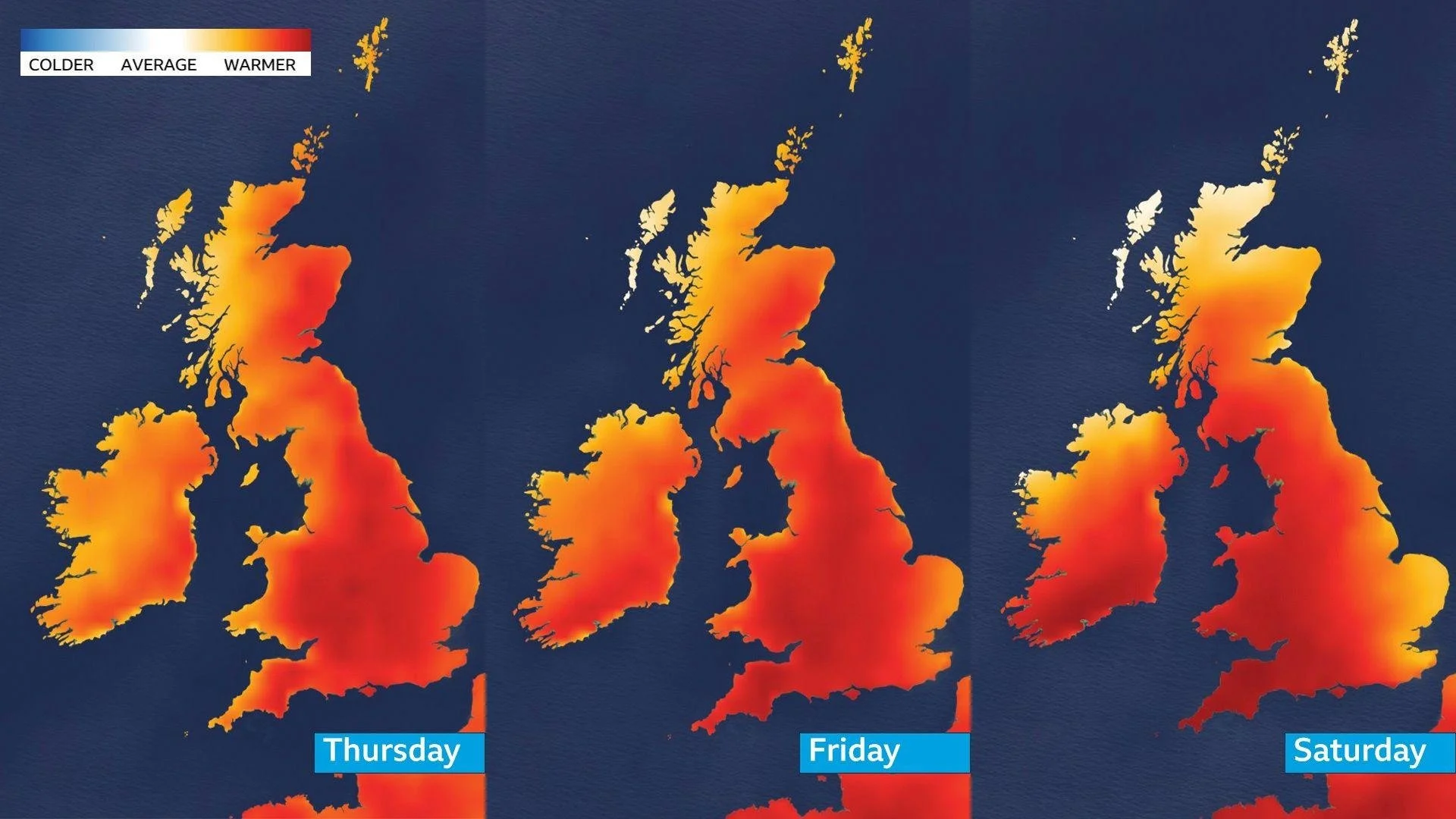
Britain is bracing for its fourth and most dangerous heatwave of the year, with temperatures set to surpass 30°C today, as Green Party MP Adrian Ramsay calls on the Prime Minister to create a dedicated Minister for Climate Adaptation.
"We are in a new climate reality," said Adrian Ramsay MP. "While the Prime Minister gets ready for his decade of renewal, he must face the fact that Britain must get used to extreme weather, from heatwaves and wildfires to flooding and storms. This is a major threat to our country and we need the Government to step up."
With land parched and a record early harvest after weeks of sustained heat, Ramsay warned that the growing wildfire risk now amounts to a national security threat, one the Government is failing to treat with the urgency it demands.
Adrian Ramsay Green Party MP for Waveney Valley said:
"With temperatures set to surpass 30°C today after a sustained period of heat this summer, our land is now a tinderbox," Ramsay said. “We're already seeing wildfires visible from space in Spain and devastating fires in France, and Britain is not immune, we've seen homes evacuated and communities put at risk by fires here too. This is what our new normal looks like, and our neighbours are living it right now. This is a national security threat, and the Prime Minister needs to treat it as one."
"With Europe the fastest-warming continent on Earth, Ramsay argued that "the crisis our neighbours are facing today is a warning of what's coming for us tomorrow," urging the Prime Minister to use this moment to put significant mitigation measures in place before it's too late including a Heat Resilience Strategy."
"This would include prioritising cooling, including air conditioning where needed, in settings where people are vulnerable, such as hospitals, schools, prisons and care homes, ensuring emergency services are properly equipped to respond to extreme heat, setting up cool spaces for the public, and introducing measures to ensure people can stay safe in the workplace. This would include."
ENDS
Notes to editors:
Adrian has called on the Government to deliver a national Heat Resilience Strategy urgently, led from the Cabinet Office with clear ministerial accountability, ensuring that decisions on housing, infrastructure, health, energy and land use are all designed for the climate we now face.
Adrian has also proposed a dedicated Climate Adaptation Unit, based in Number 10, to coordinate the Government's response to the growing risks posed by climate breakdown. A key responsibility of the unit would be ensuring councils, local authorities and public bodies work together effectively on local resilience planning, including flood prevention, heat adaptation, emergency response and protecting vulnerable communities. The proposal follows the Climate Change Committee's recommendation for a more structured national approach to managing the interdependencies between critical systems and services.
The Green Party is reiterating its call for an urgent package of heatproofing measures, including a street-by-street programme to insulate every home that needs it, keeping homes warm in winter and cool in summer, alongside blinds and shutters where needed to keep heat out.
Other measures include prioritising cooling, including air conditioning where needed, in settings where people are vulnerable, such as hospitals, schools, prisons and care homes, and introducing a maximum temperature limit for workplaces and classrooms.
"Deeply irresponsible": MP condemns Suffolk County Council's climate U-turn as firefighters battle wildfires.
"Deeply irresponsible": MP condemns Suffolk County Council's climate U-turn as firefighters battle wildfires.
Adrian Ramsay, Green MP for Waveney Valley, has warned that Suffolk County Council's move to rescind its Climate and Nature Emergency Declaration comes at exactly the wrong moment, as firefighters battle a surge in wildfires and extreme heat incidents across the country.
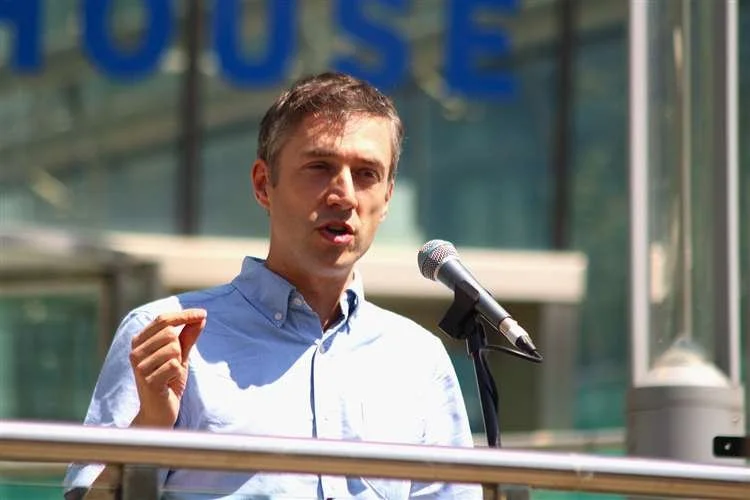
Speaking outside Endeavour House in Ipswich, where the County Council is this afternoon debating a motion from the new Reform-led administration to rescind the declaration first made in 2019, Adrian was joined by Richard from the Suffolk Fire Brigades Union, who set out the reality frontline crews are facing.
Richard said the Fire Brigades Union was currently responding to 14 wildfires declared nationwide, with a rising number of field and open fires across Suffolk. Crews are tackling these fires in full protective kit. He said flooding incidents were also increasing year on year, and that fire services are under-resourced and underfunded to meet the scale of the challenge, calling for an uplift in funding to properly protect the public.
Mr Ramsay had earlier written to Council Leader Cllr Hadwen, warning that undeclaring a climate emergency would not remove the threats of flooding or extreme heat that Suffolk residents face and would not save the council money. His letter noted that public sector organisations have worked together to deliver the Suffolk Climate Emergency Plan since 2021, with co-benefits including warmer, more affordable homes, improved air quality and health, and job creation. He warned that rescinding the declaration sends the wrong message when cross-party cooperation on these issues is needed more than ever.
Commenting today, Adrian Ramsay MP said:
"Suffolk County Council's Climate and Nature Emergency Declaration in 2019 was crucial in helping establish the UK's commitments on climate and nature. We should be stepping up that action now, not rolling it back, and we're seeing exactly why with the extreme heat we're experiencing.
"I've heard directly from firefighters on the front line of this crisis, dealing with wildfires and flooding that are becoming more frequent, without the resources they need to keep up. Whether it's our fire services, our food security, our water security, our transport, schools or hospitals, we are all feeling the impact of extreme heat right now, and it will only get worse if this is left unchecked.
"It's deeply irresponsible of Reform-led councils, like the one here in Suffolk, to be taking backward steps when we should be taking forward ones. I'm calling on the Government to urgently step up action on preparedness for extreme heat, on nature security, and on cutting emissions, and I'm calling on this council to reverse course."
ENDS
Notes to editors
In his letter to Cllr Hadwen, Leader of Suffolk County Council, Adrian Ramsay made the following points:
Undeclaring a Climate Emergency does not remove the threats of flooding or extreme heat that residents will still face, and will not, on its own, save the council money.
The council must use its powers to safeguard residents affected by extreme heat and other increasingly common extreme weather.
Understanding that this is an emergency affecting food production and economic markets, as well as the environment, is crucial to making decisions that help Suffolk residents live well in the years ahead.
Public sector organisations have worked together to deliver the Suffolk Climate Emergency Plan since 2021, with co-benefits including warmer, more affordable homes, improved air quality and health, and job creation.
Declaring a Climate Emergency is a call to focus on activity that benefits residents now and in future as the climate changes. Projects that don't improve safety and prosperity for Suffolk residents would not be compatible with the declaration in the first place, so rescinding it will not deliver savings or efficiencies.
Rescinding the declaration sends the wrong message when cross-party cooperation on these issues is vital and has, rightly, existed until now.
"Britain has entered a new climate reality" — Adrian Ramsay MP demands Government action after leading Westminster Hall debate on extreme heat
Adrian Ramsay MP, Green Party MP for Waveney Valley, today led a Westminster Hall debate on the UK's preparedness for extreme heat, warning MPs that "Britain has entered a new climate reality" and demanding the Government urgently deliver a national Heat Resilience Strategy, led from the Cabinet Office with clear ministerial accountability, ensuring that decisions on housing, infrastructure, health, energy and land use are all designed for the climate we now face. Heat-health warnings, public information and targeted support for vulnerable people should become routine before heatwaves strike.
In the debate, Adrian said recent heatwaves had exposed dangerous gaps in the country's readiness for a hotter climate, citing hospitals declaring critical incidents, record ambulance demand, school closures and major wildfires.
Among the most alarming failures raised in the debate was the breakdown of MRI scanners at the Norfolk and Norwich hospital, which serves part of Adrian’s Waveney Valley constituency, after their cooling systems failed during the June heatwave. Ramsay said this showed the NHS estate was "not designed to operate safely during prolonged periods of temperatures approaching 40°C."
Adrian pointed to analysis showing around 2,700 heat-related deaths occurred during the May and June heatwaves in England and Wales alone, and warned the June 2026 heatwave is estimated to have cost the UK economy at least £2.36 billion in lost productivity, a figure that could rise to £25 billion a year by 2030 without action.
Adrian Ramsay MP said:
"Britain has entered a new climate reality, and our public services are not ready for it. These were not isolated weather events, they were a real-world test of our preparedness for a hotter climate, exposing vulnerabilities across our health service, critical infrastructure, emergency response and natural environment.
"Hospitals have declared critical incidents and postponed operations. The London Ambulance Service recorded its busiest week on record. At the Norfolk and Norwich hospital in my constituency, MRI scanners stopped working when their cooling systems failed.
“The impacts of extreme heat don't fall evenly. It's the elderly, pregnant women and those with chronic illnesses who feel this most, and it's not just a public health issue, it threatens the resilience of the whole health and care system.
"This isn't just about hotter summers either. It's about whether our prisons, care homes, schools, transport and food supply can withstand the climate we're already living in. Water security is one of Britain's greatest long-term resilience challenges, fundamental to public health, food production, economic resilience and national security. Climate change is no longer just affecting where our food is grown, it is affecting what families can afford.
"The Government's own experts have told them what's needed, an £11 billion a year investment in resilience, led properly from the Cabinet Office. Instead, we get delay after delay.
"Adaptation is not a cost, it's an investment. Every year the Government fails to act, the bill for recovery gets bigger and the human cost gets higher. Britain needs a Heat Resilience Strategy now, not after the next heatwave kills more people."
ENDS
Cross-party Rosebank letter to the Prime Minister
-
Dear Prime Minister,
We are writing as a cross-party group of Members of Parliament and Members of the Scottish
Parliament to voice our collective opposition to the Rosebank oil field.
The decision your Government now faces is about more than just a single oil development –
a defining test of your commitment to the UK’s economic resilience and climate security.
Opposition to Rosebank spans across parliamentary benches and the nations of the UK.
Approving this development would be fundamentally incompatible with our legally binding
climate obligations and, crucially, with the secure future that energy workers and communities
deserve.
it is
While the oil and gas sector has previously served an important role in the UK’s economy,
claims that Rosebank would guarantee UK energy security or protect jobs do not hold up to
scrutiny. Most of what would be produced by Rosebank would be sold on international markets,
while profits continue to flow overseas rather than revitalising the industrial communities
currently struggling in the North East of Scotland, the North of England and beyond. The oil and
gas industry has scaled back on domestic renewable investment alongside repeated rounds of
redundancies, leading to increasingly insecure employment for the workforce.
Approving Rosebank would markedly diminish the UK’s standing on the world stage. At a time
when global climate action requires bold leadership, approving one of the largest undeveloped
oil fields in the UK would undermine our international credibility and weaken our ability to lead
on the world stage.
Instead, we urge you to use this pivotal moment to signal a decisive shift towards the green
industrial revolution. This is not a political choice between jobs and climate. This is a choice
between prolonging our dependence on volatile, declining markets, or instead investing directly
in British clean energy manufacturing capabilities that will provide employment for years to
come. Our focus must be on creating secure, well-paid jobs that place oil and gas workers at
the very heart of a genuinely fair energy transition.
The decision on Rosebank will be one of the defining choices of your premiership. We urge you
to reject this development, cement the UK’s climate leadership, and work with us to build a
fairer, cleaner, and more prosperous future for all of the communities we represent.
Yours sincerely,
Adrian Ramsay responds to an FT investigation revealing that Anglian Water withheld funds for repairs while distributing £2.5 billion to shareholders
Adrian Ramsay responds to an FT investigation revealing that Anglian Water withheld funds for repairs while distributing £2.5 billion to shareholders
An investigation by the Financial Times has found that Anglian Water is one of four water companies that underspent their infrastructure budgets between 2010 and 2025, despite the industry's repeated claims that low customer bills were to blame for a failure to fix ageing pipes and networks.
Reacting to the investigation, Adrian Ramsay, MP for Waveney Valley, said
"It's one thing to run out of money for essential repairs. Anglian Water had money to spare and still didn't spend it.
An FT investigation found it was one of four water companies that underspent their infrastructure budgets between 2010 and 2025, while paying out £2.5bn in dividends.
This is unacceptable. The public is rightly demanding action to clean up our rivers, and instead they're watching companies bank cash that should have gone into fixing crumbling pipes and ending sewage spills. People are paying record bills while shareholders profit, and rivers remain polluted.
Water companies cannot be trusted to regulate themselves. That's why I'm pressing for the water companies to be brought under public ownership, so the money goes into fixing the infrastructure, not into shareholders' pockets."
ENDS
Letter to Andy Burnham MP
-
29 June 2026
Dear Andy Burnham MP ,
We are writing to you in recognition of the increasingly likely event that you become the
next Prime Minister.
As Green Party MPs, we were elected on a manifesto of real change. It could not be clearer
that the public are desperate for politicians to deliver on this. Where our agendas overlap,
and if there is prospect of delivering real change, we will work with this government in a
spirit of cooperation. Where the government fall short, we hold Ministers accountable.
People’s lives are getting harder. Everyday life has become unaffordable and public
services are under immense pressure. People no longer trust that politicians or politics
will deliver for them, with growing unrest in our communities. We have watched a
genocide unfold in Gaza, and successive Prime Ministers have refused to take the
necessary action. And last week we witnessed some of the impacts of the climate and
nature crisis, with the second ever heat-related red alert weather warning in our country's
history. These are just some of the many crises our country is facing.
While people’s lives are becoming harder, those responsible for fuelling these crises are
cashing in. In the first month after the US and Israel’s initial strikes on Iran, the share value
of just five North Sea oil and gas companies was boosted by £73 billion (Greenpeace,
2026).
What we need, what the public want, and what Keir Starmer failed to deliver, is a
fundamental break with this failing status quo. Not tweaks, not backslides, but immediate
action to end the complex and connected crises we are experiencing. But the public are
tired of hearing about ‘change’ and not feeling it.
The Green Party is clear on what real change looks like. So, if you become the next Prime
Minister, will you to take the following initial steps?
Fix our electoral system: Introduce proportional representation for all national and
local elections before the next General Election.
Tax wealth fairly: At the Autumn Budget, align rates of Capital Gains Tax with income
tax; introduce National Insurance on investment income in line with employment
income; and take necessary steps to introduce an annual tax on the wealth of
multimillionaires and billionaires.
Hold the line on new oil and gas and restore nature: Do not approve proposed drilling
at Rosebank, Jackdaw or Cambo, or allow new oil and gas extraction through tiebacks
to existing production facilities; and rapidly scale up action to reverse the loss of
nature by 2030.Take water into public ownership: Starting with Thames Water, use powers the
government already has to bring failing water companies into special administration
and back into public hands, not just public control.
Introduce rent controls: Roll out rent controls across the country, as you have called
for as Mayor of Greater Manchester and as the new Green Party Mayors are now
demanding, and fund councils to buy existing homes from private landlords.
Uphold international law: Accept the findings of the UN Independent Commission of
Inquiry that the Israeli government has committed genocide in Gaza, and impose
comprehensive sanctions, including a full arms embargo.
This is of course not an exhaustive list of policies or actions needed to address the
multiple crises our country is facing. But taking immediate steps to deliver on the above
measures, which are hugely popular, would send a signal that you are serious about
changing course. Our constituents, and the country, need more than just a new manager.
Yours sincerely,
Dr Ellie Chowns MP
Hannah Spencer MP
Adrian Ramsay MP
Siân Berry MP
Carla Denyer MP
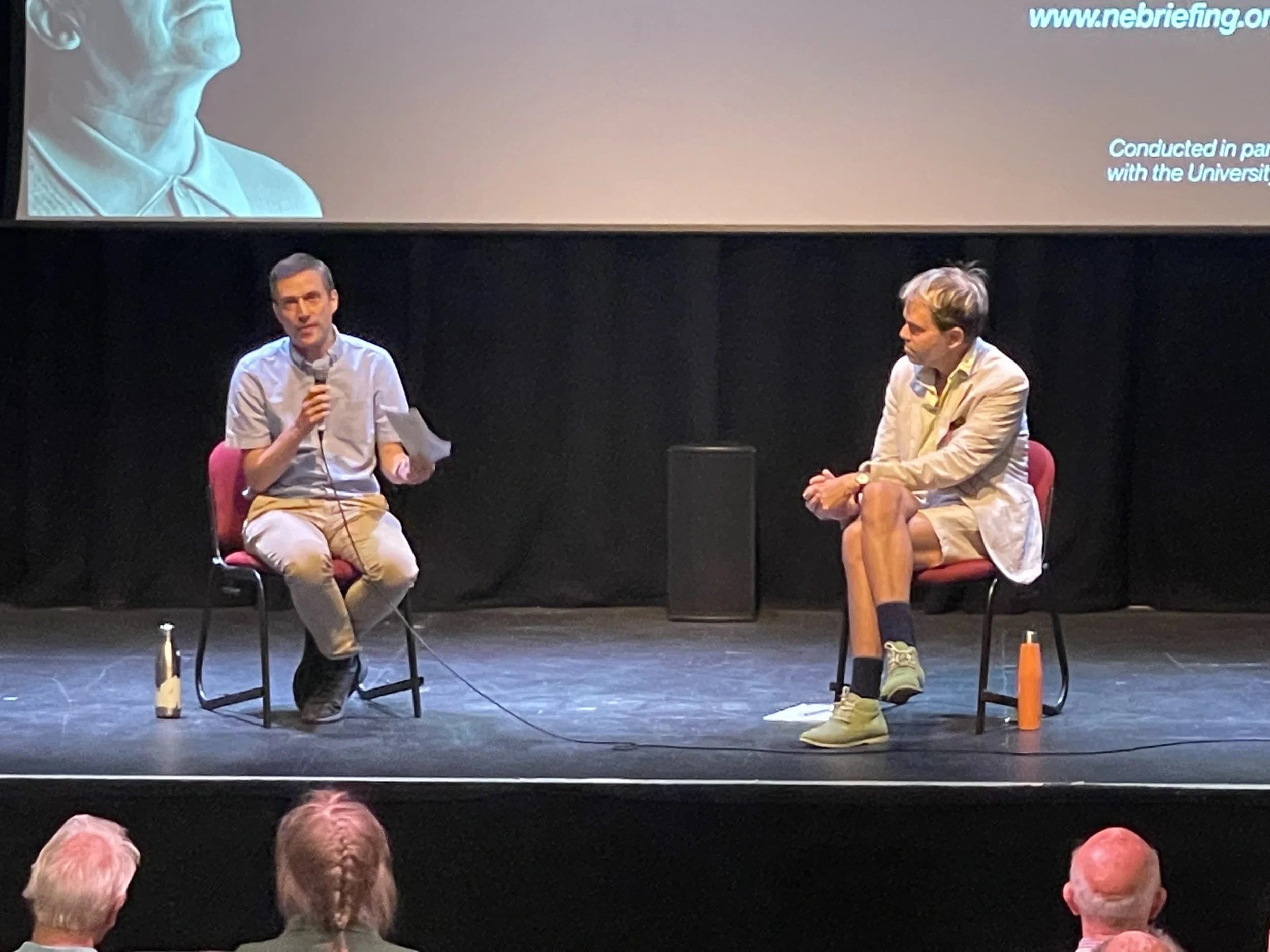
Decades of political hesitation have meant that millions are paying the price, says Green MP Adrian Ramsay, reacting to the CCC’s annual assessment of the Government's progress on reducing emissions.
Decades of political hesitation have meant that millions are paying the price, says Green MP Adrian Ramsay, reacting to the Climate Change Committee's annual assessment of the Government's progress on reducing emissions.
Reacting to today's Climate Change Committee annual assessment of the Government's progress on reducing emissions, Adrian Ramsay, Green parliamentary lead for the Department for Energy Security & Net Zero and Waveney Valley MP, said:
“Decades of political hesitation have meant that millions across the country are paying the price through higher energy bills and higher food costs. Successive Governments have kicked the can down the road instead of taking the action needed to reduce emissions, and households and businesses have suffered as a result.”
"The Climate Change Committee is clear. The Government is not moving fast enough to reduce emissions, and this is putting our climate targets at risk.”
"At the same time, any decisions to expand airports or allow the Rosebank oil field would take us further in the wrong direction.”
“Climate breakdown affects every part of our lives, and the longer action is delayed, the greater the cost to families and communities.”
ENDS
Green MP Adrian Ramsay asks the Prime Minister to commit to publishing two vital reports warning that our food and water systems are on course for catastrophic failure.
Green MP Adrian Ramsay asks the Prime Minister to commit to publishing two vital reports warning that our food and water systems are on course for catastrophic failure.
Adrian asked the Prime Minister.
‘A suppressed DEFRA report concluded that, without transformational change, our food and water systems are on course for catastrophic failure from 2030.
Another suppressed Joint Intelligence Committee assessment concluded there is a ‘high likelihood’ of ecosystem collapse, putting food production at risk.
Does the Prime Minister recognise that many of us across the House are committed to working collaboratively to address these urgent challenges - and will he commit to the publication of these two reports in full?’
In response, the Prime Minister said.
‘Well, I agree that we must act to protect ecosystems that underpin our food supply and our way of life, and I’m really proud that under this Government the UK is back playing a leading part on climate change and restoring nature. ’
Reacting to the Prime Minister's response, Adrian said: “I am deeply disappointed that the Prime Minister did not commit to publishing the reports in full.”
Ends
Notes to the editor
The suppressed report, entitled “The status of Defra’s critical systems to 2030 and beyond,” was written by the now-disbanded DEFRA futures civil servant unit for the incoming Government. It warns that there is a realistic possibility that, by 2030, the UK’s food systems, water supplies and natural ecosystems could collapse.
The report is ‘almost certain’ that DEFRA’s critical systems are on a ‘decline and collapse trajectory’, meaning that without transformational change, there is a realistic possibility that by 2030 our food, water and natural ecosystems are at risk of catastrophic collapse with a high degree of confidence.
The report was commissioned to inform the then incoming Government but was not included in ministerial handover briefings.
A separate report, the Joint Intelligence Committee’s National Security Assessment, stated that biodiversity loss and ecosystem collapse pose a threat to national security. The report lays out how regional instability throughout the world will affect the UK.
A delayed redacted version of the report was published in January only after a Freedom of Information request from Green Alliance. Adrian Ramsay has repeatedly called for a Commons debate in its contents.
Green Party MP Adrian Ramsay calls for a dedicated Climate Protection Unit in Number 10 in response to government watchdog warning way of life is under threat from heat, flooding and drought
Green Party MP Adrian Ramsay calls for a dedicated Climate Protection Unit in Number 10 in response to government watchdog warning way of life is under threat from heat, flooding and drought
Reacting to the Climate Change Committee (CCC) Report ‘A Well-Adapted UK’ , Adrian Ramsay MP said:
“The most fundamental duty of any government is to keep the public safe, and yet today’s CCC report shows we are sleepwalking towards catastrophe and the government is failing to meet the moment.
“The impacts of the climate and nature emergency are already being felt by communities across the UK, with increased food prices, more severe flooding and dangerous heatwaves. From our food and water supply to daily essential services, continued inaction is putting us all at risk. By 2050, the CCC’s report warns that up to 92% of homes could face overheating, peak river flows could rise by up to 45%, and water supply shortfalls could exceed 5 billion litres a day. Our children will not forgive us if the Government and Parliament fail to take these fundamental risks seriously due to being distracted by current political dramas.
“That is why today I am calling on the Prime Minister to establish a dedicated Climate Protection Unit in Number 10, with the sole purpose of working cross-department to drive forward the recommendations in this report.
“Because this report must mark a turning point. The Government must take concrete steps now to protect people’s lives and ensure our country is properly prepared for the growing risks posed by extreme heat, flooding and food shortages. That means investing in flood defences and nature-based solutions, preparing for extreme heat with a big focus on adapting our homes and workplaces, providing tangible support for farmers to ensure farming remains viable, and urgently adapting our infrastructure to prevent snowballing disruption across every facet of daily life. If ministers fail to take real action and deliver before the next general election, they will knowingly be putting lives at risk. The Government has been handed a plan. It is now vital they deliver it.”
ENDS
100 days on from the landmark Joint Intelligence Committee National Security Assessment, no parliamentary debate has taken place
100 days on from the landmark Joint Intelligence Committee National Security Assessment, no parliamentary debate has taken place
Parliament must debate matter of “grave importance”, says Green MP
It has now been 100 days since the Joint Intelligence Committee published its National Security Assessment which stated that global biodiversity loss and ecosystem collapse is a threat to national security. Yet, there has still been no Parliamentary scrutiny. The report, which warns of serious risks to ecological stability and national security, has not been debated in Parliament.
Green MP Adrian Ramsay, Waveney Valley, first called for a debate on the report during Business Questions on 22 January. In response, the Leader of the House stated, "The member rightly points out that the report is to be welcomed. Once the report has been considered, I will look to find time for Members to debate these matters, given their importance."
Following this commitment, Adrian wrote to the Leader of the House, as well as the Cabinet Office and DEFRA, seeking clarity on when a debate would be scheduled and urging the Government to bring forward parliamentary scrutiny of the report.
He again raised the issue during questions in Parliament on 5 February and has continued to pursue it through further correspondence with Ministers and in external speeches. Despite repeated requests, there has still been no indication from the Government that a debate will be scheduled.
Speaking on the 100 days Adrian Ramsay MP said,
“It has now been 100 days since this critical report was published, following the Government's hand being forced via a Freedom of Information request. Yet Parliament has still not been allowed to properly scrutinise its findings. For an issue of such grave importance, this is completely unacceptable. At the election, the Government promised a transparency revolution: no power without accountability, and no accountability without transparency. That must apply to matters of national security and how we restore the natural environment that we all depend on. It is incumbent on the Government to have a debate immediately after the King's Speech"
ENDS
RE: Windfall tax on those profiting from the war on Iran to tackle the cost of living crisis
-
Dear Prime Minister and Chancellor,
RE: Windfall tax on those profiting from the war on Iran to tackle the cost of living crisis
Across the UK, millions are barely staying afloat. Energy bills are bursting family budgets, childcare costs are washing away wages, businesses are struggling, and housing costs have skyrocketed. Many of the greatest problems people in the UK are facing right now will intensify as the impacts of the war on Iran continue to ripple through the economy.
The US-Israeli strikes on Iran as part of an illegal war, have caused chaos, killed civilians and have triggered the largest ever disruption to fuel supply, according to the International Energy Agency, sending crude oil costs surging over $100 per barrel in recent days. This has only worsened after the recent attacks on gasfields and LNG processing facilities in Iran and Qatar, which have caused gas prices to jump to four-year highs, with the impacts to be felt for many months and years to come.
Domestically, UK gas prices have more than doubled since late February. They are now at their highest since August 2022 and are likely to drive up energy bills unless action is taken to protect households and businesses when the next price cap is determined. Meanwhile, households are already grappling with the impacts of jumping fuel price increases, making simply getting by increasingly expensive. At the same time, experts are predicting major disruption to production and imports for agriculture inputs like fertilisers, risking further affordability issues for food and drink essentials in the months to come.
This crisis makes clear that the UK must end its reliance on fuels imported from overseas and invest in domestic renewable energy, to ensure British energy security is not left susceptible to global conflicts, disasters, or trade disputes. This will also help accelerate the UK’s transition toward a low-carbon economy, thereby reducing the likelihood of further economic shocks.
Sadly, there are some clear winners of the war on Iran. Oil and gas giants, big banks, agricultural input industries and defence companies will likely make record profits, at the expense of enormous human suffering. In recent crises, like those triggered by the Covid-19 pandemic and war in Ukraine, the wealthiest households and super-rich amassed even greater fortunes - to the tune of hundreds of billions of pounds, while millions were left struggling. Time after time, when wars break out, or major crises unfold, companies across different sectors, alongside super-rich individuals, make eye-watering sums of money. North Sea energy firms are set to make bumper profits. According to new data, for every month that energy prices remain at 18th March 2026 levels, profits could result in over £200m in tax revenue through the Energy Profits Levy. Banks reap profits due to the Bank of England’s misguided decision to raise interest rates in response to supply-side inflation. Higher rates are paid by borrowers - whose mortgage costs are already soaring off the back of the Iran crisis - and the Bank of England itself, which pays interest on the risk-free reserves banks hold with them. The latter cost is ultimately borne by the Treasury, currently to the tune of £20bn per year.
It is not right that extraordinary profits, generated off the backs of ordinary people during periods of crisis, are siphoned off into private hands and corporate bank accounts. All whilst households and businesses are in urgent need of substantial support to cope with the affordability crisis. The government’s own cost of living champion has called for measures to prevent profiteering. We urge you to make this crisis a turning point for the UK. Taking bold action to systemically reform our tax system and invest in our energy security will build resilience in our economy to
withstand future shocks and make life affordable for people and businesses in the UK.
We are writing to you today, as leading organisations from civil society, urging you to:
Ensure a permanent and strengthened energy profits mechanism which captures all excess profits made by oil and gas companies - including windfalls during crises - and close all loopholes which encourage further investment in harmful fossil fuels.
Introduce a levy on banks specifically targeting UK retail net income, profits they have made directly from the UK public.
Apply additional excess profits (windfall) taxes to companies in sectors profiteering from this crisis and the war in Iran, for example big agribusiness, the defence industry and associated AI and tech firms.
Invest revenue from excess profits into direct support to households and businesses to help weather the shock of the affordability crisis, alongside accelerating bringing online mass-scale low and zero carbon solutions to build a resilient energy system in the UK.
The billions in revenue from the additional proposed taxes on windfalls from this crisis must be reinvested into providing direct cost of living support and making our economy more resilient to withstand shocks in the future.
We can break free of the war-energy crisis doom loop, invest in renewables and low-carbon solutions, support people to deal with the cost of living crisis and put Britain on a path to better living standards for everyone in this country.
Yours sincerely,
Adrian Ramsay MP co-signed this letter along with Sian Berry MP, Carla Denyer MP, Hannah Spencer MP and Dr Ellie Chowns MP. Tax Justice UK, Faiza Shaheen, Executive Director
Greenpeace UK, Areeba Hamid, Co-Executive Director
Global Witness, Mike Davis, CEO
Women’s Budget Group, Dr Daniella Jenkins, Executive Director
National Education Union, Daniel Kebede, General Secretary38Degrees, Matthew McGregor, CEO
PCS Union, Fran Heathcote, General Secretary
Positive Money, Sara Hall, Co-Executive Director
End Fuel Poverty Coalition, Simon Francis, Coordinator
Global Justice Now, Nick Dearden, Executive Director
Autonomy Institute, Will Stronge, Chief Executive
Patriotic Millionaires UK, Rebecca Gowland, Executive Director
Green New Deal Rising
350.org, Anne Jellema, Executive Director
Zero Hour, Amy McDonnell and James Sutton, Co-Executive Directors
Care Full, Ruth Hannan & Hannah Webster, Co-Directors
Stamp Out Poverty, David Hillman, Director
War on Want, Liz McKean, Executive Director
Fairness Foundation, Will Snell, Chief Executive
Compass, Lena Swedlow, Deputy Director
Equality Trust, Priya Sahni-Nicholas and Jo Wittams; Co-Executive Directors
Taxpayers Against Poverty, Tom Burgess, CEO
Debt Justice, Heidi Chow, Executive Director
Fuel Poverty Action, Stuart Bretherton, Campaigns Lead
Mainstream
Women’s Environmental Network, Kate Metcalf, Co-Director
Voices Adfocad, Mike O'Brien, Founder
Tipping Point UK, Louise Hazan, Co-Director
Wellbeing Economy Alliance Scotland, Lisa Hough- Stewart, Interim Director
WEAll Global, Stewart Wallis, Executive Co Chair
Culture Unstained, Chris Garrard, Co-Director
Possible, Hirra Khan Adeogun & Juliet Michaelson, Co-directors
Cost of Living Action, Conor O'Shea, Campaign Coordinator Financial Transparency Coalition, Matti Kohonen, Executive Director
Conflict and Environment Observatory, Doug Weir, Director
JustMoney Movement, Sarah Edwards, Executive Director
Tipping Point North South, Deborah Burton. Co-founder
New Economics Foundation, Danny Sriskandarajah, Chief Executive
CLES (Centre for Local Economies), Dr Sarah Longlands
Oil Change International, Elizabeth Bast, Executive Director
Re: Government time to debate national security assessment on biodiversity loss, ecosystem collapse and national security
-
The Rt. Hon. Emma Reynolds MP
Secretary of State for Environment, Food and Rural Affairs
23 March 2026
Re: Government time to debate national security assessment on biodiversity loss, ecosystem
collapse and national security
Dear Secretary of State,
Further to my letter of 3 February 2026, I write again about the Government’s national security
assessment’s stark warning that global biodiversity loss and ecosystem collapse pose a serious threat to
the United Kingdom’s security and prosperity.
Today, the United Nations warned that the planet is being ‘pushed beyond its limits’ as energy imbalance
reach record high and its Secretary-General António Guterres called on countries to "deliver climate
security, energy security and national security"
.
In this context, I would be grateful for an indication on when you will set a time to debate the Joint
Intelligence Committee’s report as indicated by the Leader of the House following my Business Question
[AC/IDC1226].
With thanks,
Adrian Ramsay
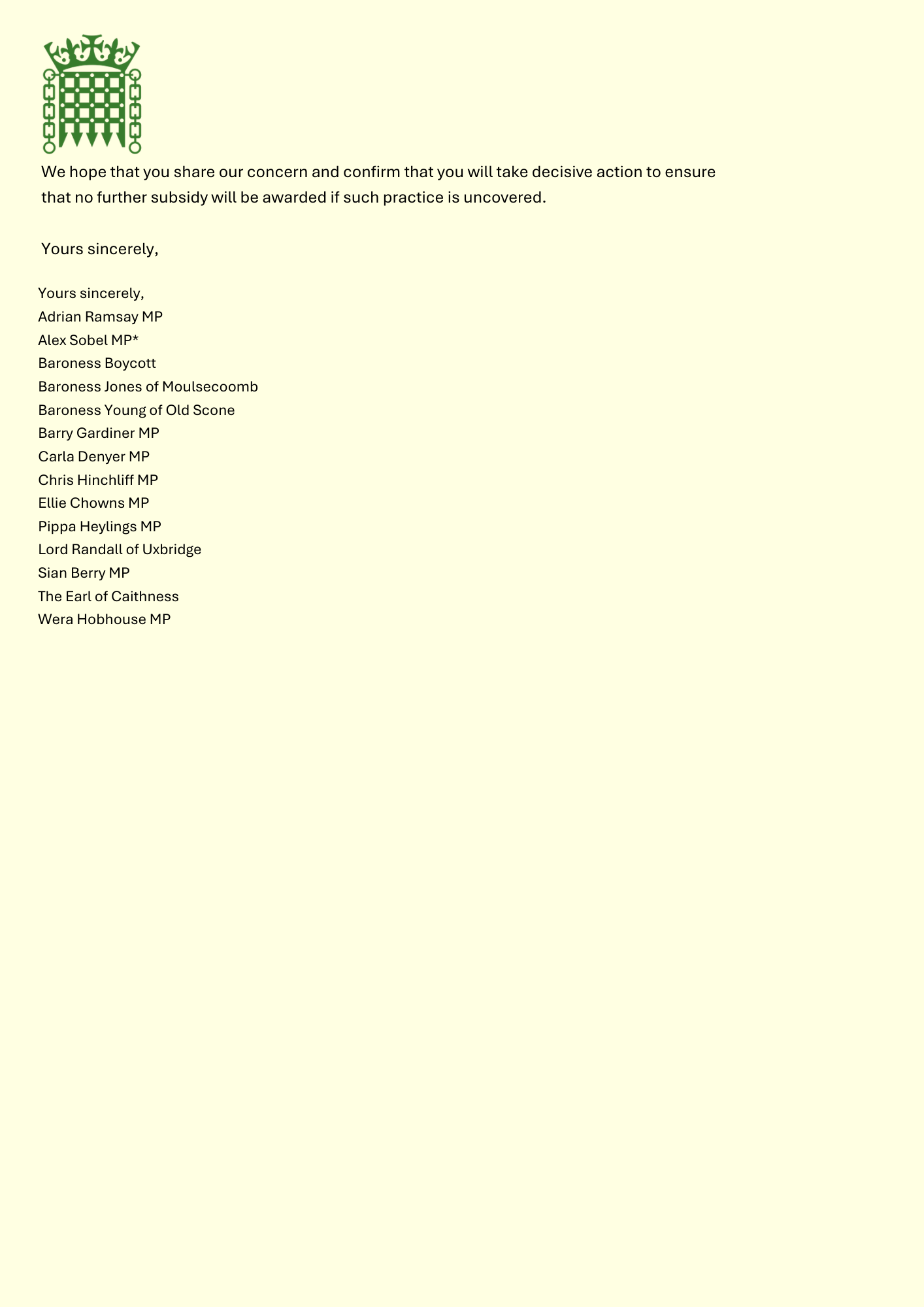
Drax internal emails and FCA investigation: cross-party request to review subsidy
-
The Rt Hon Ed Miliband MP
Secretary of State Department of Energy Security and Net Zero
18th February 2026
Drax internal emails and FCA investigation: cross-party request to review subsidy
Dear Secretary of State,
We are writing to bring your attention to a tranche of newly released internal correspondence from energy company Drax. This evidence suggests that Drax may have knowingly made misleading claims to the government, parliamentarians, Ofgem, and investors in its response to BBC Panorama’s investigation into Drax’s subsidised sourcing of wood from Canadian forests in 2022.
We are deeply concerned that a company should be in receipt of substantial billpayer subsidy, currently guaranteed until 2031, While it may have knowingly and consistently concealed information of material relevance to its legitimacy as a subsidy recipient.
According to media reports cited below, after the documentary aired, one senior manager wrote “we’ve been saying we don’t source from these forests when it appears we might be.”
This was despite public statements from the CEO stating that the BBC allegations were “false,” “ill-informed” and “promoted by vested interests.” The emails further Suggest Drax was told by lawyers “the legal view contradicts what you’ve put in the public domain.”
Given that the Financial Conduct Authority are currently investigating such “historical statements” made by Drax about their sourcing of pellets, we request that all future UK government contracts with Drax be suspended for the duration of this investigation. We ask you to clarify whether your Department considers Drax to be currently meeting the standards of transparency and compliance expected of a recipient of public subsidy.
We also highlight the quote from Lord Alan Whitehead, Energy Minister on 10th December 2025 “If Drax is non-compliant, the subsidy goes. There is no subsidy in the case of a non-
compliant organisation of any kind. If that happens, it will be the end of Drax”. We therefore
ask what steps you will take to reassess Drax’s eligibility for ongoing and future support
should the FCA investigation substantiate concerns that material information was withheld or
misrepresented.
Recent revelations are covered in the following media reports:
• Rachel Millard, Financial Times, Drax manager questioned public statements on
wood sourcing, tribunal documents show, 30th January 2026
• Jillian Ambrose, The Guardian, Drax insiders privately raised concerns over its
sustainability claims, court papers show, 4th February 2026
• Old Sparky, Private Eye, “Drax: Internal Affairs” Issue 1668, 6-19 Feb 2026
We hope that you share our concern and confirm that you will take decisive action to ensure
that no further subsidy will be awarded if such practice is uncovered.
Yours sincerely,
Adrian Ramsay MP
Alex Sobel MP*
Baroness Boycott
Baroness Jones of Moulsecoomb
Baroness Young of Old Scone
Barry Gardiner MP
Carla Denyer MP
Chris Hinchliff MP
Ellie Chowns MP
Pippa Heylings MP
Lord Randall of Uxbridge
Sian Berry MP
The Earl of Caithness
Wera Hobhouse MP
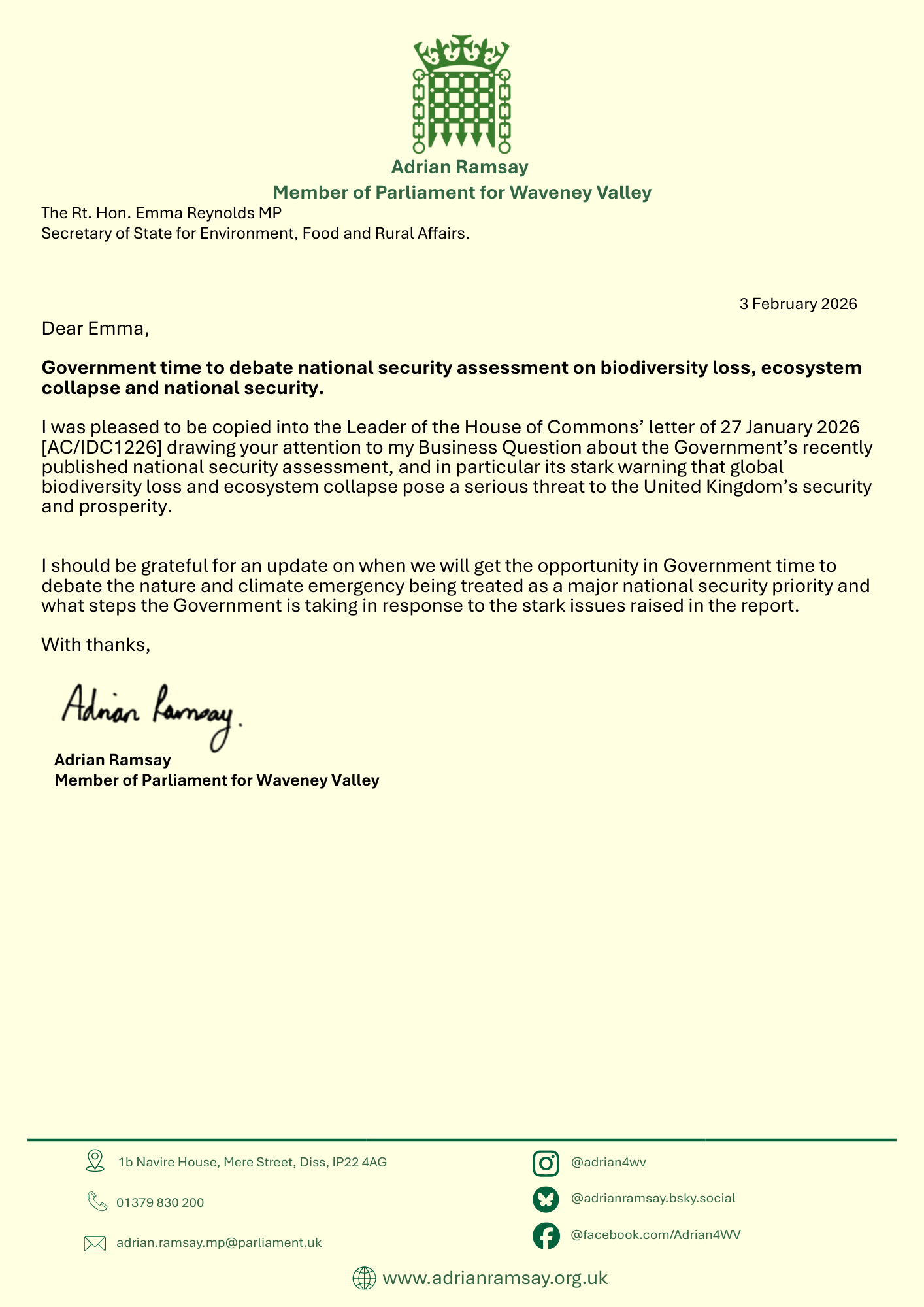
Government time to debate national security assessment on biodiversity loss, ecosystemcollapse and national security.
-
The Rt. Hon. Emma Reynolds MP
Secretary of State for Environment, Food and Rural Affairs.
Dear Emma,
3 February 2026
Government time to debate national security assessment on biodiversity loss, ecosystem
collapse and national security.
I was pleased to be copied into the Leader of the House of Commons’ letter of 27 January 2026
[AC/IDC1226] drawing your attention to my Business Question about the Government’s recently
published national security assessment, and in particular its stark warning that global
biodiversity loss and ecosystem collapse pose a serious threat to the United Kingdom’s security
and prosperity.
I should be grateful for an update on when we will get the opportunity in Government time to
debate the nature and climate emergency being treated as a major national security priority and
what steps the Government is taking in response to the stark issues raised in the report.
With thanks,
Adrian Ramsay MP

Green MP demands tougher powers for environmental watchdog after damning OEP report.
13th of January 2026
Green MP demands tougher powers for environmental watchdog after damning OEP report.
Adrian Ramsay, MP for Waveney Valley and DEFRA lead for the Green MPs, said:
"Today’s Office for Environmental Protection (OEP) report lays bare the scale of the crisis and is a deeply damning indictment of the environmental record of successive governments. The report shows that the majority of the ten environmental targets set out in the Environment Act 2021 have little to no chance of being met by 2030.
"Rather than stepping up action, the Government is actively advancing policies that will further damage it, leaving little realistic chance of stopping the decline of iconic British species such as the hedgehog and red squirrel by 2030. The Government must recognise that halting and reversing the decline of nature is central to our wellbeing and to food security as well as a healthy environment.
"If the Government is serious about its climate and biodiversity commitments, it must give the OEP real teeth, including the power to sanction and fine Government departments and local authorities that fail to meet legally binding targets. This would not be an overreach. It would simply restore the level of environmental accountability that existed before Brexit. Without these powers, the OEP risks becoming a watchdog that can bark but cannot bite, while environmental targets remain unmet and nature continues to decline."
Call it a reset, call it a “plan for change”, the Prime Minister’s administration was in desperate need of a relaunch
6th of December 2025
Call it a reset, call it a “plan for change”, the Prime Minister’s administration was in desperate need of a relaunch. Labour have had a shaky first few months, peppered with mis-steps from the ending of the winter fuel allowance to a budget which penalises small businesses and employers and won’t deliver improved living standards for people.
So now we have the Government’s new priorities from housing to NHS waiting lists to early years education. The ambition for Britain to be a clean energy superpower squeezes on to the list but, disappointingly, the ambition has been weakened to 95% clean power by 2030 – the same target set by the previous Conservative government.
What’s more disappointing is the silence on how we should be adapting to the impacts of climate breakdown which are affecting our communities now.
Even if we manage to limit global heating to 1.5C, and that looks more and more unlikely as emissions continue to grow and global efforts to decarbonise falter, significant changes to the climate and our weather systems are baked in. That means the UK faces more frequent severe flooding and more summer heatwaves.
We were all shocked this autumn by the images from Spain as the Valencia region was hit by devastating floods which destroyed homes, bridges, roads and cost hundreds of lives. The cost to the Spanish economy is huge. The Valencia region has asked for over 30 billion Euros in relief and the insurance costs are expected to run to several billion more.
Are we so confident that similar catastrophic flooding couldn’t happen here in the UK? The storms which hit parts of England and Wales this autumn were nothing like as severe as those in Spain yet they still led to hundreds of homes in the Midlands and South being flooded, exposing the total inadequacy of our flood defences. More than half the population say they’re not equipped to deal with flooding and the damage it would cause to their home.
The need to adapt to a different, more unstable climate shouldn’t come as a surprise to Government. Its own advisers, the Climate Change Committee, issued a review of the National Adaptation Programme earlier this year and it was scathing.
The UK is falling far short of what’s needed. The adaptation plans lack the pace and ambition to address the climate risks which are happening now. Fewer than half of the short-term actions needed to address the most urgent risks are in progress. There is no vision and the current approach isn’t working.
So while I welcome the Government’s ambition to make the UK a clean energy super-power to reduce our carbon emissions, ministers aren’t addressing the need to adapt and build up resilience now. And in some respects, we’re moving backwards.
Take the ambition for more house building. We urgently need more homes, especially more affordable homes and homes built for social rent. But building on floodplains not only condemns future owners to the misery of likely flooding, it also stops the land absorbing and holding back floodwater as nature intended.
Allowing floodplains to do their job isn’t the only nature-based solution that is being overlooked. We need to un-do the damage of previous generations and re-plant hedgerows and trees, rewind rivers and create ponds to hold back floodwaters. Nature is our ally in adapting to a changed climate: we shouldn’t ignore it.
Flooding is not the only risk to people’s livelihoods and the economy. So is extreme heat. We have already seen temperatures of above 40C in the UK which scientists say have happened only because of climate change. Our infrastructure needs to be resilient to these extreme temperatures so railways don’t buckle and people don’t bake in their homes. Retrofitting homes isn’t only about insulation to keep people warm in winter. It’s also about methods to keep them cool in summer. Over half of homes are at risk of over-heating which gives a sense of the scale of the challenge. On this, the Government has nothing to say.
Nor should we ignore the impact extreme temperatures have on our food security. The Climate Change Committee warned five years ago that more frequent weather extremes would damage crops and livestock, making food prices more volatile. Biodiversity loss could have an even greater impact, leaving crops more vulnerable to pests and pathogens.
So yes, Prime Minister, your Government needed a reset. But you’ve missed a critical mission – a national adaptation plan to safeguard our food security, better prepare the country for a future of more extreme weather and put nature at the heart of our response to climate change.
Letter to the Prime Minister Ahead of COP30
-
Adrian Ramsay MP co-signed this letter along with Sian Berry MP, Carla Denyer MP and Dr Ellie Chowns MP.
Rt Hon Sir Keir Starmer MP
Prime Minister
10 Downing Street
London
SW1A 2AA
31 October 2025
Dear Prime Minister,
We are writing ahead of COP30 to urge that you use the UK’s influence to ensure an ambitious outcome consistent with avoiding the most catastrophic climate impacts. This year’s COP summit is taking place at a pivotal moment in history - just past the mid-point in what’s a critical decade for climate and nature action.
The state of nature, biodiversity and ecosystems are deteriorating more rapidly than ever, and global temperatures continue to climb at a terrifyingly dangerous rate. The combined effect is devastating for the life support systems on which we all depend, and therefore also for our security, for our economic, social and political stability, and for everything from our food supplies to our health and wellbeing.
The UN Secretary General has called the fossil fuel companies the godfathers of climate chaos and the IPCC warn that emissions from fossil fuels are the dominant cause of global warming. Yet COP30 is taking place against a backdrop of continued financial support from governments for the fossil fuel industry – including an estimated £17.5 billion every year here in the UK.
At the same time, the poorest peoples of the world, with the least historic responsibility for climate emissions, continue to bear the brunt of climate breakdown. It is vital that the decisions made at COP30 do not further perpetuate climate injustice.
And with this year marking the start of a new round of Nationally Determined Contributions, COP30 is critical to closing the 1.5°C delivery gap and other gaps – as the UN Secretary General said in his remarks of 27th October 2025:
We need Nationally Determined Contributions that cut emissions much more deeply and accelerate the transition from fossil fuels to renewables. At COP30 in Brazil, we must go further and faster to close the ambition gap. We need more ambition in adaptation, mitigation and climate financial justice.
We warmly welcome your attendance at COP30 and hope your leadership will include advocating for:
A Climate Damages Tax – a “polluters pay” tax on the extraction of fossil fuels in the world’s richest advanced economies.
The Fossil Fuel Non-Proliferation Treaty – a framework to manage the global transition to safe, renewable & affordable energy for all.
Climate Justice – a climate finance package made up primarily of public funded grants funds, accompanied by debt cancellation measures, and that enables countries in the Global South to reduce their emissions, adapt to the impacts of climate change and meet the costs associated with loss and damage.
A global Just Transition - negotiators must stop blocking progress towards a Belém Action Mechanism (BAM).
An action plan to end forest destruction by 2030 - voluntary initiatives have failed to halt and reverse deforestation or to stop forest degradation, and substantive, structural change is needed to ensure existing forest commitments are met in an efficient, just and equitable way.
The UK’s global leadership should also be matched with ambitious domestic action as evidence of leading by example.
So we also call on you to back national measures that are aligned with the priorities of a successful COP30, and signal to the rest of the world that the UK is prepared to do its fair share in closing the gap between what the climate science demands and current emissions projections. Specifically, we urge you to:
End handouts to fossil fuel companies - use the forthcoming Budget to stop tax reliefs, investment allowances and subsidies, and to close loopholes in the ban on UK overseas finance supporting fossil fuels.
Play fair on climate finance – this must not come at the expense of overseas development aid, must be new government money, must not increase debt burdens, and must reflect the UK’s historic responsibilities.
Back the Energy Jobs Bill - to invest in British jobs and a just transition for workers in the oil and gas sector.
Deliver climate justice at home – with policies that ensure the poorest in our communities do not bear the financial brunt of climate action.
Keep your promise on no new oil and gas – by rejecting Rosebank, Jackdaw, other new extraction proposals and all new use of tie-backs – and go even further by refusing development consent for oil and gas projects that have already been licensed.
Step up on climate adaptation – with a national climate resilience plan and a sixth Government mission on adaptation that reflects the CCC’s advice of 15th October 2025.
Whilst we recognise that the UK and the world are making significant strides towards a carbon free economy, this is still accompanied by plans to produce more than double the quantity of fossil fuels in 2030 than would be consistent with holding global temperature rises to 1.5C above preindustrial levels.
This collective failure is driving climate breakdown.
COP 30 is an opportunity to change course – to choose transformative action that tackles injustice and inequality alongside greenhouse gas emissions.
We trust you will recognise this decisive moment by ramping up your ambition still further, in order to help secure a liveable future for all.
Yours sincerely,
Adrian Ramsay MP co-signed this letter along with Sian Berry MP, Carla Denyer MP and Dr Ellie Chowns MP.
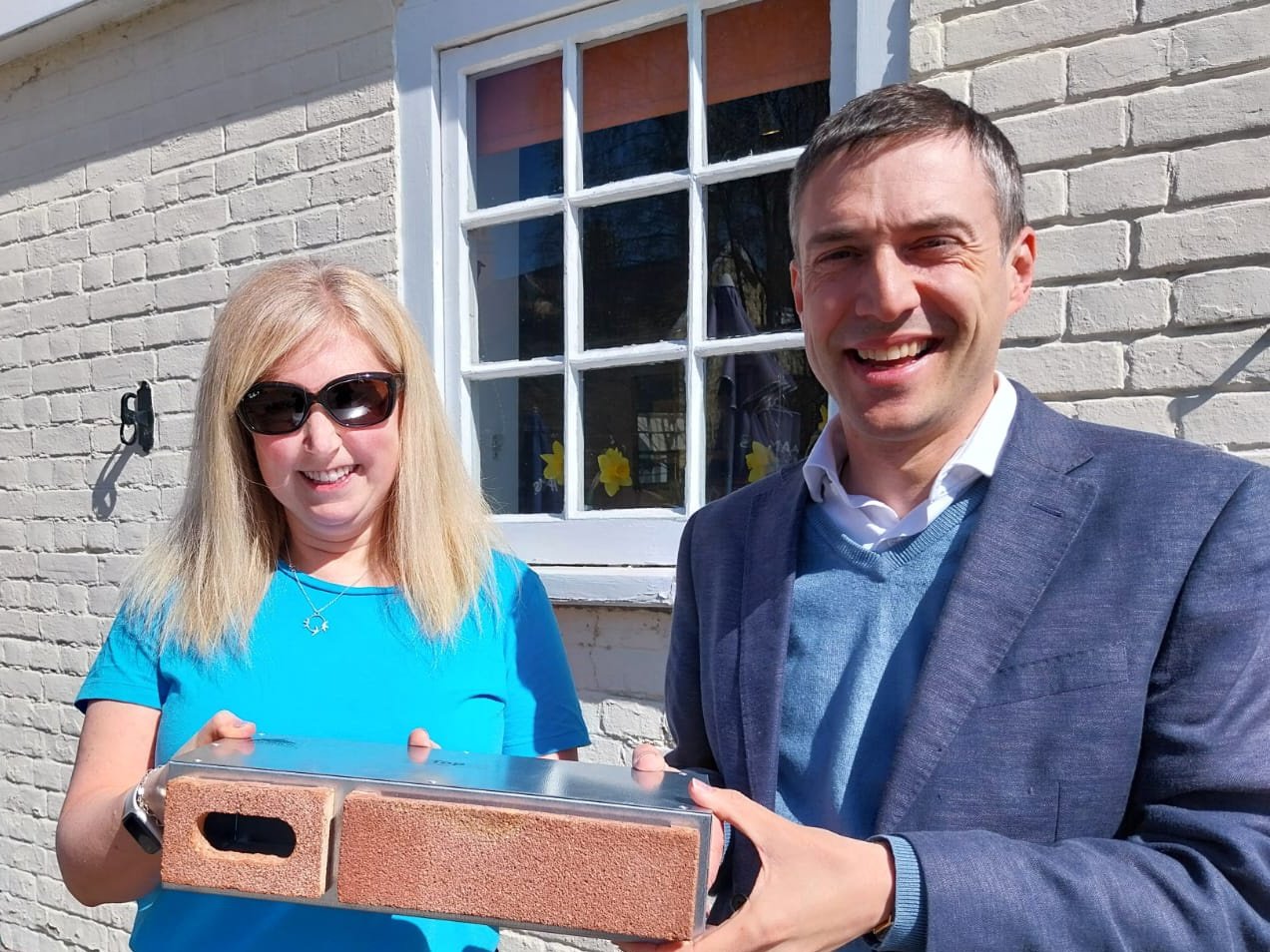
Adrian Ramsay MP Welcomes Swift Brick Pledge and Calls for Greener, Nature-Friendly Housing Standards
7th August 2025
Adrian Ramsay MP, Co-Leader of the Green Party of England and Wales and Member of Parliament for Waveney Valley, has welcomed Saffron Housing Trust’s new commitment to install swift bricks in all suitable new build homes on their future developments – calling the move “A great example of what should become the norm, not the exception.”
Saffron Housing announced that they have made this decision following representations from Adrian Ramsay on behalf of his constituents.
Speaking on the commitment Adrian Ramsay MP said
“With swifts now on the UK’s Red List, we urgently need to protect and restore their nesting sites. That is why I welcome Saffron Housing Trust's commitment to install swift bricks in all suitable new build homes on their future developments. Swift bricks are a simple, low-cost solution that offer real benefits to these birds and many other species.
“We need to make nature-friendly design and high environmental standards the norm in all new developments. We must build homes that are fit for the future – that means measures that are good for wildlife, and also measures that are good for people and reducing bills such as including renewable energy and high insulation standards as a matter of course. I commend Saffron Housing Trust for taking this step and I want to see all housing providers ensuring the highest environmental standards.”
Marie Baynham-Davies - A member of Halesworth Swifts and Suffolk Save Our Swifts who highlighted the issue with Adrian in a constituency surgery, said
“This is a real boost for swift populations which have declined by 66% since 1995. Insulation in modern developments means buildings provide no natural nest sites for birds. Swift bricks provide a safe cavity for swifts to nest in and cost less than a nest box but last the lifetime of the building. It is fantastic that Adrian Ramsay is supporting the use of Swift bricks, and we hope that Saffron Housing's decision to install them shows that putting bricks in new developments is an achievable target for all planners and developers.”
ENDS
For more information, visit https://www.actionforswifts.com and https://hannahbournetaylor.com/the-feather-speech-campaign-for-swifts/
Saffron Housing announcement https://www.linkedin.com/posts/saffron-housing-trust-limited_socialhousing-developments-environmental-activity-7358888552119615489-G4h2?utm_source=social_share_send&utm_medium=member_desktop_web&rcm=ACoAACXkKVkBzhFvdiHzxiiRBBCGJvHQaqgifLM