
Letter on the Deteriorating Security Situation in North-East Syria
-
Adrian Ramsay MP co-signed this cross-party letter initiated by Luke Akehurst MP.
Dear Yvette,
Re: The Deteriorating Security Situation in North-East Syria
As a group of cross-party MPs and Peers, we are writing to you to express our concern about the rapidly deteriorating security situation in North-East Syria, where Kurdish communities face a real and imminent threat of violence.
Over the past few days, forces under the direction of President Ahmed al-Sharaa have escalated their presence in North-East Syria, following the withdrawal of the Western-backed Syrian Democratic Forces (SDF). Credible reporting indicates severe risk to civilian life, with local authorities also reporting that more than 150,000 people have been displaced. Syrian authorities have confirmed that thousands of civilians have fled the area, amid warnings of landmines and unexploded ordnance.
The SDF’s withdrawal comes as a direct response to attacks from Syrian Government forces, including units linked directly to Hayat Tahrir al-Sham. These include the Hamza Division, the Sultan Murad Division, and the Sultan Suleiman Shah Division, all of which are designated under the UK’s sanctions regimes for their role in violent attacks against civilians.
Unfortunately, the current violence risks inflicting even more harm on innocent civilians, and particularly on the local Kurdish population. Early reports indicate indiscriminateattacks against Kurdish communities.
Of particular note is the SDF’s withdrawal from Al-Hol Camp, where the ISIS-linked families were being held, due to ongoing shelling and attacks by Syrian Government forces. Similarly, the SDF was forced to withdraw from Al-Shadadi Camp, where a reported 2,000 ISIS fighters were being held. The subsequent uncertainty over what will now happen to these ISIS fighters is deeply concerning, given the potential implications for regional and national security.
For Kurdish communities, consistently some of the UK’s staunchest allies in the region, the ongoing escalation foreshadows a return to the days of widespread ISIS terror in Syria. Given the incredible resolve that Kurdish communities displayed in defeating ISIS in Syria, the UK owes Syrian Kurds its support.
These developments demand more than expressions of concern, and calls for de-escalation. The UK must now work closely with its partners, both in the region and beyond, to coordinate a response which protects Kurdish communities in North-East Syria, and ensures a long–lasting and sustainable settlement for the region. It must do so rapidly, given how quickly the situation is evolving, and it must do so decisively. In particular, we urge the Government to:
1. Make clear its position against violence against civilians, and in favour of a long-standing political settlement in Syria which respects the rights of all minority groups;
2. Consider targeted sanctions against individuals and entities found to be responsible for violence against civilians;
3. Intensify its diplomatic efforts with both regional and global allies, to prevent further military escalation and to protect civilian populations;
4. Ensure that sufficient humanitarian aid is provided to communities in North-East Syria, and that this aid is safeguarded as it is delivered.
A failure to act quickly and decisively risks enabling a further escalation of violence, and puts Kurdish communities in Syria at risk. The safety of Kurdish communities – and of minority populations in Syria more broadly – is a matter of deep concern for the UK.
We eagerly await your response, and for a clarification on what the Government intends to do to prevent this situation from deteriorating even further. This country owes a debt of gratitude to the countless Kurdish men and women who have stood bravely against ISIS terror over many years. The very least that we can do to repay them is to take action in this hour of grave need.
Adrian Ramsay MP co-signed this cross-party letter initiated by Luke Akehurst MP.
Luke Akehurst MP
Dr Rosena Allin-Khan MP
Dr Scott Arthur MP
Richard Baker MP
Alex Ballinger MP
Paula Barker MP
Sian Berry MP
Chris Bloore MP
Dawn Butler MP
Maureen Burke MP
Ruth Cadbury MP
Sarah Champion MP
Bambos Charalambous MP
Feryal Clark MP
Dr Beccy Cooper MP
Daisy Cooper MP
Stella Creasy MP
Steve Darling MP
Carla Denyer MP
Jim Dickson MP
Mary Kelly Foy MP
Daniel Francis MP
Andrew George MP
Terry Jermy MP
Kim Johnson MP
Ben Lake MP
Peter Lamb MP
Chris Law MP
Noah Law MP
Siobhan McDonagh MP
John McDonnell MP
Llinos Medi MP
Navendu Mishra MP
Grahame Morris MP
Brendan O’Hara MP
Chi Onwurah MP
Kate Osborne MP
Toby Perkins MP
Adrian Ramsey MP
Marie Rimmer MP
Oliver Ryan MP
Liz Saville Roberts MP
Jim Shannon MP
Sarah Smith MP
Alex Sobel MP
Ian Sollom MP
Kirsteen Sullivan MP
Henry Tufnell MP
Derek Twigg MP
Chris Webb MP
Nadia Whittome MP
Gavin Williamson MP
Sean Woodcock MP
Lord Alton of Liverpool
Baroness Bennett of Manor Castle
Baroness Carberry
Lord Cashman
Lord Doyle
Lord Elliott of Mickle Fell
Baroness Foster of Aghadrumsee
Baroness Goudie
RE: Palestine Solidarity Campaign Rally 18th January 2025
-
RE: Palestine Solidarity Campaign Rally 18th January 2025
Dear Home Secretary,
We write concerning the above, and specifically to raise concerns about the manner of the policing and
the apparent denial of civil liberties and freedom to protest.
We are all cautiously relieved that a ceasefire in the Gaza Strip has been announced and is currently
being implemented with hostages starting to return to their families and Palestinian detainees being
released.
The hope is that the staged ceasefire and release of hostages and prisoners continues as planned. But
the Palestine solidarity movement remains as pertinent as ever, with Palestinians still facing daily brutal
oppression under Israel’s decades long illegal occupation.
The situation for Palestinians in the Gaza Strip is desperate, and the lifting of sanctions against violent
settlers in the West Bank by Donald Trump has already fuelled further violence against Palestinians
living there. It is clear that the injustices experienced by Palestinians continues and remains an
important issue for many millions of UK citizens and for peoples across the world. The regular large
scale protests taking place across the country over the last 15 months have been an important
democratic expression of the strength of public feeling on this issue.
These protests have been very well organised, with 24 national demonstrations each with between
100,000 and a million people attending. They have been peaceful in nature and attended by a broad
range of people and groups – including a prominent Jewish block at every march. Ahead of every march,
the organisers have discussed fully with the Metropolitan Police to ensure their success.
We are deeply troubled, however, by the obstacles put in place by the Metropolitan Police ahead of the
18th January demonstration, as well as the policing on the day. We have spoken to the key figures in the
forefront of the events of the day, listened to their first-hand accounts and viewed the video footage,
and there are some significant issues of concern.
It is very clear from the published footage that the protest organisers announced their intention to send
a small delegation to walk towards the BBC, carrying flowers which they intended to lay there. They
announced that if the police were to stop them proceeding to the BBC, then they would lay the flowers
at the feet of the police instead.
Footage clearly shows the police inviting the delegation to ‘filter through’ from Whitehall into Trafalgar
Square, as opposed to it ‘breaching police lines’ as subsequently alleged. In this context, we fail to see
how the questioning of two Members of Parliament, the charging of Ben Jamal of Palestine Solidarity
Campaign and Chris Nineham of Stop the War Coalition with public order offences, and indeed the assault on Chris Nineham during his arrest, and the interviewing of others under caution, can be
thought justified or in any way appropriate.
There is a direct conflict in the respective positions of officers facilitating the progress of a delegation
to lay flowers, and the allegation by the police that their lines had been forcibly breached. Clearly being
invited to proceed is wholly inconsistent with the allegation of a forcible breach. We invite you to
contrast the web posts and social media posts by the Metropolitan Police and the footage shared by
the Palestine Solidarity Campaign.
We know that you will have received many direct representations no doubt detailing the chronology
and the discussions had before and throughout the rally as between the PSC and the Police and we will
not repeat those details here, but we were aghast to learn that Met Commissioner Mark Rowley said
publicly the day after the protest that ‘his force imposed unprecedented restrictions’ on a major
Palestine solidarity rally in London on 18th January that led to 77 arrests.
The changes to public order legislation by the last government, through both the Police, Crime,
Sentencing and Courts Act 2022 and through the Public Order Act 2023, were rightly resisted. Civil
society called it, ‘a staggering escalation of the Government’s clampdown on protest’. The Joint
Committee on Human Rights rightly condemned the creation of, ‘a hostile environment for peaceful
protestors.’ And an opposition frontbench reasoned amendment rightly declared this legislation would,
‘erode historic freedoms of peaceful protest’.
The High Court in May this year upheld legal challenges brought by Liberty against the almost “unlimited
powers of the Police” and it is regrettable that the Government is appealing that decision and is
seemingly supporting public order measures which we opposed when in Opposition.
The Government is rightly repealing anti-trade union legislation through the Employment Rights Bill. It
should repeal anti-protest legislation as well. The use of public order legislation passed by the last
Government, should be paused and subject to reconsideration by the Home Office rather than pursuing
use of its devices.
With regards to last weekend’s protest, we ask that you clarify whether there was any discussion
between the Commissioner and the Home Office, or any prior or subsequent engagement or
communication around such a significant change in policy.
If so, could you please advise as to the origins of such a significant change and whether such an
intention was approved in any way.
We believe the charges should be dropped against those unjustly arrested, or unjustly charged,
following the protest. And we ask that the Home Office commission an independent investigation into
the policing of the protest.
It was the former Government which fomented protest and used legislation to repress it, this
Government must demonstrate it is delivering change.
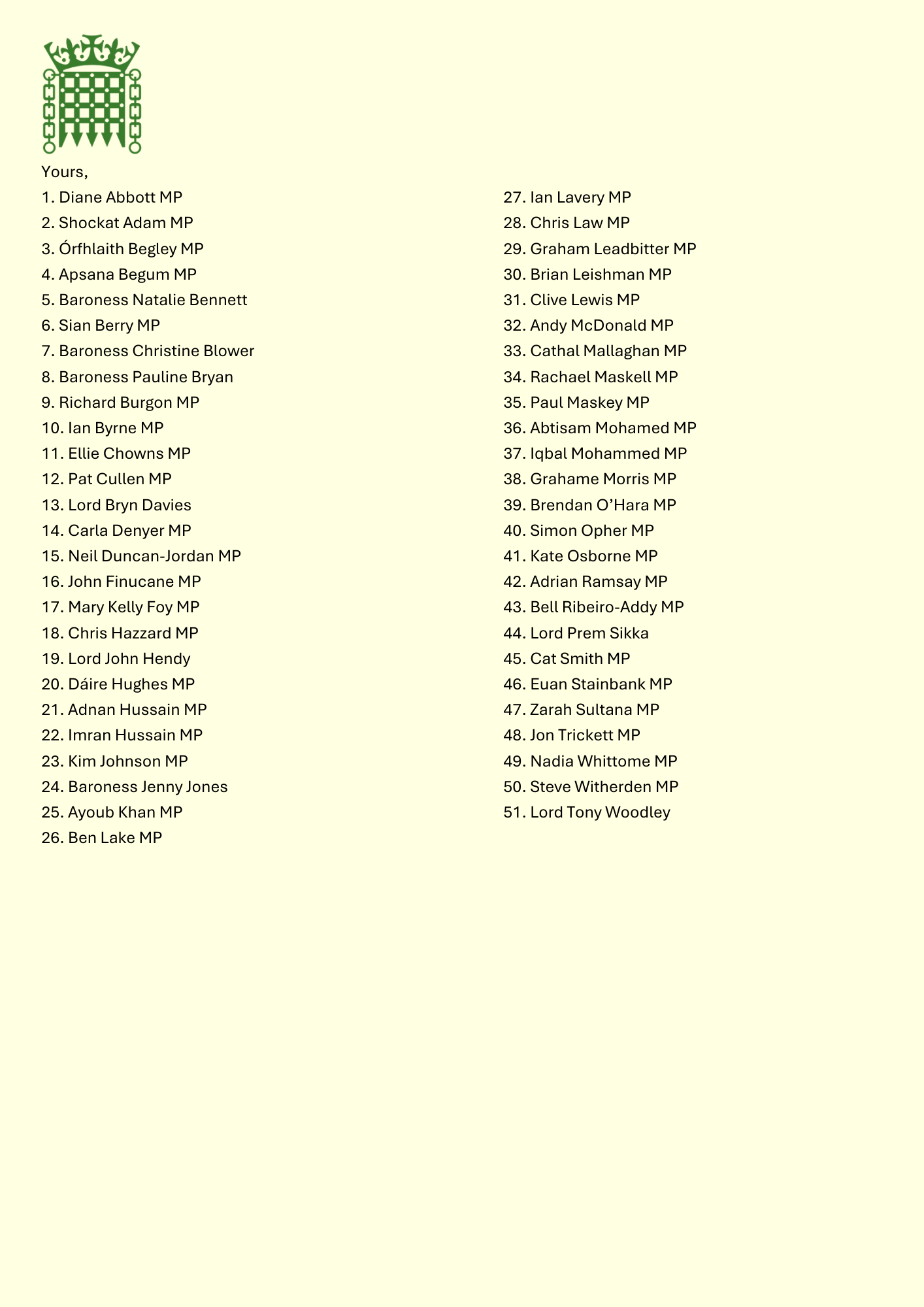
Yours,
1. Diane Abbott MP
2. Shockat Adam MP
3. Órfhlaith Begley MP
4. Apsana Begum MP
5. Baroness Natalie Bennett
6. Sian Berry MP
7. Baroness Christine Blower
8. Baroness Pauline Bryan
9. Richard Burgon MP
10. Ian Byrne MP
11. Ellie Chowns MP
12. Pat Cullen MP
13. Lord Bryn Davies
14. Carla Denyer MP
15. Neil Duncan-Jordan MP
16. John Finucane MP
17. Mary Kelly Foy MP
18. Chris Hazzard MP
19. Lord John Hendy
20. Dáire Hughes MP
21. Adnan Hussain MP
22. Imran Hussain MP
23. Kim Johnson MP
24. Baroness Jenny Jones
25. Ayoub Khan MP
26. Ben Lake MP
27. Ian Lavery MP
28. Chris Law MP
29. Graham Leadbitter MP
30. Brian Leishman MP
31. Clive Lewis MP
32. Andy McDonald MP
33. Cathal Mallaghan MP
34. Rachael Maskell MP
35. Paul Maskey MP
36. Abtisam Mohamed MP
37. Iqbal Mohammed MP
38. Grahame Morris MP
39. Brendan O’Hara MP
40. Simon Opher MP
41. Kate Osborne MP
42. Adrian Ramsay MP
43. Bell Ribeiro-Addy MP
44. Lord Prem Sikka
45. Cat Smith MP
46. Euan Stainbank MP
47. Zarah Sultana MP
48. Jon Trickett MP
49. Nadia Whittome MP
50. Steve Witherden MP
51. Lord Tony Woodley
Letter to the Home Secretary on Gaza Students Policy
-
INSERT HERE
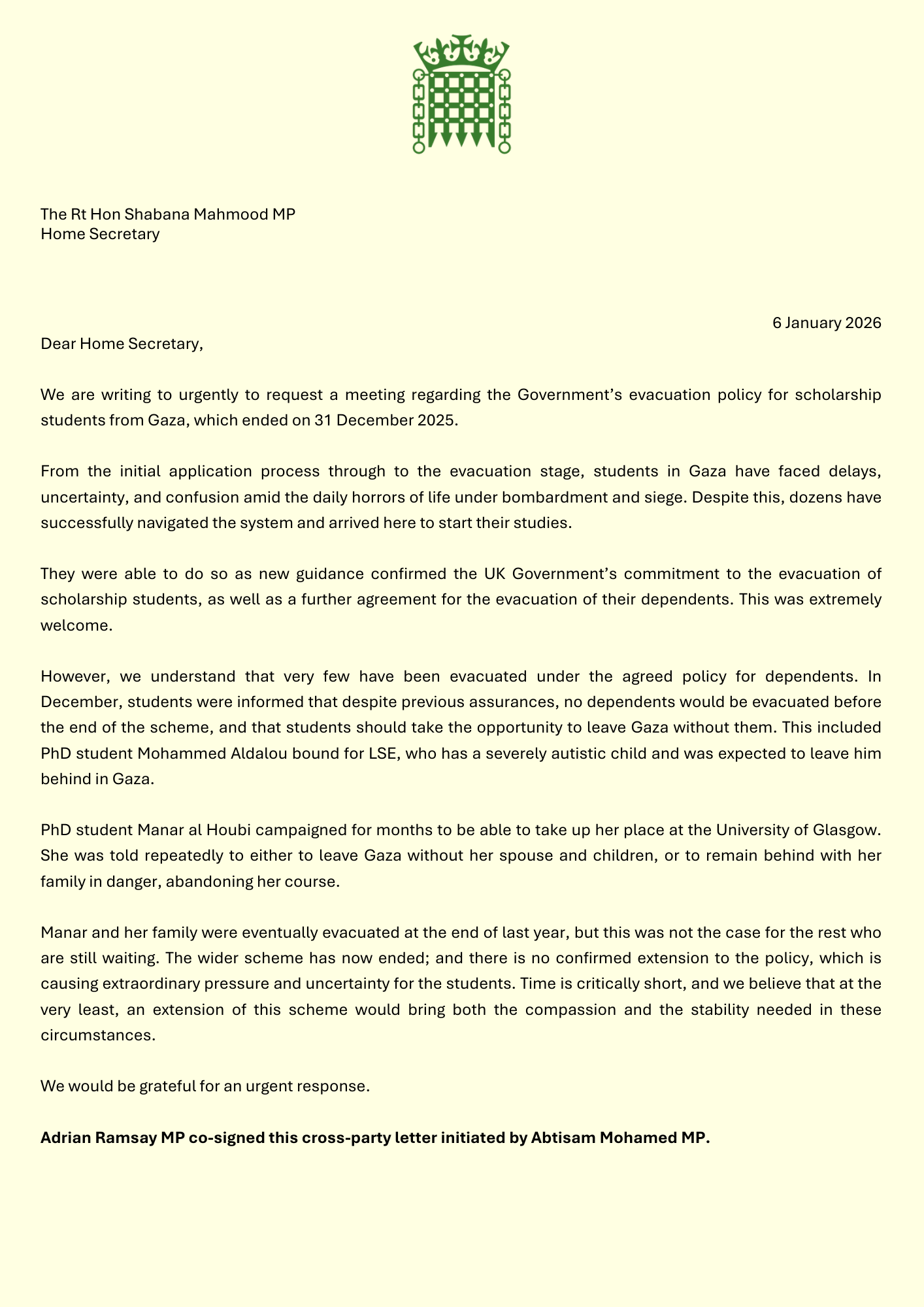
The Rt Hon Shabana Mahmood MP
Home Secretary
6 January 2026
Adrian Ramsay MP co-signed this cross-party letter initiated by Abtisam Mohamed MP.
Dear Home Secretary,
We are writing to urgently to request a meeting regarding the Government’s evacuation policy
for scholarship students from Gaza, which ended on 31 December 2025.
From the initial application process through to the evacuation stage, students in Gaza have
faced delays, uncertainty, and confusion amid the daily horrors of life under bombardment and
siege. Despite this, dozens have successfully navigated the system and arrived here to start
their studies.
They were able to do so as new guidance confirmed the UK Government’s commitment to the
evacuation of scholarship students, as well as a further agreement for the evacuation of their
dependents. This was extremely welcome.
However, we understand that very few have been evacuated under the agreed policy for
dependents. In December, students were informed that despite previous assurances, no
dependents would be evacuated before the end of the scheme, and that students should take
the opportunity to leave Gaza without them. This included PhD student Mohammed Aldalou
bound for LSE, who has a severely autistic child and was expected to leave him behind in
Gaza.
PhD student Manar al Houbi campaigned for months to be able to take up her place at the
University of Glasgow. She was told repeatedly to either to leave Gaza without her spouse
and children, or to remain behind with her family in danger, abandoning her course.
Manar and her family were eventually evacuated at the end of last year, but this was not the
case for the rest who are still waiting. The wider scheme has now ended; and there is no
confirmed extension to the policy, which is causing extraordinary pressure and uncertainty for
the students. Time is critically short, and we believe that at the very least, an extension of this
scheme would bring both the compassion and the stability needed in these circumstances.
We would be grateful for an urgent response.
Adrian Ramsay MP co-signed this cross-party letter initiated by Abtisam Mohamed MP.
Letter on Agriculture in Palestine
-
Adrian Ramsay MP co-signed this cross-party letter initiated by Steve Witherden MP.
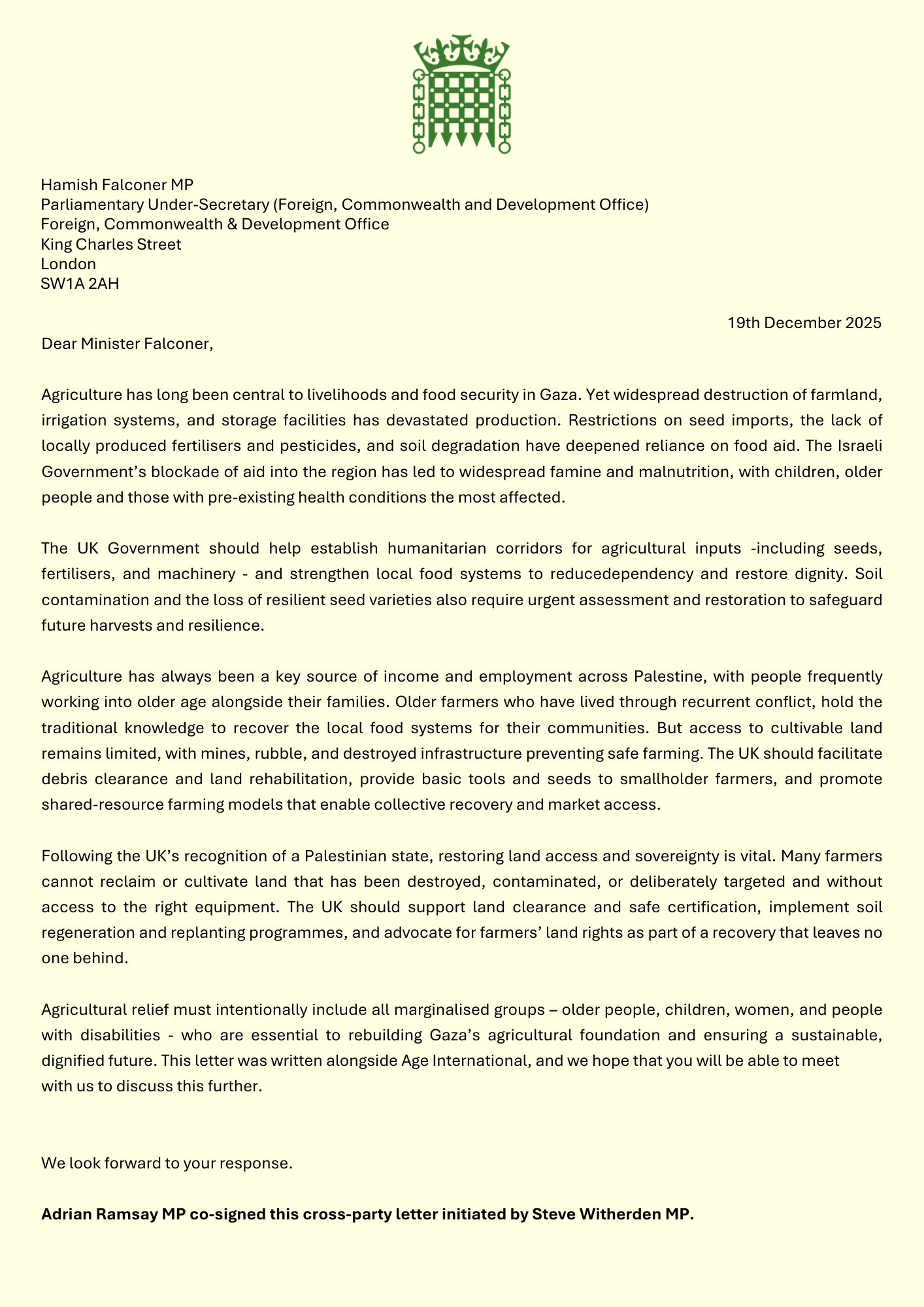
Hamish Falconer MP
Parliamentary Under-Secretary (Foreign, Commonwealth and Development Office)
Foreign, Commonwealth & Development Office
King Charles Street
London
SW1A 2AH
19th December 2025
Dear Minister Falconer,
Agriculture has long been central to livelihoods and food security in Gaza. Yet widespread
destruction of farmland, irrigation systems, and storage facilities has devastated production.
Restrictions on seed imports, the lack of locally produced fertilisers and pesticides, and soil
degradation have deepened reliance on food aid. The Israeli Government’s blockade of aid into
the region has led to widespread famine and malnutrition, with children, older people and those
with pre-existing health conditions the most affected.
The UK Government should help establish humanitarian corridors for agricultural inputs -
including seeds, fertilisers, and machinery - and strengthen local food systems to reduce
dependency and restore dignity. Soil contamination and the loss of resilient seed varieties also
require urgent assessment and restoration to safeguard future harvests and resilience.
Agriculture has always been a key source of income and employment across Palestine, with
people frequently working into older age alongside their families. Older farmers who have lived
through recurrent conflict, hold the traditional knowledge to recover the local food systems for
their communities. But access to cultivable land remains limited, with mines, rubble, and
destroyed infrastructure preventing safe farming. The UK should facilitate debris clearance and
land rehabilitation, provide basic tools and seeds to smallholder farmers, and promote shared-
resource farming models that enable collective recovery and market access.
Following the UK’s recognition of a Palestinian state, restoring land access and sovereignty is
vital. Many farmers cannot reclaim or cultivate land that has been destroyed, contaminated, or
deliberately targeted and without access to the right equipment. The UK should support land
clearance and safe certification, implement soil regeneration and replanting programmes, and
advocate for farmers’ land rights as part of a recovery that leaves no one behind.
Agricultural relief must intentionally include all marginalised groups – older people, children,
women, and people with disabilities - who are essential to rebuilding Gaza’s agricultural
foundation and ensuring a sustainable, dignified future.
This letter was written alongside Age International, and we hope that you will be able to meet
with us to discuss this further. We look forward to your response.
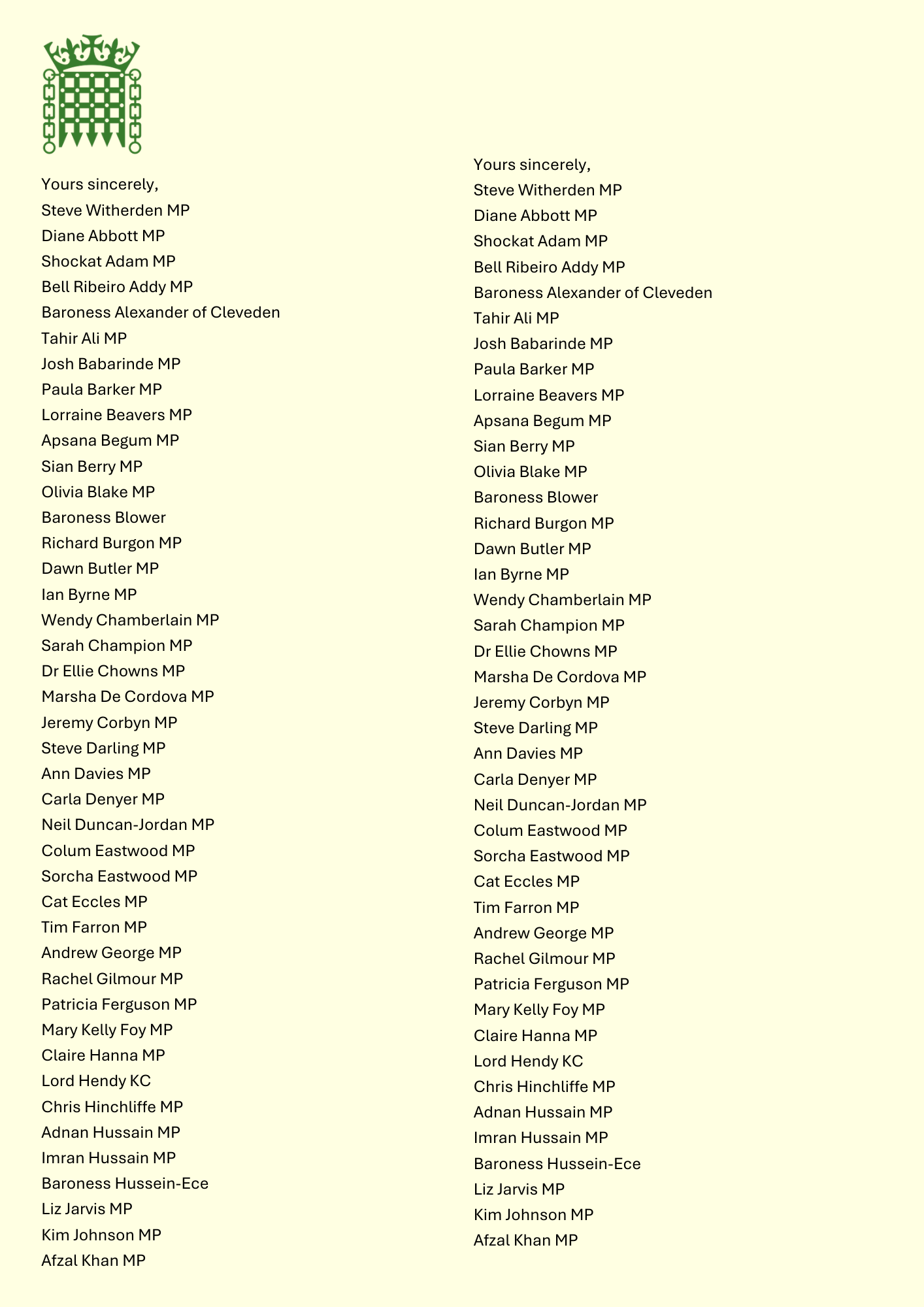
Yours sincerely,
Steve Witherden MP
Diane Abbott MP
Shockat Adam MP
Bell Ribeiro Addy MP
Baroness Alexander of Cleveden
Tahir Ali MP
Josh Babarinde MP
Paula Barker MP
Lorraine Beavers MP
Apsana Begum MP
Sian Berry MP
Olivia Blake MP
Baroness Blower
Richard Burgon MP
Dawn Butler MP
Ian Byrne MP
Wendy Chamberlain MP
Sarah Champion MP
Dr Ellie Chowns MP
Marsha De Cordova MP
Jeremy Corbyn MP
Steve Darling MP
Ann Davies MP
Carla Denyer MP
Neil Duncan-Jordan MP
Colum Eastwood MP
Sorcha Eastwood MP
Cat Eccles MP
Tim Farron MP
Andrew George MP
Rachel Gilmour MP
Patricia Ferguson MP
Mary Kelly Foy MP
Claire Hanna MP
Lord Hendy KC
Chris Hinchliffe MP
Adnan Hussain MP
Imran Hussain MP
Baroness Hussein-Ece
Liz Jarvis MP
Kim Johnson MP
Afzal Khan MP
Ayoub Khan MP
Ben Lake MP
Peter Lamb MP
Ian Lavery MP
Chris Law MP
Brian Leishman MP
Clive Lewis MP
Baroness Lister of Burtersett
Seamus Logan MP
Rebecca Long-Bailey MP
Rachael Maskell MP
Andy McDonald MP
John McDonnell MP
Llinos Medi MP
John Milne MP
Abtisam Mohamed MP
Iqbal Mohamed MP
Layla Moran MP
Grahame Morris MP
Lord Oates
Brendan O'Hara MP
Dr Simon Opher MP
Kate Osborne MP
Manuela Perteghella MP
Yasmin Qureshi MP
Adrian Ramsay MP
Martin Rhodes MP
Liz Saville Roberts MP
Roz Savage MP
Baroness Sheehan
Lord Singh of Wimbledon
Vikki Slade MP
Cat Smith MP
Jamie Stone MP
Lord Soames of Fletching
Alex Sobel MP
Jon Trickett MP
Valerie Vaz MP
Nadia Whittome MP
Lord Woodley
Mohammad Yasin MP
Hunger Strikers - request for urgent meeting with David Lammy MP
-
Dear Secretary of State,
We the undersigned MPs, are writing to implore you to meet with Imran Khan & Partners, the lawyers representing the 8 prisoners on hunger strike, immediately.
We note that Imran Khan & Partners wrote to you on the 9th December imploring you to meet with them "before our client’s health deteriorates beyond any possible recovery”. We draw your attention to the section of the letter which details the exceptionally urgent medical status of the prisoners, five of whom have already been hospitalised more than once. In particular the following extremely serious symptoms: pulse above 100 beats per minute, ketone levels above 4 (when they should be 0 in a non-diabetic person), weight loss of more than 10kg, deteriorating vision, shortness of breath, low blood pressure, hypoglycaemia, shallow breath, and signs of memory loss.
We are growing increasingly dismayed at the government’s lack of action to protect the health and well being of British citizens.
If you will not meet with the MPs who are representing the hunger strikers and their loved ones, then we plead with you to urgently meet with their solicitors and act to prevent a catastrophe.
Yours sincerely,
Adrian Ramsay MP co-signed this cross-party letter initiated by Rt Hon Jeremy Corbyn MP.
Proposed Restrictions on the Use of Terms Such as “Burger” and “Sausage” for Plant Based Foods
-
Adrian Ramsay MP co-signed this cross-party letter initiated by the Vegetarian Society.
LETTER TO MEMBERS OF THE EUROPEAN COMMISSION
From Members of Parliament of the United Kingdom
Re: Proposed Restrictions on the Use of Terms Such as “Burger” and “Sausage” for Plant Based Foods
06/12/2025
Dear Commissioners,
We write as members of the UK Parliament to express our deep concern regarding the proposed ban on the use of everyday, well-understood food terms, such as ‘burger’, ‘sausage’, and similar descriptors, when used for plant-based products. Although the United Kingdom is no longer a member of the European Union, our markets, companies, consumers, and regulatory conversations remain closely intertwined. Decisions taken at EU level continue to influence global norms, international trade, and the direction of sustainable food innovation.
We urge you not to adopt these restrictions, as we are deeply concerned about the significant global impact they could have. The evidence is clear: existing legislation already protects consumers; consumers themselves overwhelmingly understand and support current naming conventions; and new restrictions would undermine economic growth, sustainability goals, and the EU’s own simplification agenda.
1. Current legislation already ensures consumer protection
The Food Information to Consumers (FIC) Regulation provides extensive safeguards against consumer confusion. The European Court of Justice confirmed in Case C-438/23 that the current legislative framework is fully adequate to protect and inform consumers and to address misleading presentation when it arises1.
The Court also reiterated that existing rules already mandate transparency when expected ingredients are substituted - requirements that plant-based producers consistently follow.
This position has also been acknowledged at multiple points by the European Commission (see 2020 response2, 2022 response3 and 2024 response4).
2. Most consumers are not confused, however, a ban could increase confusion
1 https://eur-lex.europa.eu/legal-content/EN/TXT/PDF/?uri=CELEX:62023CJ0438
2 https://www.europarl.europa.eu/doceo/document/E-9-2020-004966-ASW_EN.html 3 https://www.europarl.europa.eu/doceo/document/E-9-2022-002681-ASW_EN.html 4 https://www.europarl.europa.eu/doceo/document/E-10-2024-002312-ASW_EN.html
Research consistently shows that consumers intentionally choose plant-based alternatives and do not confuse them with animal meat.
The Advocate-General’s Opinion (Capeta, 2024) explicitly warns that banning familiar food terms could increase confusion, not reduce it5. Empirical studies reinforce this finding:
• BEUC study (2020): ~80% support use of terms like ‘veggie burger’6 • Smart Protein (2023): Only 9% of consumers do not recognise plant-based meat alternatives7
• Germany (2022): 92% identify plant-based alternatives correctly8
• Spain (2021): Only 13% oppose plant-based use of traditional terms9 • Portugal (2021): >95% understand that plant-based alternatives contain no animal meat10
• Greece (2024): ~82% do not oppose current naming11
• Empirical study on label clarity (Gleckel, 2020)12
These findings show an overwhelming pattern; most European consumers understand the terminology for plant-based foods well.
3. The proposed ban undermines competitiveness, innovation, and the single market
Introducing a denomination ban would run counter to the EU’s commitments on simplification and competitiveness. It would create administrative burdens, force companies to redesign packaging, and generate inconsistencies across languages and Member States.
This is particularly problematic given the rapid growth of the plant-based market: • Europe remains the world’s largest consumer market for plant-based alternatives13
5
https://curia.europa.eu/juris/document/document.jsf?text=&docid=289831&pageIndex=0&doclang=en&mo de=req
6 https://www.beuc.eu/sites/default/files/publications/beuc-x-2020-
042_consumers_and_the_transition_to_sustainable_food.pdf
7 https://smartproteinproject.eu/wp-content/uploads/Smart-Protein-European-Consumer-Survey_2023.pdf 8 https://www.vzbv.de/sites/default/files/2022-
04/220307_IFH%20K%C3%96LN_Verbraucherzentrale_Kennzeichnung%20von%20Ersatzprodukten_final.p df9 https://proveg.com/es/wp-content/uploads/sites/2/2021/02/Resultados-estudio-nomenclatura-alimentos vegetales.pdf
10 https://www.atrevia.com/wp-content/uploads/2021/03/Relatorio_Upfield_FINAL_UCP.pdf 11 https://hellasveg.gr/wp-content/uploads/2025/05/survey-2024-final_EN.pdf
12https://ssrn.com/abstract=3727710
13 https://gfi.org/resource/plant-based-meat-eggs-and-dairy-state-of-the-industry-report
• The EU market grew 21% between 2020 and 202214
• Consumer trends show rising flexitarianism and reduced meat consumption15 • 31% of Europeans are reducing meat intake16
• Economic modelling demonstrates substantial opportunities: Plant-based dietary shifts could increase farm incomes by up to 71%17
• Alternative proteins could create 83 million jobs globally by 205018 • This sector is also a major opportunity for European farmers, with most crops used in plant-based dairy grown inside the EU (ProVeg International, 2022).
4. Plant-based foods support climate goals and European food security
Alternative proteins offer some of the highest emissions-reduction returns per euro invested, outperforming investments in electric vehicles and green building initiatives19.
They are also identified as one of the key ‘super-leverage points’ that can accelerate transitions across multiple sectors. Meldrum et al. (2023): The Breakthrough Effect.
Greater cultivation of pulses and legumes improves soil fertility and reduces fertiliser dependency, lowering production costs20,21. All of this shows that expanding plant-based options is aligned with environmental, economic, and food-security goals.
Conclusion
We recognise the importance of protecting consumers and ensuring clarity in food labelling. However, the evidence is unequivocal:
• Current EU law already provides full protection
• Consumers overwhelmingly understand and support the existing naming system • The proposed restrictions could damage competitiveness, innovation, and climate progress.
Clear labelling, not unnecessary terminology bans, is the best approach for consumers, producers, and the future of sustainable European food systems.
14 https://gfieurope.org/market-insights-on-european-plant-based-sales-2020-2022/ 15 https://smartproteinproject.eu/market-research/
16 https://europa.eu/eurobarometer/surveys/detail/2954
17 https://doi.org/10.1111/1477-9552.12530
18 https://www.climateworks.org/ginas-methane/
19 https://www.bcg.com/publications/2022/combating-climate-crisis-with-alternative-protein 20 https://doi.org/10.1016/j.ecolecon.2016.03.024
21 https://doi.org/10.1002/fes3.175
We therefore urge the Commission to reject these restrictions and maintain the current, proportionate, effective regulatory framework, which we firmly believe sets the global standard for best practice.
Yours sincerely,
Members of Parliament of the United Kingdom
Siân Berry MP
Irene Campbell MP
Jeremy Corbyn MP
Carla Denyer MP
Kerry McCarthy MP
Navendu Mishra MP
Adrian Ramsay MP
Alex Sobel MP
Also supported by:
The McCartney Family
End Starvation as a Weapon of War
-
Adrian Ramsay MP co-signed this cross-party letter initiated by Action Against Hunger UK.
The Rt Hon Yvette Cooper MP
Secretary of State for Foreign, Commonwealth and Development Affairs
Foreign, Commonwealth & Development Office
King Charles Street
London
SW1A 2AH
October 2025
Dear Secretary of State,
We are writing to urge the UK Government to ratify the 2019 Amendment to Article 8(2)(e)(xix) of the Rome Statute of the International Criminal Court, which criminalises the use of starvation of civilians as a method of warfare in non-international armed conflicts. As you take up this role, we hope you will seize the opportunity to strengthen the UK’s leadership in driving international accountability for such crimes.
The UK rightly supported the adoption of this amendment at the Assembly of States Parties in December 2019. However, the UK is yet to ratify it, and is therefore failing to implement its support to the ICC’s jurisdiction on this matter. At a time when starvation is being used as a method of warfare in so many conflict zones around the world - from the systematic denial of humanitarian aid to targeting food production and besieging populations - it is vital that the UK strengthens its commitment to ending these abhorrent practices.
The UK implemented the Rome Statute via the International Criminal Court Act 2001. The Act currently only criminalises starvation as a method of warfare in the context of international armed conflicts. Ratifying the 2019 amendment would send a vital signal of the UK’s intent to uphold international law and to support global accountability efforts to ensure this is illegal in non-international armed conflicts, such as civil wars.
Ratification would:
Reinforce the UK’s long-standing support for accountability and international justice
Further implementation of UN Security Council Resolution 2417, which calls for action against the use of starvation in conflict
Bolster the rules-based international order and strengthen norms against impunity
Underscore the UK’s global leadership in protecting civilians, particularly the most vulnerable
Encourage other states to follow suit and build international consensus.
We note that 21 countries have already ratified this amendment, including Germany, New Zealand, the
Netherlands, and Spain. UK ratification would send a powerful message of resolve and leadership. Ratification
will require primary legislation to ensure national compliance. Ratification is a necessary and timely step in
aligning the UK’s legal framework with the UK Government’s stated values and international commitments.
We respectfully request that the Government bring forward legislation to enable the UK’s timely ratification.
We look forward to your response.
Yours sincerely,
Adrian Ramsay MP co-signed this cross-party letter initiated by Action Against Hunger UK.
ICJ advisory opinion on unlawful occupation of Palestinian territory
-
Dear Prime Minister, Foreign Secretary, and Attorney General
On 19 July 2024, the International Court of Justice (ICJ) gave a groundbreaking
judgement on the legal consequences arising from the Policies and Practices of
Israel in the Occupied Palestinian Territory (OPT).
This advisory opinion made crystal clear determinations that:
The Israeli presence in the OPT, including Gaza, is unlawful and its policies
and practices are incompatible with international law.
All Israeli settlements are illegal and must be withdrawn immediately
Israel owes full reparation for all damage of its illegal acts since 1967,
Other states are obliged to not provide any sort of aid or assistance that
maintains Israel’s unlawful presence in the OPT, referring to Gaza, the West
Bank, and East Jerusalem.
Following this advisory opinion, the Foreign Office response was that it would
consider “carefully before responding. The UK respects the independence of the
ICJ... the UK is strongly opposed to the expansion of illegal settlements and rising
settler violence”.
The government promised to publish its formal response. One year on since the
advisory opinion was issued, it has yet to do so. Given that the ICJ referred to the
“unlawfulness” as an established fact, the UK has a legal duty to ensure that the
government and British entities take all necessary steps to ensure that we are not
complicit with this unlawful situation. This is particularly pertinent given the
seriousness of the situation, the continued and increasing Israeli violations of
international law, as well as the increase in illegal settlements. Between November
2023 – October 2024, Israel established 57 new settlements and outposts. However,
the UK needs to not just denounce the rise in settlements but the mere existence of
them, as regards the ICJ advisory opinion.
The failure of the government to publish its legal advice on the advisory opinion and
address the unlawful situation occurring in the OPT, as well its own obligations under
international law to avoid complicity, needs to be rectified.
Over the last year, since the opinion was issued, Israel has accelerated its violations
of international law including the Fourth Geneva Convention in the OPT.
We, the undersigned, urge the government immediately to publish its response to
the ICJ Advisory Opinion on the legal consequences of the Israeli occupation and
take all the necessary measures to adhere to the obligation of 3 rd party states “not to
render aid or assistance in maintaining the situation created by Israel’s illegal
presence in the Occupied Palestinian Territory” as the Court stipulated.
Joint letter sent to the Prime Minister re Alaa Abd el-Fattah
-
Dear Prime Minister,
We are writing about the case of Alaa Abd el-Fattah, the British-Egyptian political prisoner who should have been released at the end of his prison sentence in September 2024, and who has now been on hunger strike for more than 80 days. We are requesting an urgent update on progress, given the serious risks both to his health and that of his mother Laila Soueif, who has been on hunger strike in support of him since September 2024.
We welcomed your assurance to the House on 26 February that you would do everything you could to ensure Alaa’s release, and your recognition that this was an “incredibly difficult situation” for his family. We were pleased to see that on 28 February, you pressed President Sisi for Alaa’s release and agreed to speak to him again soon, and that on 2 March the National Security Adviser spoke to the Egyptian Foreign Minister about Alaa’s case.
We were relieved that following these developments, Laila Soueif agreed to ease her hunger strike somewhat by accepting 300 calories per day, in recognition of these hopeful signs of progress, and was discharged from St Thomas’ hospital.
However, we write with mounting concern about the lack of concrete progress on Alaa’s case, more than two months after your call with President Sisi. Time is in desperately short supply in this case. Alaa has been acutely unwell in prison, experiencing vomiting, stomach pains, dizziness and blurred vision. Meanwhile, Laila’s health continues to deteriorate. She has not eaten proper food for more than seven months.
Prime Minister, we remain gravely concerned about the implications for Alaa’s family if the path to resolve his case and secure his release cannot be found very soon. There is also no doubt in our minds that if the health of Laila or Alaa is further damaged by this ordeal, this would have serious long-term implications for the British-Egyptian bilateral relationship. We urge you to deploy every tool at your government’s disposal at this vital stage.
We offer our support to your efforts on behalf of Alaa and his family in any way needed.
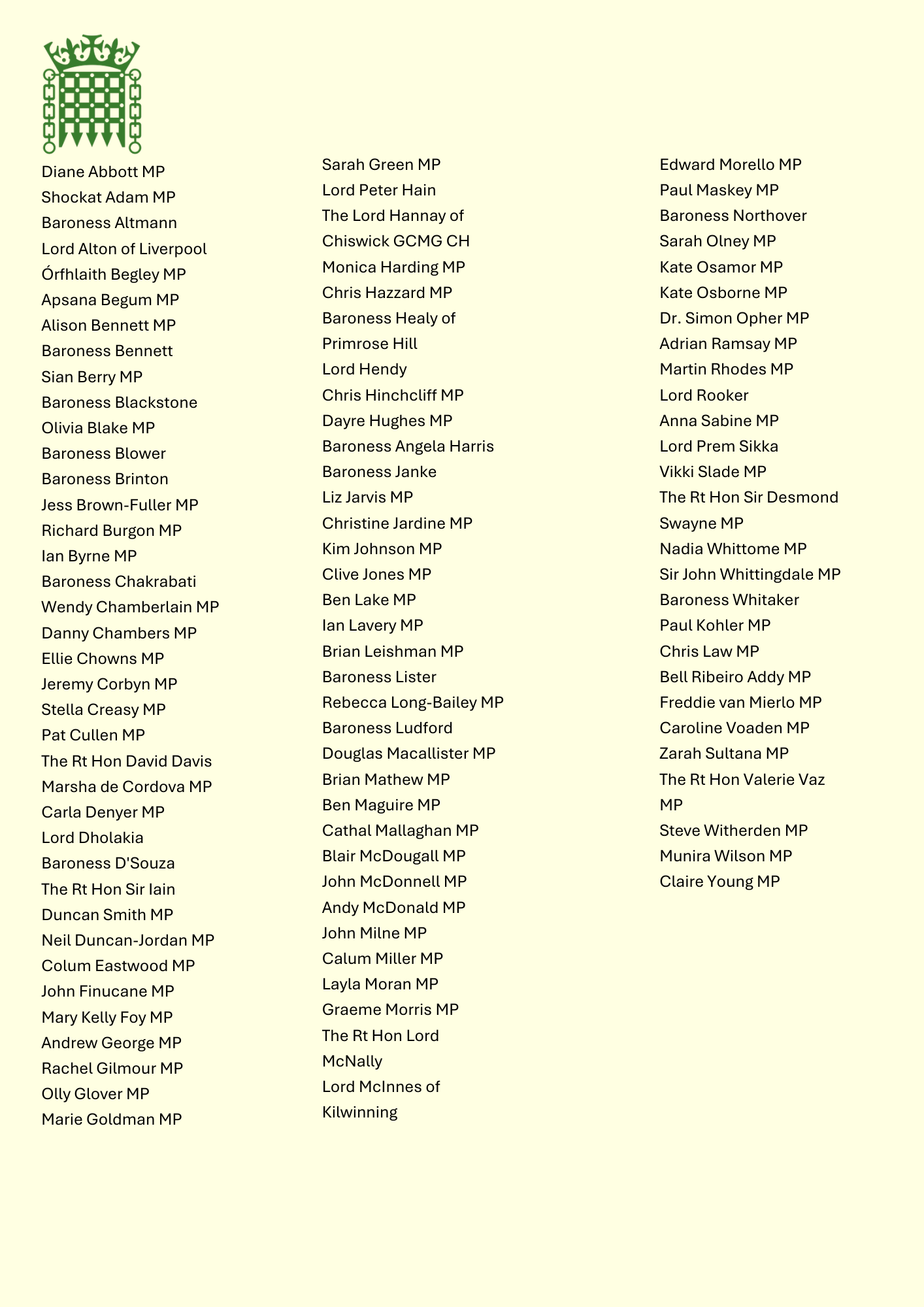
Brendan O'Hara MP, Interim Chair of the APPG
Tim Roca MP, Vice-Chair of the APPG
Baroness Helena Kennedy LT KC, Vice-Chair of the APPG
Diane Abbott MP
Shockat Adam MP
Baroness Altmann
Lord Alton of Liverpool
Órfhlaith Begley MP
Apsana Begum MP
Alison Bennett MP
Baroness Bennett
Sian Berry MP
Baroness Blackstone
Olivia Blake MP
Baroness Blower
Baroness Brinton
Jess Brown-Fuller MP
Richard Burgon MP
Ian Byrne MP
Baroness Chakrabati
Wendy Chamberlain MP
Danny Chambers MP
Ellie Chowns MP
Jeremy Corbyn MP
Stella Creasy MP
Pat Cullen MP
The Rt Hon David Davis
Marsha de Cordova MP
Carla Denyer MP
Lord Dholakia
Baroness D'Souza
The Rt Hon Sir Iain
Duncan Smith MP
Neil Duncan-Jordan MP
Colum Eastwood MP
John Finucane MP
Mary Kelly Foy MP
Andrew George MP
Rachel Gilmour MP
Olly Glover MP
Marie Goldman MP
Sarah Green MP
Lord Peter Hain
The Lord Hannay of
Chiswick GCMG CH
Monica Harding MP
Chris Hazzard MP
Baroness Healy of
Primrose Hill
Lord Hendy
Chris Hinchcliff MP
Dayre Hughes MP
Baroness Angela Harris
Baroness Janke
Liz Jarvis MP
Christine Jardine MP
Kim Johnson MP
Clive Jones MP
Ben Lake MP
Ian Lavery MP
Brian Leishman MP
Baroness Lister
Rebecca Long-Bailey MP
Baroness Ludford
Douglas Macallister MP
Brian Mathew MP
Ben Maguire MP
Cathal Mallaghan MP
Blair McDougall MP
John McDonnell MP
Andy McDonald MP
John Milne MP
Calum Miller MP
Layla Moran MP
Graeme Morris MP
The Rt Hon Lord
McNally
Lord McInnes of
Kilwinning
Edward Morello MP
Paul Maskey MP
Baroness Northover
Sarah Olney MP
Kate Osamor MP
Kate Osborne MP
Dr. Simon Opher MP
Adrian Ramsay MP
Martin Rhodes MP
Lord Rooker
Anna Sabine MP
Lord Prem Sikka
Vikki Slade MP
The Rt Hon Sir Desmond
Swayne MP
Nadia Whittome MP
Sir John Whittingdale MP
Baroness Whitaker
Paul Kohler MP
Chris Law MP
Bell Ribeiro Addy MP
Freddie van Mierlo MP
Caroline Voaden MP
Zarah Sultana MP
The Rt Hon Valerie Vaz
MP
Steve Witherden MP
Munira Wilson MP
Claire Young MP
Calling for the UK Government to support a United Nations Convention on the Rights of Older Persons
-
Dear Secretary of State for Foreign, Commonwealth and Development Affairs,
We, the undersigned, are writing to express our support for the creation of a new United Nations Convention on the Rights of Older Persons, and to call on you to offer your support as well.
As you may be aware, the need for strengthening the protection of the rights of older persons has been agreed by UN Member States, UN Agencies, National Human Rights Institutions, civil society organisations, experts, and importantly, older persons themselves. The UN Open-Ended Working Group on Ageing agreed by consensus, after 14 years of evidence gathering, that gaps in the protections of older persons’ rights exist internationally, and that an internationally binding human rights instrument should be among the responses to those gaps. You may also be aware that this understanding was further reinforced by a UN General Assembly Resolution in August 2024 that accepted the Open-Ended Working Group on Ageing’s decision by consensus and invited other bodies of the UN to consider and act upon its findings.
As a result of this, it is now anticipated that a resolution will be put to the 58th Session of the Human Rights Council (expected to take place February – March 2025) to agree a process for drafting the contents of a Convention on the Rights of Older Persons.
Therefore, in your capacity as Secretary of State for Foreign, Commonwealth and Development Affairs, we would like to ask you to support this internationally agreed treaty. Establishing a global minimum standard of legal protections for older people is essential to ensuring the rights of older people are protected. While many Member States may already have domestic legal protections in place for the rights of older people that exceed those set forth in this Convention, their role in providing universality and clarity cannot be ignored. It is therefore our belief that the United Kingdom should be forthcoming and enthusiastic in our support for a new United Nations Convention on the Rights of Older Persons.
We have much to be proud of in the United Kingdom when it comes to respecting and protecting older persons, from institutions such as the NHS, which offers comprehensive care from cradle to grave, to our state pension system. Indeed, it is a point of pride for many in the UK that if one has worked their life, then as they age, they can expect to enjoy security in their older years. As a nation that upholds these values and institutions, it is only right that we offer our support to this new United Nations Convention on the Rights of Older Persons. To that end, we urge you to support this convention.
We look forward to your response.
Yours sincerely,
Adrian Ramsay MP co-signed this cross-party letter initiated by Blair McDougall MP.
Call for the UK Government to impose sanctions on Israel following the International Court of Justice’s Landmark Advisory Opinion
-
Dear Foreign Secretary,
Re: Call for the UK Government to impose sanctions on Israel following the International Court of Justice’s Landmark Advisory Opinion
We write to urge the UK government to impose sanctions and take other concrete steps to give effect to the landmark Opinion issued by the International Court of Justice (ICJ) on Israel’s continuing illegal presence in the Occupied Palestinian Territory (OPT).
Findings of the International Court of Justice
The ICJ, the world’s top court, found on 19 July 2024 that Israel’s continued presence in the Occupied Palestinian Territory, including East Jerusalem, is unlawful. It also found that Israel is under an obligation to bring to an end its unlawful presence in the OPT as rapidly as possible and to immediately cease all new settlement activities, amongst numerous other obligations.
The Court also found that all States, including the UK, have obligations to not recognise as legal the situation arising from the unlawful presence of Israel in the OPT and to not render any aid or assistance in maintaining this.
Further, amongst the numerous other obligations cited by the ICJ, all State Parties to the Fourth Geneva Convention have an obligation to ensure compliance by Israel with international humanitarian law as embodied in that Convention.
Obligations on the UK government
Flowing from these, the ICJ found that the UK and all states must take concrete actions including: taking steps to prevent trade or investment relations that assist in the maintenance of the illegal situation created by Israel in the OPT; abstaining from entering into economic or trade dealings with Israel concerning the OPT which may entrench its unlawful presence there; and abstaining from entering into any treaty relations with Israel in all cases in which it purports to act on behalf of the OPT.
It has now been four months since this landmark ICJ ruling. Since then the situation continues to worsen including with Israel’s intensified attacks on civilians and clear violations of international law occurring in Gaza.
The UK Government has acknowledged the central findings of the ICJ’s Advisory Opinion and stated that Israel should bring an end to its presence in the OPT as rapidly as possible. However, the UK Government is yet to clarify how it intends to respond to this new legal situation and uphold its responsibilities arising from it.
In contrast, the UN General Assembly in September passed a resolution endorsing the ICJ’s opinion and calling on states to comply with their responsibility under international law to enact concrete steps including sanctions to address the ongoing situation.
Sanctions on Israel and other actions
In line with the ICJ’s Advisory Opinion and the obligations on all States, the UK Government should immediately:
Impose travel bans and asset freezes against all individuals and entities involved in maintaining Israel’s unlawful presence in the OPT.
Ban trade with illegal settlements - in so doing, the UK should also support and utilise the UN database of businesses involved in the OPT.
Suspend arms transfers to Israel including licenses for the export of F-35 components that go indirectly to Israel as well as any other equipment that might be used to carry out serious violations of international humanitarian law and/or are used to entrench Israel’s unlawful presence in the OPT.
Revoke the 2030 Roadmap, which seeks to deepen UK-Israeli economic, trade and security ties.
The Government should also undertake a comprehensive and thorough review of all of its current and pending trade relations, including the UK-Israel trade agreement, and its security, military, and diplomatic relations with Israel. This would be to ensure that it does not - directly or indirectly - entrench Israel’s unlawful presence in the OPT or otherwise provide aid or assistance in maintaining the unlawful situation created by the continued presence of Israel in the OPT or any of the other violations committed by Israel in the OPT.
The UK Government has repeatedly stated that it is committed to international law. Acting in support of the ICJ Advisory Opinion would be a critical step in demonstrating that commitment. It would also show that the UK Government is striving to do all it can to support the victims of Israel’s repeated violations of international law, and that it is not only speaking about a peaceful and negotiated two-state solution but taking concrete steps to promote this.