
Letter to the Prime Minister urging a review of the business rates changes in the November 2025 budget.
-
Adrian Ramsay MP co-signed this cross-party letter initiated by the Music Venue Trust.
Keir Starmer MP
Prime Minister
10 Downing Street
London
SW1A 2AA
Xx December 2025
Dear Prime Minister,
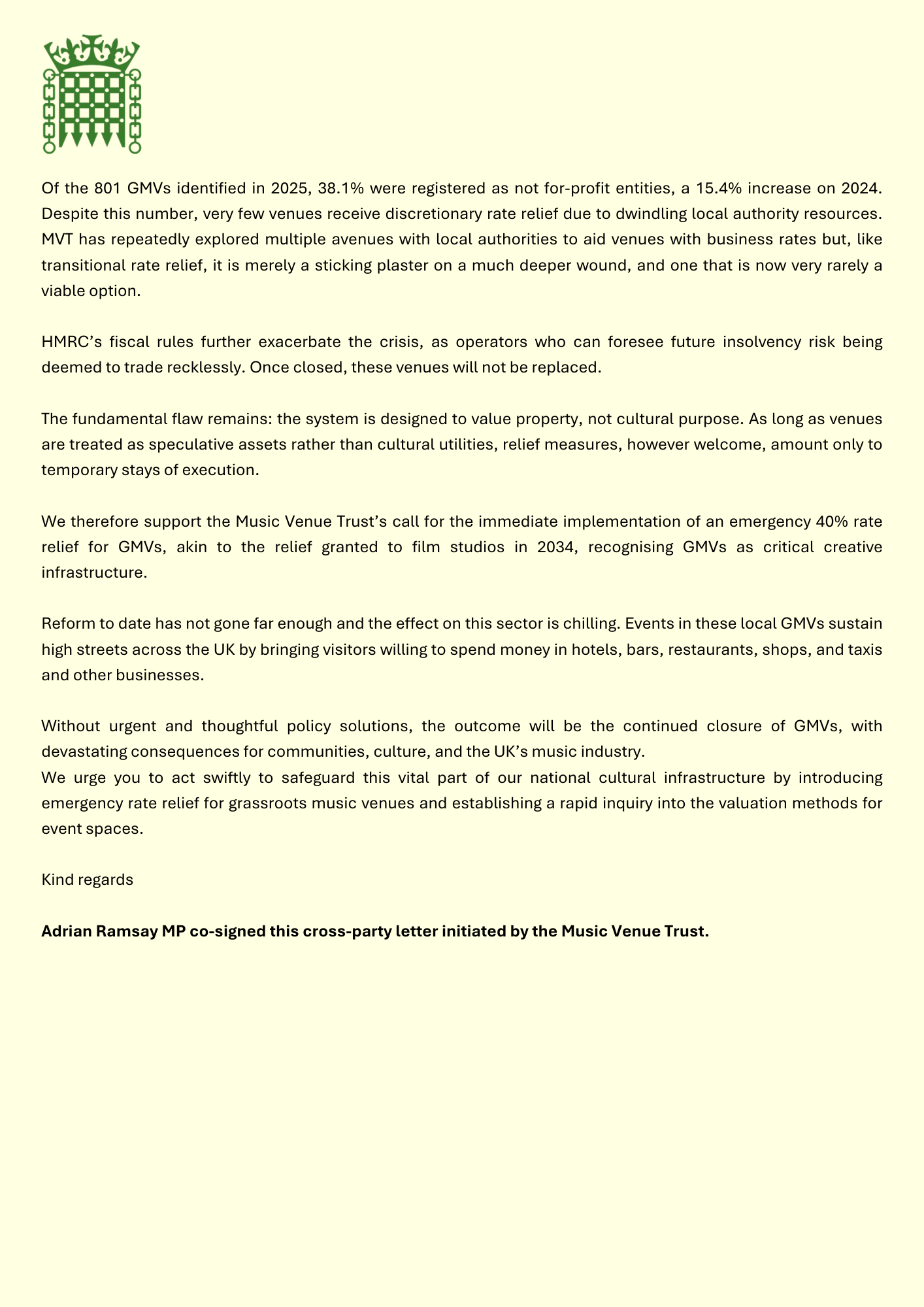
We are writing to express our deep concern regarding the decisions on business rates announced in the November 2025 Budget, which will have severe consequences for grassroots music venues (GMVs) across England.
We acknowledge the Government’s intended interventions to ease bills from business rates, including the transitional relief scheme and lower tax multipliers for hospitality. For grassroots music venues, however, these measures merely address symptoms rather than fixing the underlying problem.
Analysis of the incoming 2026 Rateable Values from the Valuation Office Agency (VOA), conducted by Music Venue Trust (MVT), reveals a catastrophic picture. The GMV sector faces a collective £7.2 million increase in its tax base. Hundreds of venues will see rises of over 50% in their Rateable Value, with dozens experiencing increases of 100%, 200%, or more. In some cases, venues that have never previously been liable for business rates will now face bills of thousands of pounds. For venues operating on passion and razor-thin margins, these are not bills - they are closure notices.
Grassroots music venues are at the heart of communities and our constituencies. They provide jobs, entertainment, access to local culture, and vital platforms for emerging artists. Yet the VOA’s methodology values them solely as commercial property, blind to their cultural role, community function, and contribution as the research and development engine of the UK’s world-leading music industry.
This creates a direct contradiction: while the Government’s Creative Industries Sector Plan seeks to drive growth through culture, the VOA’s approach dismantles the very infrastructure on which that plan depends.
The November 2025 Budget compounds this crisis by reducing rate relief from 40% to zero, following the 2024 cut from 75% to 40%. The lower multiplier means a further reduction down to 12% instead of 40%. In 2024, the entire sector of 810 venues returned a gross profit of just £2.5 million yet was asked to absorb £7 million in additional premises taxes. Transitional relief cannot bridge this gap, nor that created by higher rateable values. Data from MVT shows that a venue with a rateable value of £30,000 will see its bill rise from £8,000 under 40% relief in 2025 to £11,000 with no relief in 2026, even on the lowest multiplier.
MVT projects that around 600 GMVs in England face an average 28% increase in business rates, with some reporting rises of 91%. Based on 2025 data, this will directly close 80–120 venues, place another 120–180 at risk, and lead to 200–300 closures over the next four to five years.
Of the 801 GMVs identified in 2025, 38.1% were registered as not for-profit entities, a 15.4% increase on 2024. Despite this number, very few venues receive discretionary rate relief due to dwindling local authority resources. MVT has repeatedly explored multiple avenues with local authorities to aid venues with business rates but, like transitional rate relief, it is merely a sticking plaster on a much deeper wound, and one that is now very rarely a viable option.
HMRC’s fiscal rules further exacerbate the crisis, as operators who can foresee future insolvency risk being deemed to trade recklessly. Once closed, these venues will not be replaced.
The fundamental flaw remains: the system is designed to value property, not cultural purpose. As long as venues are treated as speculative assets rather than cultural utilities, relief measures, however welcome, amount only to temporary stays of execution.
We therefore support the Music Venue Trust’s call for the immediate implementation of an emergency 40% rate relief for GMVs, akin to the relief granted to film studios in 2034, recognising GMVs as critical creative infrastructure.
Reform to date has not gone far enough and the effect on this sector is chilling. Events in these local GMVs sustain high streets across the UK by bringing visitors willing to spend money in hotels, bars, restaurants, shops, and taxis and other businesses.
Without urgent and thoughtful policy solutions, the outcome will be the continued closure of GMVs, with devastating consequences for communities, culture, and the UK’s music industry.
We urge you to act swiftly to safeguard this vital part of our national cultural infrastructure by introducing emergency rate relief for grassroots music venues and establishing a rapid inquiry into the valuation methods for event spaces.
Kind regards
Adrian Ramsay MP co-signed this cross-party letter initiated by the Music Venue Trust.
Letter to Chancellor on Tax-Free Childcare Cap
-
Adrian Ramsay MP co-signed this cross-party letter initiated by Claire Hanna MP.
Rt Hon Rachel Reeves MP
Chancellor of the Exchequer
HM Treasury
1 Horse Guards Road
Westminster
London
SW1A 2HQ
25 November 2025
Dear Chancellor,
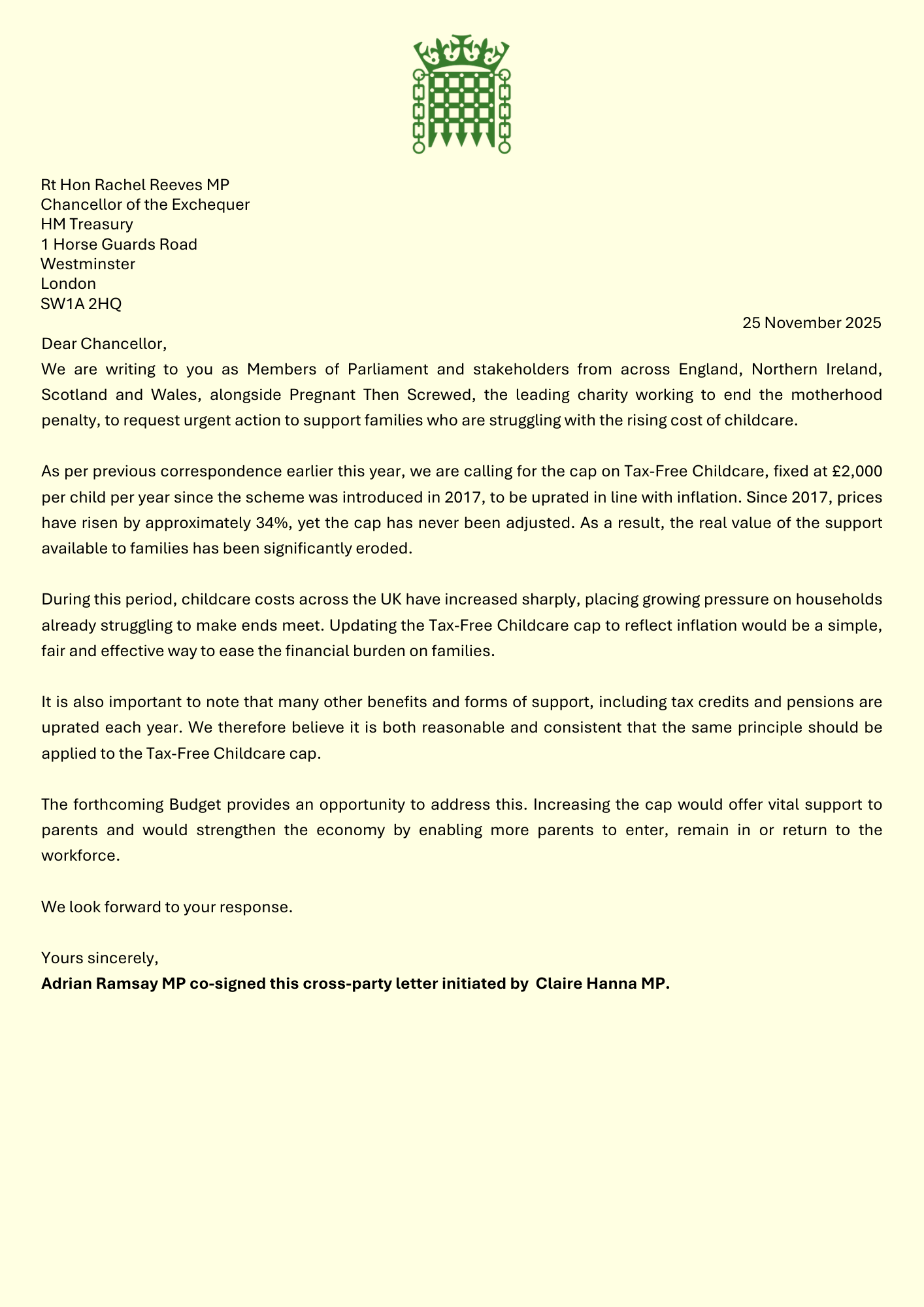
We are writing to you as Members of Parliament and stakeholders from across England, Northern Ireland,
Scotland and Wales, alongside Pregnant Then Screwed, the leading charity working to end the motherhood
penalty, to request urgent action to support families who are struggling with the rising cost of childcare.
As per previous correspondence earlier this year, we are calling for the cap on Tax-Free Childcare, fixed at
£2,000 per child per year since the scheme was introduced in 2017, to be uprated in line with inflation.
Since 2017, prices have risen by approximately 34%, yet the cap has never been adjusted. As a result, the
real value of the support available to families has been significantly eroded.
During this period, childcare costs across the UK have increased sharply, placing growing pressure on
households already struggling to make ends meet. Updating the Tax-Free Childcare cap to reflect inflation
would be a simple, fair and effective way to ease the financial burden on families.
It is also important to note that many other benefits and forms of support, including tax credits and
pensions are uprated each year. We therefore believe it is both reasonable and consistent that the same
principle should be applied to the Tax-Free Childcare cap.
The forthcoming Budget provides an opportunity to address this. Increasing the cap would offer vital
support to parents and would strengthen the economy by enabling more parents to enter, remain in or
return to the workforce.
We look forward to your response.
Use the Autumn Budget to lower electricity prices
-
Adrian Ramsay MP co-signed this cross-party letter initiated by the MCS Foundation.
Dear Chancellor,
Subject: Use the Autumn Budget to lower electricity prices
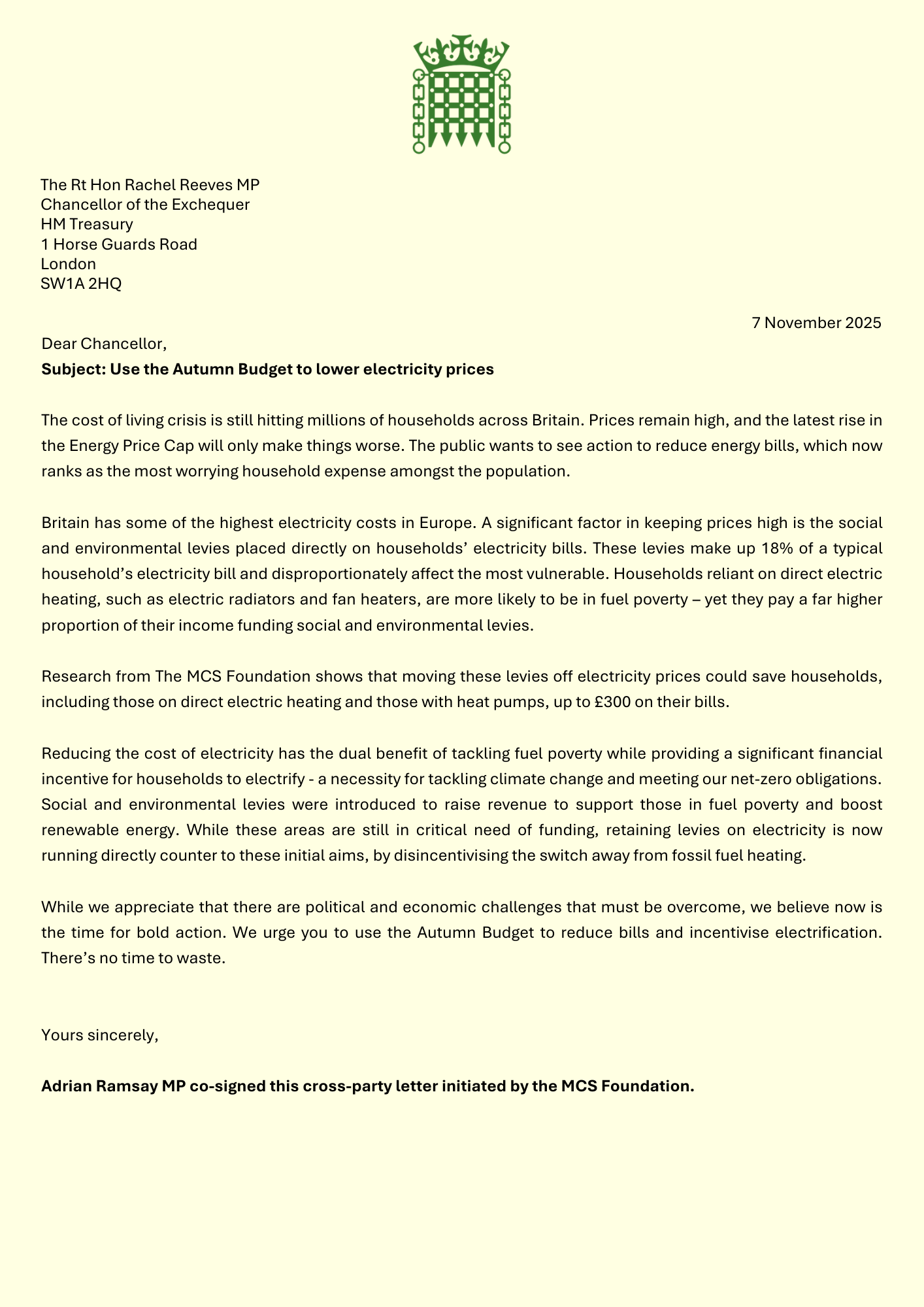
The cost of living crisis is still hitting millions of households across Britain. Prices remain high, and the latest rise in the Energy Price Cap will only make things worse. The public wants to see action to reduce energy bills, which now ranks as the most worrying household expense amongst the population.
Britain has some of the highest electricity costs in Europe. A significant factor in keeping prices high is the social and environmental levies placed directly on households’ electricity bills. These levies make up 18% of a typical household’s electricity bill and disproportionately affect the most vulnerable. Households reliant on direct electric heating, such as electric radiators and fan heaters, are more likely to be in fuel poverty – yet they pay a far higher proportion of their income funding social and environmental levies.
Research from The MCS Foundation shows that moving these levies off electricity prices could save households, including those on direct electric heating and those with heat pumps, up to £300 on their bills.
Reducing the cost of electricity has the dual benefit of tackling fuel poverty while providing a significant financial incentive for households to electrify - a necessity for tackling climate change and meeting our net-zero obligations.
Social and environmental levies were introduced to raise revenue to support those in fuel poverty and boost renewable energy. While these areas are still in critical need of funding, retaining levies on electricity is now running directly counter to these initial aims, by disincentivising the switch away from fossil fuel heating.
While we appreciate that there are political and economic challenges that must be overcome, we believe now is the time for bold action. We urge you to use the Autumn Budget to reduce bills and incentivise electrification. There’s no time to waste.
Yours sincerely,
Adrian Ramsay MP co-signed this cross-party letter initiated by the MCS Foundation.
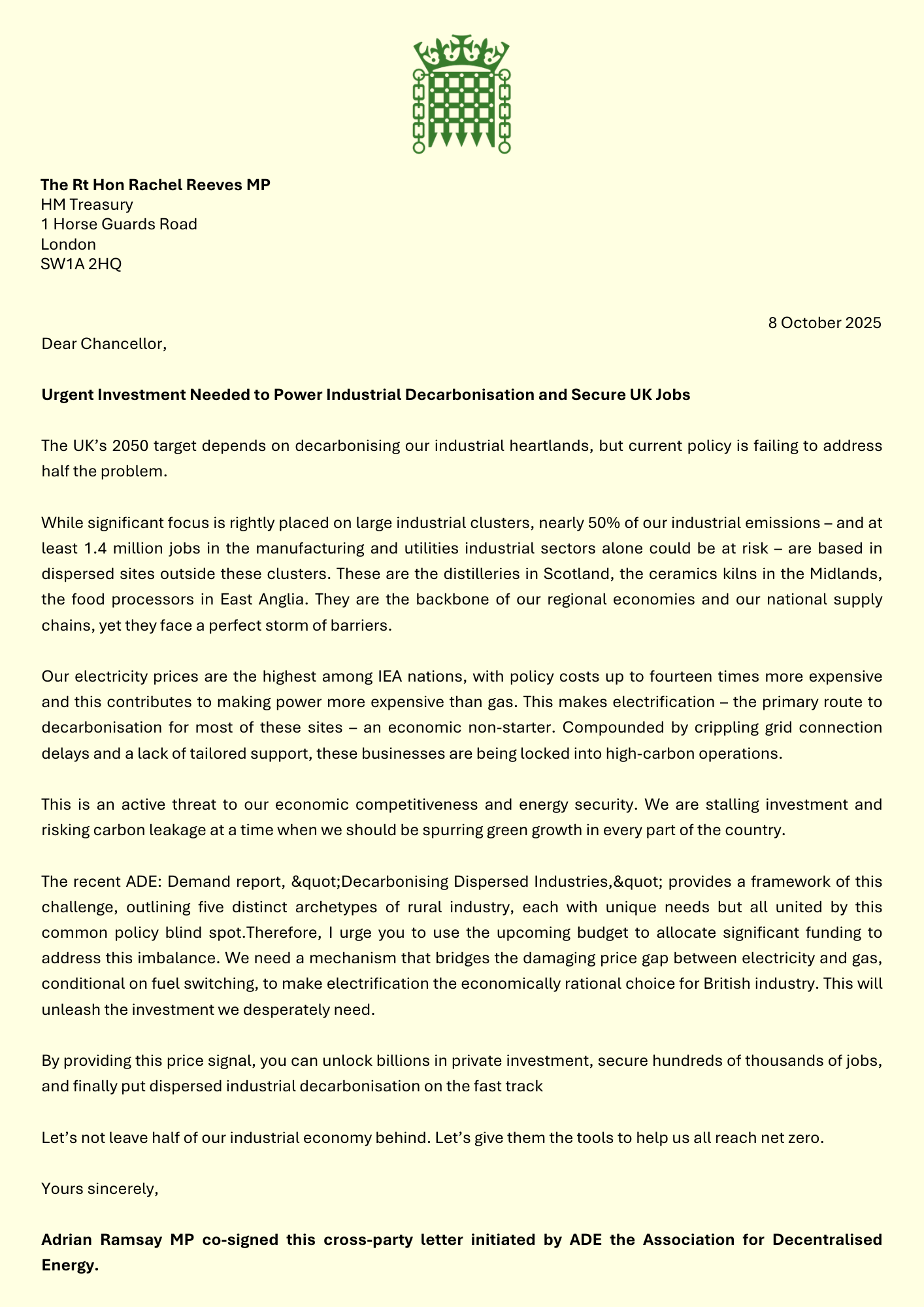
Urgent Investment Needed to Power Industrial Decarbonisation and Secure UK Jobs
-
Adrian Ramsay MP co-signed this cross-party letter initiated by ADE the Association for Decentralised Energy.
Dear Chancellor,
Urgent Investment Needed to Power Industrial Decarbonisation and Secure UK Jobs
The UK’s 2050 target depends on decarbonising our industrial heartlands, but current policy is failing to address half the problem.
While significant focus is rightly placed on large industrial clusters, nearly 50% of our industrial emissions – and at least 1.4 million jobs in the manufacturing and utilities industrial sectors alone could be at risk – are based in dispersed sites outside these clusters. These are the distilleries in Scotland, the ceramics kilns in the Midlands, the food processors in East Anglia. They are the backbone of our regional economies and our national supply chains, yet they face a perfect storm of barriers.
Our electricity prices are the highest among IEA nations, with policy costs up to fourteen times more expensive and this contributes to making power more expensive than gas. This makes electrification – the primary route to decarbonisation for most of these sites – an economic non-starter. Compounded by crippling grid connection delays and a lack of tailored support, these businesses are being locked into high-carbon operations.
This is an active threat to our economic competitiveness and energy security. We are stalling investment and risking carbon leakage at a time when we should be spurring green growth in every part of the country.
The recent ADE: Demand report, "Decarbonising Dispersed Industries," provides a framework of this challenge, outlining five distinct archetypes of rural industry, each with unique needs but all united by this common policy blind spot.Therefore, I urge you to use the upcoming budget to allocate significant funding to address this imbalance. We need a mechanism that bridges the damaging price gap between electricity and gas, conditional on fuel switching, to make electrification the economically rational choice for British industry. This will unleash the investment we desperately need.
By providing this price signal, you can unlock billions in private investment, secure hundreds of thousands of jobs, and finally put dispersed industrial decarbonisation on the fast track
Let’s not leave half of our industrial economy behind. Let’s give them the tools to help us all reach net zero.
Yours sincerely,
Adrian Ramsay MP co-signed this cross-party letter initiated by ADE the Association for Decentralised Energy.
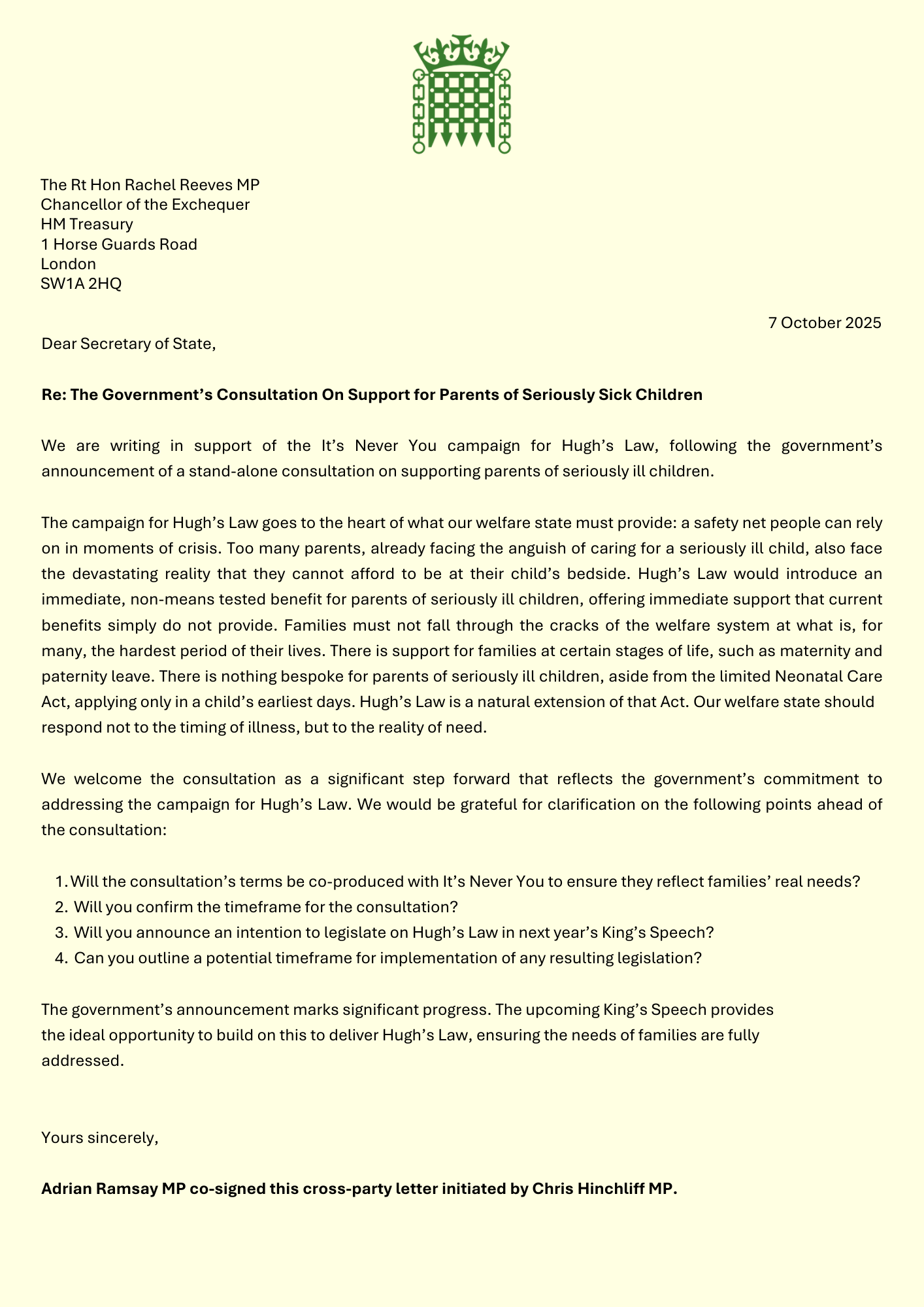
Supporting Parents of Seriously Sick Children
-
Adrian Ramsay MP co-signed this cross-party letter initiated by Chris Hinchliff MP.
Dear Secretary of State,
Re: The Government’s Consultation On Support for Parents of Seriously Sick Children
We are writing in support of the It’s Never You campaign for Hugh’s Law, following the government’s announcement of a stand-alone consultation on supporting parents of seriously ill children.
The campaign for Hugh’s Law goes to the heart of what our welfare state must provide: a safety net people can rely on in moments of crisis. Too many parents, already facing the anguish of caring for a seriously ill child, also face the devastating reality that they cannot afford to be at their child’s bedside. Hugh’s Law would introduce an immediate, non-means tested benefit for parents of seriously ill children, offering immediate support that current benefits simply do not provide. Families must not fall through the cracks of the welfare system at what is, for many, the hardest period of their lives. There is support for families at certain stages of life, such as maternity and paternity leave. There is nothing bespoke for parents of seriously ill children, aside from the limited Neonatal Care Act, applying only in a child’s earliest days. Hugh’s Law is a natural extension of that Act. Our welfare state should
respond not to the timing of illness, but to the reality of need.
We welcome the consultation as a significant step forward that reflects the government’s commitment to addressing the campaign for Hugh’s Law. We would be grateful for clarification on the following points ahead of the consultation:
Will the consultation’s terms be co-produced with It’s Never You to ensure they reflect families’ real needs?
Will you confirm the timeframe for the consultation?
Will you announce an intention to legislate on Hugh’s Law in next year’s King’s Speech?
Can you outline a potential timeframe for implementation of any resulting legislation?
The government’s announcement marks significant progress. The upcoming King’s Speech provides
the ideal opportunity to build on this to deliver Hugh’s Law, ensuring the needs of families are fully
addressed.
Yours sincerely,
Adrian Ramsay MP co-signed this cross-party letter initiated by Chris Hinchliff MP.
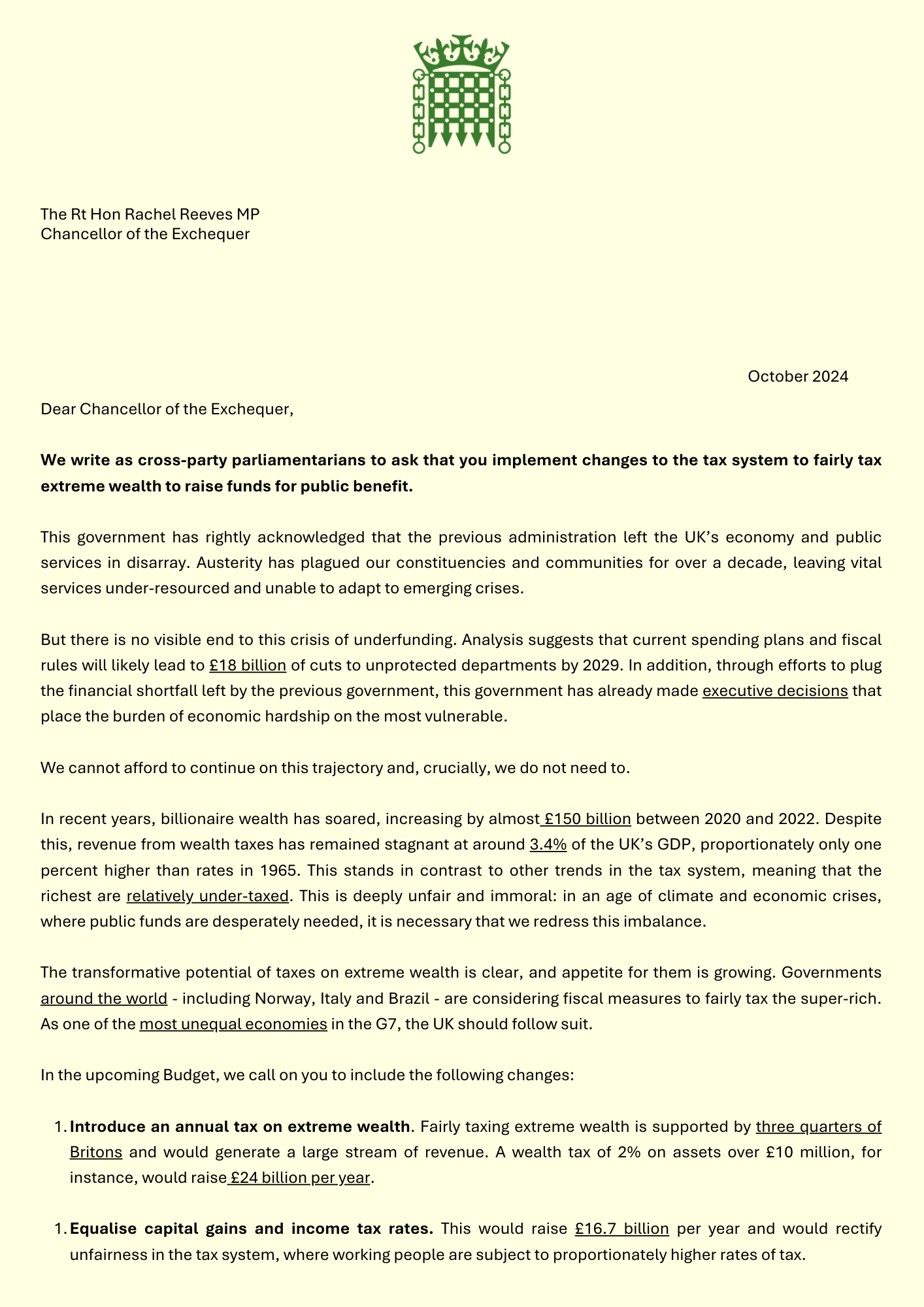
We write as cross-party parliamentarians to ask that you implement changes to the tax system to fairly tax extreme wealth to raise funds for public benefit.

-
The Rt Hon Rachel Reeves MP
Chancellor of the Exchequer
October 2024
Dear Chancellor of the Exchequer,
We write as cross-party parliamentarians to ask that you implement changes to the tax system to fairly tax extreme wealth to raise funds for public benefit.
This government has rightly acknowledged that the previous administration left the UK’s economy and public services in disarray. Austerity has plagued our constituencies and communities for over a decade, leaving vital services under-resourced and unable to adapt to emerging crises.
But there is no visible end to this crisis of underfunding. Analysis suggests that current spending plans and fiscal rules will likely lead to £18 billion of cuts to unprotected departments by 2029. In addition, through efforts to plug the financial shortfall left by the previous government, this government has already made executive decisions that place the burden of economic hardship on the most vulnerable.
We cannot afford to continue on this trajectory and, crucially, we do not need to.
In recent years, billionaire wealth has soared, increasing by almost £150 billion between 2020 and 2022. Despite this, revenue from wealth taxes has remained stagnant at around 3.4% of the UK’s GDP, proportionately only one percent higher than rates in 1965. This stands in contrast to other trends in the tax system, meaning that the richest are relatively under-taxed. This is deeply unfair and immoral: in an age of climate and economic crises, where public funds are desperately needed, it is necessary that we redress this imbalance.
The transformative potential of taxes on extreme wealth is clear, and appetite for them is growing. Governments around the world - including Norway, Italy and Brazil - are considering fiscal measures to fairly tax the super-rich. As one of the most unequal economies in the G7, the UK should follow suit.
In the upcoming Budget, we call on you to include the following changes:
Introduce an annual tax on extreme wealth. Fairly taxing extreme wealth is supported by three quarters of Britons and would generate a large stream of revenue. A wealth tax of 2% on assets over £10 million, for instance, would raise £24 billion per year.
Equalise capital gains and income tax rates. This would raise £16.7 billion per year and would rectify unfairness in the tax system, where working people are subject to proportionately higher rates of tax.
We urge you to take the bold decisions necessary to deliver the public funding that the UK desperately needs. As the first Budget of a new government, this is a key opportunity to lay the foundations for a fairer, more sustainable, and thriving economy for all.
Yours sincerely,
Adrian Co-Signed this cross-party letter initiated by Green New Deal Rising.