
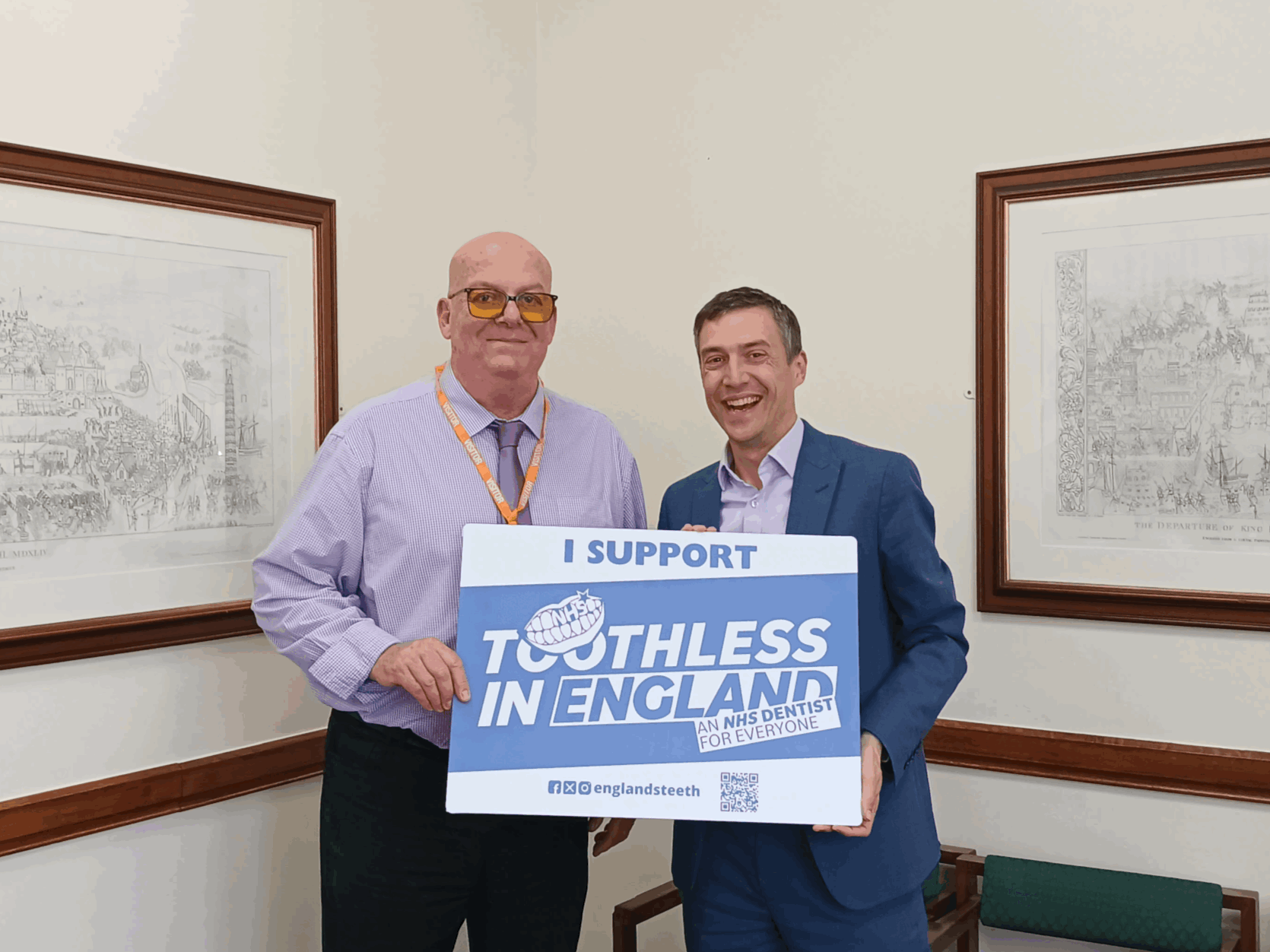
Just one out of fifteen Dentists contacted is accepting New NHS Patients in East Anglia, an investigation by Adrian Ramsay MP, finds.
Just one out of fifteen Dentists contacted is accepting New NHS Patients in East Anglia, an investigation by Adrian Ramsay MP, finds.
East Anglia is one of England’s worst dental deserts, with practices reporting waiting lists of over 1,000 patients, four-year backlogs dating back to 2021, and one list stretching across 25 pages of A4.
Reacting to the investigation Adrian said
“It is a damning indictment of this Government that, two years into their term, access to dental care remains a postcode lottery. People are being left in pain, unable to access basic care they are entitled to. The investigation in East Anglia shows that we are one of the worst-hit regions in the country.
This has been ignored for far too long. It is unacceptable that successive governments have failed to get a grip on this crisis, and the people of East Anglia are paying the price.”
Nationally, nearly two-thirds of dentists in England listed as taking NHS patients are in reality not taking new NHS patients, with some areas a complete desert.
Getting an appointment on the NHS has become next to impossible in many areas highlighting the access crisis millions still face across the country, with tooth decay the most common reason children aged five to nine are admitted to hospital.
When Labour came to power, they pledged 700,000 new NHS urgent care appointments and to recruit new dentists for areas that needed them most. But a new investigation by Adrian, reveals that getting NHS treatment remains a postcode lottery, with some parts of the country left without any NHS options.
The investigation contacted a sample of 135 practices across England which were listed on the NHS website as accepting new adult patients.
The analysis revealed that 84 out of 135 (62.2%) are not currently able to accept new NHS patients. One stated its waiting list was “at least 25 pages of A4” while others talked of four-year backlogs.
The total number of clinics not taking on NHS patients will, in reality, be significantly higher, as many on the Government site are publicly listed as not accepting new NHS patients.
MyDentist runs more than 500 practices serving over four million patients. Yet, of the 44 listed on the NHS site as offering places, only four were accepting new NHS patients.
The findings come as the Government prepares to consult on a series of changes to the dental contract. However, these reforms are understood not to be backed by any new money, and there is concern the consultation might be delayed as a result of new leadership at DHSC.
The Green Party is calling on the Government to increase NHS Dentistry funding by at least £1.5 billion per year, a figure the British Dental Association (BDA) says would ensure everyone who wants an NHS dentist can access one.
Current government budgets allow only 40% of adults to access an NHS dentist within two years. The Party argues that unless funding for NHS dentistry keeps pace with rising costs and population growth, ending the dental access crisis will remain impossible.
Dentists are deeply concerned that the current psychodrama at Westminster has seen progress stall to save the struggling service.There is no sign of public consultation expected this summer, setting out the Government's ambitions on reform. Not a penny of new investment has been pledged, and the BDA has warned that there is now a material risk that Government promises to save NHS dentistry cannot be kept.
BDA Chair Eddie Crouch said:
“Labour came to power promising change, but the crisis facing millions is still with us.
“Warm words won’t give people the dental care they need. That will require real reform and sustainable funding.”
ENDS
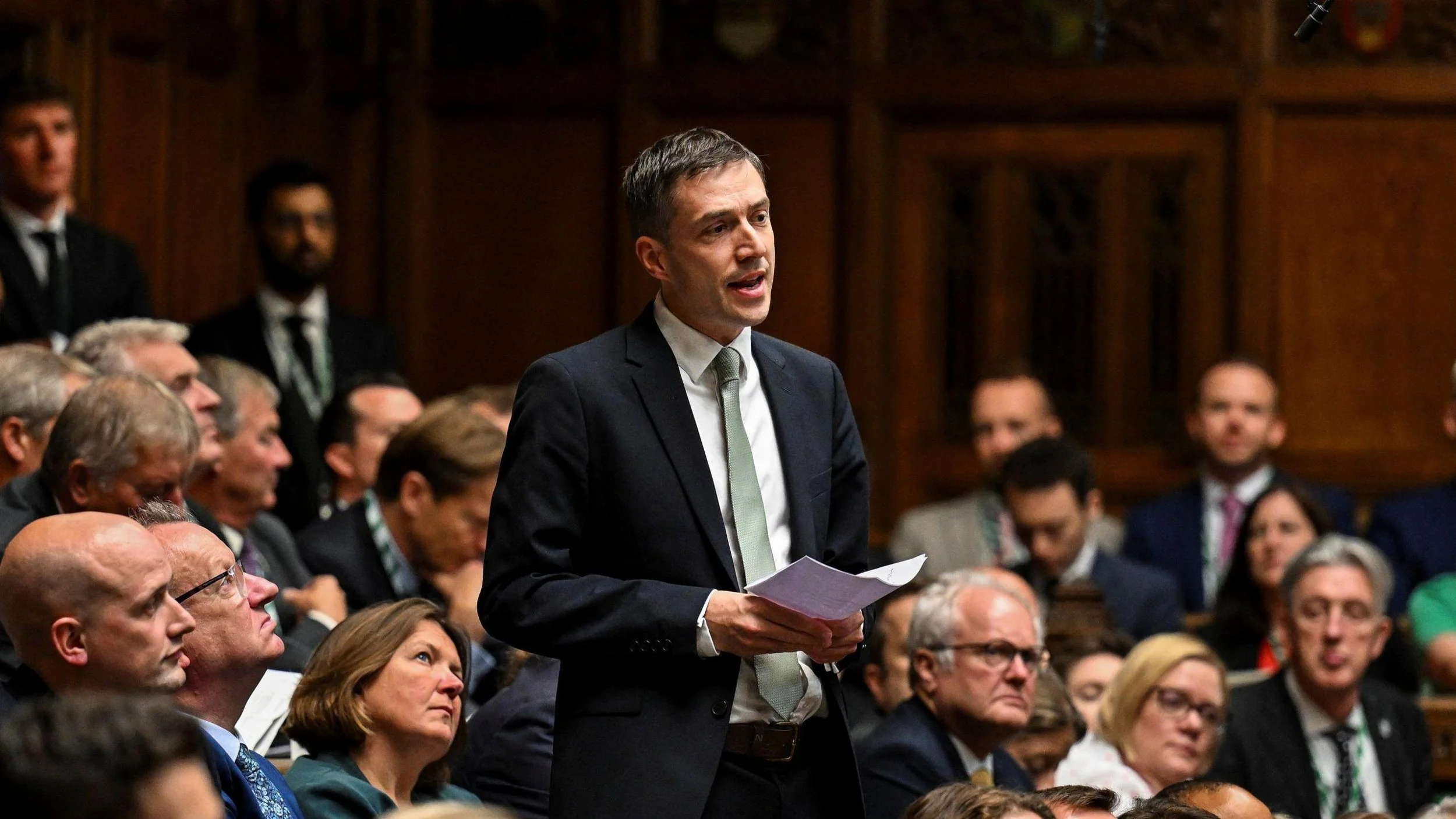
Adrian Ramsay challenges the Government on only 39% of adults having access to NHS dentistry
Adrian Ramsay challenges the Government on only 39% of adults having access to NHS dentistry
Adrian Ramsay, MP for Waveney Valley and health spokesperson for the Green MPs, questioned the Minister responsible for Dentistry: what is the Government's ambition for access to NHS Dentistry?
Adrian asked:
"The British Dental Association has highlighted that current budgets allow just 39% of adults to access NHS treatment within 2 years. Is that really the height of the Government's ambition? And if not, what percentage of access is the Government aiming for?"
In reply, Minister Stephen Kinnock said, “We are working closely with the BDA on long-term contract reform. That’s got to be about getting the balance right so that dentists are incentivised to do NHS dentistry, and we also maximise access. Fundamental contract reform. A public consultation is coming up before the summer, and I’m sure he’ll want to take part."
After questioning the Minister, Adrian said, "Of course, we need dental contract reform and also training places, and I've been actively pushing for those things. But if we are serious about NHS dentistry being accessible to everyone, the Government's ambition has got to be much greater than 39% of adults - and that is going to have to mean more funding."
ENDS
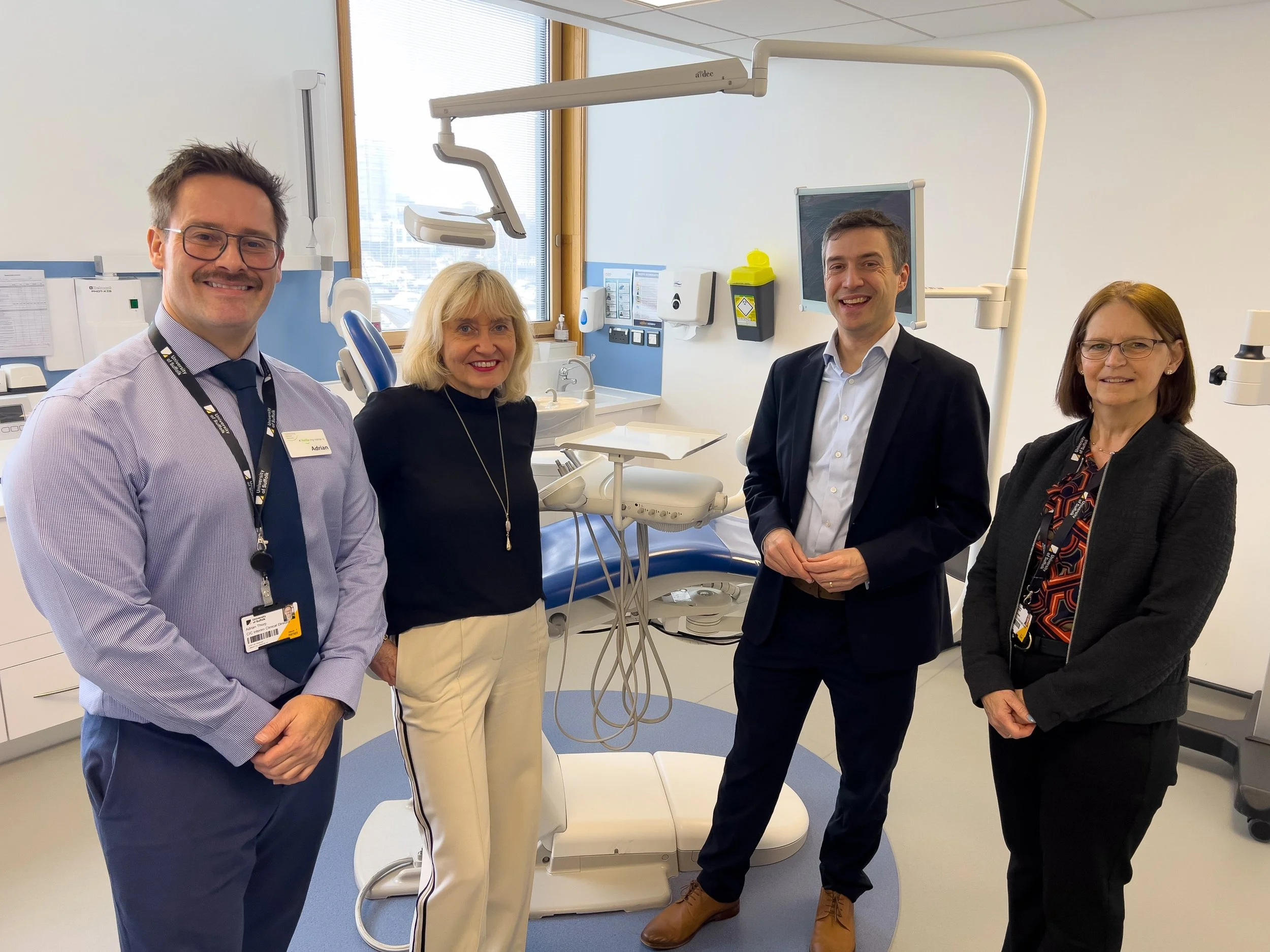
Adrian Ramsay MP presses Minister for urgent clarity on funding for UEA dental school.
11th of February 2026
Adrian Ramsay MP presses Minister for urgent clarity on funding for UEA dental school.
Adrian Ramsay, MP for Waveney Valley, has written to Stephen Kinnock MP, Minister of State for Care at the Department of Health and Social Care, seeking clarity on when funding will be confirmed to allow the University of East Anglia to open its new dental school.
The University of East Anglia has already secured General Dental Council accreditation, its new facilities will be completed this year, and it is ready to recruit its first cohort of students. The remaining barrier is confirmation of funded undergraduate places.
Speaking after sending his letter, Adrian Ramsay MP said:
“Norfolk and the Waveney Valley face some of the poorest access to NHS dentistry in England, while the East of England remains the only region without a dental training institution. Given the scale of unmet need across Norfolk and Suffolk, it is deeply frustrating that the only thing preventing dental teaching at UEA is confirmation of funding from the Department.
"Directing new training capacity to areas with the greatest need must be a priority if we are serious about improving access to NHS dentistry.”
In a Parilmentary debate this week Adrian said:
"The University of East Anglia stands ready to open a new dental school. It has permission from the General Dental Council but is awaiting the funded undergraduate dental places that will be needed to start training new dentists from 2027. Can the Minister set out how those places will be made available on the basis of regional need, so that dental deserts such as the east of England can start to build a sustainable dental workforce?"
Adrian Ramsay has again asked the Minister to set out the timetable for decisions on funded undergraduate places and how regional need will be reflected in the allocation process.
ENDS
Notes to editors
Full text of the letter is available here:
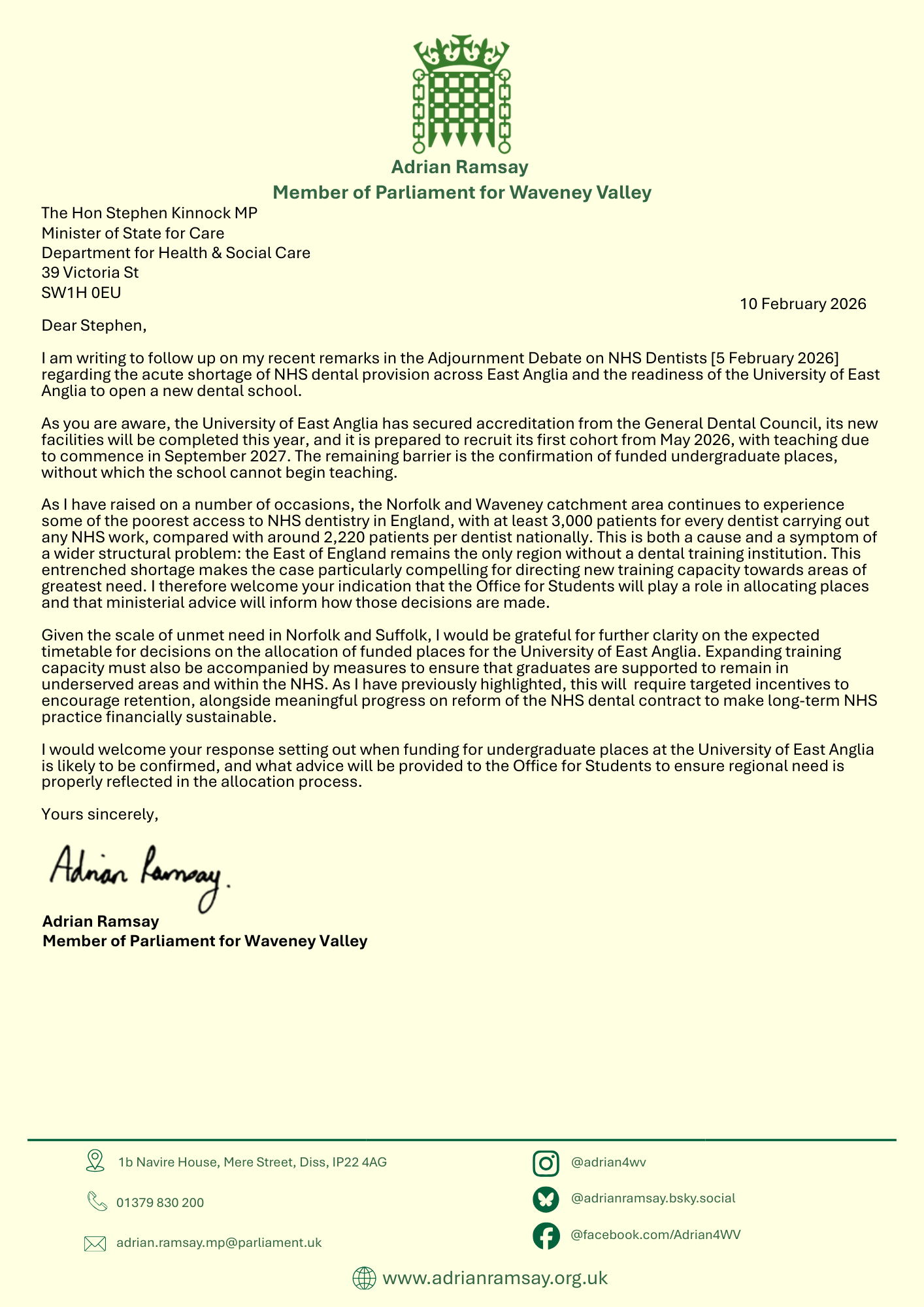
Dear Stephen,
I am writing to follow up on my recent remarks in the Adjournment Debate on NHS Dentists [5 February 2026] regarding the acute shortage of NHS dental provision across East Anglia and the readiness of the University of East Anglia to open a new dental school.
As you are aware, the University of East Anglia has secured accreditation from the General Dental Council, its new facilities will be completed this year, and it is prepared to recruit its first cohort from May 2026, with teaching due to commence in September 2027. The remaining barrier is the confirmation of funded undergraduate places, without which the school cannot begin teaching.
As I have raised on a number of occasions, the Norfolk and Waveney catchment area continues to experience some of the poorest access to NHS dentistry in England, with at least 3,000 patients for every dentist carrying out any NHS work, compared with around 2,220 patients per dentist nationally.
This is both a cause and a symptom of a wider structural problem: the East of England remains the only region without a dental training institution. This entrenched shortage makes the case particularly compelling for directing new training capacity towards areas of greatest need. I therefore welcome your indication that the Office for Students will play a role in allocating places and that ministerial advice will inform how those decisions are made.
Given the scale of unmet need in Norfolk and Suffolk, I would be grateful for further clarity on the expected timetable for decisions on the allocation of funded places for the University of East Anglia.
Expanding training capacity must also be accompanied by measures to ensure that graduates are supported to remain in underserved areas and within the NHS. As I have previously highlighted, this will require targeted incentives to encourage retention, alongside meaningful progress on reform of the NHS dental contract to make long-term NHS practice financially sustainable.
I would welcome your response setting out when funding for undergraduate places at the University of East Anglia is likely to be confirmed, and what advice will be provided to the Office for Students to ensure regional need is properly reflected in the allocation process.
UEA Dentistry School
-
The Hon Stephen Kinnock MP
Minister of State for Care
Department for Health & Social Care
39 Victoria St
London
SW1H 0EU
10 February 2026
Dear Stephen,
I am writing to follow up on my recent remarks in the Adjournment Debate on NHS Dentists [5 February 2026] regarding the acute shortage of NHS dental provision across East Anglia and the readiness of the University of East Anglia to open a new dental school.
As you are aware, the University of East Anglia has secured accreditation from the General Dental Council, its new facilities will be completed this year, and it is prepared to recruit its first cohort from May 2026, with teaching due to commence in September 2027. The remaining barrier is the confirmation of funded undergraduate places, without which the school cannot begin teaching.
As I have raised on a number of occasions, Norfolk and the Waveney Valley continue to experience some of the poorest access to NHS dentistry in England, and the East of England remains the only region without a dental training institution. This entrenched shortage makes the case particularly compelling for directing new training capacity towards areas of greatest need. I therefore welcome your indication that the Office for Students will play a role in allocating places and that ministerial advice will inform how those decisions are made.
Given the scale of unmet need in Norfolk and Suffolk, I would be grateful for further clarity on the expected timetable for decisions on the allocation of funded places for the University of East Anglia. Expanding training capacity must also be accompanied by measures to ensure that graduates are supported to remain in underserved areas and within the NHS. As I have previously highlighted, this will require targeted incentives to encourage retention, alongside meaningful progress on reform of the NHS dental contract to make long-term NHS practice financially sustainable.
I would welcome your response setting out when funding for undergraduate places at the University of East Anglia is likely to be confirmed, and what advice will be provided to the Office for Students to ensure regional need is properly reflected in the allocation process.
Yours sincerely,
Adrian Ramsay MP
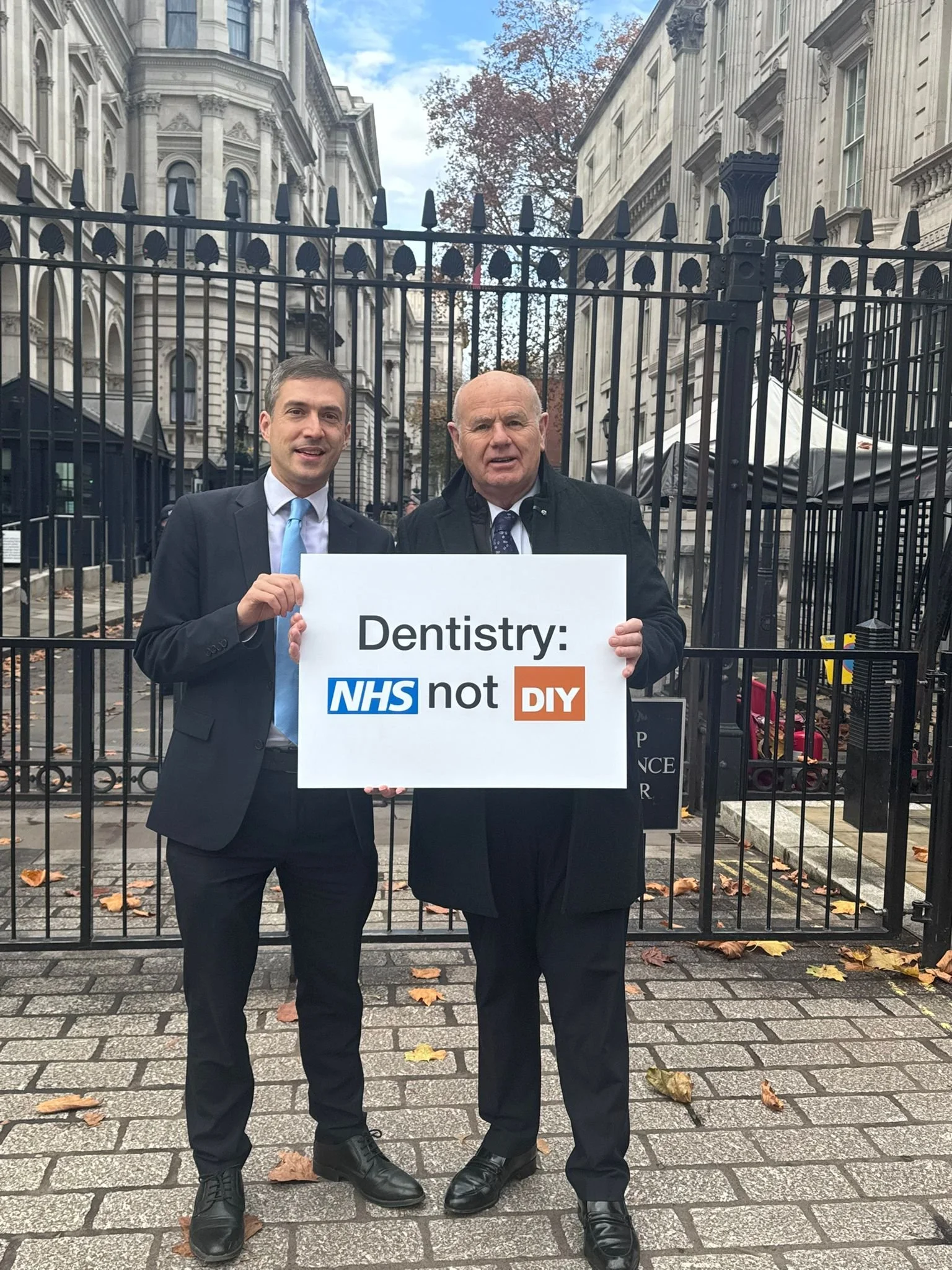
Adrian Ramsay MP Welcomes Minister’s Commitment to Direct NHS Dentistry Funding Where It Is Most Needed
19th of August 2025
Adrian Ramsay MP, Member of Parliament for Waveney Valley, has questioned the Minister of State for Care on whether the extra funding allocated to the Department will be reflected in increased funding for NHS dentistry. The question - asked last month before Parliament went into recess - secured a commitment to focusing more NHS dentistry funding in under-served areas like Waveney Valley.
Adrian Ramsay asked:
“Data published last week shows that despite the Government’s initial action, the proportion of dentists working in the NHS in Norfolk and Waveney continues to drop. I am pleased to hear about the Government’s work on the dental contract, but the Public Accounts Committee is clear that this will work only if it is backed by sustainable funding. I will give the Minister another chance to answer the question: will the Government ensure that the extra funding that has been put into the Department is actually reflected in extra funding for NHS dentistry?”
In response Stephen Kinnock MP the Minister of State for Care said
“One thing that I made clear to officials when I came into this post was that every penny that is allocated to NHS dentistry must be spent on NHS dentistry. We are in a crazy situation where demand for NHS dentistry is going through the roof, yet we have had underspends. That needs to stop. We will focus the spending on where it is most needed, including areas that are under-served, such as the hon. Gentleman’s constituency.”
Reacting to the reply Adrian Ramsay MP said
"I am glad that the Government has acknowledged the ridiculous situation where the demand for NHS dentistry is increasing while funding remains unspent and so many people just can’t get access to a dentist. I welcome the Minister’s commitment to ensuring that resources are directed to where they are most needed. In the upcoming parliamentary term, I will hold the Minister accountable to this commitment and will continue to advocate for improved access to NHS dentistry for people in East Anglia and across the country.”
ENDS

The Government has finally acknowledged the NHS dentistry crisis. Now it must take action.
8th of August 2025
When I stood for election a little over a year ago, the one issue that came up time and time again was the near-complete collapse in access to NHS dental care locally. It was raised by parents who couldn’t get appointments for their children, and by people sometimes travelling hours just to be seen. I’ve even spoken to people in so much pain that they resorted to pulling out their teeth. This cannot be right.
I’ve long believed that dentistry is the forgotten sibling of the NHS. A vital service that has been chronically underfunded for decades.
From day one in Parliament, I made it a priority to press the Government on this issue. I’ve repeatedly raised it on the floor of the House, submitted questions, and met with the British Dental Association (BDA) and the campaign group Toothless in England multiple times to hear directly from those on the front lines. Their message has been consistent: the current system is broken.
Dentists are willing and able to help, but many are leaving NHS work because the contract model is unworkable, and the funding is not there. That is why I have sought to work with the BDA to secure a new workable contract - one that serves dentists, patients, and the NHS.
The Government’s response until now has been lacklustre to say the least. They have promised reforms that never materialised and continued to allocate funding that, infuriatingly, went unspent. In fact, despite the Government’s initial action and announcements and schemes that were supposed to fix things, the proportion of dentists working in the NHS in Norfolk and Waveney continues to drop.
I took the opportunity in Parliament last month to ask the Minister of State for Care whether the recently announced additional funding for the Department of Health and Social Care would lead to substantial investment in NHS dentistry. I asked a simple, direct question. Will the Government ensure that the extra funding that has been put into the Department is actually reflected in extra funding for NHS dentistry?
This time, the Minister gave a clear and welcome commitment. He said, and I quote, “Every penny that is allocated to NHS dentistry must be spent on NHS dentistry.” He also acknowledged how outrageous it is that we have seen underspending in dentistry budgets at a time of rising demand. Crucially, he recognised that areas like East Anglia, which have been underserved for years, must be prioritised.
As someone who has worked consistently on this issue, both inside and outside Parliament, I am pleased that the Government is finally starting to recognise the scale of the problem. But let’s be clear. Words are not enough. Promises mean little unless they are followed by action. What we need is for this Government to live up to its commitment to spend every penny allocated to NHS dentistry, and to follow through as soon as possible with the contract reforms so we can stop – and then reverse – the exodus of dentists from the NHS.
For people in Waveney Valley and across East Anglia, this needs to result in more NHS dentists on the ground. It needs to mean appointments that are available when needed. Patients must not be forced into private treatment or left waiting for months or longer for basic care.
There is also a broader question here about how we view dentistry as part of our health system. For too long, dental care has been treated as a separate or second-tier service. That must change. Oral health is not an optional extra, it’s a vital part of our overall health. Until the Government sees this, we are going to get nowhere in improving our overall wellbeing.
Untreated dental problems can lead to severe pain, serious infections, and, in some cases, leave people unable to eat. Tooth decay is the number one reason for hospital admission for children – a total scandal. The idea that this essential part of healthcare is now out of reach for so many people is not just unfair. It is a public health failure.
The Government may have come to its senses on NHS dentistry, but this must now be a turning point, not just a passing gesture. In the months ahead, I will continue to work with the BDA and Toothless in England to push for tangible action, not just words.
No one should be in pain because they cannot afford to see a dentist. No child should be denied basic healthcare because of where they live. It’s time the Government made good on its promise and delivered NHS dentistry that works for the people who need it most.
I will not let this issue drop. I will continue to fight for a system that works, for patients, for dentists, and communities like ours.
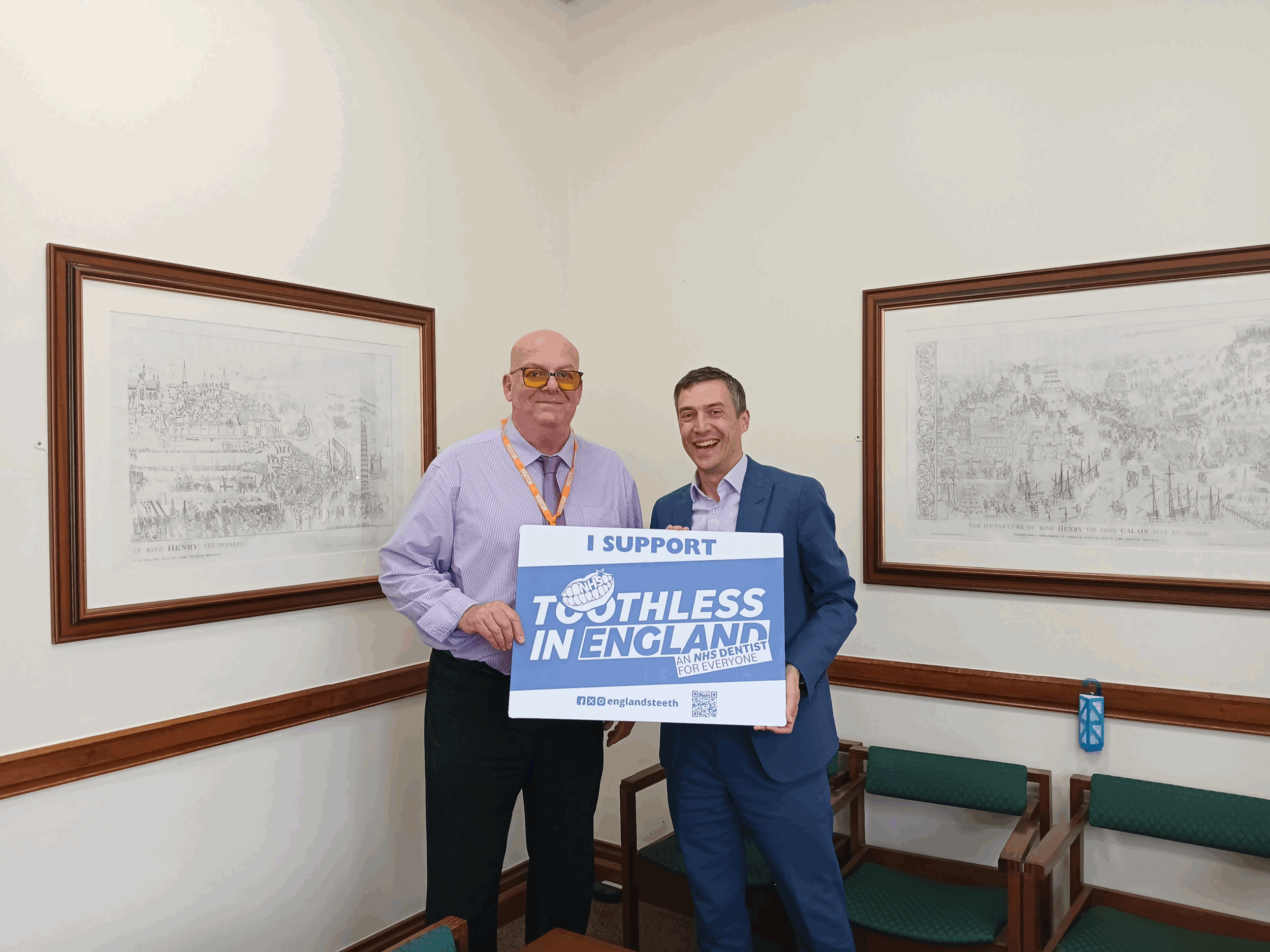
Tackling dental deserts
A shocking story on the BBC News website this month revealed that a Norwich dental practice which has 200 spaces for new NHS patients received over 16,000 applications in just one day.
I say it was shocking but, in truth, it was not surprising. East Anglia is an NHS dental desert, the worst dental desert in the country, where 99.7 percent of people are unable to find an NHS dentist. Official figures show that for new patients, NHS dentistry has effectively ceased to exist.
Around one in five patients suffer in pain. There are even reports of people resorting to pulling out their own teeth because they cannot find an NHS dentist and cannot afford to pay for a private one.
It sounds Dickensian. Yet we are living in the 21st century.
I know from my parliamentary email inbox that this is a high priority for my constituents. So when I had the opportunity to question the Prime Minister directly about it, I asked him when the Government would start the critical negotiations to reform the dental contract, which is at the heart of the problem. Dentists are not being paid appropriately for the work they do, so too many of them are quitting the NHS and treating only private patients.
I’m glad that Sir Keir Starmer acknowledged that we face a crisis and one the Government is determined to put right. I’m glad too that the Prime Minister said the Government would work on a cross-party basis to address the issue. But he wouldn’t commit to starting negotiations before the end of this year and patients are tired of waiting.
The health minister is promising a rescue plan to restore NHS dentistry with 700,000 additional urgent appointments in areas of the country most in need “as soon as possible”. Those appointments can’t come soon enough.
If access to NHS dentistry was the only problem facing health care, it would be bad enough. But it isn’t. There is a critical lack of hospital services in the constituency with some people living 20 miles or more from their nearest big hospital. There is also a lack of post-operative care following eye surgeries such as cataracts which is having an knock-on effect on local A&E services.
Soon after being elected in July, I met with the Hartismere Hospital League of Friends to talk about how the hospital might provide a wider range of services for local residents so people didn’t have to travel to Norwich, Bury St Edmunds or Ipswich for treatment.
As you will now, the hospital closed to in-patients in 2006 but, thanks to a campaign by local residents, it was kept open as a health and care centre for treatments like podiatry, physiotherapy, mental health care and rheumatology.
If its facilities were upgraded, it could provide so much more. Installing an X-ray machine would make a huge difference to local residents in both Norfolk and Suffolk.
As well as dentistry and hospital services, there is a third area vital to healthcare where our area is badly served. We don’t have enough pharmacies. In the last year, nearly six pharmacies a week have shut their doors. One of them was a Boots pharmacy which closed in Bungay earlier this year. Others are reducing their hours. The loss of pharmacies has an outsized impact on rural areas where there is often no nearby alternative.
The NHS Norfolk and Waveney integrated care board, which covers most of Waveney Valley, said it had seen the highest number of hours lost per pharmacy.
So while I welcome the Health Secretary’s promise to turn the NHS into “a neighbourhood health service”, shifting care from hospitals to the community, the proof of the pudding will be in the eating.
There is a huge amount of catching-up to do and it was alarming to see the Government back itself into a corner over its fiscal rules which just seemed to promise an extension of the austerity which has caused such damage to our public services over the past 14 years.
So at the Budget at the end of this month, I hope the Chancellor will look at all options for increasing funding to the NHS, including being willing to call on the very richest in society to pay a little more in tax, in a way that could enable us to get the funding across all NHS services – dentistry, hospital care, GP surgeries and pharmacies – that is needed to keep pace with demand.