

Assisted Dying
1st of November 2024
Of all the issues constituents have raised with me over the past few weeks, none has generated as much correspondence as the bill on assisted dying. Like many other MPs, I received hundreds of letters and emails, many of them telling powerful and moving stories about caring for loved ones in the last months of their life.
I recognised the weight of responsibility in considering people’s experiences and looking at the evidence ahead of a vote that all parties treated as a matter of individual judgement and conscience for MPs.
I and my parliamentary colleagues also heard received an extraordinary level of guidance and evidence from medical professionals, advocacy groups and faith leaders.
So when I sat through the debate on the Terminally Ill Adults (End of Life) Bill – to give it its correct title – I was aware of the very deep-felt emotions behind this issue. And I saw the House of Commons at its best with serious, considered debate conducted with a huge amount of respect for the views put forward. The speeches were honest and heartfelt, with none of the grandstanding or point-scoring which often mars parliamentary debates. Everyone there, whether on the floor of the chamber or in the public gallery, recognised that we were deciding on an issue which could profoundly impact our society.
When the vote was finally declared, there was silence in the chamber with none of the usual cheering from the winning side. I think we all realised the gravity of what we had decided.
I was one of the 330 MPs who voted in favour. I was minded to do so before the debate and while I listened carefully to the arguments of those who opposed the Bill, they didn’t change my mind. I believed, and still believe, that those facing the pain and inevitability of an acute and terminal illness should have the choice to avoid a terrible and slow decline. This is about shortening death not ending life – and giving people choice in their final weeks.
There were and are very valid ethical questions raised by the Bill’s opponents. How can we ensure that no one becomes vulnerable to coercion? Can we come up with a clear legal framework that upholds a physician’s unwavering principle of ‘do no harm’? How can we prevent the measures around assisted dying expanding beyond the intended scope? Are the safeguards put in place robust enough to ensure an individual’s choice is both voluntary and informed?
The Bill does include wide-ranging safeguards such as strict eligibility criteria so that only terminally ill adults with a life expectancy of six months or less can ask for assistance; a reflection period after the request is made; multiple healthcare professionals must confirm that the individual is making the choice freely; it must be confirmed by a High Court judge. These safeguards are essential to protect the individual from coercion from family, caregivers or healthcare providers but we need to have confidence that the NHS and judges have the capacity to play their part in this.
Although the vote on 29th November was a major milestone, it does not mean the Bill will automatically become law. There are months of scrutiny in committee to come where the Bill will be poured over line by line by MPs and, unusually, by outside experts too. It will have to pass through several stages in the House of Commons before going to the House of Lords where there will be further scrutiny.
There are MPs who have admitted they voted for the Bill even though they had serious doubts about it, in the hope that their doubts can be addressed during this scrutiny and amendment process.
The debate around assisted dying has also highlighted the urgent need to improve palliative and social care in our country. We must ensure that all individuals facing a terminal illness have access to the highest standard of care so they don’t feel forced into a decision because of inadequate care and support. Since the assisted dying debate I have asked questions in the Chamber on support for the palliative care sector and I will continue to press for this and social care to get the support and focus they need.
We have taken a momentous step as a nation. We are not the first to do so. Several countries in Europe, parts of Australia, the US and Canada have all legalised assisted dying. If the parliamentary process over the months ahead is conducted with the same care, seriousness and humanity as the debate in the House of Commons, I think we can achieve a compassionate outcome which delivers choice to terminally ill people over how their life comes to an end.
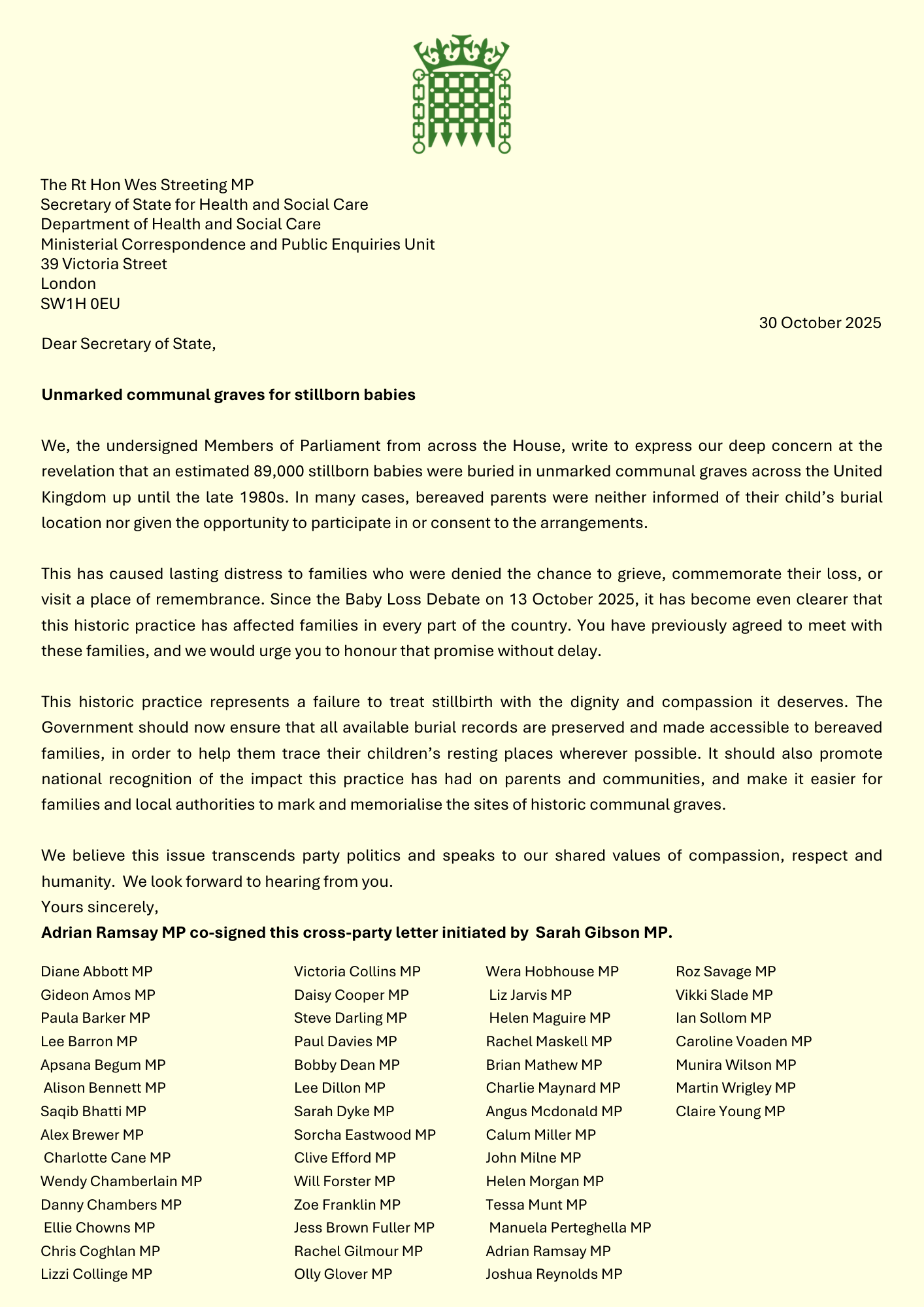
Unmarked communal graves for stillborn babies
-
Adrian Ramsay MP co-signed this cross-party letter initiated by Sarah Gibson MP.
Dear Secretary of State,
Unmarked communal graves for stillborn babies
We, the undersigned Members of Parliament from across the House, write to express our deep concern at the revelation that an estimated 89,000 stillborn babies were buried in unmarked communal graves across the United Kingdom up until the late 1980s. In many cases, bereaved parents were neither informed of their child’s burial location nor given the opportunity to participate in or consent to the arrangements.
This has caused lasting distress to families who were denied the chance to grieve, commemorate their loss, or visit a place of remembrance. Since the Baby Loss Debate on 13 October 2025, it has become even clearer that this historic practice has affected families in every part of the country. You have previously agreed to meet with these families, and we would urge you to honour that promise without delay.
This historic practice represents a failure to treat stillbirth with the dignity and compassion it deserves. The Government should now ensure that all available burial records are preserved and made accessible to bereaved families, in order to help them trace their children’s resting places wherever possible. It should also promote national recognition of the impact this practice has had on parents and communities, and make it easier for families and local authorities to mark and memorialise the sites of historic communal graves.
We believe this issue transcends party politics and speaks to our shared values of compassion, respect and humanity. We look forward to hearing from you.
Yours sincerely,
Adrian Ramsay MP co-signed this cross-party letter initiated by Sarah Gibson MP.

Rachel Reeves’ Budget ignored this one reality about Britain
30th of October 2024
There was a lot of talk ahead of this Budget about it being the most significant financial statement for decades, a Budget that would set the course of our country for years to come.
After 14 years of underfunding which has left our public services in crisis, we needed a vision. What we got was a patchwork of promises, some of them positive but barely delivering on the long-term change that people voted for in July.
Indeed, after a rush of spending over the next year, the increase in funding slows to a crawl. A growth in real terms spending on public services of 1.5% a year after next year will barely touch the sides when you consider the need after 14 years during which public services have been brought to their knees.
This doesn’t feel like a plan for long-term transformation to build the economy of the future.
Don’t get me wrong: there was much to welcome. It was right that money is set aside to compensate the victims of the infected blood scandal and the Post Office horizon scandal. It was right too that the Chancellor changed the self-imposed fiscal rules to allow more borrowing to invest in our economy.
But this was a Budget which too often gave with one hand and took away with the other. While there is welcome and substantial investment in the NHS, mainly for diagnostic services, it comes in the wake of the withdrawal of winter fuel allowance for millions of pensioners which will leave them colder and sicker. The money in the Budget for social care will barely touch the sides – hardly an example of joined-up thinking.
The funding for schools is also welcome and a recognition of the dangerous state of many school buildings, which were constructed with dangerous concrete. I was also pleased to see the Chancellor recognise the huge un-met need of families with SEND children with a £1 billion increase in funding.
But let’s not forget that this Government also chose not to lift the two-child benefit cap which condemns 300,000 children to living in poverty.
The minimum wage is going up but raising employers’ national insurance and lowering the threshold at which they have to pay it places a huge burden on small and medium-sized businesses who form the backbone of our economy and provide more than 16 million jobs. The rise in bus fares will also make it more expensive for the worst-off to get to work.
Then there is the vital green transition to a thriving, sustainable economy. In the past seven Conservative budgets, the word “climate” was mentioned barely at all and then only in passing. Rachel Reeves continued that shameful tradition. The climate and nature crises have been virtually ignored – despite the huge impact they will have on our economy in the coming years.
Worse, the money to deal with some of the biggest impacts of climate breakdown – flooding – is to be reviewed and quite possibly cut, along with the budget for farming. As an MP for a rural constituency which is regularly affected by flooding, this is deeply worrying.
Rachel Reeves also showed political cowardice by following previous Conservative chancellors in freezing the fuel duty raise. This is not only costing the public purse £3 billion a year, it has also increased our carbon emissions by seven percent over the past 15 years.
The Chancellor is planning to spend a lot of money, particularly in the coming year, and our public services desperately need it.
But she has ignored the reality of where the wealth lies in Britain. The wealthiest 10 percent of the population own around half of all wealth, much of which is taxed at a much lower rate than the income of ordinary working people. The Chancellor seems to run scared of all the talk about millionaires and billionaires leaving the country, rather than looking to them to pay their fair share of tax so everyone can benefit from improved public services.
Yes, capital gains tax is going up but there is still a yawning gap between income from work and income from wealth. The rise in employers’ national insurance contributions means the money to fund the increase in public spending is coming from taxes on work, not wealth.
Rachel Reeves said there would be no return to austerity and “people must feel that”. Based on her plans, I’m not sure they will.

100 days as an MP
18 of October 2024
It’s hard to believe it’s been 100 days since I was elected as an MP, the first-ever MP for the new constituency of Waveney Valley. The first 100 days of any job is a good time to reflect both on what’s been achieved so far and the many tasks ahead.
So what have been my first impressions as a new MP?
I don’t think anyone can visit the Houses of Parliament without feeling the weight of history and a sense of awe at the grandeur of the Palace of Westminster, despite all the scaffolding surrounding it.
Navigating around the building and getting to grips with the many arcane ways of doing business here is quite a challenge and I was very grateful to be allocated a “buddy” by the parliamentary authorities. It was my buddy’s job to show me where everything was, make sure I didn’t get lost (easy to do in the many labyrinths of the Palace of Westminster), explain some of the parliamentary processes, how I could table an urgent question, or add my name to an early day motion or apply for an adjournment debate.
When I arrived at Parliament on July 8th, four days after the election, I was one of hundreds of new MPs all trying to find somewhere to work, get connected to the IT system and get to grips with the role. All this without a group of staff as the recruitment process could only start once the election was over.
And all the while, the constituency casework in the constituency has continued to pour in. In fact, it started within moments of my election being announced – that is the level of need left by years of Conservative-led austerity and under-funding of public services. Many of the issues raised are ones that I was hearing about on the doorstep during the campaign – issues like the number of children with special educational needs or disabilities who don’t have school places or the lack of vital NHS services like dentistry.
I’ve had the opportunity to raise some of these issues in Parliament already. I spoke in a debate on healthcare provision in the East of England last month, pointing out that East Anglia is the Sahara desert of dental services. It is shocking and completely unacceptable that in the 21st century people are reduced to pulling out their own teeth because they cannot access NHS dental care. The dental contract is clearly broken and needs urgent reform.
When the Government has such a huge majority, I know it will be difficult to force a change in government policy. Even a few Labour rebels will not be sufficient to block a bad law.
But it is does create one advantage for smaller opposition parties like the Greens. Parliamentary protocol demands that the Speaker switches between government and opposition benches in debates and when the government benches are so crowded, those of us on the opposition side have a much greater chance of being selected to speak and I have more opportunity to put Waveney Valley’s voice directly to ministers and raise issues in the House of Commons chamber which might otherwise not be heard.
It was though luck rather than numbers which saw my name come up in the draw to ask a question of the Prime Minister within three weeks of being elected. I wanted to know what steps Keir Starmer would be taking to reverse the catastrophic depletion of nature in Britain. It was an opportunity for him to show leadership on this vital issue to our common future. Needless to say, he didn’t answer and just chose to score a political point. The collegiality which I saw during the first few days of this Parliament didn’t last long.
It is the privilege of my life to serve as the first MP for Waveney Valley. I hope constituents will bear with me as I build a team so I can deliver the best possible service as your MP.
I promised in my election leaflets that I would be Waveney Valley’s voice at Westminster, nor Westminster’s voice in Waveney Valley. That is my aim over the next four or five years of this Parliament.
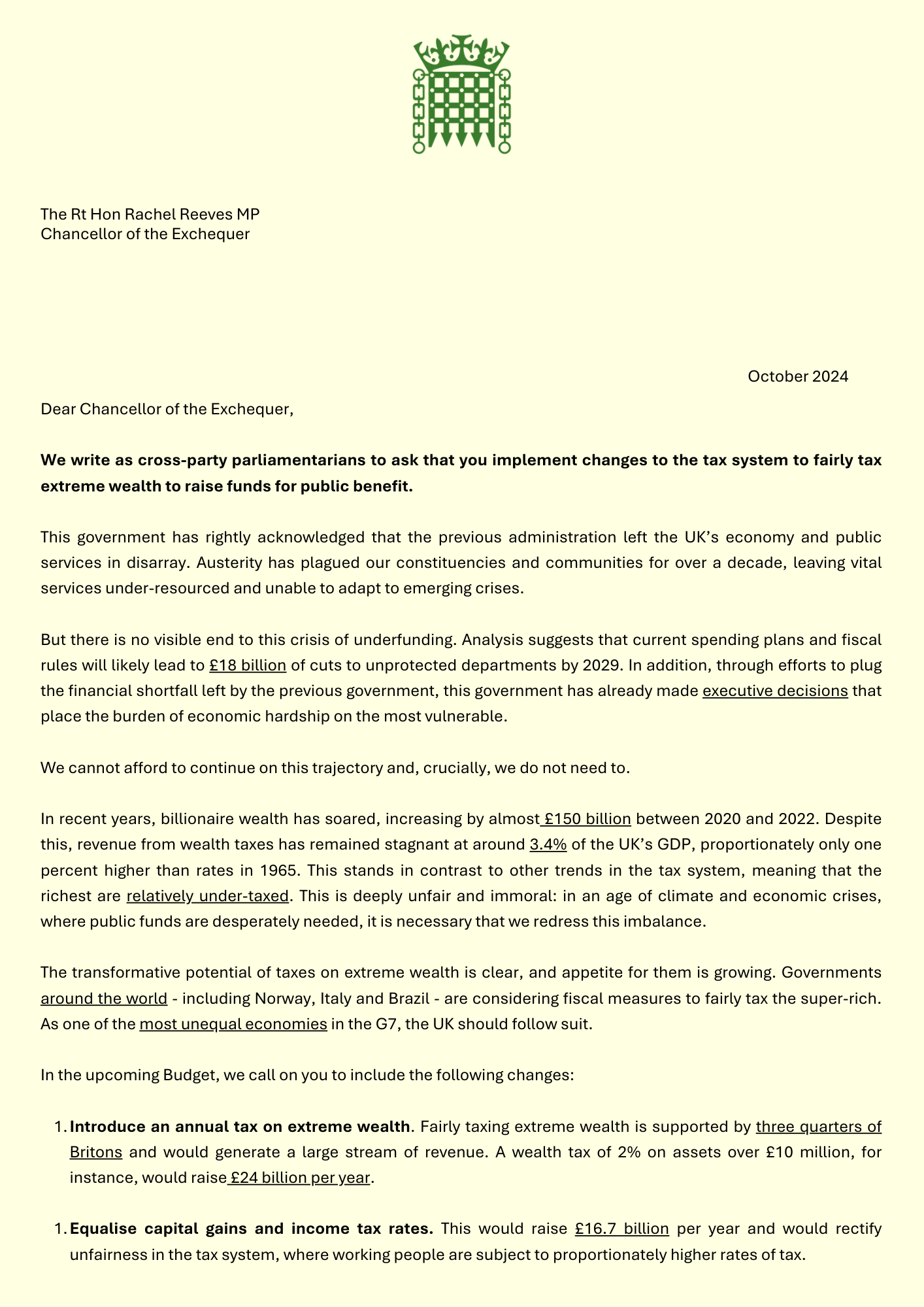
We write as cross-party parliamentarians to ask that you implement changes to the tax system to fairly tax extreme wealth to raise funds for public benefit.

-
The Rt Hon Rachel Reeves MP
Chancellor of the Exchequer
October 2024
Dear Chancellor of the Exchequer,
We write as cross-party parliamentarians to ask that you implement changes to the tax system to fairly tax extreme wealth to raise funds for public benefit.
This government has rightly acknowledged that the previous administration left the UK’s economy and public services in disarray. Austerity has plagued our constituencies and communities for over a decade, leaving vital services under-resourced and unable to adapt to emerging crises.
But there is no visible end to this crisis of underfunding. Analysis suggests that current spending plans and fiscal rules will likely lead to £18 billion of cuts to unprotected departments by 2029. In addition, through efforts to plug the financial shortfall left by the previous government, this government has already made executive decisions that place the burden of economic hardship on the most vulnerable.
We cannot afford to continue on this trajectory and, crucially, we do not need to.
In recent years, billionaire wealth has soared, increasing by almost £150 billion between 2020 and 2022. Despite this, revenue from wealth taxes has remained stagnant at around 3.4% of the UK’s GDP, proportionately only one percent higher than rates in 1965. This stands in contrast to other trends in the tax system, meaning that the richest are relatively under-taxed. This is deeply unfair and immoral: in an age of climate and economic crises, where public funds are desperately needed, it is necessary that we redress this imbalance.
The transformative potential of taxes on extreme wealth is clear, and appetite for them is growing. Governments around the world - including Norway, Italy and Brazil - are considering fiscal measures to fairly tax the super-rich. As one of the most unequal economies in the G7, the UK should follow suit.
In the upcoming Budget, we call on you to include the following changes:
Introduce an annual tax on extreme wealth. Fairly taxing extreme wealth is supported by three quarters of Britons and would generate a large stream of revenue. A wealth tax of 2% on assets over £10 million, for instance, would raise £24 billion per year.
Equalise capital gains and income tax rates. This would raise £16.7 billion per year and would rectify unfairness in the tax system, where working people are subject to proportionately higher rates of tax.
We urge you to take the bold decisions necessary to deliver the public funding that the UK desperately needs. As the first Budget of a new government, this is a key opportunity to lay the foundations for a fairer, more sustainable, and thriving economy for all.
Yours sincerely,
Adrian Co-Signed this cross-party letter initiated by Green New Deal Rising.

The crisis in SEND provision in East Anglia
In my constituency surgeries, I meet people who are often at the end of their tether and have reached out to me because they don’t know where else to turn. Many of their stories are heart-rending and some of the most powerful, and most frequent, are the ones from parents who have children with special educational needs or disabilities (SEND). When they turn to the “system” for help, they often find they’re on their own.
In my constituency surgeries, I meet people who are often at the end of their tether and have reached out to me because they don’t know where else to turn.
Many of their stories are heart-rending and some of the most powerful, and most frequent, are the ones from parents who have children with special educational needs or disabilities (SEND). When they turn to the “system” for help, they often find they’re on their own.
Let me tell you about one parent. Her young child has what’s known as an EHCP, a document which sets out the educational, health and care plan the child needs because of their disabilities or a long-term illness. Her child couldn’t go to a mainstream primary school after leaving nursery but there were no places available at special needs schools. After a long period at home, the family were told there wouldn’t be a place until 2025.
Her son desperately missed being with other children and his mum had had to give up work for care for him. The lack of a special school place put enormous stress on other members of the family. Trying to navigate the system was bad enough, she said, but even worse was the “not knowing” and feeling that when she reached out for support, there was almost none there.
Even an educational psychologist who is used to navigating the relevant systems told me she struggled to get a place for her child in a suitable school and when one was offered, it was many miles from her home in a rural village.
It’s common for families to wait two years or more for an assessment of their child’s needs, whatever their age even though, by law, the process is supposed to take no more than 20 weeks. And specialist services can only be accessed once the child has been assessed and issued with that all-important EHCP which can take another year.
While the family are waiting, over-stretched teachers are struggling to support a child who has complex needs but they can’t get specialist services to help them because there isn’t yet an EHCP.
Families who are struggling are at the sharp end of this crisis. And the need is rocketing. Many of my fellow Norfolk and Suffolk MPs tell me they’re also seeing a huge caseload of SEND cases. Along with many of them, I spoke in a debate at Westminster last week about SEND provision in the East of England. And that was the eleventh debate on SEND education in Parliament just this year. That is how critical this issue has become.
I know from my discussions with Suffolk County Council leaders that they are worried about the sharp increase in cases involving children with special needs and disabilities. They’ve gone up by over 60 percent in the last two years, putting huge pressure on resources.
Norfolk County Council is spending nearly £50 million a year taking pupils with special educational needs to school, inside and outside the county. That’s not money for their education, it’s just for getting the children to school, often travelling quite long distances.
An Ofsted report late last year into Suffolk’s SEND provision said children got “lost in the system and (fell) through the cracks.” That’s certainly been the experience of some of my constituents. Six months after that Ofsted report, and despite Suffolk saying they’d find the money to turn around the service, parents were still saying the Council wasn’t acting on their concerns or dealing with their complaints.
The head of Suffolk’s SEND services highlight that they need more staff to help it improve, particularly more education psychologists who can assess a child’s needs. Speeding up the assessment process is vital.
But we also need more places for special needs children in our area, either in specialist schools or units within mainstream schools. And the system needs to be streamlined so parents find it much easier to navigate.
The Government is promising extra funding for special education, with about £13 million going to local authorities in the East of England. I hope there will be funding too for better access to mental health and other support, whether that’s for speech and language delay or ADHD.
Parents should have confidence that government and local authorities are there for them and able to provide the services their children need. They don’t feel that at the moment, and that has to change.
Adrian Ramsay MP