
Re: Government time to debate national security assessment on biodiversity loss, ecosystem collapse and national security
-
The Rt. Hon. Emma Reynolds MP
Secretary of State for Environment, Food and Rural Affairs
23 March 2026
Re: Government time to debate national security assessment on biodiversity loss, ecosystem
collapse and national security
Dear Secretary of State,
Further to my letter of 3 February 2026, I write again about the Government’s national security
assessment’s stark warning that global biodiversity loss and ecosystem collapse pose a serious threat to
the United Kingdom’s security and prosperity.
Today, the United Nations warned that the planet is being ‘pushed beyond its limits’ as energy imbalance
reach record high and its Secretary-General António Guterres called on countries to "deliver climate
security, energy security and national security"
.
In this context, I would be grateful for an indication on when you will set a time to debate the Joint
Intelligence Committee’s report as indicated by the Leader of the House following my Business Question
[AC/IDC1226].
With thanks,
Adrian Ramsay
Letter to the Prime Minister to express our alarm at the UK’s involvement in the illegal US-Israeli war on Iran.
-
The Rt Hon Sir Keir Starmer KCB KC MP
Prime Minister
Office of the Prime Minister
10 Downing Street
London SW1A 2AA
20 March 2026
Dear Prime Minister,
We are writing as Green Party MPs and Peers to express our alarm at the UK’s involvement in the illegal US-Israeli war on Iran.
Already well over 1,000 civilians have been killed, including a reported 168 children killed by a missile now widely believed to be from the United States (Guardian, 2026). UNICEF has reported that the Israeli military's assault on
Lebanon is killing or injuring the equivalent of one classroom of children every day (Reuters, 2026).
In addition to the grave humanitarian impacts, the longer this illegal, unnecessary war continues, the greater the global economic fallout – to which the UK is particularly exposed because it remains heavily reliant on fossil fuels.
In light of this, there are urgent questions your government must answer:
What steps, if any, is your government taking to ensure that B-1 and B-52 bombers taking off from RAF Fairford are being used for ‘specific, limited defensive purposes’– as you committed to?
What assessment have you made, if any, of how many Iranian civilians have been killed by US bombing missions from British air bases?
Are target lists for US strikes from British soil approved by the Ministry of Defence before each mission or audited afterwards?
Is the US being permitted to load banned cluster munitions at British bases?
What assessment has the government made of the risk of UK-made weapons components being used in violation of international law in Iran, including in the Tomahawk missile systems which may have been involved in the strike on the Shajareh Tayyerbeh girls’s school which killed a reported 168 children and 14 teachers, in the single deadliest known attack so far?
What assessment has the government made of the risk of UK-made weapons components being used by the Israeli government in violation of international law in Lebanon?
The UK is obliged under international law to have no involvement in illegal military action, including the use of UK bases and UK-made weapons. It is therefore of the utmost importance that these questions are answered as a matter of urgency.
This illegal war is inflicting untold suffering and devastation in the region and will cause huge and long lasting human, political, economic and environmental ramifications, as well as the immediate impact on the cost-of-living for our constituents. We, as Green Party MPs and Peers, reiterate our calls for the UK government to:
Withdraw all permission for the US to use UK military bases for attacks on Iran.
End all arms sales to and military cooperation with the Israeli government.
Impose sanctions on government officials responsible for breaches of international law.
Condemn the actions of Trump and Netanyahu for their flagrant violations of international law.
Refuse any further complicity in this illegal war.
Yours sincerely,
Dr Ellie Chowns MP
Carla Denyer MP
Siân Berry MP
Hannah Spencer MP
Adrian Ramsay MP
Baroness Bennett of Manor Castle
Baroness Jones of Moulsecoomb
Letter to the Prime Minister on Bowel Cancer
-
The Rt Hon Sir Keir Starmer KC MP
Prime Minister
10 Dowing Street
London
SW1A 2AB
Dear Prime Minister,
Bowel cancer is the second biggest cancer killer in the UK, with someone diagnosed every 12
minutes. Around one in four people with bowel cancer will be diagnosed in an emergency
setting, often in A&E when the cancer is usually more advanced, and survival chances are
lower.
We want a future where this no longer happens—a future where symptoms are recognised
early, referrals happen quickly, and screening reaches everyone it should, so bowel cancer is
detected at the earliest possible stage. With 609,000 new bowel cancer cases projected in
England by 2040, we pledge to work with Bowel Cancer UK, and the Government to
prioritise reducing cancer deaths and help build a future where bowel cancer is found early,
not in A&E.
Together, we can ensure fewer families lose loved ones to a disease that is treatable and
survivable if diagnosed sooner.
Yours sincerely,
Danny Beales MP
Uxbridge and South
Ruislip
Paul Davies MP
Colne Valley
Helen Morgan MP
North Shropshire
Jim Dickson MP
Susan Murray MP
Shockat Adam MP
Dartford
Mid Dunbartonshire
Leicester South
Linsey Farnsworth
Jo Platt MP
Rt Hon Stuart Andrew
MP
Leigh and Atherton
MP
Amber Valley
Daventry
Adrian Ramsay MP
Waveney Valley
Tonia Antoniazzi MP
Gower
Brian Leishman MP
Alloa and Grangemouth
Rebecca Long-Bailey
Jim Shannon MP
Strangford
Dr Scott Arthur MP
Edinburgh South West
MP
Salford
Martin Vickers MP
Brigg and Immingham
Bob Blackman MP
Harrow East
Douglas McAllister
MP
West Dunbartonshire
Prevalence of Criminal Activity Across the Greyhound Racing Industry
-
The Rt Hon Emma Reynolds MP
Secretary of State
Department for Environment, Food and Rural Affairs
Nobel House
17 Smith Square
London
SW1P 3JR
16 March 2026
RE: Prevalence of Criminal Activity Across the Greyhound Racing Industry
Dear Secretary of State,
I am writing further to the correspondence you have recently received from Animal Aid regarding criminal activity and animal protection concerns within the greyhound racing industry. I wish to raise serious concerns about evidence of potential criminality and regulatory failure in the sector, and to urge you to consider the case for a phased ban on the sport. Doing so would both support your Department’s priorities around animal protection as set out in the Animal Welfare Strategy, as well as wider Government priorities.
New analysis compiled by Animal Aid demonstrates that the greyhound racing industry continues to fall short of its duty of care to the dogs it breeds, trains and races, and that its system of self‑regulation by the Greyhound Board of Great Britain (GBGB) is shielding it from proper legal oversight. Since January 2025, the GBGB has published 128 breaches of its own rules, which Animal Aid assesses amount to 237 possible criminal offences. This includes cases involving dangerous neglect and failures to protect dogs from injury and death, potentially in breach of the Animal Welfare Act 2006.
Despite these widespread failings, none of these incidents were referred to the police. Instead, suspected criminal activity continues to be addressed internally by the greyhound racing industry. The GBGB has imposed modest fines and reprimands, without external referral or escalation to statutory authorities. This raises significant concerns about the transparency and accountability of an industry in which animals are experiencing widespread harm.
Considering these concerns, I urge you to consider the case for a phased ban on the sport, which is necessary to safeguard animal protection. Such an approach would align with the Government’s commitment to high animal welfare standards and its ambition to deliver world-leading protections, reflecting the values of the UK as a nation of animal lovers.
I would welcome a meeting with you to discuss this issue further and to understand how the Department intends to respond to these concerns.
Yours sincerely,
Adrian Ramsay
Member of Parliament for Waveney Valley
Informing Women of Dense Breasts After NHS Screening
-
Rt Hon Wes Streeting MP
Department of Health and Social Care
39 Victoria Street
London
SW1H 0EU
6 March 2026
Dear Secretary of State,
Re: Informing Women of Dense Breasts After NHS Screening
As MPs representing constituents affected by breast cancer and breast cancer screening, we
are writing to request urgent action in relation to the UK National Routine Breast Screening
Programme.
Dense breast tissue is present in around 40% of women undergoing mammography.
Standardised terminology to describe breast density has been in use for over 30 years, based on
radiologists’ visual assessment and computer software.
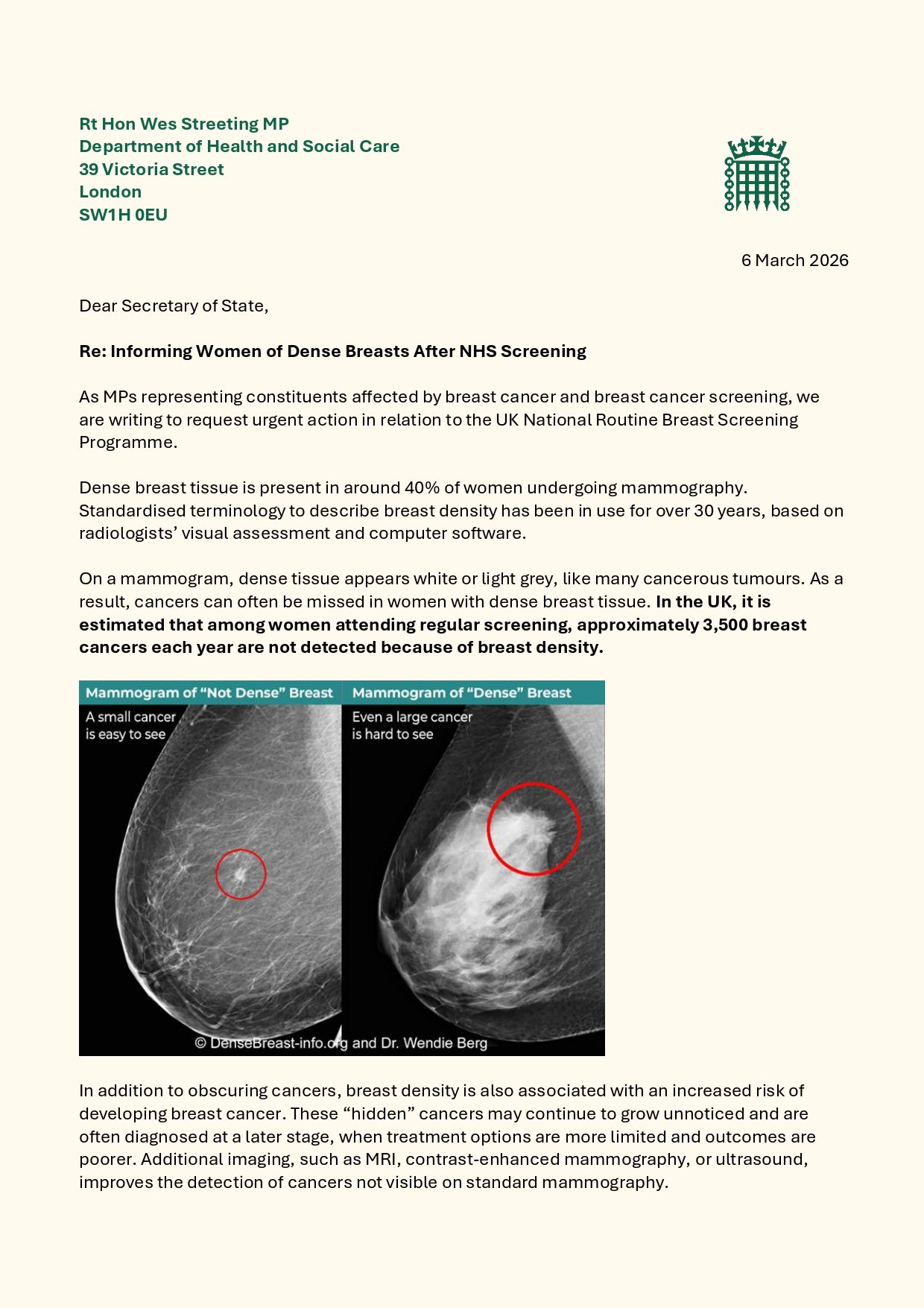
On a mammogram, dense tissue appears white or light grey, like many cancerous tumours. As a
result, cancers can often be missed in women with dense breast tissue. In the UK, it is
estimated that among women attending regular screening, approximately 3,500 breast
cancers each year are not detected because of breast density.
In addition to obscuring cancers, breast density is also associated with an increased risk of
developing breast cancer. These “hidden” cancers may continue to grow unnoticed and are
often diagnosed at a later stage, when treatment options are more limited and outcomes are
poorer. Additional imaging, such as MRI, contrast-enhanced mammography, or ultrasound,
improves the detection of cancers not visible on standard mammography.However, women attending routine NHS breast screening are not informed if they have
dense breasts, nor are they routinely offered additional imaging. In the United States, federal
law since 2024 requires that all women be notified following a mammogram whether their
breasts are classified as “dense” or “not dense”.
International breast experts understand that research and trials to aid early detection can take
years to translate into practice. Cancer does not wait.
Women in the UK deserve access to potentially life-saving information. Being informed of their
breast density empowers women to have meaningful conversations with their clinicians about
risk, to consider appropriate follow-up imaging and, importantly, to remain vigilant about their
breast health.
Many UK breast cancer experts, including breast surgeons, recognise this issue and are
increasingly encouraging women to contact their Members of Parliament to call for change.
We therefore request that you support the Dense Breast Inform campaign and consider
policy changes to ensure women are informed about breast density following screening.
Yours sincerely,
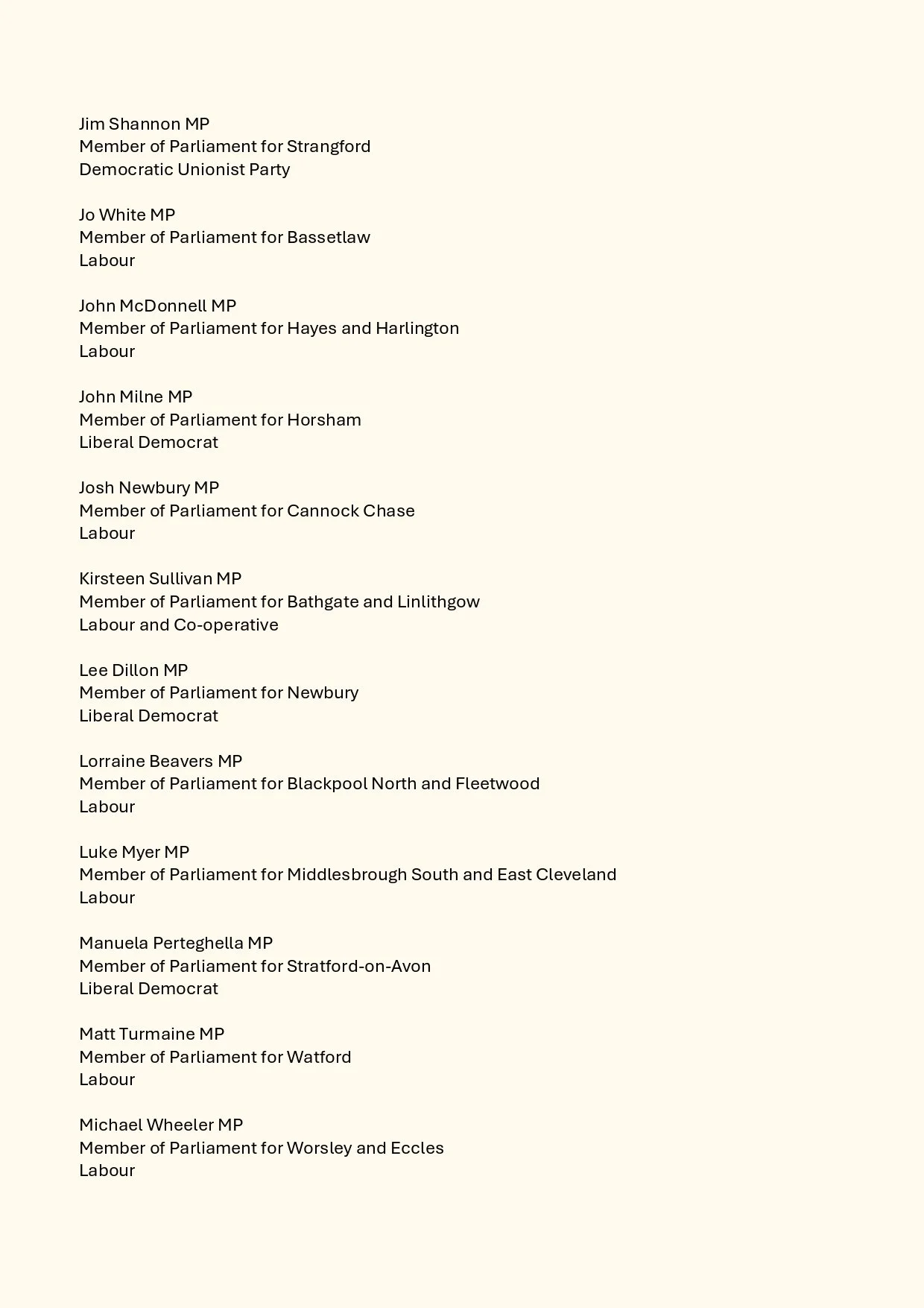
Lee Barron MP
Member of Parliament for Corby and East Northamptonshire
Labour
Steve Yemm MP
Member of Parliament for Mansfield
Labour
Abtisam Mohamed MP
Member of Parliament for Sheffield Central
Labour
Adrian Ramsay MP
Member of Parliament for Waveney Valley
Green Party
Alison Hume MP
Member of Parliament for Scarborough and Whitby
Labour
Allison Gardner MP
Member of Parliament for Stoke-on-Trent South
LabourAmanda Hack MP
Member of Parliament for North West Leicestershire
Labour
Andy McDonald MP
Member of Parliament for Middlesbrough and Thornaby East
Labour
Anneliese Midgley MP
Member of Parliament for Knowsley
Labour
Ayoub Khan MP
Member of Parliament for Birmingham Perry Barr
Independent
Bell Ribeiro-Addy MP
Member of Parliament for Clapham and Brixton Hill
Labour
Brian Leishman MP
Member of Parliament for Alloa and Grangemouth
Labour
Carla Denyer MP
Member of Parliament for Bristol Central
Green Party
Cat Eccles MP
Member of Parliament for Stourbridge
Labour
Chris Webb MP
Member of Parliament for Blackpool South
Labour
Clive Jones MP
Member of Parliament for Wokingham
Liberal Democrat
Clive Lewis MP
Member of Parliament for Norwich South
Labour
Colum Eastwood MP
Member of Parliament for Foyle
Social Democratic and Labour PartyDaisy Cooper MP
Member of Parliament for St Albans
Liberal Democrat
Daniel Francis MP
Member of Parliament for Bexleyheath and Crayford
Labour
David Baines MP
Member of Parliament for St Helens North
Labour
Elaine Stewart MP
Member of Parliament for Ayr, Carrick and Cumnock
Labour
Ellie Chowns MP
Member of Parliament for North Herefordshire
Green Party
Graeme Downie MP
Member of Parliament for Dunfermline and Dollar
Labour
Grahame Morris MP
Member of Parliament for Easington
Labour
Henry Tufnell MP
Member of Parliament for Mid and South Pembrokeshire
Labour
Ian Byrne MP
Member of Parliament for Liverpool West Derby
Labour
Ian Lavery MP
Member of Parliament for Blyth and Ashington
Labour
Jess Asato MP
Member of Parliament for Lowestoft
Labour
Jim Dickson MP
Member of Parliament for Dartford
LabourJim Shannon MP
Member of Parliament for Strangford
Democratic Unionist Party
Jo White MP
Member of Parliament for Bassetlaw
Labour
John McDonnell MP
Member of Parliament for Hayes and Harlington
Labour
John Milne MP
Member of Parliament for Horsham
Liberal Democrat
Josh Newbury MP
Member of Parliament for Cannock Chase
Labour
Kirsteen Sullivan MP
Member of Parliament for Bathgate and Linlithgow
Labour and Co-operative
Lee Dillon MP
Member of Parliament for Newbury
Liberal Democrat
Lorraine Beavers MP
Member of Parliament for Blackpool North and Fleetwood
Labour
Luke Myer MP
Member of Parliament for Middlesbrough South and East Cleveland
Labour
Manuela Perteghella MP
Member of Parliament for Stratford-on-Avon
Liberal Democrat
Matt Turmaine MP
Member of Parliament for Watford
Labour
Michael Wheeler MP
Member of Parliament for Worsley and Eccles
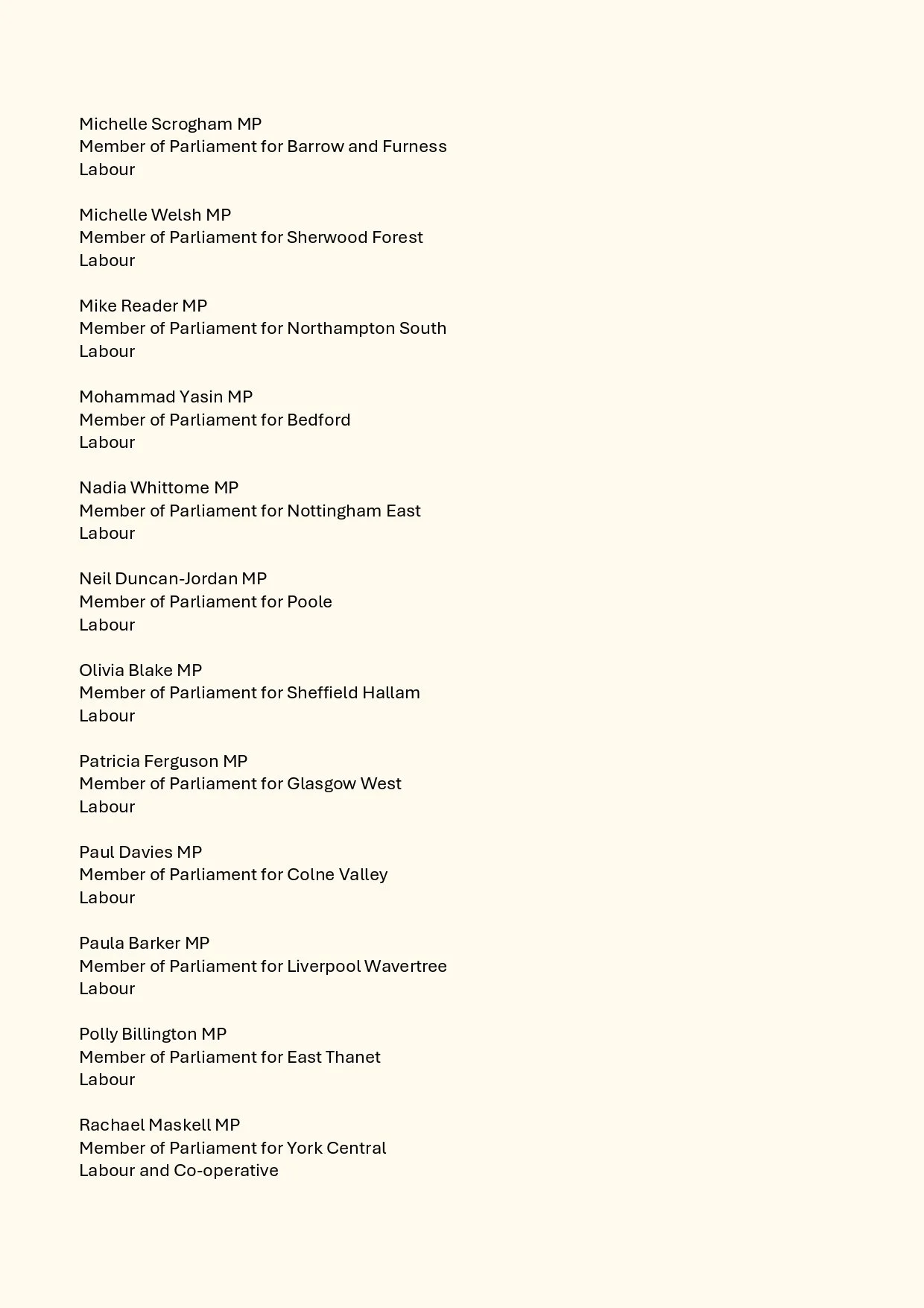
LabourMichelle Scrogham MP
Member of Parliament for Barrow and Furness
Labour
Michelle Welsh MP
Member of Parliament for Sherwood Forest
Labour
Mike Reader MP
Member of Parliament for Northampton South
Labour
Mohammad Yasin MP
Member of Parliament for Bedford
Labour
Nadia Whittome MP
Member of Parliament for Nottingham East
Labour
Neil Duncan-Jordan MP
Member of Parliament for Poole
Labour
Olivia Blake MP
Member of Parliament for Sheffield Hallam
Labour
Patricia Ferguson MP
Member of Parliament for Glasgow West
Labour
Paul Davies MP
Member of Parliament for Colne Valley
Labour
Paula Barker MP
Member of Parliament for Liverpool Wavertree
Labour
Polly Billington MP
Member of Parliament for East Thanet
Labour
Rachael Maskell MP
Member of Parliament for York Central
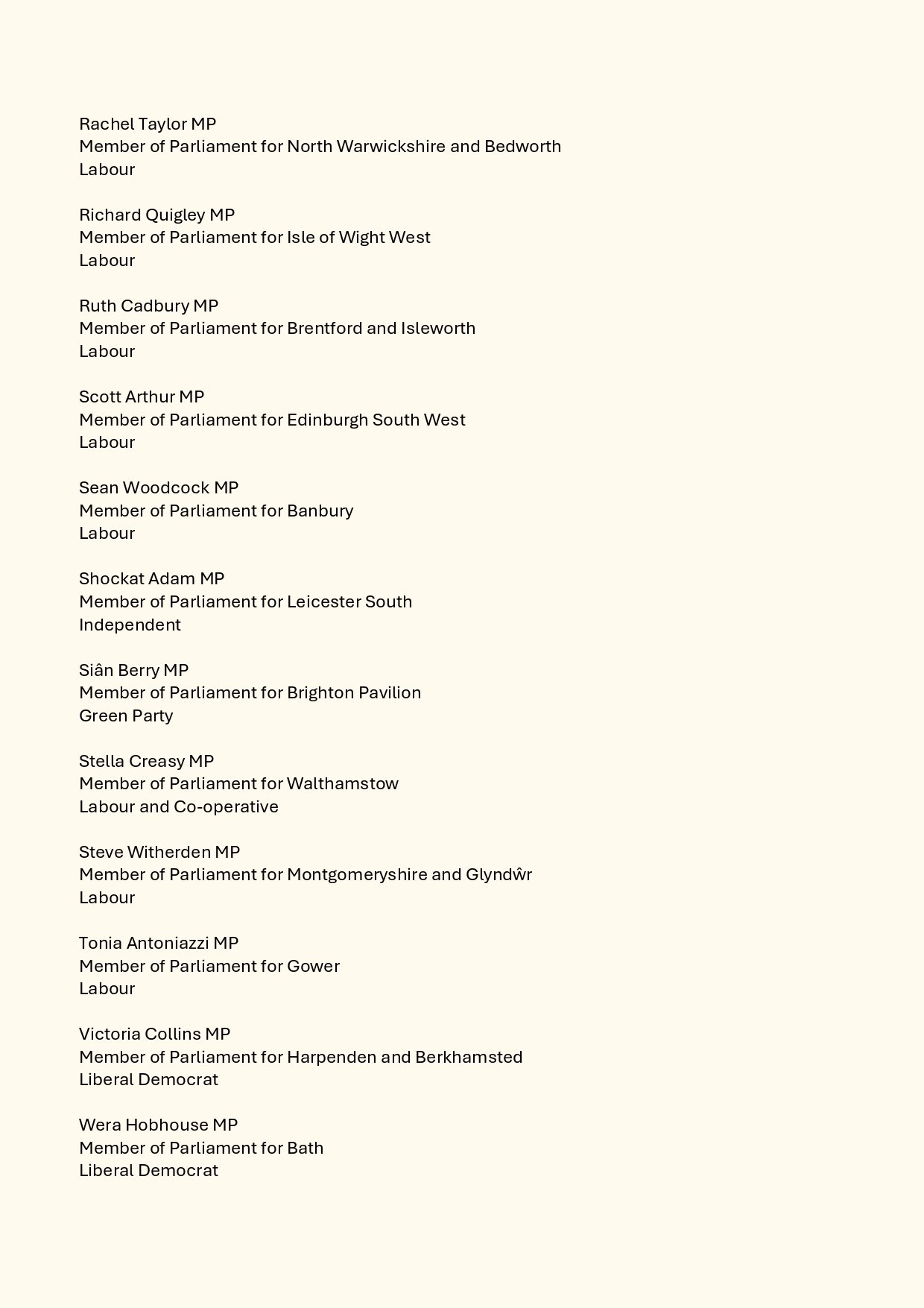
Labour and Co-operativeRachel Taylor MP
Member of Parliament for North Warwickshire and Bedworth
Labour
Richard Quigley MP
Member of Parliament for Isle of Wight West
Labour
Ruth Cadbury MP
Member of Parliament for Brentford and Isleworth
Labour
Scott Arthur MP
Member of Parliament for Edinburgh South West
Labour
Sean Woodcock MP
Member of Parliament for Banbury
Labour
Shockat Adam MP
Member of Parliament for Leicester South
Independent
Siân Berry MP
Member of Parliament for Brighton Pavilion
Green Party
Stella Creasy MP
Member of Parliament for Walthamstow
Labour and Co-operative
Steve Witherden MP
Member of Parliament for Montgomeryshire and Glyndŵr
Labour
Tonia Antoniazzi MP
Member of Parliament for Gower
Labour
Victoria Collins MP
Member of Parliament for Harpenden and Berkhamsted
Liberal Democrat
Wera Hobhouse MP
Member of Parliament for Bath
Liberal Democrat.
Drax internal emails and FCA investigation: cross-party request to review subsidy
-
The Rt Hon Ed Miliband MP
Secretary of State Department of Energy Security and Net Zero
18th February 2026
Drax internal emails and FCA investigation: cross-party request to review subsidy
Dear Secretary of State,
We are writing to bring your attention to a tranche of newly released internal correspondence from energy company Drax. This evidence suggests that Drax may have knowingly made misleading claims to the government, parliamentarians, Ofgem, and investors in its response to BBC Panorama’s investigation into Drax’s subsidised sourcing of wood from Canadian forests in 2022.
We are deeply concerned that a company should be in receipt of substantial billpayer subsidy, currently guaranteed until 2031, While it may have knowingly and consistently concealed information of material relevance to its legitimacy as a subsidy recipient.
According to media reports cited below, after the documentary aired, one senior manager wrote “we’ve been saying we don’t source from these forests when it appears we might be.”
This was despite public statements from the CEO stating that the BBC allegations were “false,” “ill-informed” and “promoted by vested interests.” The emails further Suggest Drax was told by lawyers “the legal view contradicts what you’ve put in the public domain.”
Given that the Financial Conduct Authority are currently investigating such “historical statements” made by Drax about their sourcing of pellets, we request that all future UK government contracts with Drax be suspended for the duration of this investigation. We ask you to clarify whether your Department considers Drax to be currently meeting the standards of transparency and compliance expected of a recipient of public subsidy.
We also highlight the quote from Lord Alan Whitehead, Energy Minister on 10th December 2025 “If Drax is non-compliant, the subsidy goes. There is no subsidy in the case of a non-
compliant organisation of any kind. If that happens, it will be the end of Drax”. We therefore
ask what steps you will take to reassess Drax’s eligibility for ongoing and future support
should the FCA investigation substantiate concerns that material information was withheld or
misrepresented.
Recent revelations are covered in the following media reports:
• Rachel Millard, Financial Times, Drax manager questioned public statements on
wood sourcing, tribunal documents show, 30th January 2026
• Jillian Ambrose, The Guardian, Drax insiders privately raised concerns over its
sustainability claims, court papers show, 4th February 2026
• Old Sparky, Private Eye, “Drax: Internal Affairs” Issue 1668, 6-19 Feb 2026
We hope that you share our concern and confirm that you will take decisive action to ensure
that no further subsidy will be awarded if such practice is uncovered.
Yours sincerely,
Adrian Ramsay MP
Alex Sobel MP*
Baroness Boycott
Baroness Jones of Moulsecoomb
Baroness Young of Old Scone
Barry Gardiner MP
Carla Denyer MP
Chris Hinchliff MP
Ellie Chowns MP
Pippa Heylings MP
Lord Randall of Uxbridge
Sian Berry MP
The Earl of Caithness
Wera Hobhouse MP
Urgent need for Government commitment to progress Ely and Haughley junction improvements
-
Urgent need for Government commitment to progress Ely and Haughley junction
improvements
Dear Secretary of State for Transport, the Rt Hon Heidi Alexander MP, and Chief Secretary to the
Treasury, the Rt Hon Darren Jones MP
The Government’s Plan for Change has made delivering economic growth across the UK its central mission. To achieve this, growth must be unlocked across every UK region. We are therefore writing to you to restate the six chief facts that make clear how upgrading Ely and Haughley rail junctions would directly contribute to the Government’s ambition to grow the whole of the UK.
These schemes have been in the pipeline for decades with the case for them strengthening year on year. They are now restricting growth and the country’s progress to cleaner, greener transport connections. We are now calling on Government to commit in this Spending Review to provide Network Rail with the funds to develop the Full Business Case for the Ely Area Capacity Enhancements, so it can be delivered as soon as possible with appropriate phasing, and to provide the relatively low level of funding needed to deliver the Haughley Junction upgrade.
The case for this investment is clear. It would:
1. Enable businesses from Land’s End to John O’Groats: Rail freight from the Port of Felixstowe primarily serves freight terminals in the Midlands, North and Scotland, with the greatest density of goods destinations being cities in the North of England. Unlocking this bottle-neck would increase international trade flows by enabling 2,900 extra freight services to and from the Port of Felixstowe every year, also releasing capacity on rail routes serving the growing Thames ports.
2. Unlock sustainable homes growth: It is anticipated that across the corridors which would see increased passenger services there will need to be 310,00 new homes built by 2404. People in these new communities will be the talent for the high-skilled, high-growth sectors in Cambridge, Peterborough, Norwich and Ipswich.
3. Relieve pressure on our stretched road network: By increasing capacity and reducing bottlenecks, taking 98,000 HGVs off the road and stimulating 277,000 extra rail passenger journeys per year, it will reduce congestion by 5.6 million hours per year. Ely is also referenced in the strategies of Transport for London, Transport for the North and Midlands Connect reflecting the knock-on benefits to capacity in the wider rail and road network.
. Payback the investment 5-fold: The scheme has a remarkably high benefit-cost ratio, returning £4.89 of benefits for every £1 invested. An additional £60m of wider economic benefits has already been identified within the Outline Business Case. However, this does not reflect fully the growth opportunities now centred on Cambridge and Peterborough, or the Freeports.
Align with, and unlock, private sector investment: Hundreds of millions of pounds have already been invested by the private sector in this trade corridor, including in new port capacity, vessels, rail rolling stock and logistics facilities. Only recently £130m has been invested from private sector levies to deepen the channel at the Port of Felixstowe. Public funding for Ely helps match and capture the full value of these prior investments, whilst also unlocking more in the future including upgraded rail freight terminal facilities and new bi-mode locomotives. But it needs clear signals from Government that rail freight capacity will be released.
Deliver greener transport: By supporting modal shift to rail, Ely will remove the need for 98,000 HGV journeys every year, and attract substantially more rail users as evidence of increased passenger frequencies across the East has already demonstrated. It would also reduce carbon emissions by 1.7m tonnes of CO2 over 60 years.
Delaying these projects further will delay national growth and productivity enhancements. We trust
you will view these schemes positively as you determine the Spending Review.
Yours sincerely
Jess Asato MP Co-chair, East of England APPG
Andrew Pakes MP Co-chair, East of England APPG
Marie Goldman MP Vice Chair,East of England APPG
Blake Stephenson MP Vice Chair,East of England APPG
Jack Abbott MP East of England Missions Champion
Alice Macdonald MP East of England Missions Champion
Bayo Alaba MP East of England Business Champion
David Burton-Sampson MP East of England Business Champion
Adrian Ramsay MP co-signed this cross-party letter initiated by the East of England All-Party Parliamentary Group.
Letter to the Secretary of State for the Home Department on proscription of Palestine Action
-
Adrian Ramsay MP co-signed this letter initiated by Dr Ellie Chowns MP.
Dear Home Secretary,
We write as Parliamentarians who either originally opposed the proscription of Palestine Action (PA) or who have come to see it as wrong and unworkable. Today's decision by the high court vindicates our position and we welcome the ruling.
The Home Office's position has put enormous pressure on the courts and the police.
We understand that 2787 people have been arrested for terrorism offences for peacefully holding signs that express their support for Palestine Action, including more than 250 on 9th August last year who are aged over 60 years old. And one outcome of the proscription of Palestine Action is that more people were arrested for terrorist offences in just one day than have ever previously been arrested under terror legislation in an entire year in the UK (REE).
Proscribing Palestine Action has also had grave consequences for fundamental human rights and our international reputation.
Mr Justice Chamberlain granted permission for a judicial review of proscription on the grounds that included it being contrary to the Human Rights Act 1998 and amounts to a disproportionate interference with Articles 10 and 11 on the rights to freedom of expression and the right to freedom of assembly). And you will know
that Volker Turk, the United Nations' human rights chief, called the proscription "disproportionate and unnecessary", warning that a broad definition of terrorism, that encompasses serious damage to property, places the UK outside international law. (REF).
A cross-party submission to the High Court, which many of us signed, warned that "proscription risks becoming a blunt tool to silence dissent and criminalise legitimate protest and democratic debate-particularly where it relates to British complicity in atrocities committed by the Israeli government and the broader struggle for Palestinian human rights."
Today's verdict is an opportunity to change course, and we hope you will now commit to ending the suppression of UK citizens who oppose the genocide in Gaza.
Yours sincerely,
Yours sincerely,
Ellie Chowns MP
Carla Denyer MP
Siân Berry MP
Adrian Ramsay MP
Shockat Adam MP
Ayoub Khan MP
Jeremy Corbyn MP
Nadia Whittome MP
Manuela Perteghella MP
Adnan Hussain MP
Liz Saville Roberts MP
Ben Lake MP
Ann Davies MP
Llinos Medi MP
Iqbal Mohamed MP
Baroness Jones of Moulsecoomb
Baroness Bennett of Manor Castle
Lord Cashman
Baroness Smith of Llanfaes
Lord Freyberg
Baroness Uddin
The Right Honourable Lord Hain
Lord Tope OBE
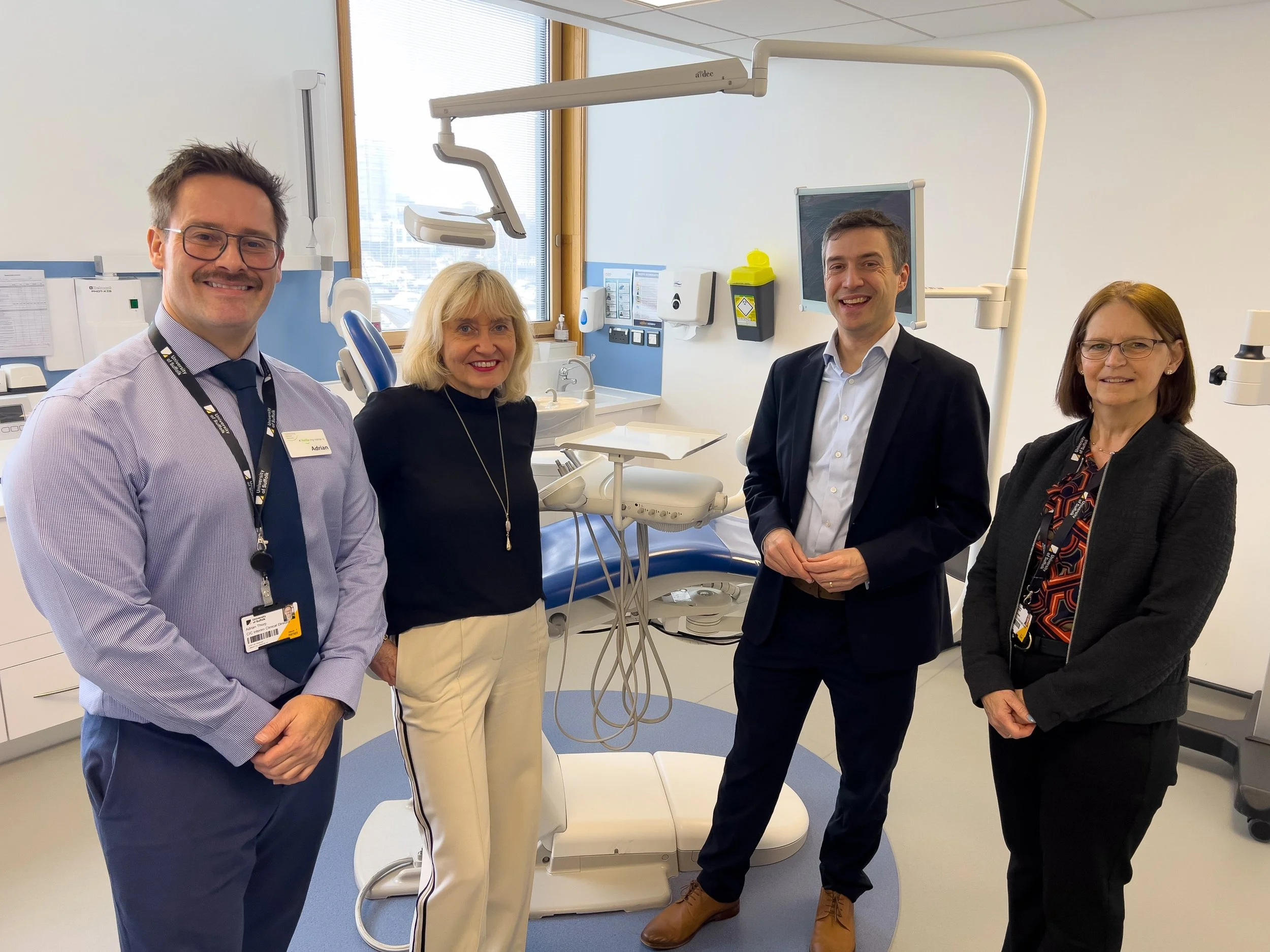
Adrian Ramsay MP presses Minister for urgent clarity on funding for UEA dental school.
11th of February 2026
Adrian Ramsay MP presses Minister for urgent clarity on funding for UEA dental school.
Adrian Ramsay, MP for Waveney Valley, has written to Stephen Kinnock MP, Minister of State for Care at the Department of Health and Social Care, seeking clarity on when funding will be confirmed to allow the University of East Anglia to open its new dental school.
The University of East Anglia has already secured General Dental Council accreditation, its new facilities will be completed this year, and it is ready to recruit its first cohort of students. The remaining barrier is confirmation of funded undergraduate places.
Speaking after sending his letter, Adrian Ramsay MP said:
“Norfolk and the Waveney Valley face some of the poorest access to NHS dentistry in England, while the East of England remains the only region without a dental training institution. Given the scale of unmet need across Norfolk and Suffolk, it is deeply frustrating that the only thing preventing dental teaching at UEA is confirmation of funding from the Department.
"Directing new training capacity to areas with the greatest need must be a priority if we are serious about improving access to NHS dentistry.”
In a Parilmentary debate this week Adrian said:
"The University of East Anglia stands ready to open a new dental school. It has permission from the General Dental Council but is awaiting the funded undergraduate dental places that will be needed to start training new dentists from 2027. Can the Minister set out how those places will be made available on the basis of regional need, so that dental deserts such as the east of England can start to build a sustainable dental workforce?"
Adrian Ramsay has again asked the Minister to set out the timetable for decisions on funded undergraduate places and how regional need will be reflected in the allocation process.
ENDS
Notes to editors
Full text of the letter is available here:
Dear Stephen,
I am writing to follow up on my recent remarks in the Adjournment Debate on NHS Dentists [5 February 2026] regarding the acute shortage of NHS dental provision across East Anglia and the readiness of the University of East Anglia to open a new dental school.
As you are aware, the University of East Anglia has secured accreditation from the General Dental Council, its new facilities will be completed this year, and it is prepared to recruit its first cohort from May 2026, with teaching due to commence in September 2027. The remaining barrier is the confirmation of funded undergraduate places, without which the school cannot begin teaching.
As I have raised on a number of occasions, the Norfolk and Waveney catchment area continues to experience some of the poorest access to NHS dentistry in England, with at least 3,000 patients for every dentist carrying out any NHS work, compared with around 2,220 patients per dentist nationally.
This is both a cause and a symptom of a wider structural problem: the East of England remains the only region without a dental training institution. This entrenched shortage makes the case particularly compelling for directing new training capacity towards areas of greatest need. I therefore welcome your indication that the Office for Students will play a role in allocating places and that ministerial advice will inform how those decisions are made.
Given the scale of unmet need in Norfolk and Suffolk, I would be grateful for further clarity on the expected timetable for decisions on the allocation of funded places for the University of East Anglia.
Expanding training capacity must also be accompanied by measures to ensure that graduates are supported to remain in underserved areas and within the NHS. As I have previously highlighted, this will require targeted incentives to encourage retention, alongside meaningful progress on reform of the NHS dental contract to make long-term NHS practice financially sustainable.
I would welcome your response setting out when funding for undergraduate places at the University of East Anglia is likely to be confirmed, and what advice will be provided to the Office for Students to ensure regional need is properly reflected in the allocation process.
UEA Dentistry School
-
The Hon Stephen Kinnock MP
Minister of State for Care
Department for Health & Social Care
39 Victoria St
London
SW1H 0EU
10 February 2026
Dear Stephen,
I am writing to follow up on my recent remarks in the Adjournment Debate on NHS Dentists [5 February 2026] regarding the acute shortage of NHS dental provision across East Anglia and the readiness of the University of East Anglia to open a new dental school.
As you are aware, the University of East Anglia has secured accreditation from the General Dental Council, its new facilities will be completed this year, and it is prepared to recruit its first cohort from May 2026, with teaching due to commence in September 2027. The remaining barrier is the confirmation of funded undergraduate places, without which the school cannot begin teaching.
As I have raised on a number of occasions, Norfolk and the Waveney Valley continue to experience some of the poorest access to NHS dentistry in England, and the East of England remains the only region without a dental training institution. This entrenched shortage makes the case particularly compelling for directing new training capacity towards areas of greatest need. I therefore welcome your indication that the Office for Students will play a role in allocating places and that ministerial advice will inform how those decisions are made.
Given the scale of unmet need in Norfolk and Suffolk, I would be grateful for further clarity on the expected timetable for decisions on the allocation of funded places for the University of East Anglia. Expanding training capacity must also be accompanied by measures to ensure that graduates are supported to remain in underserved areas and within the NHS. As I have previously highlighted, this will require targeted incentives to encourage retention, alongside meaningful progress on reform of the NHS dental contract to make long-term NHS practice financially sustainable.
I would welcome your response setting out when funding for undergraduate places at the University of East Anglia is likely to be confirmed, and what advice will be provided to the Office for Students to ensure regional need is properly reflected in the allocation process.
Yours sincerely,
Adrian Ramsay MP
Palantir and Peter Mandelson
-
Adrian Ramsay MP co-signed this letter along with Sian Berry MP, Carla Denyer MP and Dr Ellie Chowns MP.
Dear Cabinet Secretary,
We are writing with deep concern to urgently call for an immediate inquiry into the Government’s current contracts with US-based spy-tech giant Palantir and the influence that Peter Mandelson had on these contracts.
Last week, by his own admission, we learned that the Prime Minister was aware of Mandelson’s close ties to Jeffrey Epstein when he appointed him as British Ambassador to the United States of America.1 Given what we know now, and what the Prime Minister knew then, we believe this appointment should have never happened. Mandelson was forced to resign in disgrace, permitted to maintain his Labour party membership and position in the House of Lords for several more months, and now a criminal investigation has been launched into his conduct in public office.
This all could have and should have been avoided. And still, the lingering effects of Mandelson’s corruption remain, especially in the Government’s contracts with Palantir. As you know, Mandelson co-founded a lobbying firm, Global Counsel, to help private companies procure massive contracts with governments. Palantir hired Global Counsel as a client, and even though Mandelson resigned from his post at the firm when he became ambassador, he retained a large stake in the company, reportedly around 21%. 2
As reported by the New York Times, the US Justice Department releases of the Epstein files revealed that Peter Thiel, the co-founder of Palantir, maintained a close financial and personal relationship with Jeffrey Epstein. Epstein invested $40m into Valar Ventures, a firm that Thiel co-founded. There are many questions and ethical concerns about the web of connections between Thiel, Epstein and Mandelson.3 Last year, Mandelson’s team arranged a meeting for the Prime Minister to visit Palantir’s offices in Washington D.C. at which Mandelson was also present in his official role as ambassador and seemingly his unofficial role as Palantir stakeholder. This meeting was not initially listed on the PM’s register of visits, and later last year, the Government awarded Palantir a £240m Ministry of Defence contract through a direct award, meaning without any competition.
The Government has still so far refused to share details of this meeting. Until it does, it would seem highly plausible that Mandelson could have used his position and influence with this Government, and his connections gained from being part of Epstein's network, for his own financial gain - and that the Government both knew about and permitted this to happen. While also employing Mandelson’s Global Counsel, Palantir was awarded an NHS contract of over £330m by a previous Conservative Government in 2023. We do not know the extent to which Mandelson influenced the procurement of this contract. Moreover, as Green Party leader Zack Polanski pointed out to Wes Streeting in a letter last week, the workers who keep our NHS running have misgivings about this contract, not least because of the risk of long- term vendor lock-in leading to increasing costs and price gouging. We join the British Medical Association and others who have called on the Government to scrap the contract.
Palantir technology has reportedly been used by U.S. immigration authorities to profile and target migrants and has been used by the Israeli military in Gaza - it has no place in our NHS or any of our public services.
Our concerns with Palantir are not just moral and ethical, important as those are. They are also strategic.
Palantir is now deeply embedded in the NHS and Ministry of Defence - and the longer they are in place, the harder and more expensive it becomes to remove them and the more the risk of poor value for money increases. There are already long-term risks to UK sovereign decision-making from dependencies on US-based tech giants like Microsoft, Amazon, and Oracle. The UK’s reliance on Palantir risks making it even more difficult for the UK to confront or even publicly disagree with the US administration, adding to pre-existing challenges posed by increasing belligerence over software access, tariffs and trade.
The risks of sanctions and data exploitation by the US through tech giants are well established and has led to firm action from France, Denmark and others.4567 Parliament and the public deserve clarity on how the Palantir contracts were awarded, what alternative suppliers were considered, and what assessment was made of long-term dependency risks, sovereign capability impacts, and whole-life value for money.
We are therefore calling on the Government to:
Conduct an internal and independent inquiry into Mandelson’s involvement in contracts between the UK Government and Palantir and publish the findings, including whether Mandelson shared privileged information with Palantir and the extent to which he used his role in Government for personal gain
Scrap its NHS and MoD contracts with Palantir at the earliest opportunity
Review UK dependence on contractors such as Palantir to secure the UK’s digital sovereignty
Our democratic institutions depend on transparency, oversight, and accountability. We thus look forward to your prompt attention to these issues of national interest and the highest standards of transparency in all matters relating to Palantir.
Adrian Ramsay MP co-signed this letter along with Sian Berry MP, Carla Denyer MP and Dr Ellie Chowns MP.
1 https://hansard.parliament.uk/Commons/2026-02-04/debates/C63E8C34-DFCA-499D-8E13-
515C58BEA3DA/Engagements?highlight=mandelson#contribution-A5818A02-A078-494E-9AA9-
05A58ED97B3B
and-ends-dividend-payments
3 https://www.nytimes.com/2025/06/04/business/jeffrey-epstein-peter-thiel-
estate.html#:~:text=Epstein's%20Inner%20Circle-
,Jeffrey%20Epstein%20Invested%20With%20Peter%20Thiel%2C%20and%20His%20Estate%20Is,asset%20sti
ll%20held%20by%20Mr
it-seeks-to-embrace-digital-sovereignty
5 https://apnews.com/article/europe-digital-sovereignty-big-tech-9f5388b68a0648514cebc8d92f682060
6 https://www.brennancenter.org/our-work/policy-solutions/checking-presidents-sanctions-powers
7 https://columbialawreview.org/wp-content/uploads/2018/10/Schwartz-
LEGAL_ACCESS_TO_THE_GLOBAL_CLOUD.pdf
Flawed recommendations in the Nuclear Regulatory Review
-
The Rt Hon Ed Miliband MP
Secretary of State for Energy Security and Net Zero
3-8 Whitehall Place
London
SW1A 2EG
Sent by email
9
th February 2026
Re: Flawed recommendations in the Nuclear Regulatory Review
Dear Secretary of State,
We are writing with the support of the parliamentarians listed below to urge you not to take an
environmental policy misstep.
As DESNZ considers next steps for progressing the recommendations made by the Nuclear Regulatory
Review, we believe that three of the forty-seven recommendations are particularly flawed and would set
back nature protection, climate and clean energy progress if implemented.
Review recommendations 11 and 12 propose amending the Habitats Regulations to reduce the
requirement on developers to avoid harm to nature sites when they build nuclear plants.
Recommendation 19 proposes removing a duty on local authorities to further the conservation and
public access purposes of National Parks and National Landscapes, which the Review authors felt
imposed undue burdens on nuclear developers.
Environmental groups have highlighted that these recommendations were primarily made based on just
one nuclear case study in the review, that of the Hinkley C nuclear project. This case study included
incorrect statistics which understated the environmental impact of the project and overstated the cost
of environmental mitigation measures. It also omitted to set out the marginal role that environmental
matters have played in the escalating costs and delays to the project, due largely to mistakes made by
the developer. These result of these inaccuracies, and the extrapolation of the one flawed case study to
wider development, has been the erroneous portrayal of nature protection as a significant blocker to
nuclear energy requiring a sledgehammer solution in the form of recommendations 11, 12 and 19.
Acting on this flawed premise would have detrimental consequences for nature, climate and energy.
This will especially be the case if the recommendations are applied beyond nuclear development to all
infrastructure, as was suggested in December. Nature in England is in decline, and the Office for
Environmental Protection has this month warned that the Government ‘remains largely off track to meet
its environmental targets and obligations, including legally binding biodiversity targets set under the
Environment Act’. Recommendations 11, 12 and 19 would allow more damage to be inflicted to
protected sites and landscapes, putting Environment Act targets decisively out of reach. Such a collapse
in nature recovery would impact net zero efforts, reducing the number of healthy natural habitats
needed to sequester large amounts of carbon. All three recommendations would require legislation to
put them into effect, resulting in a controversial new planning bill that will take up considerable
parliamentary time and Government capacity. This would be at the expense of other, better-founded
reforms which will more effectively hasten the delivery of energy infrastructure.
Such a blow to nature protection, net zero and clean energy delivery is not yet Government policy. It
can still be avoided, if you decide not to progress the three flawed recommendations in the Nuclear
Regulatory Review. We urge you to follow the evidence, reject the three recommendations and prevent
unnecessary and hugely damaging environmental regression.
Your sincerely,
Craig Bennett, Chief Executive, The Wildlife Trusts
Hilary McGrady, Director General, The National Trust
Beccy Speight, Chief Executive, RSPB
Darren Moorcroft, Chief Executive, The Woodland Trust
Roger Mortlock, Chief Executive, CPRE
Dr Rose O’Neill, Chief Executive, Campaign for National Parks
Kyle Lischak, Head of UK, ClientEarth
Richard Benwell, Chief Executive, Wildlife & Countryside Link
Letter also signed by:
Chris Hinchliff MP
Toby Perkins MP
Pippa Heylings MP
Clive Efford MP
Cat Eccles MP
Helen Maguire MP
Ian Sollom MP
Ellie Chowns MP
Bell Ribeiro-Addy MP
Neil Duncan-Jordan MP
Julia Buckley MP
Ian Byrne MP
Wera Hobhouse MP
Dr Peter Prinsley MP
John McDonnell MP
Kate Osborne MP
Terry Jermy MP
Cat Smith MP
Olivia Blake MP
Jenny Riddell Carpenter MP
Adrian Ramsay MP
Jon Trickett MP
Barry Gardiner MP
Mary Glindon MP
Rebecca Long-Bailey MP
Kim Johnson MP
Imran Hussain MP
Simon Opher MP
Zarah Sultana MP
Andrew George MP
Brian Leishman MP
Iqbal Mohamed MP
Carla Denyer MP
Siân Berry MP
Abtisam Mohamed MP
Tom Morrison MP
Nadia Whittome MP
Grahame Morris MP
Rachael Maskell MP
Alex Sobel MP
Jeremy Corbyn MP
Clive Lewis MP
John Milne MP
Manuela Perteghella MP
Alex Easton MP
John Whitby MP
Richard Burgon MP
Andy McDonald MP
Martin Rhodes MP
Ian Lavery MP
Mary Kelly Foy MP
Richard Quigley MP
Steve Witherden MP
Irene Campbell MP
Steve Darling MP
Vikki Slade MP
Richard Foord MP
Lord Randall of Uxbridge
Baroness Miller of Chilthorne Domer
Baroness Jones of Moulsecoomb
Baroness Bennett of Manor Castle
Lord Thurlow
Lord Bradshaw
Professor Lord Krebs Kt FRS FMedSci ML
Baroness Manzoor MA CBE
Baroness Bakewell of Hardington Mandeville MBE
Baroness Lister of Burtersett
Lord Teverson
Lord Taylor of Goss Moor
CC:
Rt Hon Emma Reynolds MP, Secretary of State for the Environment, Food and Rural Affairs
Chris Stark, Head of UK’s Mission for Clean Power
Emily Shukburgh, Chief Scientific advisor at DESNZ
Anjali Goswami, Chief Scientific advisor at Defra
Ruth Davies, Foreign Secretary’s Nature Envoy
Tony Juniper, Chair of Natural England
Alan Lovell, Chair of Environment Agency
Letter on the Deteriorating Security Situation in North-East Syria
-
Adrian Ramsay MP co-signed this cross-party letter initiated by Luke Akehurst MP.
Dear Yvette,
Re: The Deteriorating Security Situation in North-East Syria
As a group of cross-party MPs and Peers, we are writing to you to express our concern about the rapidly deteriorating security situation in North-East Syria, where Kurdish communities face a real and imminent threat of violence.
Over the past few days, forces under the direction of President Ahmed al-Sharaa have escalated their presence in North-East Syria, following the withdrawal of the Western-backed Syrian Democratic Forces (SDF). Credible reporting indicates severe risk to civilian life, with local authorities also reporting that more than 150,000 people have been displaced. Syrian authorities have confirmed that thousands of civilians have fled the area, amid warnings of landmines and unexploded ordnance.
The SDF’s withdrawal comes as a direct response to attacks from Syrian Government forces, including units linked directly to Hayat Tahrir al-Sham. These include the Hamza Division, the Sultan Murad Division, and the Sultan Suleiman Shah Division, all of which are designated under the UK’s sanctions regimes for their role in violent attacks against civilians.
Unfortunately, the current violence risks inflicting even more harm on innocent civilians, and particularly on the local Kurdish population. Early reports indicate indiscriminateattacks against Kurdish communities.
Of particular note is the SDF’s withdrawal from Al-Hol Camp, where the ISIS-linked families were being held, due to ongoing shelling and attacks by Syrian Government forces. Similarly, the SDF was forced to withdraw from Al-Shadadi Camp, where a reported 2,000 ISIS fighters were being held. The subsequent uncertainty over what will now happen to these ISIS fighters is deeply concerning, given the potential implications for regional and national security.
For Kurdish communities, consistently some of the UK’s staunchest allies in the region, the ongoing escalation foreshadows a return to the days of widespread ISIS terror in Syria. Given the incredible resolve that Kurdish communities displayed in defeating ISIS in Syria, the UK owes Syrian Kurds its support.
These developments demand more than expressions of concern, and calls for de-escalation. The UK must now work closely with its partners, both in the region and beyond, to coordinate a response which protects Kurdish communities in North-East Syria, and ensures a long–lasting and sustainable settlement for the region. It must do so rapidly, given how quickly the situation is evolving, and it must do so decisively. In particular, we urge the Government to:
1. Make clear its position against violence against civilians, and in favour of a long-standing political settlement in Syria which respects the rights of all minority groups;
2. Consider targeted sanctions against individuals and entities found to be responsible for violence against civilians;
3. Intensify its diplomatic efforts with both regional and global allies, to prevent further military escalation and to protect civilian populations;
4. Ensure that sufficient humanitarian aid is provided to communities in North-East Syria, and that this aid is safeguarded as it is delivered.
A failure to act quickly and decisively risks enabling a further escalation of violence, and puts Kurdish communities in Syria at risk. The safety of Kurdish communities – and of minority populations in Syria more broadly – is a matter of deep concern for the UK.
We eagerly await your response, and for a clarification on what the Government intends to do to prevent this situation from deteriorating even further. This country owes a debt of gratitude to the countless Kurdish men and women who have stood bravely against ISIS terror over many years. The very least that we can do to repay them is to take action in this hour of grave need.
Adrian Ramsay MP co-signed this cross-party letter initiated by Luke Akehurst MP.
Luke Akehurst MP
Dr Rosena Allin-Khan MP
Dr Scott Arthur MP
Richard Baker MP
Alex Ballinger MP
Paula Barker MP
Sian Berry MP
Chris Bloore MP
Dawn Butler MP
Maureen Burke MP
Ruth Cadbury MP
Sarah Champion MP
Bambos Charalambous MP
Feryal Clark MP
Dr Beccy Cooper MP
Daisy Cooper MP
Stella Creasy MP
Steve Darling MP
Carla Denyer MP
Jim Dickson MP
Mary Kelly Foy MP
Daniel Francis MP
Andrew George MP
Terry Jermy MP
Kim Johnson MP
Ben Lake MP
Peter Lamb MP
Chris Law MP
Noah Law MP
Siobhan McDonagh MP
John McDonnell MP
Llinos Medi MP
Navendu Mishra MP
Grahame Morris MP
Brendan O’Hara MP
Chi Onwurah MP
Kate Osborne MP
Toby Perkins MP
Adrian Ramsey MP
Marie Rimmer MP
Oliver Ryan MP
Liz Saville Roberts MP
Jim Shannon MP
Sarah Smith MP
Alex Sobel MP
Ian Sollom MP
Kirsteen Sullivan MP
Henry Tufnell MP
Derek Twigg MP
Chris Webb MP
Nadia Whittome MP
Gavin Williamson MP
Sean Woodcock MP
Lord Alton of Liverpool
Baroness Bennett of Manor Castle
Baroness Carberry
Lord Cashman
Lord Doyle
Lord Elliott of Mickle Fell
Baroness Foster of Aghadrumsee
Baroness Goudie
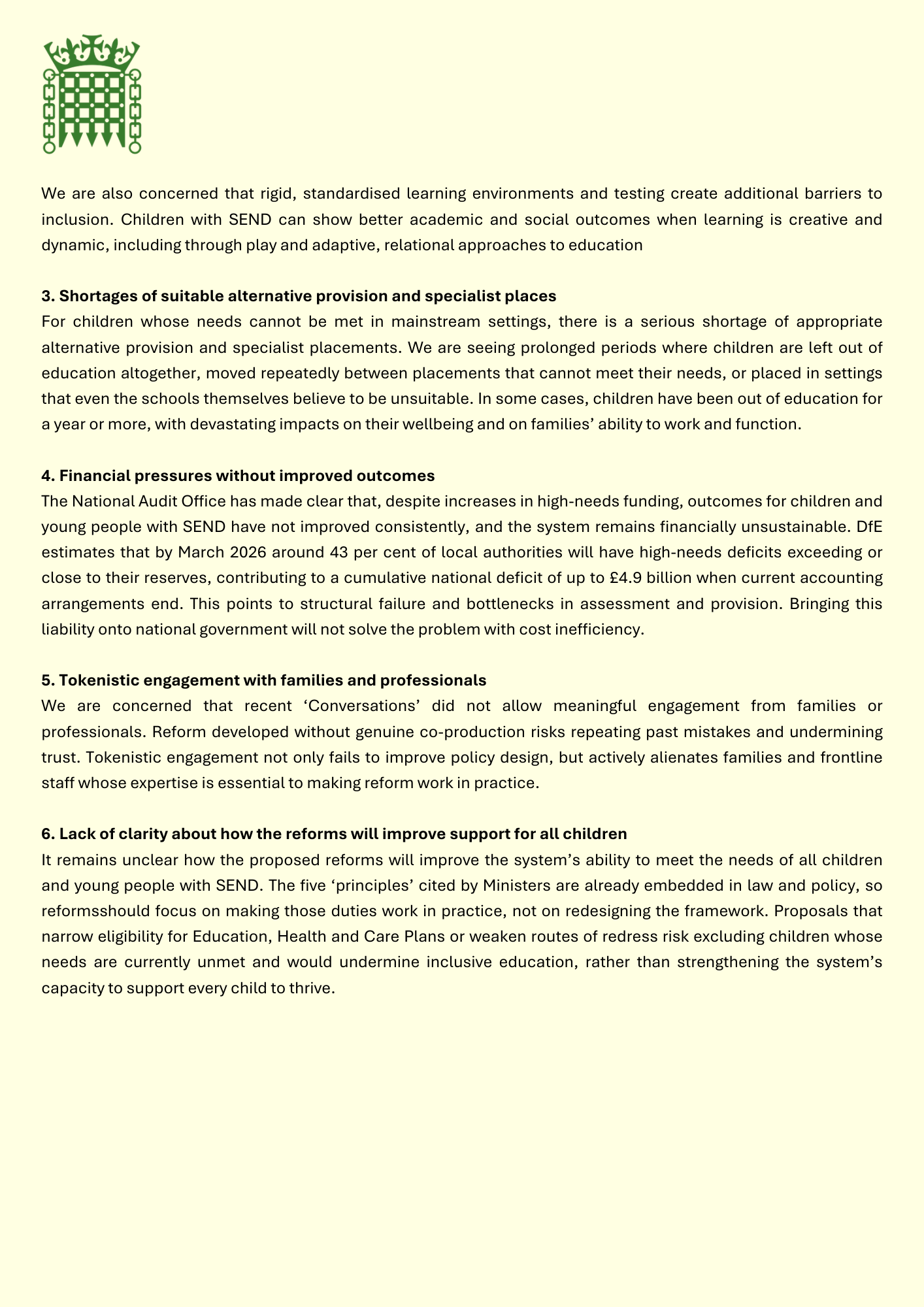
Letter to Secretary of State for Education about the direction of travel on the Government’s proposed reforms to SEND.
-
Adrian Ramsay MP co-signed this letter along with Sian Berry MP, Carla Denyer MP and Dr Ellie Chowns MP.
Dear Bridget,
We are writing to you collectively as the Green Party Members of Parliament to raise concerns about
the direction of travel on the Government’s proposed reforms to the system supporting SEND
provisions ahead of the anticipated White Paper.
This is a critical moment for children, families, and schools. It is vital that the proposed reforms do not
weaken a child’s legal right to an education that meets their needs at a time when the system is failing
to deliver for children and families. The Education Select Committee has been clear that the SEND crisis
stems from failures of delivery, capacity, and resourcing. Earlier intervention and inclusive education
are achievable within current law; weakening rights would worsen inequity and reduce families’ routes
to challenge decisions. Any reforms should seek only to strengthen provision, not dilute statutory
entitlements.
1. Long waits for diagnosis and Education, Health and Care Plans
Families consistently tell us that navigating the SEND system is one of the most distressing experiences
they face, particularly relating to unacceptable delays in diagnosis and in securing EHCPs. These delays
undermine early intervention, exacerbate children’s distress, and have lasting impacts on mental health
and educational outcomes. We are aware of cases where children have been placed in mainstream
settings despite being non-verbal because no specialist language unit places were available, and where
families must privately fund speech and language therapy (SALT) after receiving only one NHS
appointment. In other cases, delays by NHS trusts in assessments have directly prevented children from
accessing EHCPs and the support they need.
2. Insufficient support for inclusive education in mainstream schools
Government data shows that the majority of children with EHCPs are already educated in mainstream
settings. Special schools are for children with the most complex needs and should not be used as default
destinations. Many schools put support in place even before EHCPs are secured, often beyond what
resources allow. Without sufficient capacity, children who could thrive in mainstream settings with
appropriate adjustments can experience exacerbated problems and, in some cases, school avoidance.
There is also growing evidence that inadequate support for children with autism or ADHD/ADD can lead
to long-term mental health harm.
We consistently hear from teachers who are committed to inclusive practice that they lack the staff,
specialist expertise, and funding to meet the diversity of needs in the class. Teachers are operating
under intense and unsustainable pressure, with growing class sizes, rising levels of unmet need, and
insufficient specialist support. Many report expectations to deliver increasingly complex provision with
inadequate resources, contributing to burnout and low retention of teaching staff, and further
exacerbating resource pressures. This is a systemic failure, not a failure of school ethos or staff
commitment.
We are also concerned that rigid, standardised learning environments and testing create additional
barriers to inclusion. Children with SEND can show better academic and social outcomes when learning
is creative and dynamic, including through play and adaptive, relational approaches to education.
3. Shortages of suitable alternative provision and specialist places
For children whose needs cannot be met in mainstream settings, there is a serious shortage of
appropriate alternative provision and specialist placements. We are seeing prolonged periods where
children are left out of education altogether, moved repeatedly between placements that cannot meet
their needs, or placed in settings that even the schools themselves believe to be unsuitable. In some
cases, children have been out of education for a year or more, with devastating impacts on their
wellbeing and on families’ ability to work and function.
4. Financial pressures without improved outcomes
The National Audit Office has made clear that, despite increases in high-needs funding, outcomes for
children and young people with SEND have not improved consistently, and the system remains
financially unsustainable. DfE estimates that by March 2026 around 43 per cent of local authorities will
have high-needs deficits exceeding or close to their reserves, contributing to a cumulative national
deficit of up to £4.9 billion when current accounting arrangements end. This points to structural failure
and bottlenecks in assessment and provision. Bringing this liability onto national government will not
solve the problem with cost inefficiency.
5. Tokenistic engagement with families and professionals
We are concerned that recent ‘Conversations’ did not allow meaningful engagement from families or
professionals. Reform developed without genuine co-production risks repeating past mistakes and
undermining trust. Tokenistic engagement not only fails to improve policy design, but actively alienates
families and frontline staff whose expertise is essential to making reform work in practice.
6. Lack of clarity about how the reforms will improve support for all children
It remains unclear how the proposed reforms will improve the system’s ability to meet the needs of all
children and young people with SEND. The five ‘principles’ cited by Ministers are already embedded in
law and policy, so reforms should focus on making those duties work in practice, not on redesigning the
framework. Proposals that narrow eligibility for Education, Health and Care Plans or weaken routes of
redress risk excluding children whose needs are currently unmet and would undermine inclusive
education, rather than strengthening the system’s capacity to support every child to thrive.
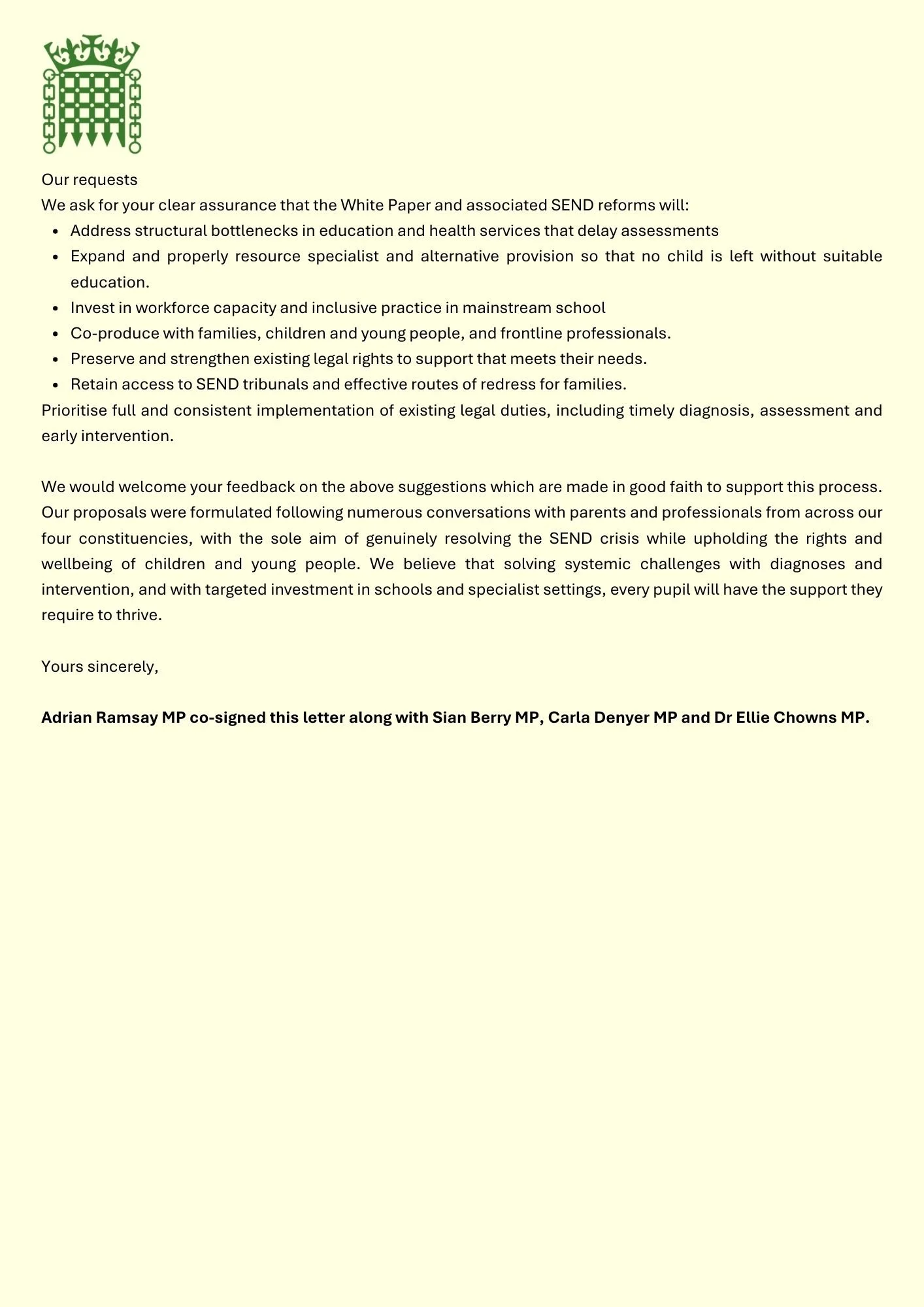
Our requests
We ask for your clear assurance that the White Paper and associated SEND reforms will:
Address structural bottlenecks in education and health services that delay assessments
Expand and properly resource specialist and alternative provision so that no child is left without
suitable education.
Invest in workforce capacity and inclusive practice in mainstream school
Co-produce with families, children and young people, and frontline professionals.
Preserve and strengthen existing legal rights to support that meets their needs.
Retain access to SEND tribunals and effective routes of redress for families.
Prioritise full and consistent implementation of existing legal duties, including timely diagnosis,
assessment and early intervention.
We would welcome your feedback on the above suggestions which are made in good faith to support
this process. Our proposals were formulated following numerous conversations with parents and
professionals from across our four constituencies, with the sole aim of genuinely resolving the SEND
crisis while upholding the rights and wellbeing of children and young people. We believe that solving
systemic challenges with diagnoses and intervention, and with targeted investment in schools and
specialist settings, every pupil will have the support they require to thrive.
Yours sincerely,
Adrian Ramsay MP co-signed this letter along with Sian Berry MP, Carla Denyer MP and Dr Ellie Chowns MP.
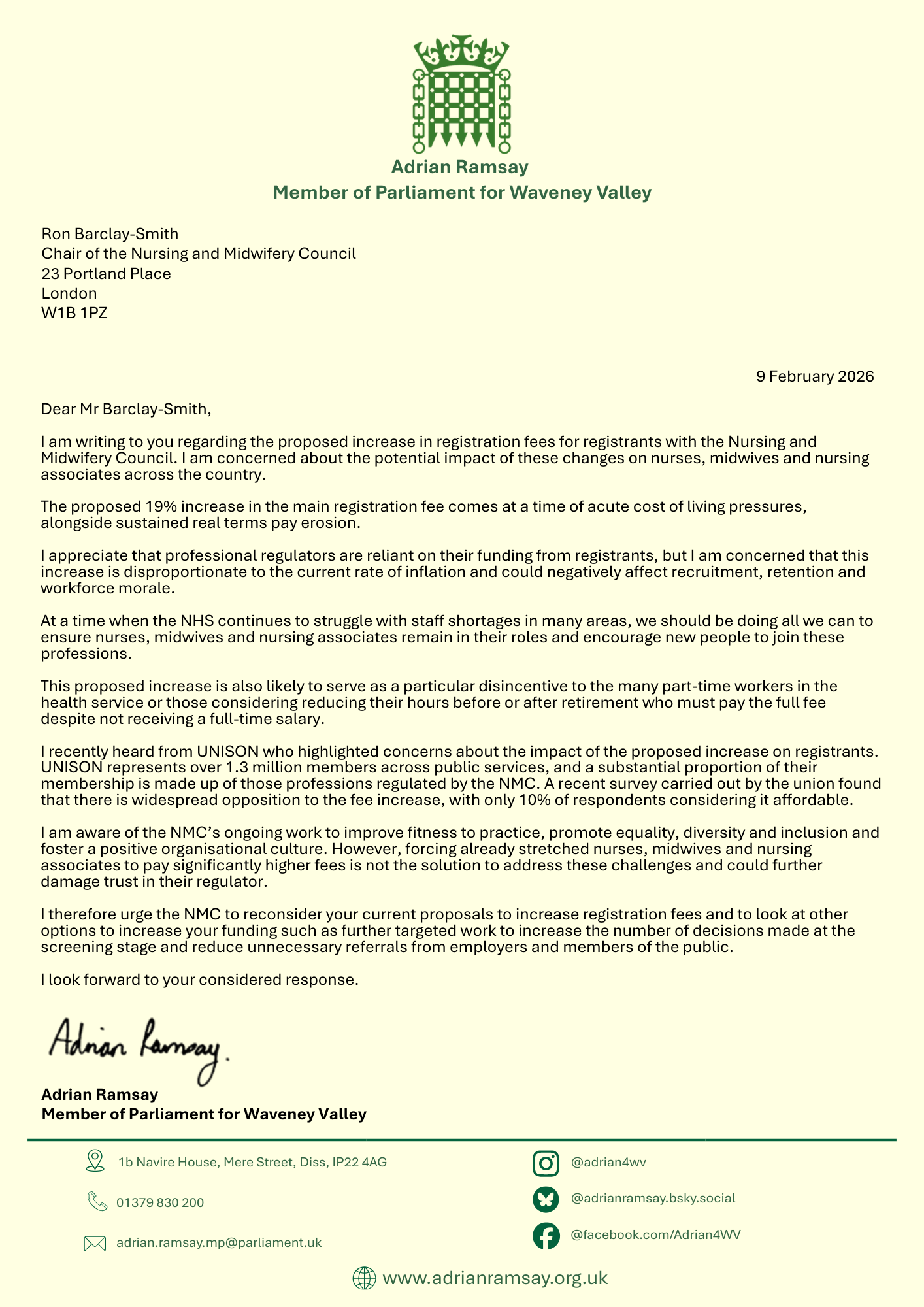
Letter to Chair of the Nursing and Midwifery Council on Government commitments to nursing career progression
-
Ron Barclay-Smith
Chair of the Nursing and Midwifery Council
23 Portland Place
London
W1B 1PZ
Adrian Ramsay MP
House of Commons
London
SW1A 0AA
09.02.26
Dear Mr Barclay-Smith,
I am writing to you regarding the proposed increase in registration fees for registrants with the
Nursing and Midwifery Council. I am concerned about the potential impact of these changes
on nurses, midwives and nursing associates across the country.
The proposed 19% increase in the main registration fee comes at a time of acute cost of living
pressures, alongside sustained real terms pay erosion.
I appreciate that professional regulators are reliant on their funding from registrants, but I am
concerned that this increase is disproportionate to the current rate of inflation and could
negatively affect recruitment, retention and workforce morale.
At a time when the NHS continues to struggle with staff shortages in many areas, we should
be doing all we can to ensure nurses, midwives and nursing associates remain in their roles
and encourage new people to join these professions.
This proposed increase is also likely to serve as a particular disincentive to the many part-time
workers in the health service or those considering reducing their hours before or after
retirement who must pay the full fee despite not receiving a full-time salary.
I recently heard from UNISON who highlighted concerns about the impact of the proposed
increase on registrants. UNISON represents over 1.3 million members across public services,
and a substantial proportion of their membership is made up of those professions regulated
by the NMC. A recent survey carried out by the union found that there is widespread opposition
to the fee increase, with only 10% of respondents considering it affordable.
I am aware of the NMC’s ongoing work to improve fitness to practice, promote equality,
diversity and inclusion and foster a positive organisational culture. However, forcing already
stretched nurses, midwives and nursing associates to pay significantly higher fees is not the
solution to address these challenges and could further damage trust in their regulator.
I therefore urge the NMC to reconsider your current proposals to increase registration fees
and to look at other options to increase your funding such as further targeted work to increase
the number of decisions made at the screening stage and reduce unnecessary referrals from
employers and members of the public.
I look forward to your considered response.
Adrian Ramsay MP
Waveney Valley
Pensions the PHSO Report Response
-
Rt Hon Pat McFadden MP, Secretary of State for Work and Pensions
and Torsten Bell, Minister for Pensions
Department for Work and Pensions
Caxton House, 6-12 Tothill Street,
London
SW1H 9DA
BY EMAIL
6 February 2026
Dear Ministers
Re. Pensions Update 29 January 2026 on the PHSO Report Response
We collectively represent millions of women born in the 1950s and express our grave disappointment that the Government has once again chosen to reject compensation for the 1950s women affected by state pension age changes. This was the wrong decision, but you have the opportunity to put this right.
The Parliamentary and Health Service Ombudsman (PHSO) found that maladministration and injustice had occurred and, as a result, they recommended compensation.
In your Oral Statement on 29 January, you stated "[w]e also agree with the Ombudsman that women did not suffer any direct financial loss from the delay". However, this sadly represents only part of the PHSO's determinations which conclude with recommendations to compensate, not on the basis of ‘direct financial loss’ but on the basis of a ‘lost opportunity’ injustice. This has caused significant concern that the findings and recommendations of the PHSO’s report have not been fully considered in making the decision not to compensate.
To quote the full paragraph directly from their 2024 final report's summary of findings, in the section 'Injustice', page 8, paragraph 12:
"We find that maladministration in DWP’s communication about the 1995 Pensions Act resulted in complainants losing opportunities to make informed decisions about some things and to do some things differently, and diminished their sense of personal autonomy and financial control. We do not find that it resulted in them suffering direct financial loss." (Emphasis ours.)
Then in their consideration of 'Financial loss that is not direct financial loss', p68-69 they state:
"We do not think it is appropriate to quantify losses stemming from lost opportunities to make different choices in the way that we do with direct financial loss.... The sample complainants told us they lost out financially because they made decisions they would not have made if they had known, or known earlier, that their State Pension age had changed. Even if the sample complainants would have made different choices, any financial loss resulting from the choices they made is not direct financial loss. Their loss would flow primarily from the choices they made, for which DWP is not directly responsible or accountable. To decide what is an appropriate amount of compensation in these circumstances we apply our severity of injustice scale... When considering
1
where a ‘lost opportunity’ injustice sits on the scale, we consider the significance of the opportunity that was lost." (Emphasis ours.)
Finally, in their consideration of injustice, section E. 5, page 83, paragraph 459, they state:
"For most sample complainants we consider the primary injustice is that they were denied opportunities to make informed decisions about some things, and to do some things differently, because of maladministration in DWP’s communication about State Pension age. That is a material injustice." (Emphasis ours.)
On the issue of financial remedy they state, at section F.3.1, paragraph 489:
“We have explained our thinking about where on our severity of injustice scale the sample complainants’ injustice sits. We would have recommended they are paid compensation at level 4 of the scale.” (Emphasis ours.)
Then at paragraph 502:
“As a matter of principle, redress should reflect individual impact. But the numbers of people who have potentially suffered injustice because of the maladministration, the need for remedy to be delivered without delay, and the cost and administrative burden of assessing potentially millions of individual women’s circumstances may indicate the need for a more standardised approach. HM Treasury’s ‘Managing Public Money’ requires compensation schemes to be efficient, effective and deliver value for money. It also says the administrative costs associated with compensation schemes should not be excessive." (Emphasis ours.)
And finally at paragraph 503:
“Parliament may want to consider a mechanism for assessing individual claims of injustice. Or it may consider a flat-rate payment would deliver more efficient resolution, recognising that will inevitably mean some women being paid more or less compensation than they otherwise would.” (Emphasis ours.)
As such, the PHSO clearly determined that compensation should be paid on the basis of ‘injustice’ and they advised that Parliament may wish to consider either an individual or flat rate compensation scheme. At no point in the report did they determine that issuing no compensation at all should be an option.
We believe that the PHSO’s advice to Government was clear and ignoring it is not only unprecedented, it also undermines the authority of the Ombudsman and sends a damaging message to the public about how the state responds when it gets things wrong.
Women pensioners have lost their homes and their savings, and their health has been impacted over this matter. The Government have rightly apologised for the wrong; now they need to put that wrong right.
2
We urge you to urgently engage with the impacted women and reconsider this decision again. Yours sincerely,
Rebecca Long-Bailey MP (APPG on State Pension Inequality for Women Co-Chair) Bryn Davies, Lord Davies of Brixton (APPG on State Pension Inequality for Women Co-Chair) Rt Hon Sir Julian Lewis MP (APPG on State Pension Inequality for Women Officer) Liz Jarvis MP (APPG on State Pension Inequality for Women Officer)
Rt Hon Sir John Hayes MP
Abtisam Mohamad MP
Adrian Ramsay MP
Alison Hume MP
Andrew George MP
Andrew Ranger MP
Andy McDonald MP
Ann Davies MP
Anna Dixon MP
Anna Sabine MP
Apsana Begum MP
Beccy Cooper MP
Bell Ribeiro-Addy MP
Ben Lake MP
Brian Leishman MP
Carla Denyer MP
Cat Eccles MP
Cat Smith MP
Chris Hinchliff MP
Chris Webb MP
Clive Lewis MP
Colum Eastwood MP
Douglas McAllister MP
Elaine Stewart MP
Ellie Chowns MP
Emma Lewell MP
Euan Stainbank MP
Graham Leadbitter MP
Grahame Morris MP
Helen Morgan MP
Ian Byrne MP
Ian Lavery MP
Imran Hussain MP
Iqbal Mohamed MP
Rt Hon Jeremy Corbyn MP
Jess Brown-Fuller MP
Jim Allister MP
Jo Platt MP
Jodie Gosling MP
Rt Hon John McDonnell MP
3
John Milne MP
Jon Trickett MP
Jonathan Brash MP
Julia Buckley MP
Kate Osborne MP
Kim Johnson MP
Kirsteen Sullivan MP
Kirsty Blackman MP
Lauren Edwards MP
Lee Barron MP
Lee Dillon MP
Lee Pitcher MP
Lillian Jones MP
Rt Hon Liz Saville Roberts MP
Llinos Medi MP
Lorraine Beavers MP
Manuela Perteghella MP
Mary Foy MP
Mary Glindon MP
Michelle Scrogham MP
Nadia Whittome MP
Navendu MishraMP
Neil Duncan-Jordan MP
Olivia Blake MP
Patricia Ferguson MP
Paula Barker MP
Pete Wishart MP
Peter Dowd MP
Prem Sikka, Lord Sikka
Rachael Maskell MP
Richard Burgon MP
Robin Swann MP
Roz Savage MP
Ruth Jones MP
Sarah Champion MP
Sarah Dyke MP
Sarah Hall MP
Seamus Logan MP
Sian Berry MP
Dr Simon Opher MP
Rt Hon Stephen Flynn MP
Steve Darling MP
Steve Witherden MP
Tom Gordon MP
Rt Hon Valerie Vaz MP
Warinder Juss MP
Wendy Chamberlain MP
Yasmin Qureshi MP
4

Adrian Ramsay MP welcomes today’s news that a new Post Office will open in the Eye this spring
5th of February 2025
Adrian Ramsay MP welcomes today’s news that a new Post Office will open in the Eye this spring, after the previous office closed more than two years ago and left residents without this vital service. District Councillor Lucy Elkin has worked to restore the post office service as soon as possible.
Adrian, speaking after learning the news, said
“I'm delighted that, following a lot of behind-the-scenes work from Green Councillor Lucy Elkin, Eye will soon have a permanent post office, located in a new convenience store. For far too long, residents have been left without this vital service since the previous post office closed over 2 years ago. With no bank in the town, having a post office is crucial for businesses and residents alike. In Parliament, I have been pushing the need for local post offices to be restored, and I congratulate Lucy, who has worked hard to restore the Eye post office service, assisting local postmaster Minesh Patel in finding a suitable location in the town. I wish Minesh, who already runs the post office in Mendlesham, all the best with this new venture and look forward to visiting.”
Government time to debate national security assessment on biodiversity loss, ecosystemcollapse and national security.
-
The Rt. Hon. Emma Reynolds MP
Secretary of State for Environment, Food and Rural Affairs.
Dear Emma,
3 February 2026
Government time to debate national security assessment on biodiversity loss, ecosystem
collapse and national security.
I was pleased to be copied into the Leader of the House of Commons’ letter of 27 January 2026
[AC/IDC1226] drawing your attention to my Business Question about the Government’s recently
published national security assessment, and in particular its stark warning that global
biodiversity loss and ecosystem collapse pose a serious threat to the United Kingdom’s security
and prosperity.
I should be grateful for an update on when we will get the opportunity in Government time to
debate the nature and climate emergency being treated as a major national security priority and
what steps the Government is taking in response to the stark issues raised in the report.
With thanks,
Adrian Ramsay MP

Adrian Ramsay MP visits Burston School and tours new community orchard bug hotel.
2nd of February 2026
Green Party MP for Waveney Valley, Adrian Ramsay, visited Burston Primary School this week, where he spoke at a school assembly and was shown the new bug hotel in the community orchard beside the school.
He was joined at the orchard by Green County Councillor Catherine Rowett, who helped the parish council secure funding for the project, and Vice Chair of the Parish Council Keith Cowley.
After speaking at the assembly, Mr Ramsay met with pupils who proudly showed him the bug hotel they had created to support local wildlife and biodiversity.
Speaking after the visit, Adrian Ramsay MP said,
“I always love speaking at school assemblies across Waveney Valley and the boys and girls in Burston were so enthusiastic about showing me their new bug hotel in the community orchard - a great way to foster their care for nature. It is really great to see the orchard thriving after so much work by the parish council supported by County Councillor Catherine Rowett.
ENDS
Combating Illegal Seafood Imports
-
Adrian Ramsay MP co-signed this cross-party letter initiated by Kerry McCarthy MP & Sarah Champion MP.
Rt Hon Emma Reynolds MP
Secretary of State for Environment, Food and Rural Affairs
2 Marsham Street
London
SW1P 4DF
December 2025
Dear Secretary of State,
We are writing to express our alarm at the findings of the Coalition for Fisheries Transparency’s report, Criminal catches: how to stop the supply of illegal seafood to the UK, and urge the government to take urgent action in response to increase risk-based import controls and fully implement the Charter for Transparency.
The report reveals that seafood linked to illegal, unreported and unregulated (IUU) fishing and severe human rights abuses is entering the UK due to weak enforcement and under utilisation of our import controls. As a result, the public is at real risk of unwittingly purchasing seafood tainted by environmental harm and exploitation, while law-abiding British fishers are forced to compete to sell their produce on a domestic market flooded with cheap,
imported seafood that is at high risk of being illegally-caught.
IUU fishing has devastating impacts on marine ecosystems, it drives the collapse of fish populations, and often involves destructive fishing practices such as shark finning and the targeting of endangered species. It directly undermines global conservation efforts and the long-term sustainability of fish populations that support UK coastal livelihoods and provide a vital source of income and nutrition for billions of people in the Global South. Furthermore, investigations frequently show that where IUU fishing occurs, it is accompanied by human
trafficking, forced, bonded and slave labour.
As covered in The Times and revealed in Criminal catches, more than a quarter of UK seafood imports originate from countries that ranked among the world’s most notorious offenders for illegal fishing, including those that have been formally warned by the European Union (EU) for failing to address IUU fishing in their fleets. China and Russia are consistently among the worst-performing states globally, yet scrutiny of their imports remains far below
levels required to identify and screen out illegal catches. The UK receives around 1,000 catch certificates annually from China – covering roughly 58,000 tonnes of seafood – but only four consignments have been refused since 2012. No Russian catch certificates have been verified or refused since 2021.
Verification checks – a process through which authorities scrutinise catch documentation and request evidence from exporting flag-states to confirm legality – are a critical safeguard and using them frequently sends a clear message that a country wants to protect its market from illegal seafood. Despite this, since Brexit the UK has seen a three-fold decline in verifications – significantly fewer than best practice countries. Spain, for example, carries out more than 18 times as many verifications as the UK, despite historically importing only
around twice the number of catch certificates. Since Brexit, key monitoring and reporting of the UK’s IUU import controls has also ended, meaning we are now effectively blind to the full extent to which these controls are being implemented. Further, we are deeply concerned to learn from the report that Port Health Authorities currently receive no guidance identifying and prioritising high-risk seafood consignments for scrutiny. This lack of advice prevents a coordinated, risk-based approach and hinders the efficient use of their limited resources.
We welcome the government’s recent confirmation of its intention to update the information required in the UK catch certificate next year. It is imperative that these reforms match new data requirements from the EU – improvements that parliamentarians, industry and civil society have long supported. Falling behind the EU in this and other related areas risks the UK becoming Europe’s dumping ground for illegal and slave-caught seafood.
We should also match the EU’s introduction of a digitised catch certificate system, which would speed up processing times, allow for less administrative burden, and aid UK authorities in using a risk-based approach to identify and respond to IUU fishing links in imports. The use of a paper-based system in 2026 is deeply outdated and leaves us vulnerable to seafood fraud.
Crucially, we also urge the UK to require the provision of labour-specific risk information in catch certificates provided by seafood importers to the UK. Information such as the vessel’s time at sea, trans-shipment history, a vessel or captain’s history of prosecutions for labour offences, and whether crew have access to wifi serve as internationally recognised indicators of forced labour, trafficking and other serious abuses of crew. This information, which should already be held or easily accessible to importers, would enable UK authorities to assess the risk that seafood has been produced through both IUU fishing and associated labour abuses, which so often occur side-by-side. It would also encourage importers to conduct more robust supply chain due diligence, while creating a strong incentive to source from vessels and captains with clean records on labour abuses, rather than having to disclose links to unscrupulous operators.
We regard these changes to the UK’s catch documentation as important priorities. However, further strengthening is urgently required to ensure that the UK is not seen as an easy entry point for seafood linked to criminality, environmental destruction and human exploitation.
We therefore urge the government to adopt the full set of recommendations outlined in Criminal catches, including:
Turning the UK’s public support into a timebound commitment to fully implement the Global Charter for Fisheries Transparency.
Implementing a “carding” system based on yellow and red cards to incentivise positive reforms and ensure meaningful consequences for countries failing to act against IUU fishing. UK consumers were protected by such a system before Brexit.
Significantly increasing verification checks – with a clear focus on high-risk consignments – to prevent illegal imports and protect responsible industry.
Implement a risk-based approach to identify consignments for further scrutiny at the border.
Together, these measures would help protect our ocean, support ethical supply chains and level the playing field for responsible UK fishers and businesses that sell seafood on the UK market.
We would welcome a meeting with you or a member of your ministerial team to discuss these findings and how we can work together to support a strengthened UK response.
We look forward to your reply.
Adrian Ramsay MP co-signed this cross-party letter initiated by Kerry McCarthy MP & Sarah Champion MP.