
Green Party MPs’ Response to SEND Reform Consultation
-
The Rt Hon Bridget Phillipson MP
Secretary of State for Education
Dear Bridget,
We are writing as Green Party Members of Parliament in response to the latest consultation
on proposed reforms to the Special Educational Needs and Disabilities (SEND) system.
Every child has the right to dignity, respect and the support they need to develop their full
potential. But the current SEND system is leaving far too many children and young people
unsupported and forcing countless families into a constant struggle just to access the help
their child needs. We therefore welcome the government’s ambitions for educational
reform, including earlier intervention and more inclusive mainstream education.
However, aspiration is not enough. Meaningful reform to the SEND system requires
sustained investment in people, capacity and culture. SEND reform will only succeed in
building a genuinely inclusive education system if the government protects legal rights and
provides urgent clarity on the details of implementation. Above all, the success of these
reforms will depend on whether they are accompanied by a bold workforce strategy that
delivers real staffing support on the ground.
Below, we have set out some specific concerns with the current plan for SEND reform.
Prioritise workforce capacity
The success of any attempt to reform the SEND system will depend on the capacity of the
workforce that delivers it. The number of children with Special Educational Needs continues
to rise rapidly (DfE, 2025), placing increased pressure on already stretched school staff. At
the same time, there are well-documented workforce shortages across the entire SEND
system, with the demand for teaching assistants, specialist staff and educational
psychologists significantly outstripping supply. Recent analysis by the Education Policy
Institute suggests that local authorities (LAs) in England would need to hire 1,400 additional
educational psychologists just to meet current levels of need (EPI, 2026), far exceeding the
extra 200 per year proposed in the government’s current plan. Meanwhile, there is a
longstanding nationwide teacher shortage, particularly in further education colleges, with
high workload and stress driving many staff to leave the profession (DfE, 2025; NAO, 2025).
While proposals such as Experts at Hand and Inclusion Bases have the potential to
significantly strengthen SEND support in mainstream schools, they will require a well-
resourced, highly motivated and appropriately trained workforce with sufficient capacity to
deliver them. As part of its plan for SEND reform, the government must therefore urgently
set out a long-term coherent workforce strategy that addresses the interlinked crises of
recruitment, retention, pay, training, wellbeing and workload.Protect legal rights
Children and young people with SEND must retain strong and enforceable legal rights
to the support they need. We are deeply concerned that the newly proposed
Individual Support Plans (ISPs) will not carry the same statutory duty to deliver the
provision laid out in them as Education, Health and Care Plans (EHCPs), which under
current proposals would be reserved only for children with the most complex needs.
This represents a fundamental shift away from enforceable legal rights towards a
system where support is increasingly at schools’ discretion, with significant
consequences for consistency and equality of provision.
While we welcome efforts to provide support for a wider group of pupils, this must
not come at the expense of accountability for those pupils. We echo the Education
Committee’s warning that “SEND reforms must not be based on any withdrawal of
statutory entitlements for children and young people” (Education Committee, 2025).
Watering down legal protections risks undermining parental confidence and
weakening families’ ability to secure appropriate support for their children.
We are particularly concerned that these changes may disproportionately affect
those least able to advocate for themselves within the system. The new ISPs must
therefore be supported by a clear statutory duty to deliver the provision they
specify, and it is vital that families retain a robust right of appeal.
We are also concerned that where legal duties do exist, structural bottlenecks across
education and health services mean that they will continue to be inconsistently
implemented. The principles set out in this plan must therefore be accompanied by
more detailed operational plans for ensuring compliance and delivery, including
timely assessments, diagnosis and early intervention.
‘Complex needs’ and EHCPs
The government’s current plan for SEND reform would restrict access to EHCPs and
highly specialised provision to those with ‘complex needs.
’ We are concerned that the
meaning of this term is not currently clear enough to enable adequate scrutiny or
confidence.
At present, there is no definition of what constitutes ‘complex needs,
’ nor how
decisions will be made about who qualifies for specialist support. The current plan
suggests that forthcoming need profiles within ‘Specialist Provision Packages’ will
define complex needs going forward. But the draft outline of Specialist Provision
Packages simply raises further questions about how these will work, particularly since
some children may require elements of support from multiple packages. Without
detailed examples and transparent criteria, there is a significant risk of inconsistency,
exclusion and increased local disputes.This lack of clarity also makes it difficult for families, schools, teachers and indeed
Parliament to adequately assess the likely impact of the reforms. The government must
urgently publish detailed guidance on who will qualify for EHCPs and Specialist Provision
Packages, including worked case studies. Clear definitions and operational detail are
essential to ensure the system is fair, consistent and trusted by families.
Culture change and co-production
Progress towards greater inclusion must be driven as much by culture and practice as by
structural reform. Too many children and young people continue to face barriers created
by inflexible behaviour policies, limited understanding of neurodiversity and
environments that do not meet their sensory needs. Without addressing these issues,
changes to systems and funding will have limited impact in the classroom.
We therefore welcome the proposed investment in new guidance, National Inclusion
Standards and SEND training for all staff in schools, colleges and early years settings. This
must include evidence-based guidance on how to design accessible and inclusive sensory
environments and how to embed inclusive practice in behaviour and classroom
management policies. It is essential that this guidance and the National Inclusion
Standards are genuinely co-produced. Tokenistic engagement and consultation are not
enough: the government needs to ensure that children and young people with SEND,
alongside their parents, carers and educators, are treated as equal partners in the design,
delivery and evaluation of SEND policy at every level. Lived experience must not be an
afterthought but a guiding principle of the system.
Special school capacity
While we support the government’s ambition to make mainstream education more
inclusive, this must be accompanied by a sufficient supply of special school places for
those children and young people whose needs cannot be met in mainstream settings. At
present, many areas face acute shortages of special school places and around two thirds
of special schools are at or over capacity (DfE, 2026), leaving families without appropriate
local provision. Increasing specialist support within mainstream, including through
Specialist Bases, will help to reduce reliance on special school placements. However, even
with these improvements in mainstream settings, demand for special school places is
likely to continue to outstrip capacity in some places, especially in the short term.
We are concerned that a rigid national push towards mainstream inclusion risks
overlooking this reality and failing those children for whom mainstream settings are not
suitable. Provision must be flexible, locally planned and responsive to need, rather than
driven by a one-size-fits-all national model.Tackle profiteering
At present, exploitative private companies are profiting from the SEND crisis by buying up
special schools and services and charging excessively high placement fees to LAs,
exacerbating an already unsustainable situation. Urgent action is desperately needed to
address this blatant profiteering.
While the government’s proposal to introduce national funding bands for independent
special school placements is a welcome step in the right direction, the current plans are
lacking in detail on what constitutes a “reasonable price” or how these bands will be set.
Without such clarity, it is difficult to be confident that these measures will meaningfully
curb excessive costs or protect public funds. We urge the government to be bold:
independent providers must not be allowed to continue charging, on average, more than
double the cost of state-funded special school provision (NAO, 2024).
Alongside stronger regulation and scrutiny of the independent sector, there must be a
rapid expansion of state-funded special school capacity to reduce reliance on
independent special schools. While the current plan for SEND reform proposes a total
£3.7 billion of capital investment, we are concerned by the lack of detail concerning how
much of this money will be invested in new special school capacity and how many new
state-funded special school places will be created. To ensure that special school provision
does not become increasingly dominated by the private sector, the government must
urgently proceed with building the state-funded special schools that are currently
planned for construction.
LAs must also be empowered with streamlined access to funding for increasing state-
funded special school capacity. We are concerned that requiring LAs to provide detailed
justification for using SEND payments to invest in new special school places instead of
mainstream settings will only create unnecessary delays. The government should trust
councils to exercise local democratic oversight and make data-led decisions based on the
local situation.
Reform admissions
Narrow attainment-focused performance pressures are currently disincentivising some
schools from admitting or retaining pupils with SEND. This is exacerbating inequities in
access and requires urgent government intervention. In a recent survey, 41% of senior
school leaders reported that some local schools actively discourage applications from
children and young people with SEND (Sutton Trust, 2026). The gap in access to high-
performing schools is especially large for children with SEND who are eligible for Free
School Meals and do not have an EHCP , with top schools taking in around 36% fewer
pupils in this category than live locally (Sutton Trust, 2026).We are concerned that the current proposals for SEND reform do not do enough to
strengthen fair admissions or ensure genuine accountability across all types of school,
including academies, faith schools and free schools. Restricting access to EHCPs risks
weakening accountability in admissions even further, since EHCPs are currently one of the
main mechanisms by which LAs can direct a maintained school to admit a child or young
person with SEND.
LAs must be given stronger levers to ensure equitable access across all state-funded
schools. They should have the ability to direct placements for children with ISPs as well as
EHCPs, including at academies, faith schools and free schools where necessary.
Accountability and performance frameworks for schools must also be rebalanced so that
inclusion and wellbeing metrics are treated as equal in importance to academic
outcomes, not as secondary considerations. We desperately need a new approach that
moves away from the current high-stakes testing and exam-driven accountability culture,
which incentivises exclusion and indirect selection, towards a broader, child-centred
assessment system.
We urge the government to match its ambitions with decisive action by safeguarding legal
rights, investing in workforce and school capacity and delivering a transparent,
accountable SEND system that meets the needs of every child and family it is meant to
serve. We would welcome the opportunity to discuss these proposals further with your
Department.
Yours sincerely,
Adrian Ramsay MP , Waveney Valley
Dr Ellie Chowns MP , North Herefordshire
Siân Berry MP , Brighton Pavilion
Carla Denyer MP , Bristol Central
Hannah Spencer MP , Gorton & Denton
Green Party Members of Parliament
Letter to Secretary of State for Education about the direction of travel on the Government’s proposed reforms to SEND.
-
Adrian Ramsay MP co-signed this letter along with Sian Berry MP, Carla Denyer MP and Dr Ellie Chowns MP.
Dear Bridget,
We are writing to you collectively as the Green Party Members of Parliament to raise concerns about
the direction of travel on the Government’s proposed reforms to the system supporting SEND
provisions ahead of the anticipated White Paper.
This is a critical moment for children, families, and schools. It is vital that the proposed reforms do not
weaken a child’s legal right to an education that meets their needs at a time when the system is failing
to deliver for children and families. The Education Select Committee has been clear that the SEND crisis
stems from failures of delivery, capacity, and resourcing. Earlier intervention and inclusive education
are achievable within current law; weakening rights would worsen inequity and reduce families’ routes
to challenge decisions. Any reforms should seek only to strengthen provision, not dilute statutory
entitlements.
1. Long waits for diagnosis and Education, Health and Care Plans
Families consistently tell us that navigating the SEND system is one of the most distressing experiences
they face, particularly relating to unacceptable delays in diagnosis and in securing EHCPs. These delays
undermine early intervention, exacerbate children’s distress, and have lasting impacts on mental health
and educational outcomes. We are aware of cases where children have been placed in mainstream
settings despite being non-verbal because no specialist language unit places were available, and where
families must privately fund speech and language therapy (SALT) after receiving only one NHS
appointment. In other cases, delays by NHS trusts in assessments have directly prevented children from
accessing EHCPs and the support they need.
2. Insufficient support for inclusive education in mainstream schools
Government data shows that the majority of children with EHCPs are already educated in mainstream
settings. Special schools are for children with the most complex needs and should not be used as default
destinations. Many schools put support in place even before EHCPs are secured, often beyond what
resources allow. Without sufficient capacity, children who could thrive in mainstream settings with
appropriate adjustments can experience exacerbated problems and, in some cases, school avoidance.
There is also growing evidence that inadequate support for children with autism or ADHD/ADD can lead
to long-term mental health harm.
We consistently hear from teachers who are committed to inclusive practice that they lack the staff,
specialist expertise, and funding to meet the diversity of needs in the class. Teachers are operating
under intense and unsustainable pressure, with growing class sizes, rising levels of unmet need, and
insufficient specialist support. Many report expectations to deliver increasingly complex provision with
inadequate resources, contributing to burnout and low retention of teaching staff, and further
exacerbating resource pressures. This is a systemic failure, not a failure of school ethos or staff
commitment.
We are also concerned that rigid, standardised learning environments and testing create additional
barriers to inclusion. Children with SEND can show better academic and social outcomes when learning
is creative and dynamic, including through play and adaptive, relational approaches to education.
3. Shortages of suitable alternative provision and specialist places
For children whose needs cannot be met in mainstream settings, there is a serious shortage of
appropriate alternative provision and specialist placements. We are seeing prolonged periods where
children are left out of education altogether, moved repeatedly between placements that cannot meet
their needs, or placed in settings that even the schools themselves believe to be unsuitable. In some
cases, children have been out of education for a year or more, with devastating impacts on their
wellbeing and on families’ ability to work and function.
4. Financial pressures without improved outcomes
The National Audit Office has made clear that, despite increases in high-needs funding, outcomes for
children and young people with SEND have not improved consistently, and the system remains
financially unsustainable. DfE estimates that by March 2026 around 43 per cent of local authorities will
have high-needs deficits exceeding or close to their reserves, contributing to a cumulative national
deficit of up to £4.9 billion when current accounting arrangements end. This points to structural failure
and bottlenecks in assessment and provision. Bringing this liability onto national government will not
solve the problem with cost inefficiency.
5. Tokenistic engagement with families and professionals
We are concerned that recent ‘Conversations’ did not allow meaningful engagement from families or
professionals. Reform developed without genuine co-production risks repeating past mistakes and
undermining trust. Tokenistic engagement not only fails to improve policy design, but actively alienates
families and frontline staff whose expertise is essential to making reform work in practice.
6. Lack of clarity about how the reforms will improve support for all children
It remains unclear how the proposed reforms will improve the system’s ability to meet the needs of all
children and young people with SEND. The five ‘principles’ cited by Ministers are already embedded in
law and policy, so reforms should focus on making those duties work in practice, not on redesigning the
framework. Proposals that narrow eligibility for Education, Health and Care Plans or weaken routes of
redress risk excluding children whose needs are currently unmet and would undermine inclusive
education, rather than strengthening the system’s capacity to support every child to thrive.
Our requests
We ask for your clear assurance that the White Paper and associated SEND reforms will:
Address structural bottlenecks in education and health services that delay assessments
Expand and properly resource specialist and alternative provision so that no child is left without
suitable education.
Invest in workforce capacity and inclusive practice in mainstream school
Co-produce with families, children and young people, and frontline professionals.
Preserve and strengthen existing legal rights to support that meets their needs.
Retain access to SEND tribunals and effective routes of redress for families.
Prioritise full and consistent implementation of existing legal duties, including timely diagnosis,
assessment and early intervention.
We would welcome your feedback on the above suggestions which are made in good faith to support
this process. Our proposals were formulated following numerous conversations with parents and
professionals from across our four constituencies, with the sole aim of genuinely resolving the SEND
crisis while upholding the rights and wellbeing of children and young people. We believe that solving
systemic challenges with diagnoses and intervention, and with targeted investment in schools and
specialist settings, every pupil will have the support they require to thrive.
Yours sincerely,
Adrian Ramsay MP co-signed this letter along with Sian Berry MP, Carla Denyer MP and Dr Ellie Chowns MP.
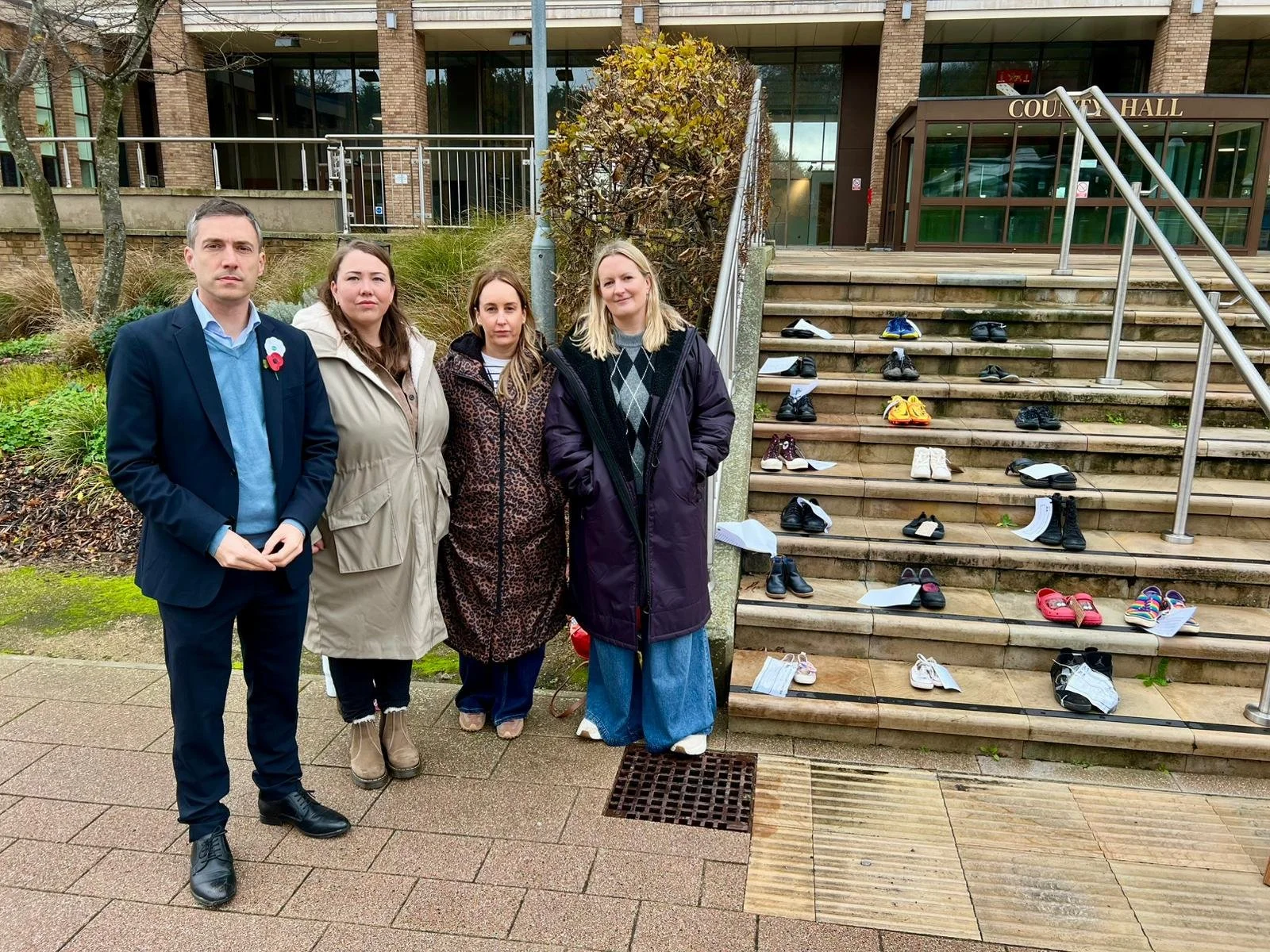
Every Pair Tells a Story: The Human Cost of a Broken SEND System
10th of November 2025
Recently, I joined parents and campaigners outside Norfolk County Hall for “Every Pair Tells a Story.” The steps of County Hall were lined with rows of empty shoes, each pair representing a child who has been failed by the Special Educational Needs and Disabilities (SEND) system. It was a powerful sight, both moving and enraging. Behind each set of shoes was a story of a family pushed to the edge by a system that has promised help, only to deliver delay and bureaucracy.
Standing there, surrounded by those empty shoes, I felt a mix of grief and rage at how badly these children have been let down. The SEND crisis is not new. It is not unforeseen. It has been warned about for years, reported on repeatedly. Yet still, children are waiting months or even years for assessments. Schools are still expected to cope with too little funding and too few resources. Still, parents are forced into legal battles to secure the basic support their child is entitled to by law.
Every one of those shoes told a story that should send a powerful message to those in power. A story of a child denied an Education, Health and Care Plan because of a stretched budget. A story of a pupil struggling without the proper support, then ending up out of school. A story of parents taking time off work, fighting bureaucracy to get their child what the system is supposed to provide. These are not statistics. They are children. And they deserve better.
Like many MPs, children who have been let down by the SEND system form a big part of my caseload, and I do everything I can to advocate for them. But the truth is that there are major systemic issues that need addressing in order for the situation to change.
What makes this situation so maddening is that the failures are systemic, predictable, and could be resolved with genuine political will. Successive governments have known for years that SEND provision is collapsing under the weight of rising demand and inadequate funding. Councils like Norfolk and Suffolk have pleaded for fairer settlements and better guidance, while schools juggle impossible workloads and overstretched budgets. The result is a system built on goodwill and desperation, where families are expected to do the heavy lifting while ministers debate policy papers and budgets.
The anger among parents is not misplaced. They are not asking for special treatment. All they are asking is that the system meet its legal responsibilities. The Children and Families Act 2014 was supposed to guarantee that children with additional needs would receive coordinated, timely, and appropriate support. More than a decade later, for many, those guarantees exist only on paper. Families are left chasing paperwork, fighting for appeals, and explaining their child’s condition again and again to a carousel of professionals who often lack the resources or authority to act.
It is time for the Government at all levels to stop making excuses and start delivering change. This means urgent investment in early intervention, proper funding for Education, Health and Care Plans, and genuine accountability when councils fail to meet their legal duties. It means ensuring schools have the specialist staff and resources to meet children’s needs and that teachers receive the support and training needed to enable far more children to thrive in mainstream schools. And for those children for whom a mainstream school is not the right setting, we need adequate spaces in alternative provision schools. At its core, we need a system that treats parents as partners, not adversaries, and children as real people whose right to proper support is non-negotiable.
Norfolk and Suffolk’s children deserve better than being represented by empty shoes on cold concrete. They deserve classrooms that welcome them, schools that have the resources to help them, and councils that see them as individuals rather than numbers on a spreadsheet. I will keep pressing both the Government and county councils to deliver the reforms and funding that are long overdue.
Every Pair Tells a Story
3rd of November 2025
I was pleased to stand with families at Every Pair Tells a Story outside Norfolk County Hall this morning. Seeing those empty shoes lined up was infuriating, because each one represents a child who has been failed by a system that should protect and support them. We cannot allow these stories to continue. Norfolk and Suffolk's children deserve better, and I will keep pressing both the government and our County Councils to deliver the changes needed to ensure every child gets the support and school place they need.
Letter to the Secretary of State for Education on school funding
-
The Right Honourable Bridget Phillipson MP
Secretary of State for Education
Department for Education
Sanctuary Buildings
Great Smith Street
London
SW1P 3BTOur Ref: AR03094
23 April 2025
Dear Secretary of State,
I am writing to express my concerns about the inadequate level of funding available for schools in my constituency. I request that the Government explores options to increase that funding and to ensure that pupils in my constituency are able to access the education that they need and deserve. I would particularly like to highlight the following issues which are particularly affecting rural schools in Norfolk and Suffolk.
Real-Term Budget Reductions:
Ongoing economic challenges and rising inflation have increased operational costs, while funding has not kept pace. Schools are struggling to maintain the same level of educational provision with reduced resources. While national pay rises for staff are to be welcomed, the fact that they have been only partly funded by government is putting further pressure on school budgets, resulting in a reduced staffing model, larger class sizes, and diminished support for students. Schools are facing difficult decisionsabout staffing levels, redundancies, and service reductions along with the concomitant impact on staff wellbeing and morale.
Lack of Capital Spending on Physical Infrastructure:
School buildings are increasingly difficult to maintain as they age. They require substantial maintenance and repair, but there is insufficient capital investment to address these needs. I am aware of one school which has a leaking science block roof. This has been a health and safety risk while negatively impacting lesson delivery and student morale. Additionally, rising energy costs are placing further strain on school budgets and aging heating systems are leaving pupils cold during some lessons. Adequate funding for critical maintenance and repairs is essential to ensure that students can learn in a safe, secure, and comfortable environment.
Insufficient SEND funding:
Schools have seen a significant rise in the number of students with special educational needs, but the funding allocated for SEND support has not kept pace with the growing demand. This shortfall hinders the ability of a school to provide appropriate staffing, resources, and specialized interventions. Without sufficient funding, schools in rural areas like the Waveney Valley struggle to secure the expertise and support that every child with SEND deserves.
Reduction of Support Services and Increased Waiting Times:
Vulnerable students requiring support services such as CAMHS and SEN assessments are facing extended waiting times, negatively impacting their education and well-being. Meanwhile, the number of students requiring Education, Health, and Care Plans (EHCPs) has risen, but funding for SEND support has not increased accordingly. Local authorities are struggling to meet their statutory obligations, leaving schools to supplement inadequate SEND funding from their core budgets, which is simply not sustainable. While the focus is rightly on supporting children to be in mainstream schools as far as possible, this situation is compounded by a lack of alternative provision for those students for whom the traditional classroom environment is not beneficial.
In summary, schools in Waveney Valley need increased capital funding to repair and upgrade their aging buildings, additional SEND funding and specialized support services so that all learners, regardless of their needs, have fair access to education, and improved alternative provision. Meanwhile, core budgets for staffing and operational costs need to be protected to ensure that the basic needs of pupils can be met.
I hope you will consider these points carefully and expand funding for rural schools.
Yours sincerely,
Adrian Ramsay MP
Member of Parliament for Waveney Valley

The crisis in SEND provision in East Anglia
In my constituency surgeries, I meet people who are often at the end of their tether and have reached out to me because they don’t know where else to turn. Many of their stories are heart-rending and some of the most powerful, and most frequent, are the ones from parents who have children with special educational needs or disabilities (SEND). When they turn to the “system” for help, they often find they’re on their own.
In my constituency surgeries, I meet people who are often at the end of their tether and have reached out to me because they don’t know where else to turn.
Many of their stories are heart-rending and some of the most powerful, and most frequent, are the ones from parents who have children with special educational needs or disabilities (SEND). When they turn to the “system” for help, they often find they’re on their own.
Let me tell you about one parent. Her young child has what’s known as an EHCP, a document which sets out the educational, health and care plan the child needs because of their disabilities or a long-term illness. Her child couldn’t go to a mainstream primary school after leaving nursery but there were no places available at special needs schools. After a long period at home, the family were told there wouldn’t be a place until 2025.
Her son desperately missed being with other children and his mum had had to give up work for care for him. The lack of a special school place put enormous stress on other members of the family. Trying to navigate the system was bad enough, she said, but even worse was the “not knowing” and feeling that when she reached out for support, there was almost none there.
Even an educational psychologist who is used to navigating the relevant systems told me she struggled to get a place for her child in a suitable school and when one was offered, it was many miles from her home in a rural village.
It’s common for families to wait two years or more for an assessment of their child’s needs, whatever their age even though, by law, the process is supposed to take no more than 20 weeks. And specialist services can only be accessed once the child has been assessed and issued with that all-important EHCP which can take another year.
While the family are waiting, over-stretched teachers are struggling to support a child who has complex needs but they can’t get specialist services to help them because there isn’t yet an EHCP.
Families who are struggling are at the sharp end of this crisis. And the need is rocketing. Many of my fellow Norfolk and Suffolk MPs tell me they’re also seeing a huge caseload of SEND cases. Along with many of them, I spoke in a debate at Westminster last week about SEND provision in the East of England. And that was the eleventh debate on SEND education in Parliament just this year. That is how critical this issue has become.
I know from my discussions with Suffolk County Council leaders that they are worried about the sharp increase in cases involving children with special needs and disabilities. They’ve gone up by over 60 percent in the last two years, putting huge pressure on resources.
Norfolk County Council is spending nearly £50 million a year taking pupils with special educational needs to school, inside and outside the county. That’s not money for their education, it’s just for getting the children to school, often travelling quite long distances.
An Ofsted report late last year into Suffolk’s SEND provision said children got “lost in the system and (fell) through the cracks.” That’s certainly been the experience of some of my constituents. Six months after that Ofsted report, and despite Suffolk saying they’d find the money to turn around the service, parents were still saying the Council wasn’t acting on their concerns or dealing with their complaints.
The head of Suffolk’s SEND services highlight that they need more staff to help it improve, particularly more education psychologists who can assess a child’s needs. Speeding up the assessment process is vital.
But we also need more places for special needs children in our area, either in specialist schools or units within mainstream schools. And the system needs to be streamlined so parents find it much easier to navigate.
The Government is promising extra funding for special education, with about £13 million going to local authorities in the East of England. I hope there will be funding too for better access to mental health and other support, whether that’s for speech and language delay or ADHD.
Parents should have confidence that government and local authorities are there for them and able to provide the services their children need. They don’t feel that at the moment, and that has to change.
Adrian Ramsay MP