
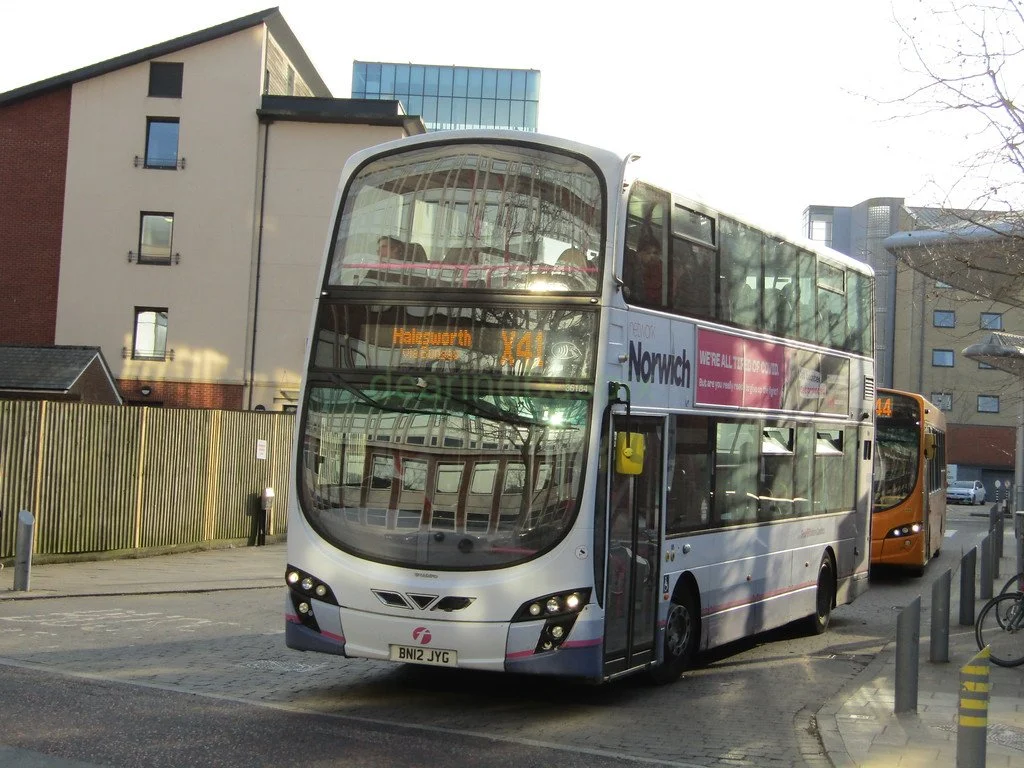
Adrian Ramsay MP demands Reform restore funding for rural buses as X41 service is cut back
Adrian Ramsay, Green Party MP for Waveney Valley, is calling on Reform to provide the funding needed to keep rural bus services running, after it was annouced that the X41 will have a reduced service between Halesworth, Bungay and Norwich.
The X41 now runs only once an hour, and journeys are taking longer. Adrian and Peter Ianno, the Green County Councillor for Bungay, say the change is having a huge impact on people in Bungay, Halesworth and the surrounding area, with residents contacting both of them in large numbers to complain.
Adrian has requested a meeting with the Reform cabinet member to discuss the X41's timetable and funding.
Adrian Ramsay MP said:
"Rural buses are a lifeline. They get people to work, to appointments and to see family, and for many they are the only way to do it. Reform are refusing to provide the funding needed to keep the X41 going, and people in Bungay, Halesworth and the surrounding area are paying the price.
"Cutting rural buses cuts people off from jobs, healthcare and each other. I will keep pressing Reform to provide the funding our crucial local bus services need, and I will keep standing up for residents until this service is protected."
ENDS
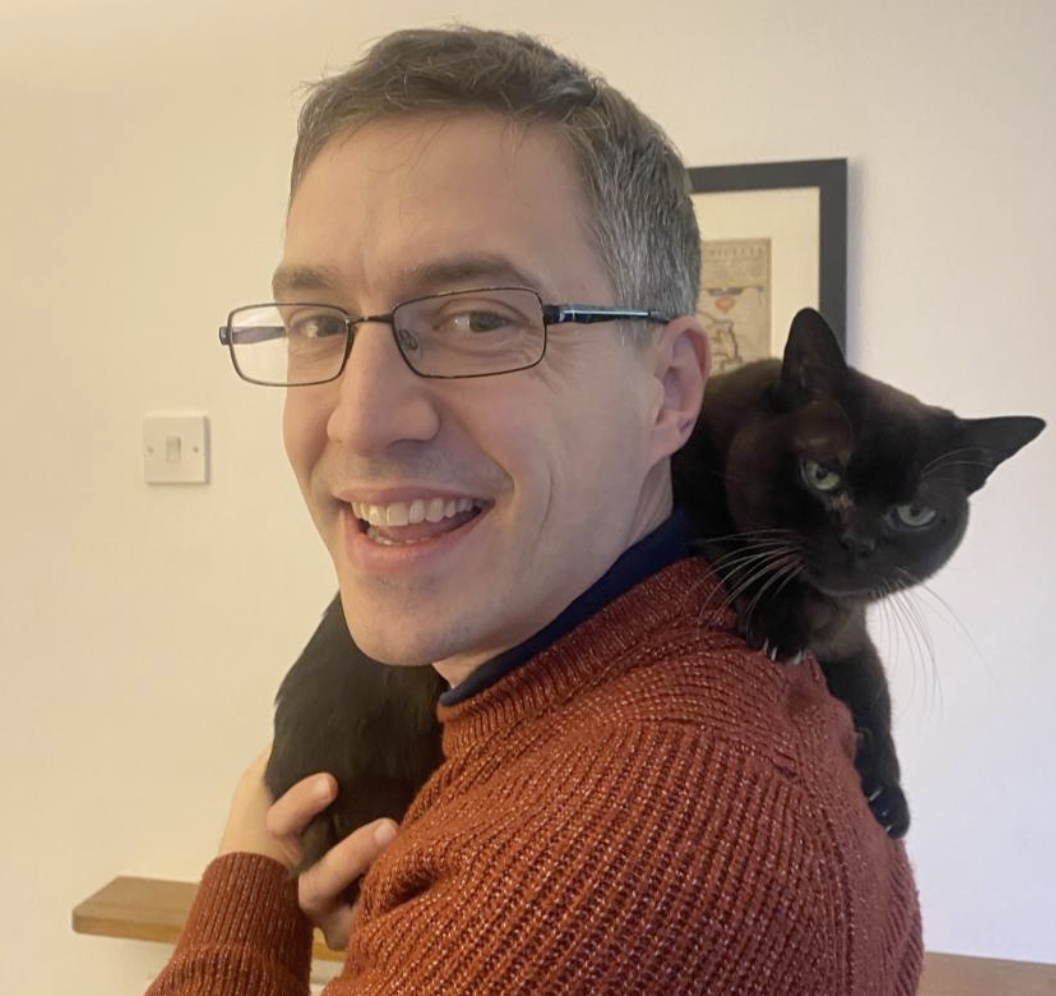
Adrian Ramsay MP's cat Bella crowned Purr Minister of 2026
Adrian Ramsay MP for Waveney Valley is delighted that his beloved cat Bella has won the public vote for Purr Minister of the Year.
Welcoming the victory and reinforcing his work on animal protection, Adrian said:
“I'm delighted that the real boss of our house, Bella, has been crowned Purr Minister of the United Kingdom. I'm very proud of her! Battersea does vital work on behalf of cats nationwide, helping to highlight the welfare challenges cats face and the action needed to keep them safe and healthy.”
Adrian continued by saying, “We are a nation of animal lovers, and I am proud to play a leading role in championing animal issues in Parliament. Animal protection isn’t a side issue. It is fundamental to the kind of country we want to be, and the public rightly expects us to act.”
“That is why it is vital that this Government fully implements the commitments in the Animal Welfare Strategy published last December. Ministers must set clear timescales to phase out confined systems in factory farms like crates and cages, properly support farmers through the transition, and ensure imports meet the same standards we expect of our own farmers. Warm words in a strategy document mean nothing without delivery, and animals deserve action not more delay.”
ENDS
Notes to editors:
Through Purr Minister, Battersea aims to encourage policymakers and the public alike to consider the welfare challenges facing cats today and the actions needed to help keep them safe and healthy.
For those inspired by Bella's success, Battersea encourages prospective owners to consider adopting a rescue cat and helping more animals find the loving homes they deserve. For more information about Purr Minister 2026, and to read Bella's winning 'Manifursto', visit: https://www.battersea.org.uk/about-us/news/purr-minister
Adrian has a long-standing record on animal welfare. In December 2025, he coordinated a cross-party letter, signed by over 35 Parliamentarians, urging the Government to ensure the forthcoming Animal Welfare Strategy included a time-bound phase-out of all confinement cages and crates in UK farming, alongside a fully-funded package to support farmers through the transition. At the time, Adrian said: "We often say the UK leads the world on animal welfare, yet millions of animals remain confined in awful conditions that many other European countries have already moved away from. As a nation that prides itself on caring for animals, it is unacceptable that these cruel practices continue."
When the Government's Animal Welfare Strategy was published, Adrian welcomed it but warned it "must have real teeth to deliver meaningful improvements for animals," calling for clear timescales to phase out crates and cages, proper support for farmers through the transition, and no imports that fail to meet UK standards. He also welcomed action on snares, hunting and puppy farming, while calling for the strategy to go further, including by ending greyhound racing, as the Welsh Government is doing.
Picture of Adrian & Bella can be found it at this link https://drive.google.com/file/d/1wyrPZdxsWLfMM39hVRMUsV7yRK3WN-f8/view?usp=sharing.
Press release from Battersea in case you did not receive it.
Battersea is delighted to announce that Bella, the beloved cat of Waveney Valley MP Adrian Ramsay, has been elected Purr Minister 2026.
After weeks of campaigning and public voting, 14-year-old Bella secured 36 per cent of the public vote, triumphing over three fellow feline candidates to become Westminster's top cat for 2026.
Bella won over voters with the promise of sweeping reforms - such as a ban on visible bowl bottoms and the introduction of a tuna-based economy - positioning herself as the candidate determined to tackle the issues that matter most to cats. Her vision of a future built on sunlight, full bowls, warm
keyboards and obedient humans clearly struck a chord with the electorate, landing her the title of Purr Minister 2026.
Battersea's much-loved Purr Minister competition continues to celebrate the unique role cats play in our lives while raising awareness of important cat welfare issues. Since launching in 2014, the contest has seen parliamentary cats from across Westminster compete for the prestigious title.
Adrian Ramsay, Waveney Walley MP and proud owner of Bella said: “Bella is greatly looking forward to devoting all of her 1.5 waking hours per day - when she isn’t eating, hunting spiders or grooming – to serving the cats of the United Kingdom and advancing the battle for full feline dominance and
sovereignty.”
Bella's victory comes as Battersea continues to campaign on behalf of cats nationwide. While microchipping became compulsory for pet cats in England in 2024, Battersea's latest research found that more than one in five cats still do not have a microchip, highlighting the ongoing need to raise awareness among owners. Through Purr Minister, Battersea aims to encourage policymakers and the public alike to consider the welfare challenges facing cats today and the actions needed to help keep them safe and healthy.
For those inspired by Bella's success, Battersea encourages prospective owners to consider adopting a rescue cat and helping more animals find the loving homes they deserve.

Bungay illustrates "biggest problem" with rural banking access, says Adrian Ramsay MP
Speaking in a parliamentary debate on access to face-to-face banking, Adrian Ramsay MP for Waveney Valley highlighted the market town of Bungay as an example of the collapse of banking services in rural communities.
“Bungay once had branches of HSBC, Barclays, NatWest and Lloyds. All four have now closed.
Mr Ramsay told the Commons that Link, the body responsible for assessing community access to cash, had says that Bungay does not qualify for a banking hub because cash facilities remain available in the town. He said: "Access to cash is not the same as access to banking and the personalised support that staffed branches or banking hubs provide."
He also challenged Link's reasoning that a hub would not be granted for Bungay because one already exists in nearby Harleston, saying: "In rural communities, getting from one market town to another is not always easy."
Mr Ramsay pressed the Minister to review the criteria used to assess eligibility for banking hubs, asking: "Will she look at whether communities such as Bungay can qualify for banking hubs where there's a clear demand for face-to-face services, even if cash withdrawals are accessible?"
ENDS
Link to the intervention
https://parliamentlive.tv/Download/Index/b72c2f12-ac6f-4e8d-924e-6bcc0ebb6fa0
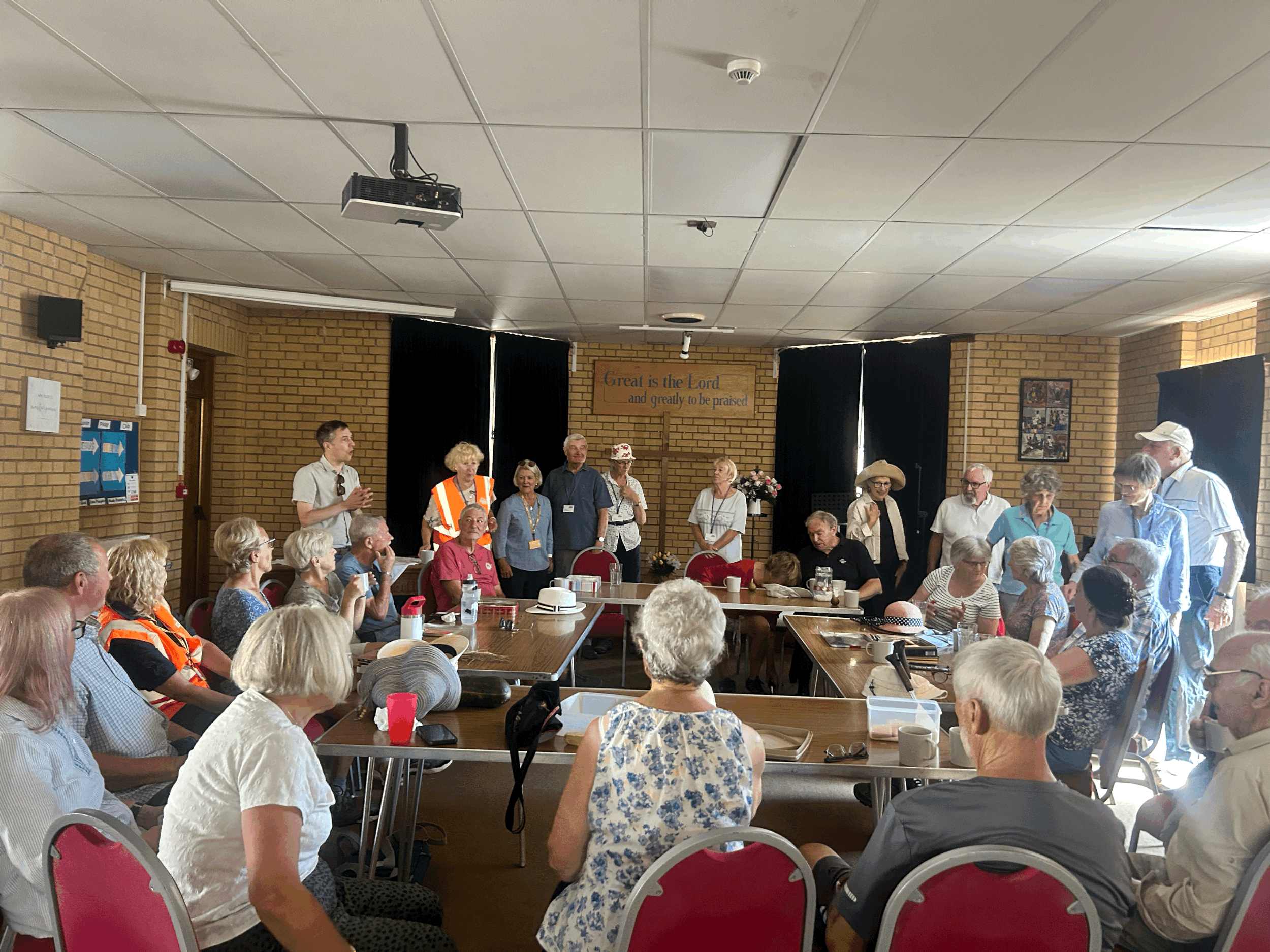
Adrian Ramsay MP joins Botesdale & Rickinghall Ramblers for social walk at Redgrave Park
Adrian Ramsay MP joins Botesdale & Rickinghall Ramblers for social walk at Redgrave Park
Adrian Ramsay MP, Green Party MP for Waveney Valley, said:
"It was a pleasure to join the Ramblers group in Botesdale & Rickinghall for their weekly walk, taking in the beautiful surroundings of Redgrave Park on a gorgeous day. It was great to spend time with local residents and hear more about what the group means to them.
"What makes this group so special is that it's part of a social prescribing model, local medical centres identify people who could benefit from a bit more company and connection and refer them to join the Ramblers. It's a brilliant example of a simple, community-led idea making a real difference to people's health and wellbeing.
"I want to thank everyone who came along today, and everyone involved in keeping this group going every week. Groups like this are a lifeline for many people, and exactly the kind of community support we should be championing."
ENDS
Notes to editors:
The Botesdale & Rickinghall Ramblers meet every Tuesday morning for a social walk around the village and surrounding area.
The group operates as part of a social prescribing model, with local medical centres referring residents who may benefit from increased social contact and community connection.
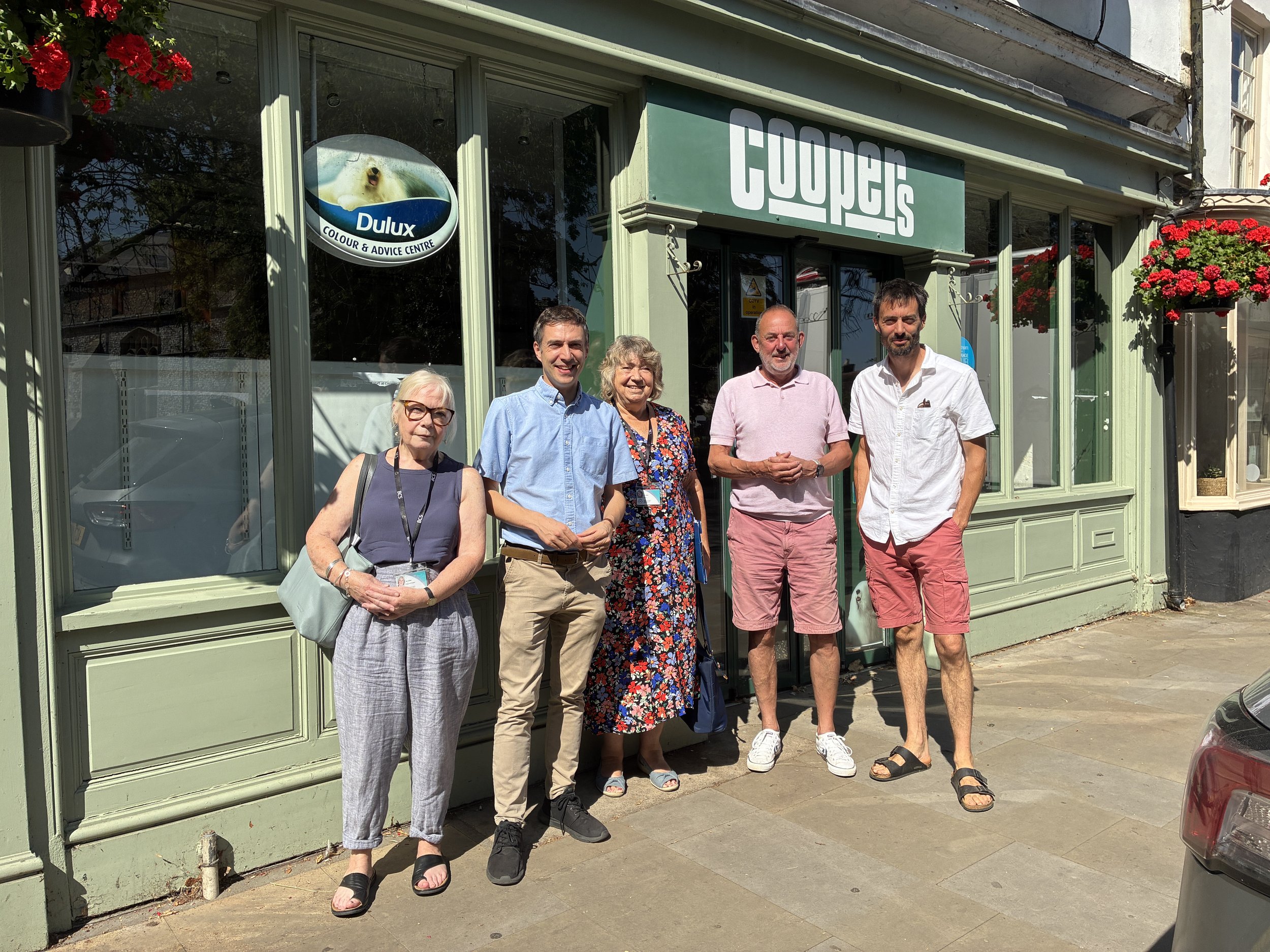
Adrian Ramsay MP encourages local business people to apply to be a trustee of Bungay Community Support
Adrian Ramsay MP encourages local business people to apply to be a trustee of Bungay Community Support
Bungay Community Support (BCS) is appealing for a new trustee with business or property expertise to join its board on a voluntary basis, as the charity works to secure a landmark building in the town centre for community use.
BCS has identified a former retail building in the heart of Bungay, as a potential long-term home for its work supporting the local community.
The charity's plan is to secure funding from a local benefactor, or benefactors, to purchase the building outright, with BCS then renting the space from them to run its services. To help make this happen, BCS is now looking to strengthen its board with a trustee who can bring business, financial or property expertise to guide the charity through the purchase and beyond.
Trustees give their time voluntarily and play a vital role in shaping the charity's strategy and ensuring it is run responsibly and sustainably.
Adrian Ramsay, Green Party MP for Waveney Valley, said:
"Bungay Community Support does incredible work for people across our town, and securing a permanent home in the heart of Bungay would make a real difference to what they can offer local people for years to come. This is a brilliant opportunity for someone with business or property expertise to put those skills to use for their community. I'd encourage anyone who cares about Bungay's future to seriously consider putting themselves forward."
Susan Collins BEM the Chair of Trustees for BCS
“Since our beginnings in 2020, the kindness and dedication of local people have shaped everything we do. Their spirit has carried us forward and strengthened our belief in what a united community can achieve.
Today, Bungay Community Support is an ever-increasing lifeline for residents across Bungay and the surrounding villages — and this moment feels full of possibility.
We are seeking people who share our determination to build a brighter future. Whether you can offer your expertise and time, or contribute financially, we invite you to join us and help transform that shared vision into lasting change.”
ENDS
Notes to editors:
Bungay Community Support (BCS) is a registered charity (CIO), Registered Charity No: 1200141, providing practical support to local residents affected by age, ill-health, disability, or social or economic hardship.
BCS began in March 2020 as Bungay Emergency Community Support (BECS), set up by Bungay Town Council, local residents and a local charity to deliver food and prescriptions to vulnerable residents during the first lockdown. It became an independent charity in August 2022.
The charity now runs a range of services from Number 28, Bungay's community hub in the town centre, including a befriending service for housebound residents, shopping and prescription collection, winter Warm Rooms, and a Food Hall offering discounted staple and fresh food on a community pantry model.
For more information, visit bungaycommunitysupport.org.uk
Image available here https://drive.google.com/drive/folders/1DV54px7g0iAxbSHcTAAuXWuReImEqGFs?usp=sharing
"Deeply irresponsible": MP condemns Suffolk County Council's climate U-turn as firefighters battle wildfires.
"Deeply irresponsible": MP condemns Suffolk County Council's climate U-turn as firefighters battle wildfires.
Adrian Ramsay, Green MP for Waveney Valley, has warned that Suffolk County Council's move to rescind its Climate and Nature Emergency Declaration comes at exactly the wrong moment, as firefighters battle a surge in wildfires and extreme heat incidents across the country.
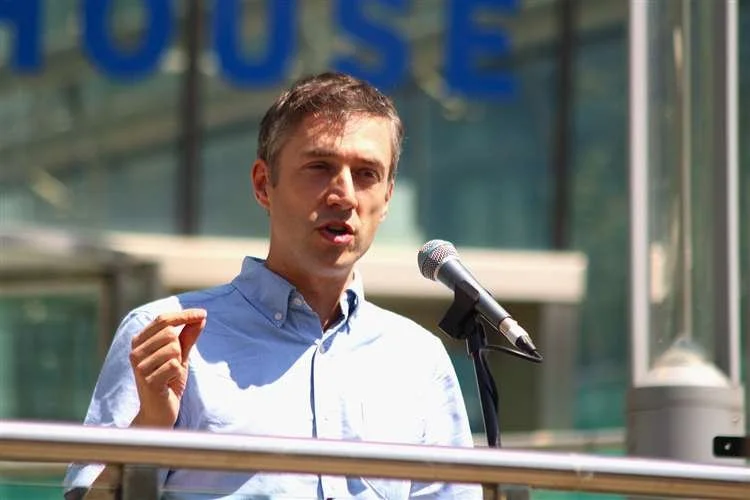
Speaking outside Endeavour House in Ipswich, where the County Council is this afternoon debating a motion from the new Reform-led administration to rescind the declaration first made in 2019, Adrian was joined by Richard from the Suffolk Fire Brigades Union, who set out the reality frontline crews are facing.
Richard said the Fire Brigades Union was currently responding to 14 wildfires declared nationwide, with a rising number of field and open fires across Suffolk. Crews are tackling these fires in full protective kit. He said flooding incidents were also increasing year on year, and that fire services are under-resourced and underfunded to meet the scale of the challenge, calling for an uplift in funding to properly protect the public.
Mr Ramsay had earlier written to Council Leader Cllr Hadwen, warning that undeclaring a climate emergency would not remove the threats of flooding or extreme heat that Suffolk residents face and would not save the council money. His letter noted that public sector organisations have worked together to deliver the Suffolk Climate Emergency Plan since 2021, with co-benefits including warmer, more affordable homes, improved air quality and health, and job creation. He warned that rescinding the declaration sends the wrong message when cross-party cooperation on these issues is needed more than ever.
Commenting today, Adrian Ramsay MP said:
"Suffolk County Council's Climate and Nature Emergency Declaration in 2019 was crucial in helping establish the UK's commitments on climate and nature. We should be stepping up that action now, not rolling it back, and we're seeing exactly why with the extreme heat we're experiencing.
"I've heard directly from firefighters on the front line of this crisis, dealing with wildfires and flooding that are becoming more frequent, without the resources they need to keep up. Whether it's our fire services, our food security, our water security, our transport, schools or hospitals, we are all feeling the impact of extreme heat right now, and it will only get worse if this is left unchecked.
"It's deeply irresponsible of Reform-led councils, like the one here in Suffolk, to be taking backward steps when we should be taking forward ones. I'm calling on the Government to urgently step up action on preparedness for extreme heat, on nature security, and on cutting emissions, and I'm calling on this council to reverse course."
ENDS
Notes to editors
In his letter to Cllr Hadwen, Leader of Suffolk County Council, Adrian Ramsay made the following points:
Undeclaring a Climate Emergency does not remove the threats of flooding or extreme heat that residents will still face, and will not, on its own, save the council money.
The council must use its powers to safeguard residents affected by extreme heat and other increasingly common extreme weather.
Understanding that this is an emergency affecting food production and economic markets, as well as the environment, is crucial to making decisions that help Suffolk residents live well in the years ahead.
Public sector organisations have worked together to deliver the Suffolk Climate Emergency Plan since 2021, with co-benefits including warmer, more affordable homes, improved air quality and health, and job creation.
Declaring a Climate Emergency is a call to focus on activity that benefits residents now and in future as the climate changes. Projects that don't improve safety and prosperity for Suffolk residents would not be compatible with the declaration in the first place, so rescinding it will not deliver savings or efficiencies.
Rescinding the declaration sends the wrong message when cross-party cooperation on these issues is vital and has, rightly, existed until now.
Final weekend to catch "All Aboard for the Waveney Valley Line!" at Harleston Players
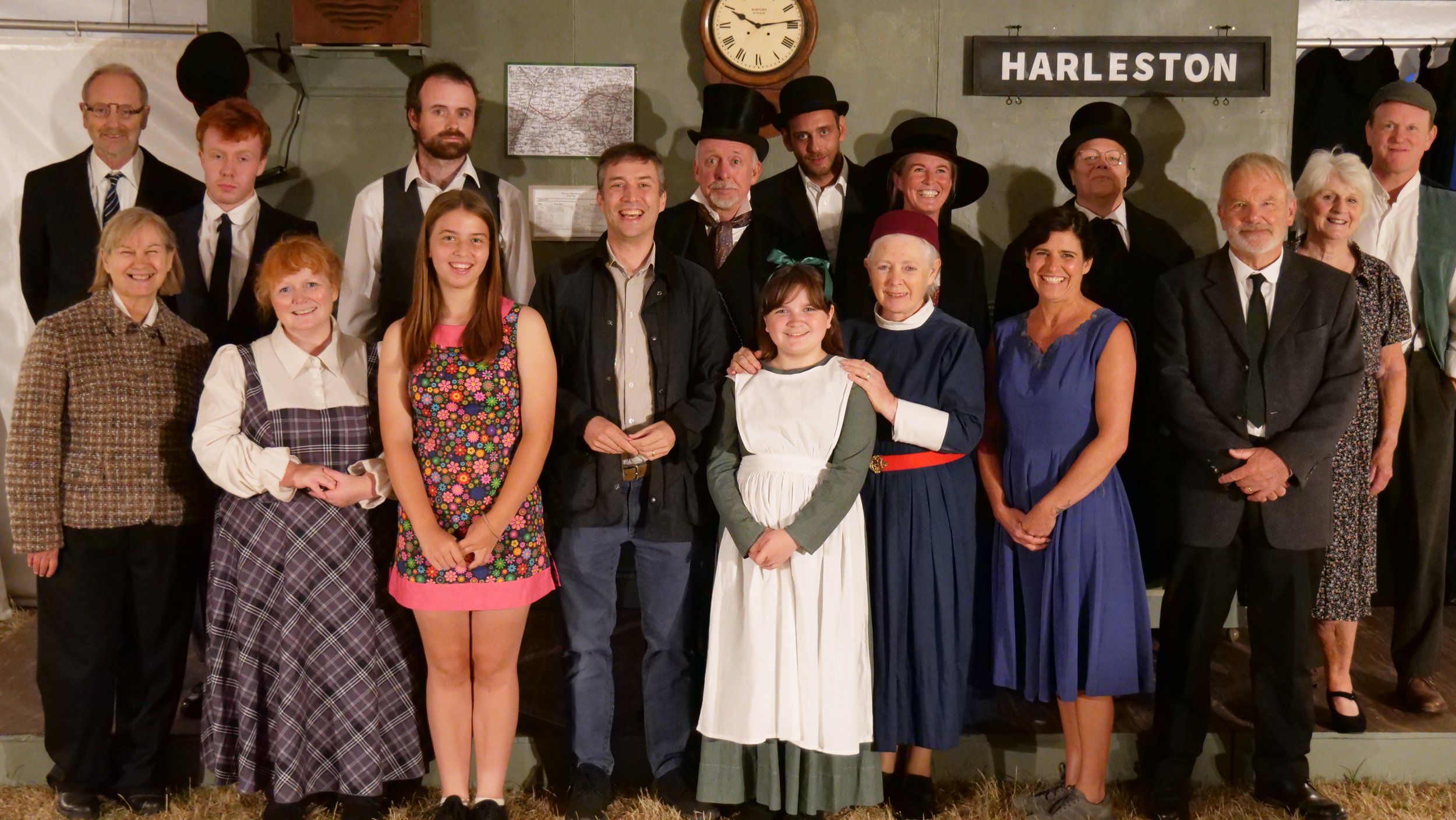
Harleston Players' community production "All Aboard for the Waveney Valley Line!" reaches its final weekend on Thursday, 17th and Friday, 18th July.
The play follows a typical "railway" family as they work their way along the Waveney Valley Line, from Tivetshall to Beccles, charting its story from its opening in the 1850s to its closure a century later. The script draws on extensive research, contemporary newspaper reports and interviews with local people who remember the line when trains were still running.
The production brings together a cast of local amateurs spanning an age range of nearly seventy years, whose day jobs include teachers, nurses, social workers and sports instructors, to tell the story of an important part of the region's heritage.
Adrian Ramsay, MP for Waveney Valley, attended a recent performance and praised the production:
"I really enjoyed watching 'All Aboard for the Waveney Valley Line'. Congratulations to Harleston Players on a fantastic play, beautifully delivered. Eileen Ryan's extensive research of our local history enabled them to tell the story of the Waveney Valley line from its hopeful inception to its sad closure a century later. It was such a big part of the fabric of our wonderful area, and we can see the history around us today.
"The closure of so many railway lines in the 1950s and 60s was one of the most short-sighted political decisions ever. These lines today would be popular, financially viable, and have clean trains taking people around our communities.
"The play is funny, entertaining and educational, and I would recommend others to watch."
ENDS
Adrian Ramsay responds to an FT investigation revealing that Anglian Water withheld funds for repairs while distributing £2.5 billion to shareholders
Adrian Ramsay responds to an FT investigation revealing that Anglian Water withheld funds for repairs while distributing £2.5 billion to shareholders
An investigation by the Financial Times has found that Anglian Water is one of four water companies that underspent their infrastructure budgets between 2010 and 2025, despite the industry's repeated claims that low customer bills were to blame for a failure to fix ageing pipes and networks.
Reacting to the investigation, Adrian Ramsay, MP for Waveney Valley, said
"It's one thing to run out of money for essential repairs. Anglian Water had money to spare and still didn't spend it.
An FT investigation found it was one of four water companies that underspent their infrastructure budgets between 2010 and 2025, while paying out £2.5bn in dividends.
This is unacceptable. The public is rightly demanding action to clean up our rivers, and instead they're watching companies bank cash that should have gone into fixing crumbling pipes and ending sewage spills. People are paying record bills while shareholders profit, and rivers remain polluted.
Water companies cannot be trusted to regulate themselves. That's why I'm pressing for the water companies to be brought under public ownership, so the money goes into fixing the infrastructure, not into shareholders' pockets."
ENDS
Just one out of fifteen Dentists contacted is accepting New NHS Patients in East Anglia, an investigation by Adrian Ramsay MP, finds.
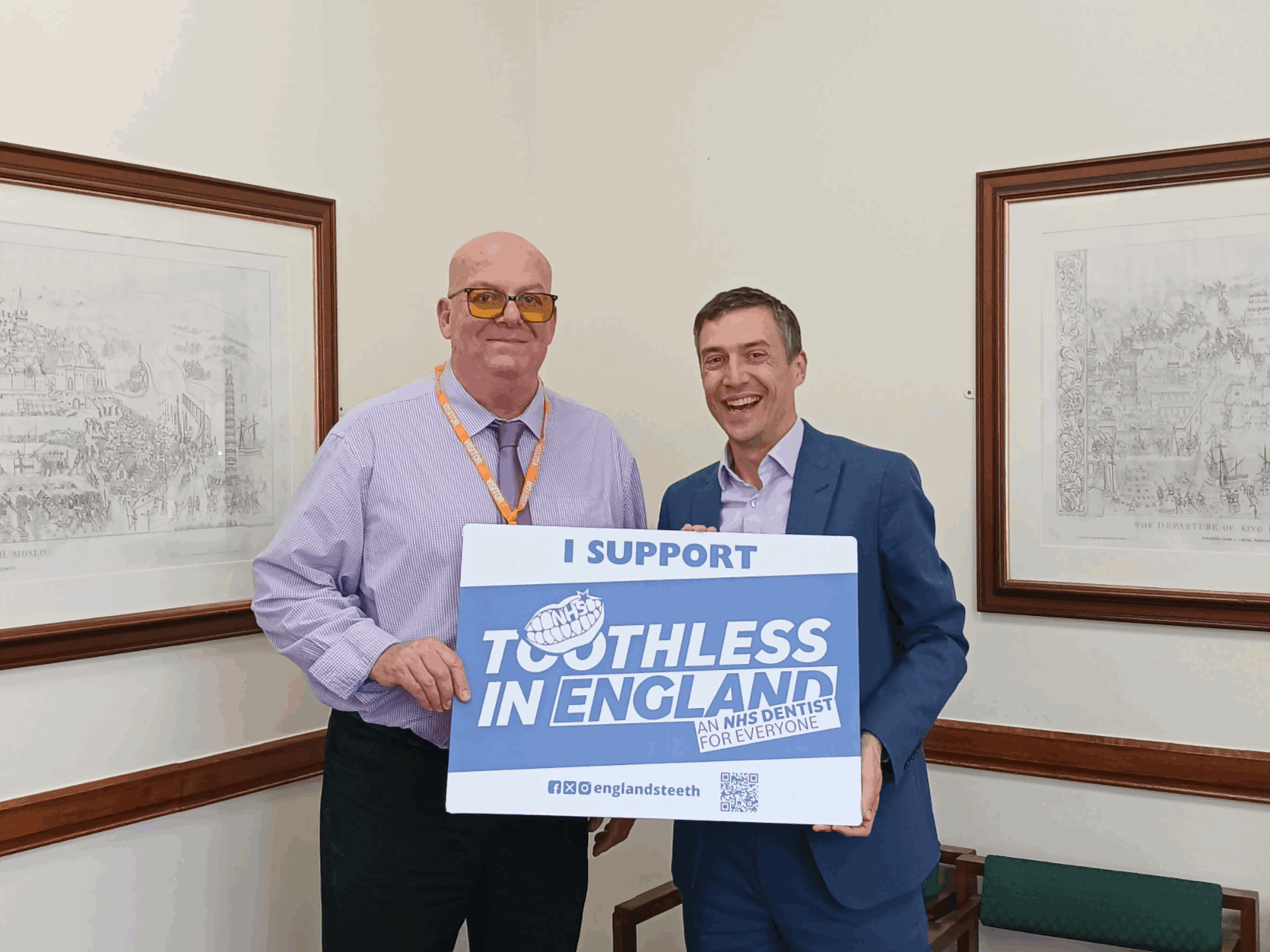
Just one out of fifteen Dentists contacted is accepting New NHS Patients in East Anglia, an investigation by Adrian Ramsay MP, finds.
East Anglia is one of England’s worst dental deserts, with practices reporting waiting lists of over 1,000 patients, four-year backlogs dating back to 2021, and one list stretching across 25 pages of A4.
Reacting to the investigation Adrian said
“It is a damning indictment of this Government that, two years into their term, access to dental care remains a postcode lottery. People are being left in pain, unable to access basic care they are entitled to. The investigation in East Anglia shows that we are one of the worst-hit regions in the country.
This has been ignored for far too long. It is unacceptable that successive governments have failed to get a grip on this crisis, and the people of East Anglia are paying the price.”
Nationally, nearly two-thirds of dentists in England listed as taking NHS patients are in reality not taking new NHS patients, with some areas a complete desert.
Getting an appointment on the NHS has become next to impossible in many areas highlighting the access crisis millions still face across the country, with tooth decay the most common reason children aged five to nine are admitted to hospital.
When Labour came to power, they pledged 700,000 new NHS urgent care appointments and to recruit new dentists for areas that needed them most. But a new investigation by Adrian, reveals that getting NHS treatment remains a postcode lottery, with some parts of the country left without any NHS options.
The investigation contacted a sample of 135 practices across England which were listed on the NHS website as accepting new adult patients.
The analysis revealed that 84 out of 135 (62.2%) are not currently able to accept new NHS patients. One stated its waiting list was “at least 25 pages of A4” while others talked of four-year backlogs.
The total number of clinics not taking on NHS patients will, in reality, be significantly higher, as many on the Government site are publicly listed as not accepting new NHS patients.
MyDentist runs more than 500 practices serving over four million patients. Yet, of the 44 listed on the NHS site as offering places, only four were accepting new NHS patients.
The findings come as the Government prepares to consult on a series of changes to the dental contract. However, these reforms are understood not to be backed by any new money, and there is concern the consultation might be delayed as a result of new leadership at DHSC.
The Green Party is calling on the Government to increase NHS Dentistry funding by at least £1.5 billion per year, a figure the British Dental Association (BDA) says would ensure everyone who wants an NHS dentist can access one.
Current government budgets allow only 40% of adults to access an NHS dentist within two years. The Party argues that unless funding for NHS dentistry keeps pace with rising costs and population growth, ending the dental access crisis will remain impossible.
Dentists are deeply concerned that the current psychodrama at Westminster has seen progress stall to save the struggling service.There is no sign of public consultation expected this summer, setting out the Government's ambitions on reform. Not a penny of new investment has been pledged, and the BDA has warned that there is now a material risk that Government promises to save NHS dentistry cannot be kept.
BDA Chair Eddie Crouch said:
“Labour came to power promising change, but the crisis facing millions is still with us.
“Warm words won’t give people the dental care they need. That will require real reform and sustainable funding.”
ENDS
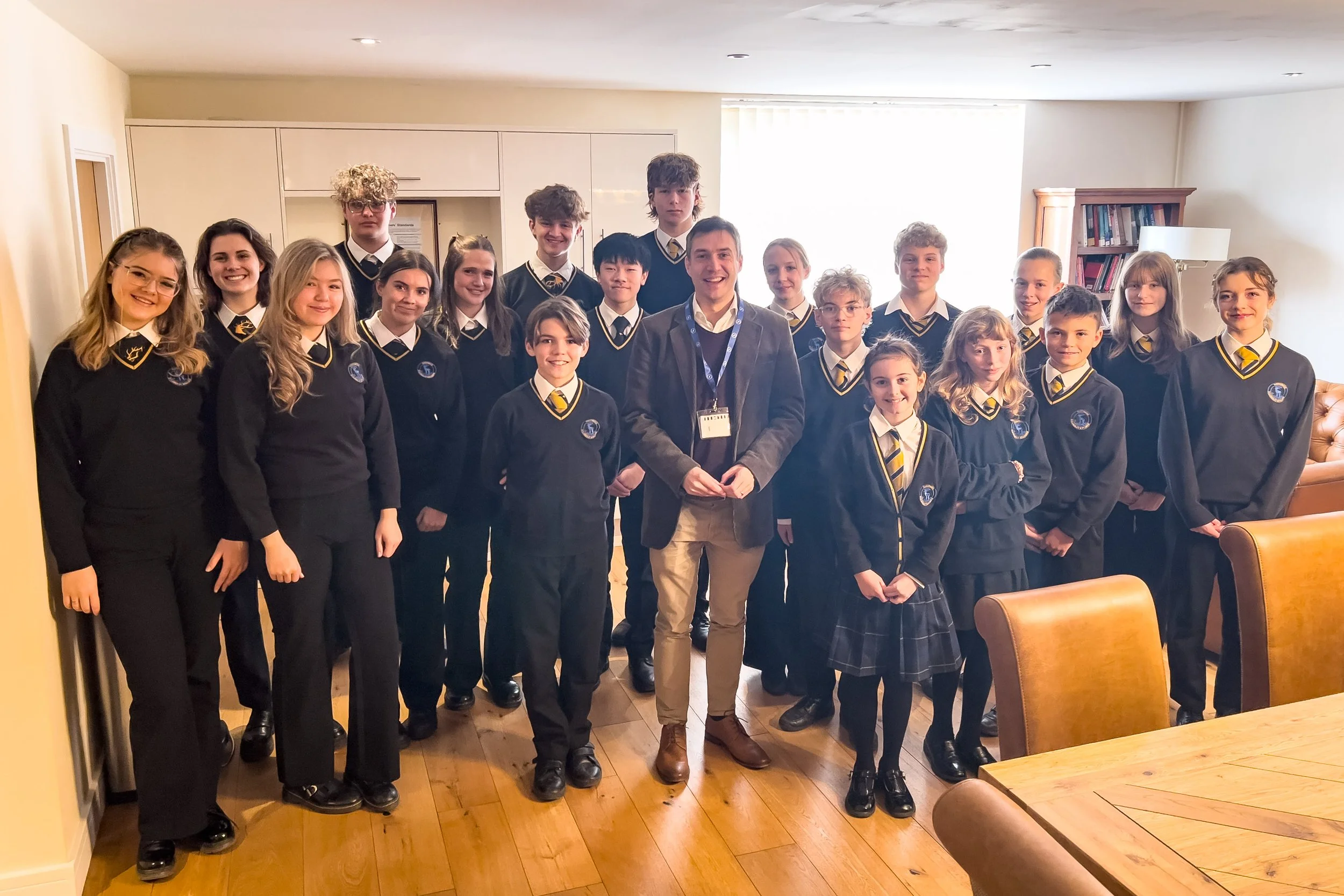
Adrian Ramsay questions the Minister for Education about cuts to physical education that will disproportionately affect Waveney Valley.
Adrian Ramsay questions the Minister for Education about cuts to physical education that will disproportionately affect Waveney Valley.
Adrian Ramsay, Green Party MP for Waveney Valley, asked the Minister:
“Primary school headteachers in my constituency tell me that, according to their budget calculations, the cut in funding for physical education will have a real impact on opportunities for young people, especially in rural areas. What assurance can the Government give me that young people, especially those in rural areas such as Waveney Valley, will not lose out on vital sporting opportunities?”
The Minister, Georgia Gould, in reply said:
“We are investing £1 billion over three years to build new sports networks. That money will be used by many different partners to support schools, bring resources together, and put funding directly into school budgets. We will be setting out more plans to reassure primary school heads of our commitment to increasing activity for children and young people.”
Reacting to the Minister's answer, Adrian said:
"Physical education is vital for pupils. Not just for their physical health, but for their mental wellbeing too. I am deeply disappointed that headteachers in constituencies like Waveney Valley are facing real-terms cuts to their PE budgets under the new funding model. I hope the Minister's assurances are well-founded, and that the promised £1 billion investment in sports networks will genuinely deliver for schools and ensure that rural areas are not left behind."
ENDS
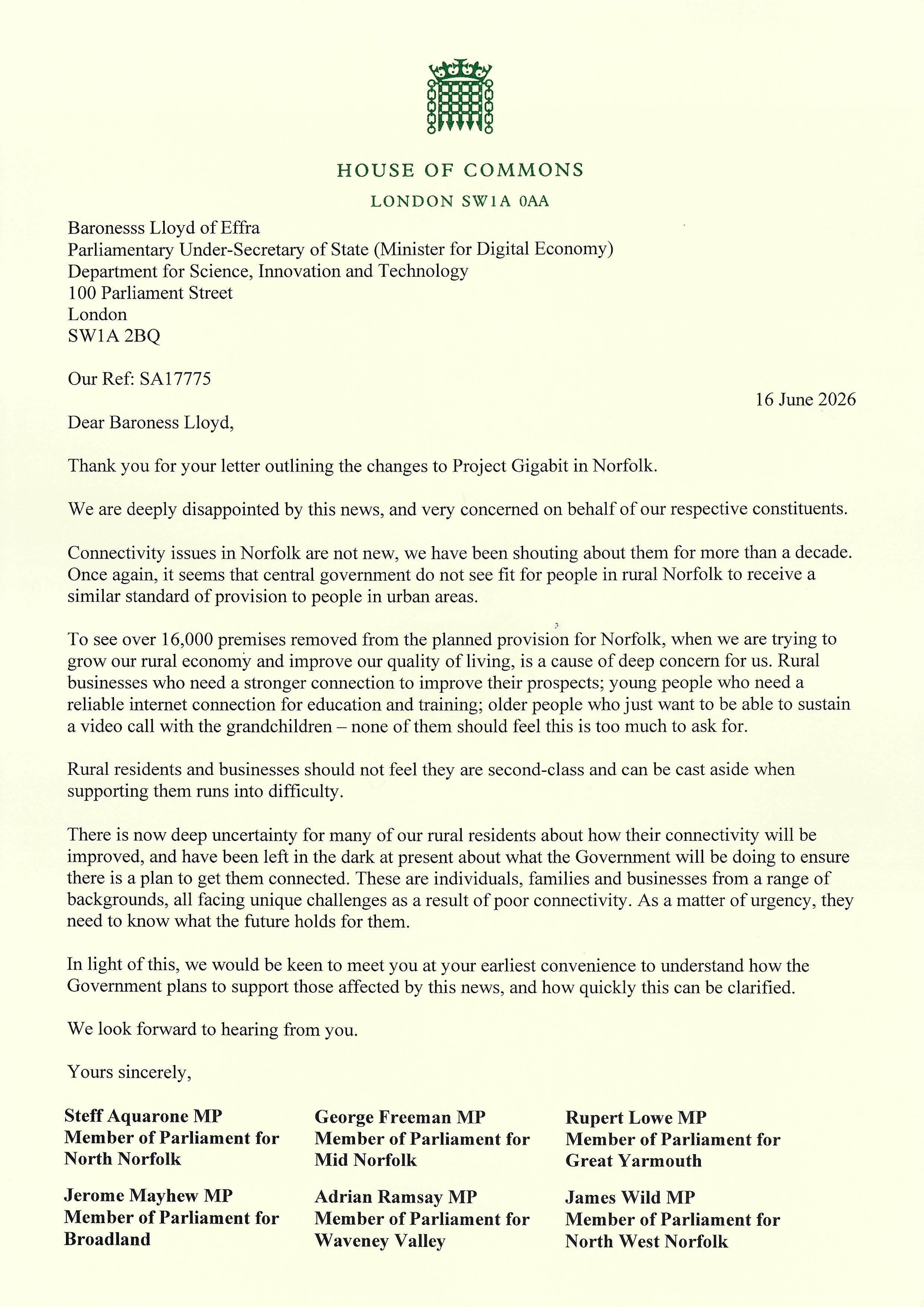
Project Gigabit Letter
-
Baronesss Lloyd of Effra
Parliamentary Under-Secretary of State (Minister for Digital Economy) Department for Science, Innovation and Technology
100 Parliament Street
London
SWIA 2BQ
Our Ref: SA17775
16 June 2026
Dear Baroness Lloyd,
Thank you for your letter outlining the changes to Project Gigabit in Norfolk.
We are deeply disappointed by this news, and very concerned on behalf of our respective constituents.
Connectivity issues in Norfolk are not new, we have been shouting about them for more than a decade.
Once again, it seems that central government do not see fit for people in rural Norfolk to receive a similar standard of provision to people in urban areas.
To see over 16,000 premises removed from the planned provision for Norfolk, when we are trying to grow our rural economy and improve our quality of living, is a cause of deep concern for us. Rural businesses who need a stronger connection to improve their prospects; young people who need a reliable internet connection for education and training; older people who just want to be able to sustain a video call with the andchildren - none of them should feel this is too much to ask for.
Rural residents and businesses should not feel they are second-class and can be cast aside when supporting them runs into difficulty.
There is now deep uncertainty for many of our rural residents about how their connectivity will be improved, and have been left in the dark at present about what the Government will be doing to ensure there is a plan to get them connected. These are individuals, families and businesses from a range of backgrounds, all facing unique challenges as a result of poor connectivity. As a matter of urgency, they need to know what the future holds for them.
In light of this, we would be keen to meet you at your earliest convenience to understand how the Government plans to support those affected by this news, and how quickly this can be clarified.
We look forward to hearing from you.
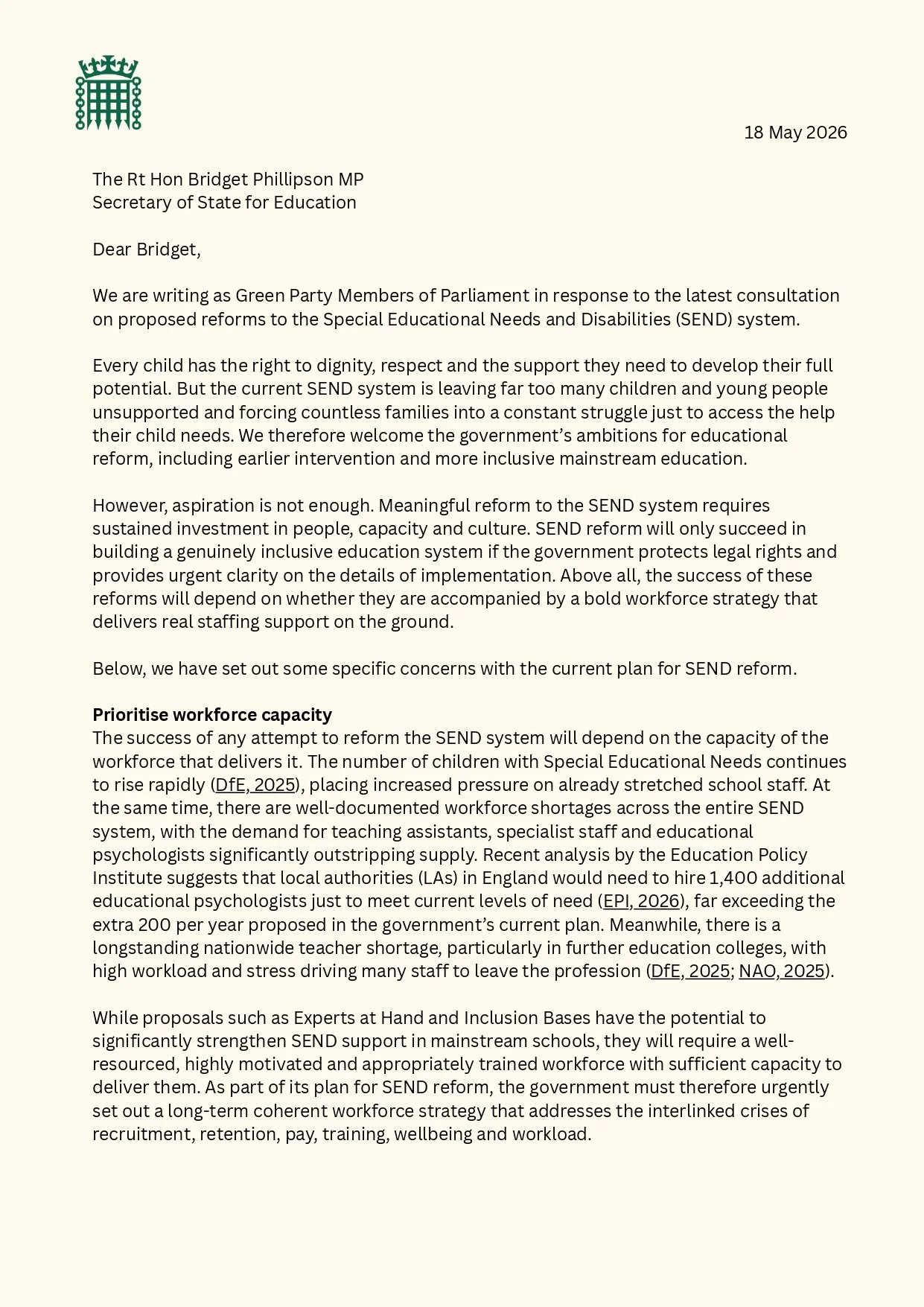
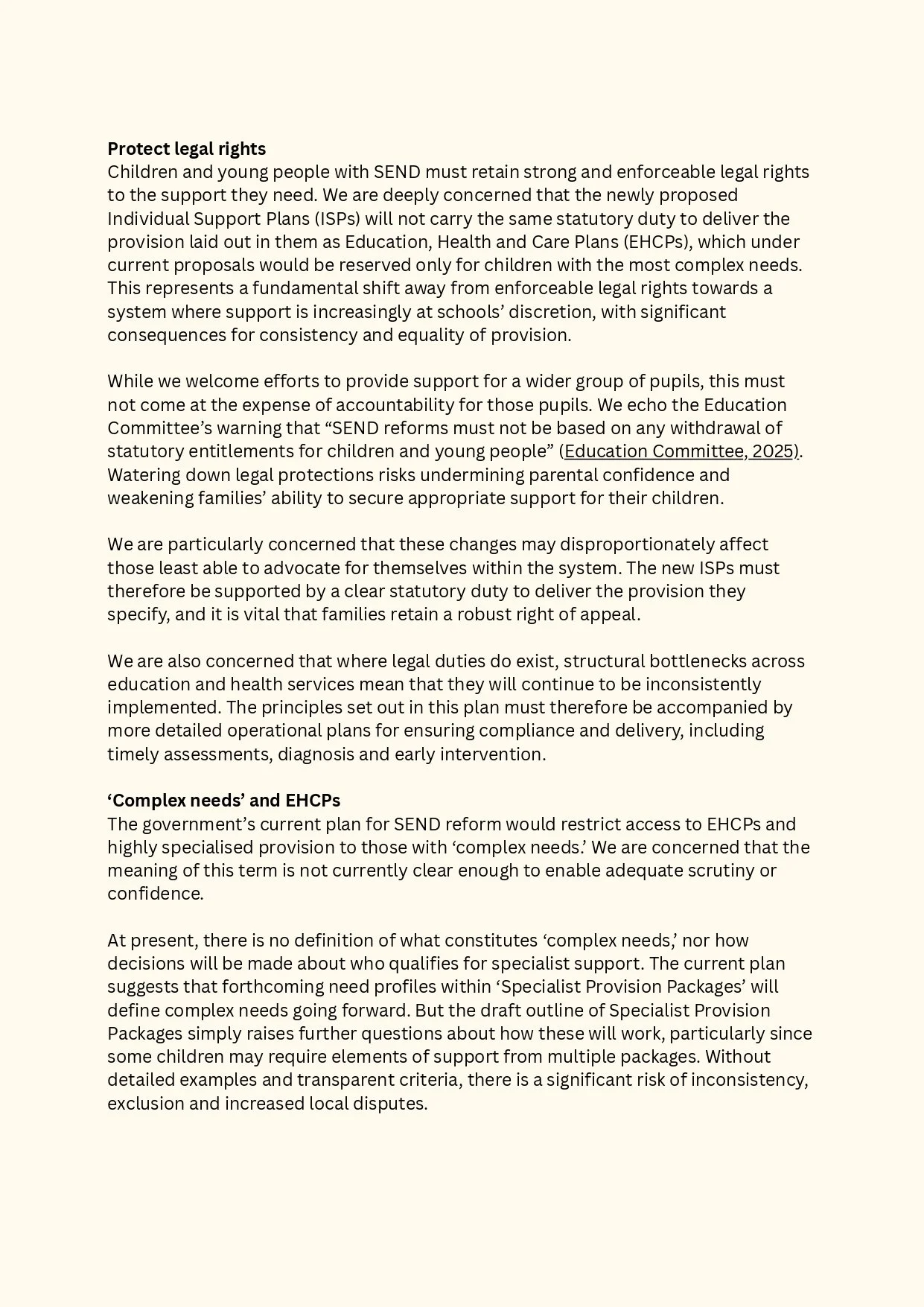
Green Party MPs’ Response to SEND Reform Consultation
-
The Rt Hon Bridget Phillipson MP
Secretary of State for Education
Dear Bridget,
We are writing as Green Party Members of Parliament in response to the latest consultation
on proposed reforms to the Special Educational Needs and Disabilities (SEND) system.
Every child has the right to dignity, respect and the support they need to develop their full
potential. But the current SEND system is leaving far too many children and young people
unsupported and forcing countless families into a constant struggle just to access the help
their child needs. We therefore welcome the government’s ambitions for educational
reform, including earlier intervention and more inclusive mainstream education.
However, aspiration is not enough. Meaningful reform to the SEND system requires
sustained investment in people, capacity and culture. SEND reform will only succeed in
building a genuinely inclusive education system if the government protects legal rights and
provides urgent clarity on the details of implementation. Above all, the success of these
reforms will depend on whether they are accompanied by a bold workforce strategy that
delivers real staffing support on the ground.
Below, we have set out some specific concerns with the current plan for SEND reform.
Prioritise workforce capacity
The success of any attempt to reform the SEND system will depend on the capacity of the
workforce that delivers it. The number of children with Special Educational Needs continues
to rise rapidly (DfE, 2025), placing increased pressure on already stretched school staff. At
the same time, there are well-documented workforce shortages across the entire SEND
system, with the demand for teaching assistants, specialist staff and educational
psychologists significantly outstripping supply. Recent analysis by the Education Policy
Institute suggests that local authorities (LAs) in England would need to hire 1,400 additional
educational psychologists just to meet current levels of need (EPI, 2026), far exceeding the
extra 200 per year proposed in the government’s current plan. Meanwhile, there is a
longstanding nationwide teacher shortage, particularly in further education colleges, with
high workload and stress driving many staff to leave the profession (DfE, 2025; NAO, 2025).
While proposals such as Experts at Hand and Inclusion Bases have the potential to
significantly strengthen SEND support in mainstream schools, they will require a well-
resourced, highly motivated and appropriately trained workforce with sufficient capacity to
deliver them. As part of its plan for SEND reform, the government must therefore urgently
set out a long-term coherent workforce strategy that addresses the interlinked crises of
recruitment, retention, pay, training, wellbeing and workload.Protect legal rights
Children and young people with SEND must retain strong and enforceable legal rights
to the support they need. We are deeply concerned that the newly proposed
Individual Support Plans (ISPs) will not carry the same statutory duty to deliver the
provision laid out in them as Education, Health and Care Plans (EHCPs), which under
current proposals would be reserved only for children with the most complex needs.
This represents a fundamental shift away from enforceable legal rights towards a
system where support is increasingly at schools’ discretion, with significant
consequences for consistency and equality of provision.
While we welcome efforts to provide support for a wider group of pupils, this must
not come at the expense of accountability for those pupils. We echo the Education
Committee’s warning that “SEND reforms must not be based on any withdrawal of
statutory entitlements for children and young people” (Education Committee, 2025).
Watering down legal protections risks undermining parental confidence and
weakening families’ ability to secure appropriate support for their children.
We are particularly concerned that these changes may disproportionately affect
those least able to advocate for themselves within the system. The new ISPs must
therefore be supported by a clear statutory duty to deliver the provision they
specify, and it is vital that families retain a robust right of appeal.
We are also concerned that where legal duties do exist, structural bottlenecks across
education and health services mean that they will continue to be inconsistently
implemented. The principles set out in this plan must therefore be accompanied by
more detailed operational plans for ensuring compliance and delivery, including
timely assessments, diagnosis and early intervention.
‘Complex needs’ and EHCPs
The government’s current plan for SEND reform would restrict access to EHCPs and
highly specialised provision to those with ‘complex needs.
’ We are concerned that the
meaning of this term is not currently clear enough to enable adequate scrutiny or
confidence.
At present, there is no definition of what constitutes ‘complex needs,
’ nor how
decisions will be made about who qualifies for specialist support. The current plan
suggests that forthcoming need profiles within ‘Specialist Provision Packages’ will
define complex needs going forward. But the draft outline of Specialist Provision
Packages simply raises further questions about how these will work, particularly since
some children may require elements of support from multiple packages. Without
detailed examples and transparent criteria, there is a significant risk of inconsistency,
exclusion and increased local disputes.This lack of clarity also makes it difficult for families, schools, teachers and indeed
Parliament to adequately assess the likely impact of the reforms. The government must
urgently publish detailed guidance on who will qualify for EHCPs and Specialist Provision
Packages, including worked case studies. Clear definitions and operational detail are
essential to ensure the system is fair, consistent and trusted by families.
Culture change and co-production
Progress towards greater inclusion must be driven as much by culture and practice as by
structural reform. Too many children and young people continue to face barriers created
by inflexible behaviour policies, limited understanding of neurodiversity and
environments that do not meet their sensory needs. Without addressing these issues,
changes to systems and funding will have limited impact in the classroom.
We therefore welcome the proposed investment in new guidance, National Inclusion
Standards and SEND training for all staff in schools, colleges and early years settings. This
must include evidence-based guidance on how to design accessible and inclusive sensory
environments and how to embed inclusive practice in behaviour and classroom
management policies. It is essential that this guidance and the National Inclusion
Standards are genuinely co-produced. Tokenistic engagement and consultation are not
enough: the government needs to ensure that children and young people with SEND,
alongside their parents, carers and educators, are treated as equal partners in the design,
delivery and evaluation of SEND policy at every level. Lived experience must not be an
afterthought but a guiding principle of the system.
Special school capacity
While we support the government’s ambition to make mainstream education more
inclusive, this must be accompanied by a sufficient supply of special school places for
those children and young people whose needs cannot be met in mainstream settings. At
present, many areas face acute shortages of special school places and around two thirds
of special schools are at or over capacity (DfE, 2026), leaving families without appropriate
local provision. Increasing specialist support within mainstream, including through
Specialist Bases, will help to reduce reliance on special school placements. However, even
with these improvements in mainstream settings, demand for special school places is
likely to continue to outstrip capacity in some places, especially in the short term.
We are concerned that a rigid national push towards mainstream inclusion risks
overlooking this reality and failing those children for whom mainstream settings are not
suitable. Provision must be flexible, locally planned and responsive to need, rather than
driven by a one-size-fits-all national model.Tackle profiteering
At present, exploitative private companies are profiting from the SEND crisis by buying up
special schools and services and charging excessively high placement fees to LAs,
exacerbating an already unsustainable situation. Urgent action is desperately needed to
address this blatant profiteering.
While the government’s proposal to introduce national funding bands for independent
special school placements is a welcome step in the right direction, the current plans are
lacking in detail on what constitutes a “reasonable price” or how these bands will be set.
Without such clarity, it is difficult to be confident that these measures will meaningfully
curb excessive costs or protect public funds. We urge the government to be bold:
independent providers must not be allowed to continue charging, on average, more than
double the cost of state-funded special school provision (NAO, 2024).
Alongside stronger regulation and scrutiny of the independent sector, there must be a
rapid expansion of state-funded special school capacity to reduce reliance on
independent special schools. While the current plan for SEND reform proposes a total
£3.7 billion of capital investment, we are concerned by the lack of detail concerning how
much of this money will be invested in new special school capacity and how many new
state-funded special school places will be created. To ensure that special school provision
does not become increasingly dominated by the private sector, the government must
urgently proceed with building the state-funded special schools that are currently
planned for construction.
LAs must also be empowered with streamlined access to funding for increasing state-
funded special school capacity. We are concerned that requiring LAs to provide detailed
justification for using SEND payments to invest in new special school places instead of
mainstream settings will only create unnecessary delays. The government should trust
councils to exercise local democratic oversight and make data-led decisions based on the
local situation.
Reform admissions
Narrow attainment-focused performance pressures are currently disincentivising some
schools from admitting or retaining pupils with SEND. This is exacerbating inequities in
access and requires urgent government intervention. In a recent survey, 41% of senior
school leaders reported that some local schools actively discourage applications from
children and young people with SEND (Sutton Trust, 2026). The gap in access to high-
performing schools is especially large for children with SEND who are eligible for Free
School Meals and do not have an EHCP , with top schools taking in around 36% fewer
pupils in this category than live locally (Sutton Trust, 2026).We are concerned that the current proposals for SEND reform do not do enough to
strengthen fair admissions or ensure genuine accountability across all types of school,
including academies, faith schools and free schools. Restricting access to EHCPs risks
weakening accountability in admissions even further, since EHCPs are currently one of the
main mechanisms by which LAs can direct a maintained school to admit a child or young
person with SEND.
LAs must be given stronger levers to ensure equitable access across all state-funded
schools. They should have the ability to direct placements for children with ISPs as well as
EHCPs, including at academies, faith schools and free schools where necessary.
Accountability and performance frameworks for schools must also be rebalanced so that
inclusion and wellbeing metrics are treated as equal in importance to academic
outcomes, not as secondary considerations. We desperately need a new approach that
moves away from the current high-stakes testing and exam-driven accountability culture,
which incentivises exclusion and indirect selection, towards a broader, child-centred
assessment system.
We urge the government to match its ambitions with decisive action by safeguarding legal
rights, investing in workforce and school capacity and delivering a transparent,
accountable SEND system that meets the needs of every child and family it is meant to
serve. We would welcome the opportunity to discuss these proposals further with your
Department.
Yours sincerely,
Adrian Ramsay MP , Waveney Valley
Dr Ellie Chowns MP , North Herefordshire
Siân Berry MP , Brighton Pavilion
Carla Denyer MP , Bristol Central
Hannah Spencer MP , Gorton & Denton
Green Party Members of Parliament
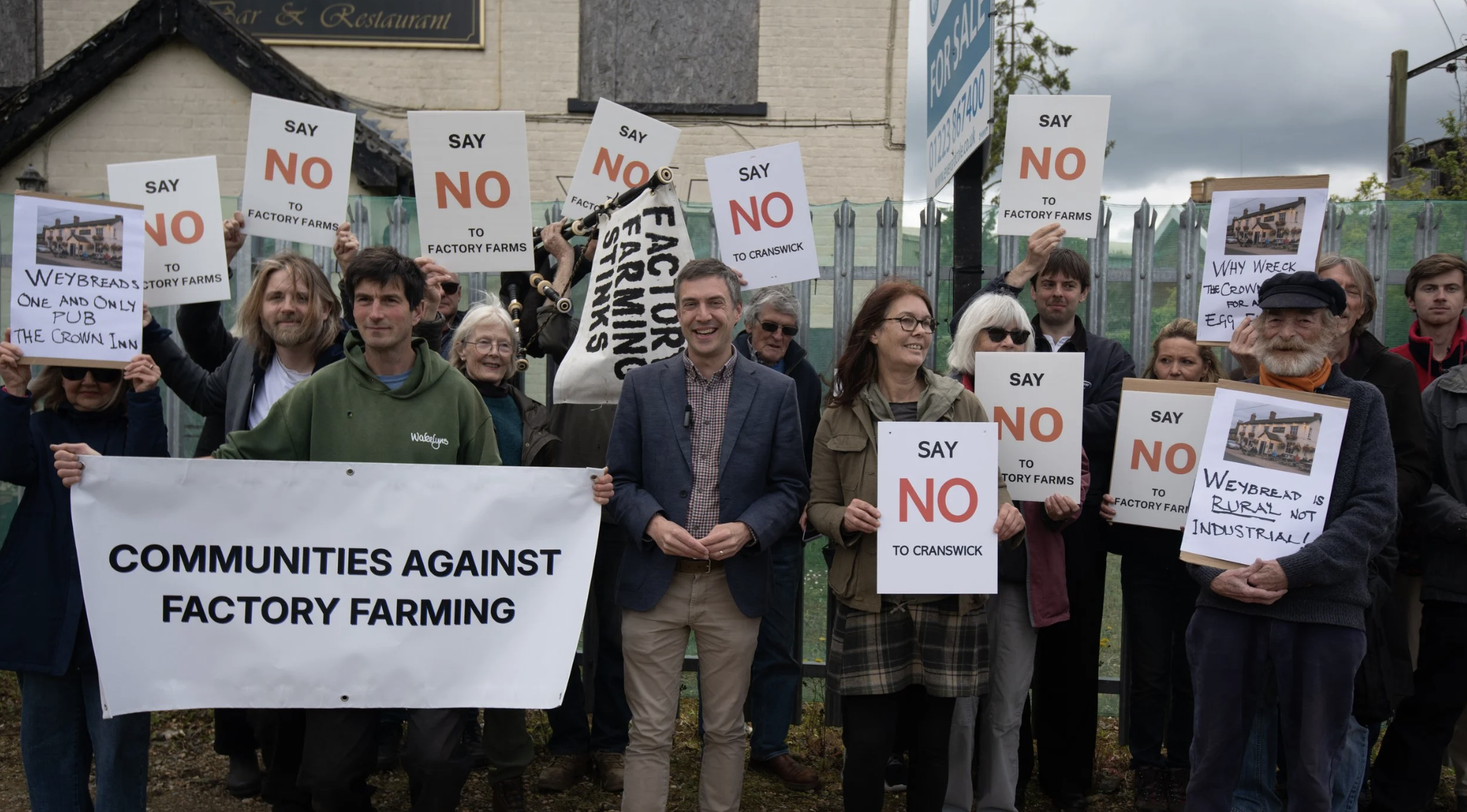
Green MP and Newly Elected Councilor join residents in Weybread to protest the Cranswick expansion.
Adrian Ramsay MP for Waveney Valley & Cllr Sally Mittuch joined residents in Weybread in a peaceful protest today against plans for a large-scale chicken incubation unit in the village.
The protest will see residents and campaigners gather outside the former Crown Inn to voice concerns over agricultural giant Cranswick’s controversial planning application for a broiler chicken incubation facility.
Campaign group Communities Against Factory Farming (CAFF), which has been supporting residents opposing the application, will attend alongside members of the Weybread Community Group.
Campaigners are urging Mid Suffolk District Council’s planning committee to “Stop the Incubator” and “Save Our Pub”.
Under the plans, The Crown Inn, which has been owned by Cranswick and closed for several years, would be demolished to make way for the factory development. Residents have raised concerns about the long-term loss of an important community asset, alongside worries over increased HGV traffic, industrial activity, pollution and the wider impact on village life.
Adrian Ramsay MP said
“The impact of large-scale factory farm developments on rural communities, like the one proposed in Weybread, is becoming increasingly concerning. These enormous industrial operations are being placed in tiny villages that are just not suitable.
Residents are rightly worried about the impact of three shift working patterns, with significant numbers of HGV movements travelling through small village roads throughout the day and night.
At a time when many rural communities desperately need genuinely affordable housing and investment in local services, people are asking why yet more large-scale industrial facilities are being prioritised over developments that would actually strengthen village life and support local people.
In addition, residents in Weybread are rightly concerned about the pollution impacts of this development and the huge implications of an increasingly industrialised food system for animal welfare."
Cllr Sally Mittuch, newly elected Green Councillor for Hoxne & Eye, said.
“Our community in Weybread has already seen huge changes over the past decade, and many residents feel we are gradually losing the very character of the village we love. People move to places like Weybread because of the countryside, the peace and the strong sense of community, but increasingly those qualities are being eroded by large-scale industrial developments that are completely out of keeping with a small rural village.
Residents still feel the loss of the village pub. Rural pubs are not just businesses; they are community spaces that bring people together and help sustain village life. We are deeply worried about the growing levels of industrial traffic, noise and disturbance associated with these kinds of developments, alongside the wider environmental impacts on the River Waveney and the surrounding countryside.”
ENDS
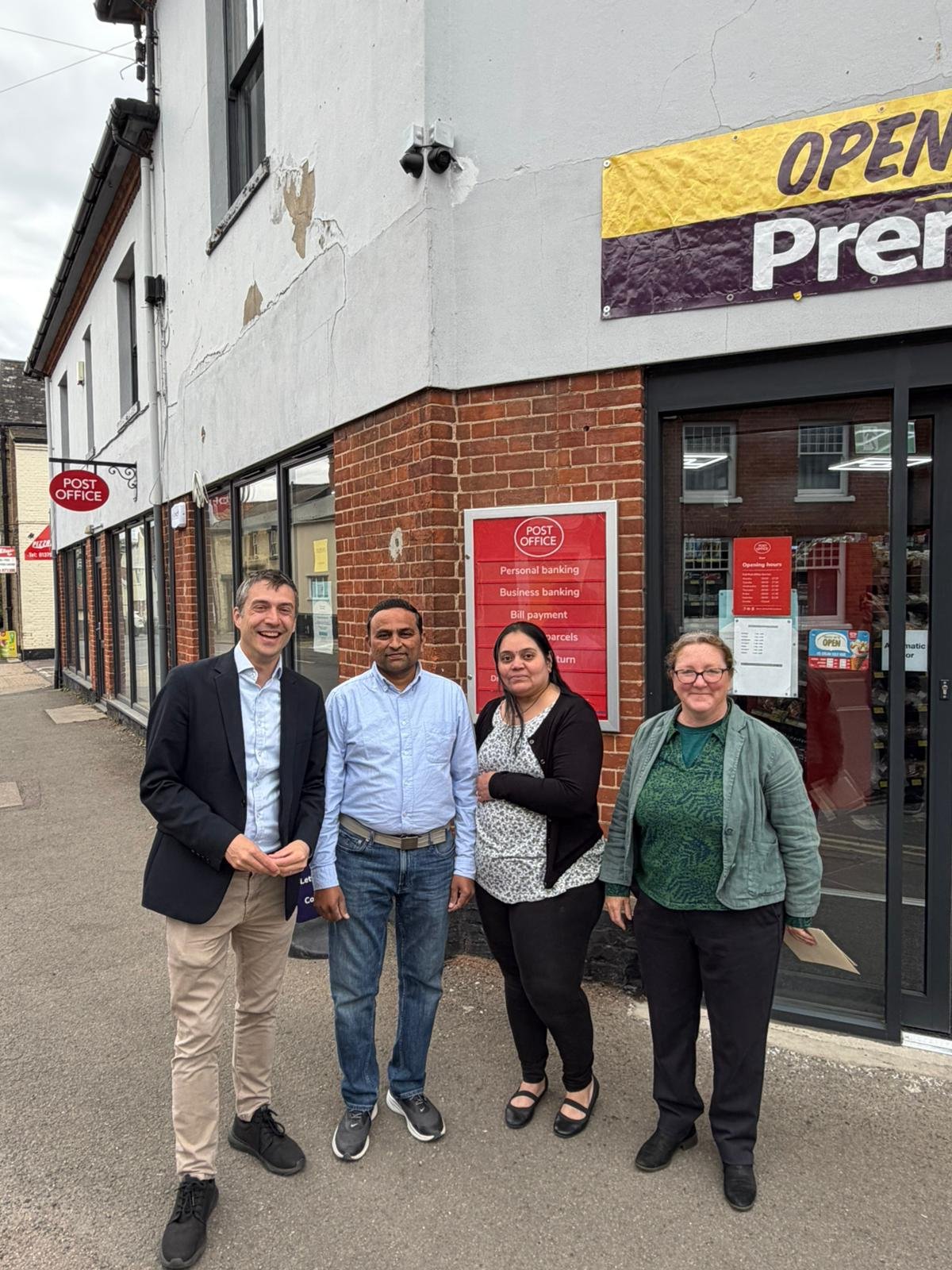
Adrian Ramsay MP visits the new Eye Post Office during the first week of operation.
Adrian Ramsay MP visits the new Eye Post Office during the first week of operation.
Adrian Ramsay MP visited the new Post Office in Eye during its first week of operation, marking the return of a permanent Post Office service to the town for the first time in more than two years.
The reopening follows work by District Councillor Lucy Elkin, who has worked alongside Adrian to help restore the service for residents and businesses as quickly as possible.
The new branch is being run by local postmaster Minesh Patel, who already operates the Post Office in Mendlesham.
Speaking at the Eye Post Office, Adrian Ramsay MP said:
“I’m delighted that, following a lot of behind-the-scenes work from Green Councillor Lucy Elkin, Eye now has a permanent post office again. For far too long, residents have been left without this vital service. With no bank in the town, having a post office is crucial for businesses and residents. In Parliament, I have been pushing for the restoration of local post offices, and I wish the local postmaster, Minesh Patel, all the best.”
Minesh Patel, the postmaster, said.
“I’m delighted that the Eye post office is now operating. From this week, we will be serving the community here in Eye, along with my other store in Mendlesham. I want to thank residents for the warm welcome and support we have already received.”
Cllr Lucy Elkin added.
“Since the previous Post Office closed, residents have consistently told me how important it was to restore this vital service to Eye. I am delighted that, after a great deal of work behind the scenes with Minesh, we now once again have a permanent Post Office in Eye.”
ENDS
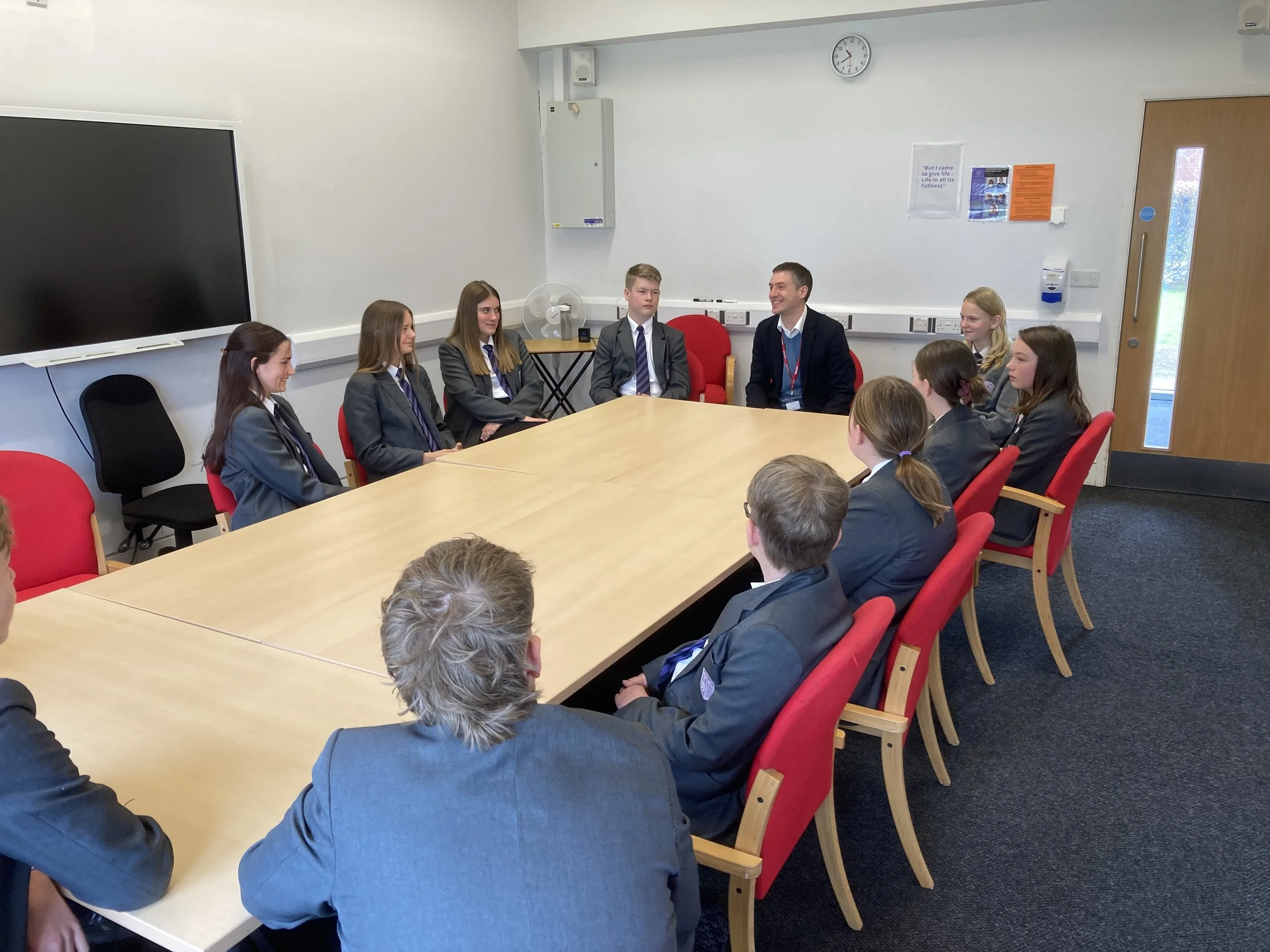
Adrian Ramsay MP seeks young people’s views on proposed social media ban.
Adrian Ramsay MP seeks young people’s views on proposed social media ban.
Adrian Ramsay, Green Party MP for Waveney Valley, has visited two secondary schools in his constituency to speak with young people and teachers about the proposed social media ban.
Speaking after both forums, Adrian said
“Access to social media for children and teenagers has been a constant topic of discussion in recent months. We all recognise the substantial risks, but we should also acknowledge the benefits of social media.
“I’ve received many welcome emails from parents expressing their views and concerns. I also felt it was important to hear directly from young people and teachers. Over the past few weeks, I have met with secondary school pupils and teachers at Harleston Sancroft and Hartismere School to hear their views and experiences.
“There was a range of views, but overall, the feeling was that there needs to be far stronger restrictions on the content that the tech firms allow on their platforms to ensure we keep young people safe online. Age restrictions need to be put in place which correspond with the content on each platform. Phones need to be set up so that a responsible adult always has control over a phone used by an under-16. And stronger resourcing of social services is needed to support those young people who are becoming vulnerable to online harms.
“These responses reinforce my own feelings on the topic, as an MP and as a parent, that it’s probably not a case of there being a total ban or not but about what restrictions are needed to keep young people safe and what is the right age for different apps. I will be responding to the Government consultation informed by these helpful discussions and will carefully follow the outcomes of the Government consultation which must inform the debate.”
Teachers who attended the roundtables also shared their perspectives, noting that, from a safeguarding standpoint,
“The majority of what we are dealing with as safeguarding leads is via social media.”
Students also had their say. One who is supportive of a ban said,
“Whilst scrolling through short-form media my phone picks up inappropriate content and restricts me from seeing it. Although scrolling is addictive, you do learn about other people’s lives.”
Others highlighted the need for balance, with one stating,
“There are games where you can make friends without insecurities, but there should also be a balance (on usage)”.
Teachers also recognised some of the benefits of social media, saying,
“Pupils gain more knowledge and power, better communication skills, especially for those with neurodivergence. [They can] gain more confidence socially via chatting online than they might get from family and friends.”
ENDS
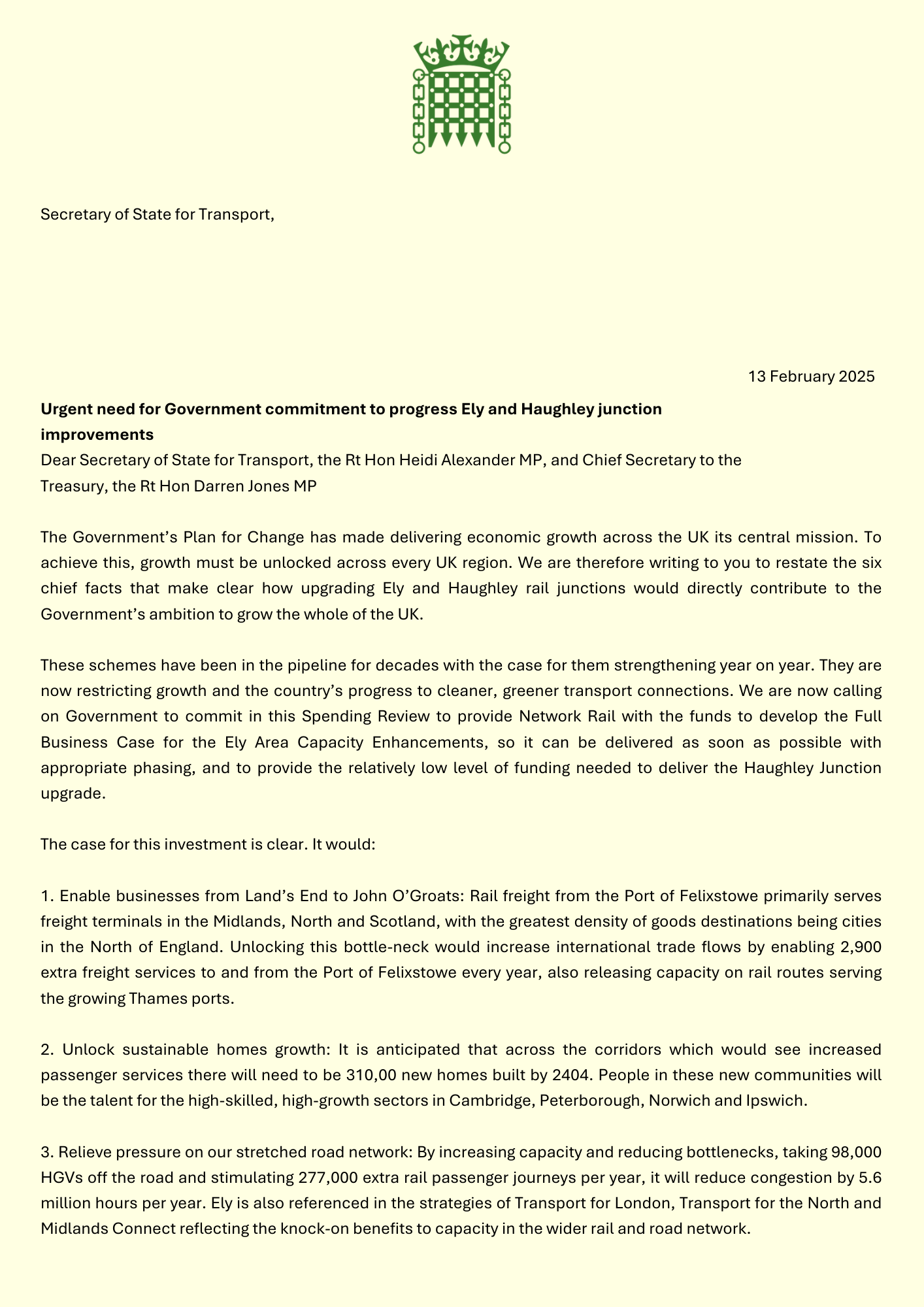
Urgent need for Government commitment to progress Ely and Haughley junction improvements
-
Urgent need for Government commitment to progress Ely and Haughley junction
improvements
Dear Secretary of State for Transport, the Rt Hon Heidi Alexander MP, and Chief Secretary to the
Treasury, the Rt Hon Darren Jones MP
The Government’s Plan for Change has made delivering economic growth across the UK its central mission. To achieve this, growth must be unlocked across every UK region. We are therefore writing to you to restate the six chief facts that make clear how upgrading Ely and Haughley rail junctions would directly contribute to the Government’s ambition to grow the whole of the UK.
These schemes have been in the pipeline for decades with the case for them strengthening year on year. They are now restricting growth and the country’s progress to cleaner, greener transport connections. We are now calling on Government to commit in this Spending Review to provide Network Rail with the funds to develop the Full Business Case for the Ely Area Capacity Enhancements, so it can be delivered as soon as possible with appropriate phasing, and to provide the relatively low level of funding needed to deliver the Haughley Junction upgrade.
The case for this investment is clear. It would:
1. Enable businesses from Land’s End to John O’Groats: Rail freight from the Port of Felixstowe primarily serves freight terminals in the Midlands, North and Scotland, with the greatest density of goods destinations being cities in the North of England. Unlocking this bottle-neck would increase international trade flows by enabling 2,900 extra freight services to and from the Port of Felixstowe every year, also releasing capacity on rail routes serving the growing Thames ports.
2. Unlock sustainable homes growth: It is anticipated that across the corridors which would see increased passenger services there will need to be 310,00 new homes built by 2404. People in these new communities will be the talent for the high-skilled, high-growth sectors in Cambridge, Peterborough, Norwich and Ipswich.
3. Relieve pressure on our stretched road network: By increasing capacity and reducing bottlenecks, taking 98,000 HGVs off the road and stimulating 277,000 extra rail passenger journeys per year, it will reduce congestion by 5.6 million hours per year. Ely is also referenced in the strategies of Transport for London, Transport for the North and Midlands Connect reflecting the knock-on benefits to capacity in the wider rail and road network.
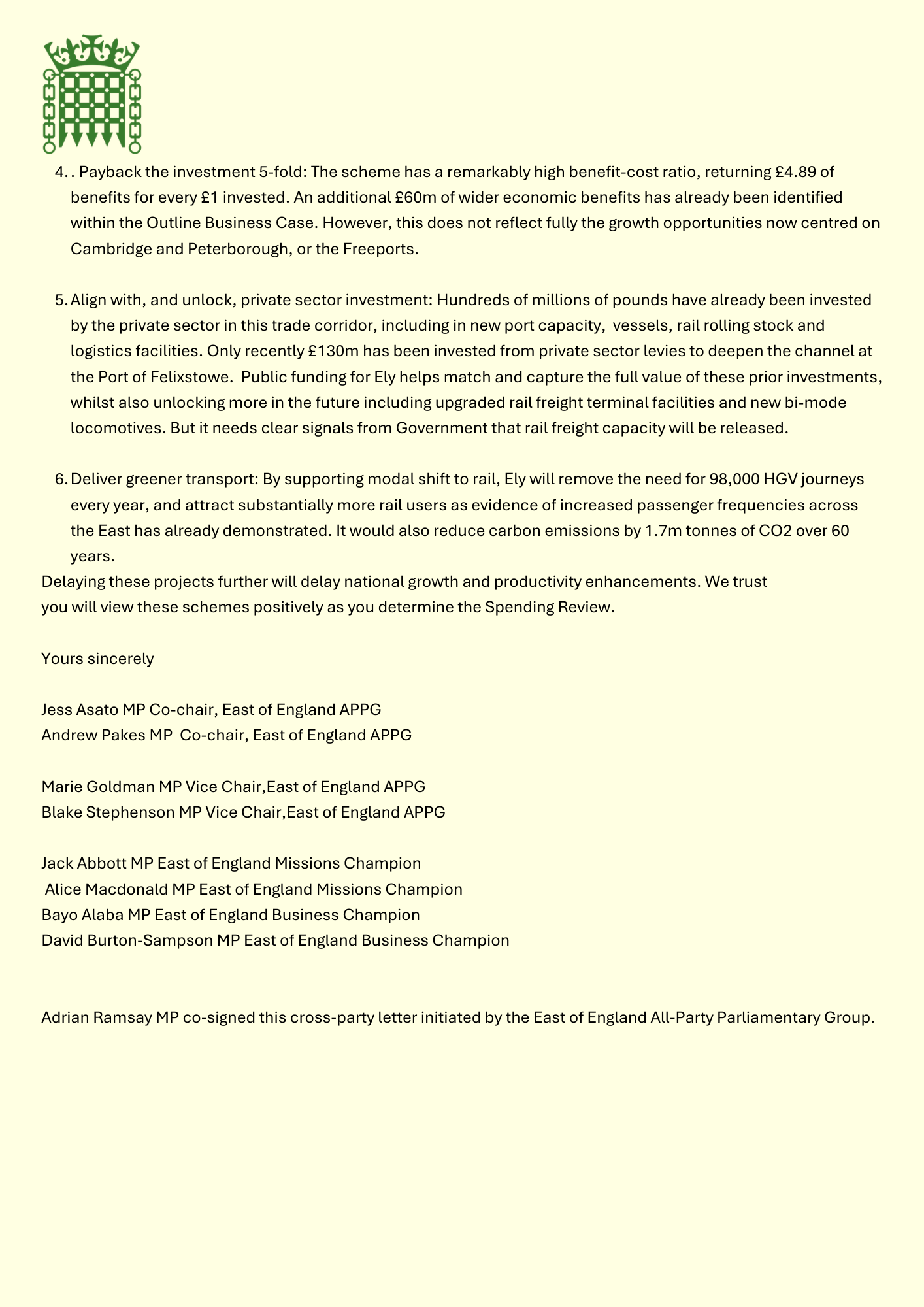
. Payback the investment 5-fold: The scheme has a remarkably high benefit-cost ratio, returning £4.89 of benefits for every £1 invested. An additional £60m of wider economic benefits has already been identified within the Outline Business Case. However, this does not reflect fully the growth opportunities now centred on Cambridge and Peterborough, or the Freeports.
Align with, and unlock, private sector investment: Hundreds of millions of pounds have already been invested by the private sector in this trade corridor, including in new port capacity, vessels, rail rolling stock and logistics facilities. Only recently £130m has been invested from private sector levies to deepen the channel at the Port of Felixstowe. Public funding for Ely helps match and capture the full value of these prior investments, whilst also unlocking more in the future including upgraded rail freight terminal facilities and new bi-mode locomotives. But it needs clear signals from Government that rail freight capacity will be released.
Deliver greener transport: By supporting modal shift to rail, Ely will remove the need for 98,000 HGV journeys every year, and attract substantially more rail users as evidence of increased passenger frequencies across the East has already demonstrated. It would also reduce carbon emissions by 1.7m tonnes of CO2 over 60 years.
Delaying these projects further will delay national growth and productivity enhancements. We trust
you will view these schemes positively as you determine the Spending Review.
Yours sincerely
Jess Asato MP Co-chair, East of England APPG
Andrew Pakes MP Co-chair, East of England APPG
Marie Goldman MP Vice Chair,East of England APPG
Blake Stephenson MP Vice Chair,East of England APPG
Jack Abbott MP East of England Missions Champion
Alice Macdonald MP East of England Missions Champion
Bayo Alaba MP East of England Business Champion
David Burton-Sampson MP East of England Business Champion
Adrian Ramsay MP co-signed this cross-party letter initiated by the East of England All-Party Parliamentary Group.
Adrian Ramsay MP presses Minister for urgent clarity on funding for UEA dental school.
11th of February 2026
Adrian Ramsay MP presses Minister for urgent clarity on funding for UEA dental school.
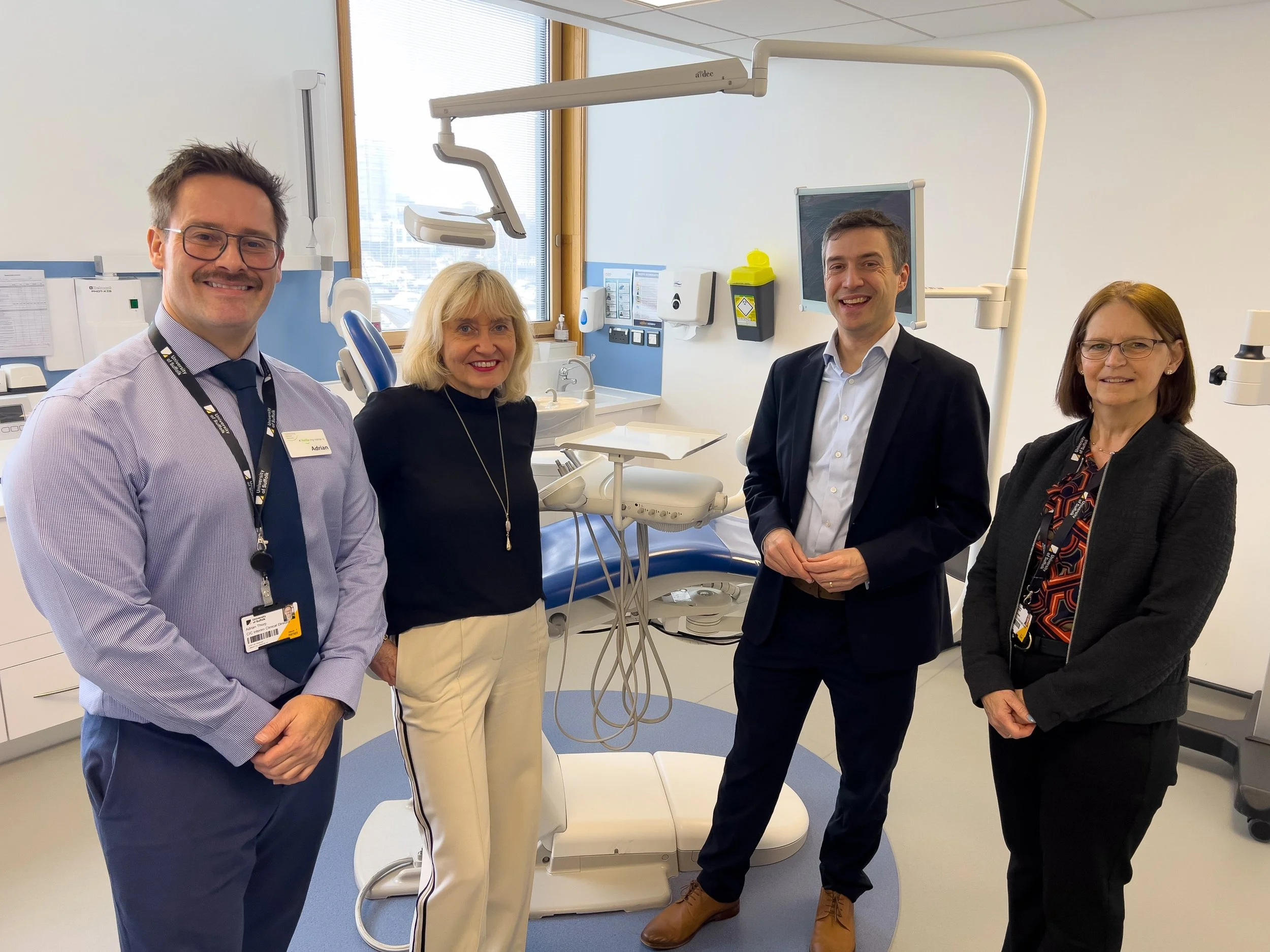
Adrian Ramsay, MP for Waveney Valley, has written to Stephen Kinnock MP, Minister of State for Care at the Department of Health and Social Care, seeking clarity on when funding will be confirmed to allow the University of East Anglia to open its new dental school.
The University of East Anglia has already secured General Dental Council accreditation, its new facilities will be completed this year, and it is ready to recruit its first cohort of students. The remaining barrier is confirmation of funded undergraduate places.
Speaking after sending his letter, Adrian Ramsay MP said:
“Norfolk and the Waveney Valley face some of the poorest access to NHS dentistry in England, while the East of England remains the only region without a dental training institution. Given the scale of unmet need across Norfolk and Suffolk, it is deeply frustrating that the only thing preventing dental teaching at UEA is confirmation of funding from the Department.
"Directing new training capacity to areas with the greatest need must be a priority if we are serious about improving access to NHS dentistry.”
In a Parilmentary debate this week Adrian said:
"The University of East Anglia stands ready to open a new dental school. It has permission from the General Dental Council but is awaiting the funded undergraduate dental places that will be needed to start training new dentists from 2027. Can the Minister set out how those places will be made available on the basis of regional need, so that dental deserts such as the east of England can start to build a sustainable dental workforce?"
Adrian Ramsay has again asked the Minister to set out the timetable for decisions on funded undergraduate places and how regional need will be reflected in the allocation process.
ENDS
Notes to editors
Full text of the letter is available here:
Dear Stephen,
I am writing to follow up on my recent remarks in the Adjournment Debate on NHS Dentists [5 February 2026] regarding the acute shortage of NHS dental provision across East Anglia and the readiness of the University of East Anglia to open a new dental school.
As you are aware, the University of East Anglia has secured accreditation from the General Dental Council, its new facilities will be completed this year, and it is prepared to recruit its first cohort from May 2026, with teaching due to commence in September 2027. The remaining barrier is the confirmation of funded undergraduate places, without which the school cannot begin teaching.
As I have raised on a number of occasions, the Norfolk and Waveney catchment area continues to experience some of the poorest access to NHS dentistry in England, with at least 3,000 patients for every dentist carrying out any NHS work, compared with around 2,220 patients per dentist nationally.
This is both a cause and a symptom of a wider structural problem: the East of England remains the only region without a dental training institution. This entrenched shortage makes the case particularly compelling for directing new training capacity towards areas of greatest need. I therefore welcome your indication that the Office for Students will play a role in allocating places and that ministerial advice will inform how those decisions are made.
Given the scale of unmet need in Norfolk and Suffolk, I would be grateful for further clarity on the expected timetable for decisions on the allocation of funded places for the University of East Anglia.
Expanding training capacity must also be accompanied by measures to ensure that graduates are supported to remain in underserved areas and within the NHS. As I have previously highlighted, this will require targeted incentives to encourage retention, alongside meaningful progress on reform of the NHS dental contract to make long-term NHS practice financially sustainable.
I would welcome your response setting out when funding for undergraduate places at the University of East Anglia is likely to be confirmed, and what advice will be provided to the Office for Students to ensure regional need is properly reflected in the allocation process.
UEA Dentistry School
-
The Hon Stephen Kinnock MP
Minister of State for Care
Department for Health & Social Care
39 Victoria St
London
SW1H 0EU
10 February 2026
Dear Stephen,
I am writing to follow up on my recent remarks in the Adjournment Debate on NHS Dentists [5 February 2026] regarding the acute shortage of NHS dental provision across East Anglia and the readiness of the University of East Anglia to open a new dental school.
As you are aware, the University of East Anglia has secured accreditation from the General Dental Council, its new facilities will be completed this year, and it is prepared to recruit its first cohort from May 2026, with teaching due to commence in September 2027. The remaining barrier is the confirmation of funded undergraduate places, without which the school cannot begin teaching.
As I have raised on a number of occasions, Norfolk and the Waveney Valley continue to experience some of the poorest access to NHS dentistry in England, and the East of England remains the only region without a dental training institution. This entrenched shortage makes the case particularly compelling for directing new training capacity towards areas of greatest need. I therefore welcome your indication that the Office for Students will play a role in allocating places and that ministerial advice will inform how those decisions are made.
Given the scale of unmet need in Norfolk and Suffolk, I would be grateful for further clarity on the expected timetable for decisions on the allocation of funded places for the University of East Anglia. Expanding training capacity must also be accompanied by measures to ensure that graduates are supported to remain in underserved areas and within the NHS. As I have previously highlighted, this will require targeted incentives to encourage retention, alongside meaningful progress on reform of the NHS dental contract to make long-term NHS practice financially sustainable.
I would welcome your response setting out when funding for undergraduate places at the University of East Anglia is likely to be confirmed, and what advice will be provided to the Office for Students to ensure regional need is properly reflected in the allocation process.
Yours sincerely,
Adrian Ramsay MP
Letter to Secretary of State for Education about the direction of travel on the Government’s proposed reforms to SEND.
-
Adrian Ramsay MP co-signed this letter along with Sian Berry MP, Carla Denyer MP and Dr Ellie Chowns MP.
Dear Bridget,
We are writing to you collectively as the Green Party Members of Parliament to raise concerns about
the direction of travel on the Government’s proposed reforms to the system supporting SEND
provisions ahead of the anticipated White Paper.
This is a critical moment for children, families, and schools. It is vital that the proposed reforms do not
weaken a child’s legal right to an education that meets their needs at a time when the system is failing
to deliver for children and families. The Education Select Committee has been clear that the SEND crisis
stems from failures of delivery, capacity, and resourcing. Earlier intervention and inclusive education
are achievable within current law; weakening rights would worsen inequity and reduce families’ routes
to challenge decisions. Any reforms should seek only to strengthen provision, not dilute statutory
entitlements.
1. Long waits for diagnosis and Education, Health and Care Plans
Families consistently tell us that navigating the SEND system is one of the most distressing experiences
they face, particularly relating to unacceptable delays in diagnosis and in securing EHCPs. These delays
undermine early intervention, exacerbate children’s distress, and have lasting impacts on mental health
and educational outcomes. We are aware of cases where children have been placed in mainstream
settings despite being non-verbal because no specialist language unit places were available, and where
families must privately fund speech and language therapy (SALT) after receiving only one NHS
appointment. In other cases, delays by NHS trusts in assessments have directly prevented children from
accessing EHCPs and the support they need.
2. Insufficient support for inclusive education in mainstream schools
Government data shows that the majority of children with EHCPs are already educated in mainstream
settings. Special schools are for children with the most complex needs and should not be used as default
destinations. Many schools put support in place even before EHCPs are secured, often beyond what
resources allow. Without sufficient capacity, children who could thrive in mainstream settings with
appropriate adjustments can experience exacerbated problems and, in some cases, school avoidance.
There is also growing evidence that inadequate support for children with autism or ADHD/ADD can lead
to long-term mental health harm.
We consistently hear from teachers who are committed to inclusive practice that they lack the staff,
specialist expertise, and funding to meet the diversity of needs in the class. Teachers are operating
under intense and unsustainable pressure, with growing class sizes, rising levels of unmet need, and
insufficient specialist support. Many report expectations to deliver increasingly complex provision with
inadequate resources, contributing to burnout and low retention of teaching staff, and further
exacerbating resource pressures. This is a systemic failure, not a failure of school ethos or staff
commitment.
We are also concerned that rigid, standardised learning environments and testing create additional
barriers to inclusion. Children with SEND can show better academic and social outcomes when learning
is creative and dynamic, including through play and adaptive, relational approaches to education.
3. Shortages of suitable alternative provision and specialist places
For children whose needs cannot be met in mainstream settings, there is a serious shortage of
appropriate alternative provision and specialist placements. We are seeing prolonged periods where
children are left out of education altogether, moved repeatedly between placements that cannot meet
their needs, or placed in settings that even the schools themselves believe to be unsuitable. In some
cases, children have been out of education for a year or more, with devastating impacts on their
wellbeing and on families’ ability to work and function.
4. Financial pressures without improved outcomes
The National Audit Office has made clear that, despite increases in high-needs funding, outcomes for
children and young people with SEND have not improved consistently, and the system remains
financially unsustainable. DfE estimates that by March 2026 around 43 per cent of local authorities will
have high-needs deficits exceeding or close to their reserves, contributing to a cumulative national
deficit of up to £4.9 billion when current accounting arrangements end. This points to structural failure
and bottlenecks in assessment and provision. Bringing this liability onto national government will not
solve the problem with cost inefficiency.
5. Tokenistic engagement with families and professionals
We are concerned that recent ‘Conversations’ did not allow meaningful engagement from families or
professionals. Reform developed without genuine co-production risks repeating past mistakes and
undermining trust. Tokenistic engagement not only fails to improve policy design, but actively alienates
families and frontline staff whose expertise is essential to making reform work in practice.
6. Lack of clarity about how the reforms will improve support for all children
It remains unclear how the proposed reforms will improve the system’s ability to meet the needs of all
children and young people with SEND. The five ‘principles’ cited by Ministers are already embedded in
law and policy, so reforms should focus on making those duties work in practice, not on redesigning the
framework. Proposals that narrow eligibility for Education, Health and Care Plans or weaken routes of
redress risk excluding children whose needs are currently unmet and would undermine inclusive
education, rather than strengthening the system’s capacity to support every child to thrive.
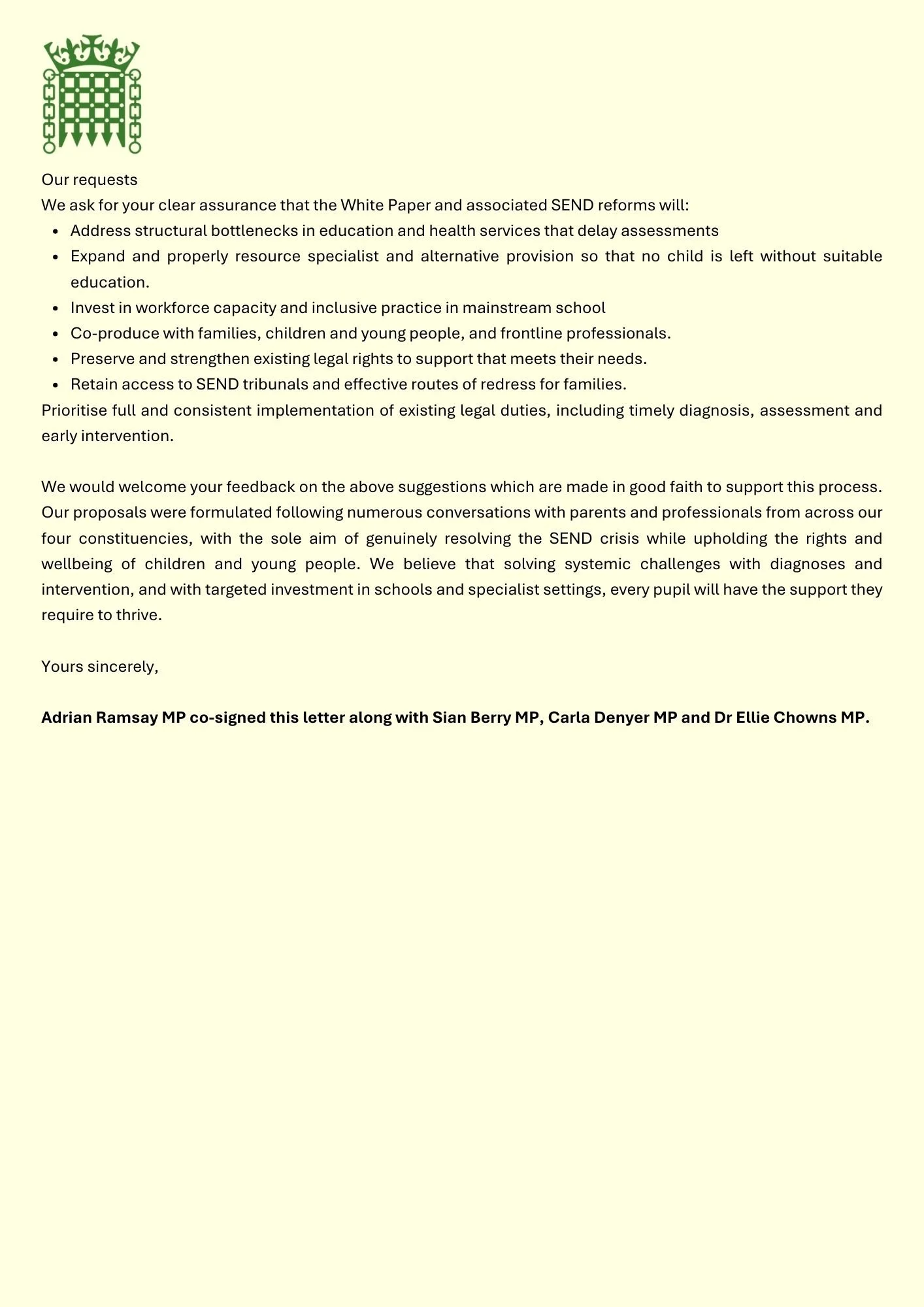
Our requests
We ask for your clear assurance that the White Paper and associated SEND reforms will:
Address structural bottlenecks in education and health services that delay assessments
Expand and properly resource specialist and alternative provision so that no child is left without
suitable education.
Invest in workforce capacity and inclusive practice in mainstream school
Co-produce with families, children and young people, and frontline professionals.
Preserve and strengthen existing legal rights to support that meets their needs.
Retain access to SEND tribunals and effective routes of redress for families.
Prioritise full and consistent implementation of existing legal duties, including timely diagnosis,
assessment and early intervention.
We would welcome your feedback on the above suggestions which are made in good faith to support
this process. Our proposals were formulated following numerous conversations with parents and
professionals from across our four constituencies, with the sole aim of genuinely resolving the SEND
crisis while upholding the rights and wellbeing of children and young people. We believe that solving
systemic challenges with diagnoses and intervention, and with targeted investment in schools and
specialist settings, every pupil will have the support they require to thrive.
Yours sincerely,
Adrian Ramsay MP co-signed this letter along with Sian Berry MP, Carla Denyer MP and Dr Ellie Chowns MP.
Letter to Chair of the Nursing and Midwifery Council on Government commitments to nursing career progression
-
Ron Barclay-Smith
Chair of the Nursing and Midwifery Council
23 Portland Place
London
W1B 1PZ
Adrian Ramsay MP
House of Commons
London
SW1A 0AA
09.02.26
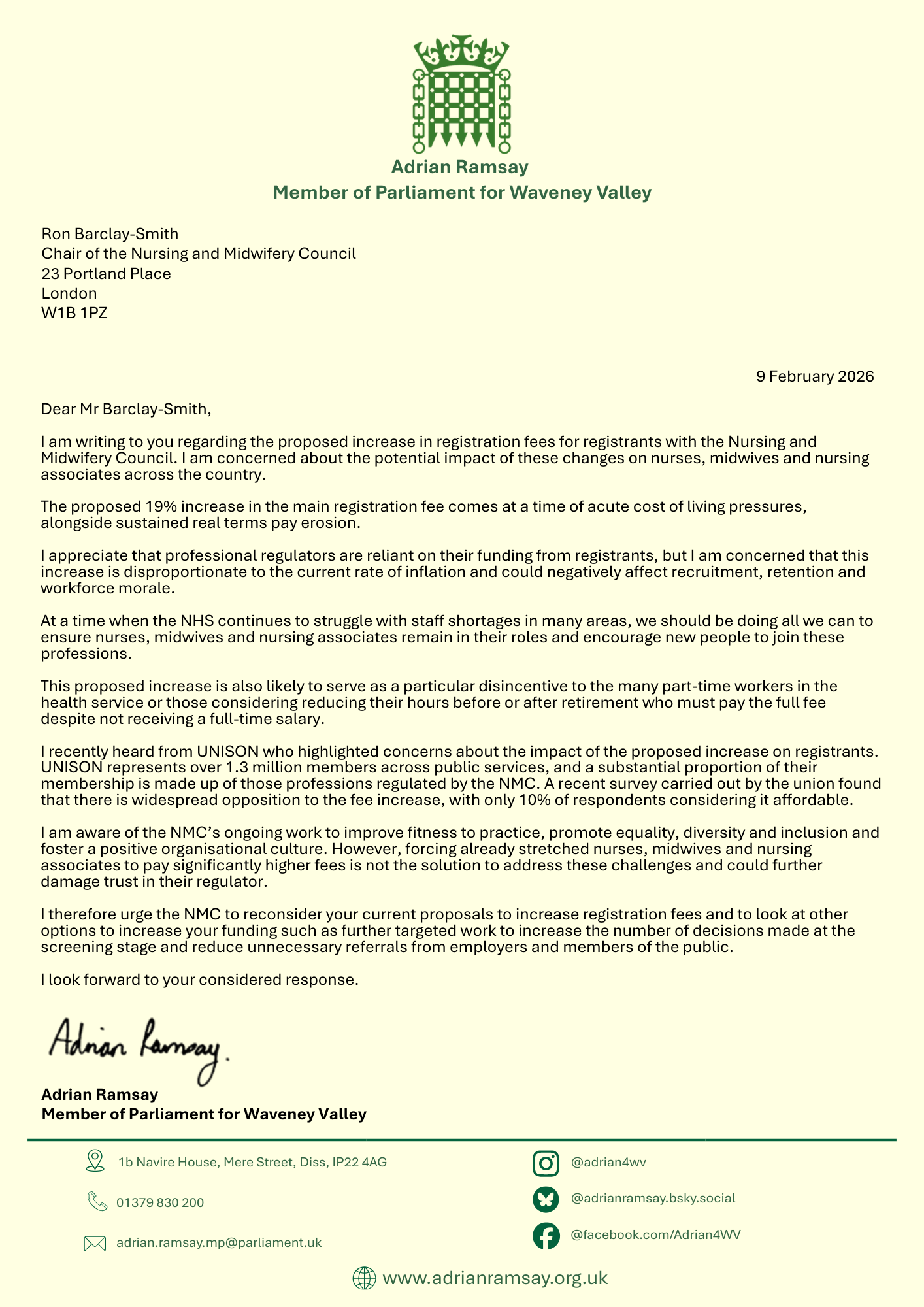
Dear Mr Barclay-Smith,
I am writing to you regarding the proposed increase in registration fees for registrants with the
Nursing and Midwifery Council. I am concerned about the potential impact of these changes
on nurses, midwives and nursing associates across the country.
The proposed 19% increase in the main registration fee comes at a time of acute cost of living
pressures, alongside sustained real terms pay erosion.
I appreciate that professional regulators are reliant on their funding from registrants, but I am
concerned that this increase is disproportionate to the current rate of inflation and could
negatively affect recruitment, retention and workforce morale.
At a time when the NHS continues to struggle with staff shortages in many areas, we should
be doing all we can to ensure nurses, midwives and nursing associates remain in their roles
and encourage new people to join these professions.
This proposed increase is also likely to serve as a particular disincentive to the many part-time
workers in the health service or those considering reducing their hours before or after
retirement who must pay the full fee despite not receiving a full-time salary.
I recently heard from UNISON who highlighted concerns about the impact of the proposed
increase on registrants. UNISON represents over 1.3 million members across public services,
and a substantial proportion of their membership is made up of those professions regulated
by the NMC. A recent survey carried out by the union found that there is widespread opposition
to the fee increase, with only 10% of respondents considering it affordable.
I am aware of the NMC’s ongoing work to improve fitness to practice, promote equality,
diversity and inclusion and foster a positive organisational culture. However, forcing already
stretched nurses, midwives and nursing associates to pay significantly higher fees is not the
solution to address these challenges and could further damage trust in their regulator.
I therefore urge the NMC to reconsider your current proposals to increase registration fees
and to look at other options to increase your funding such as further targeted work to increase
the number of decisions made at the screening stage and reduce unnecessary referrals from
employers and members of the public.
I look forward to your considered response.
Adrian Ramsay MP
Waveney Valley